Quick Answer: Top Recruitment CRM Trends for 2026
Key trends: AI-powered candidate matching, WhatsApp/SMS outreach integration, predictive hiring analytics, candidate re-engagement automation, and unified ATS + CRM platforms. Agencies that adopt these trends in 2026 will significantly outpace those still using fragmented point solutions.
Introduction
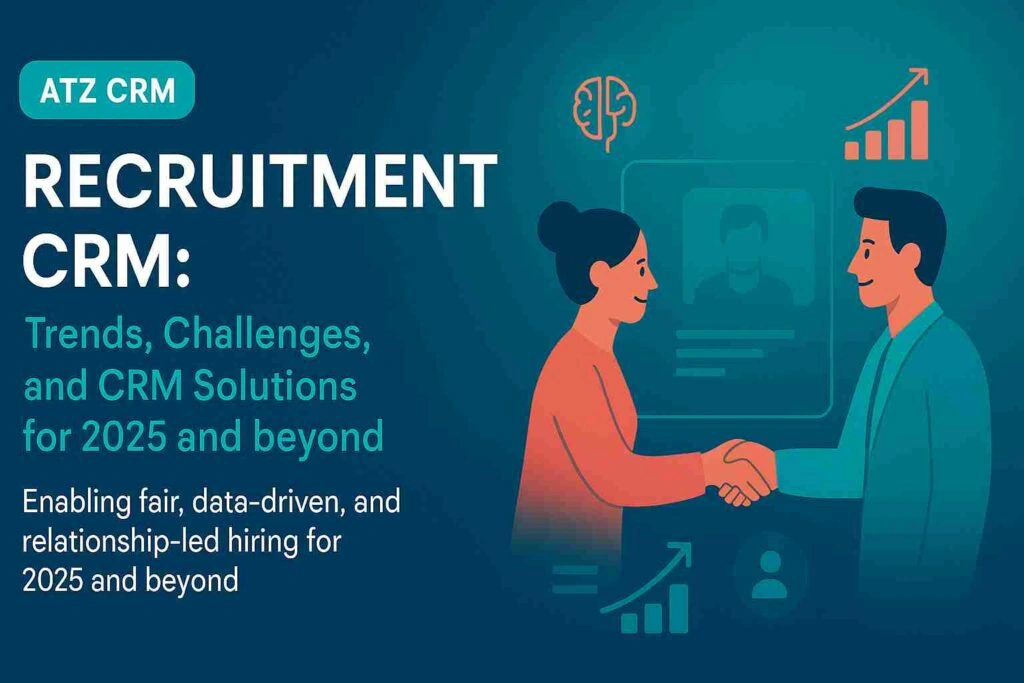
The Future of Recruitment is evolving rapidly: technology, shifting candidate expectations, and new work norms are reshaping how organisations attract, engage, and retain talent. This blog outlines the most important Recruitment Trends, explains core Recruitment Challenges, and shows how Recruitment CRM solutions can help talent teams succeed in 2026 and beyond.
Major Recruitment Trends for 2026 and Beyond
1. AI and Automation
AI and automation are becoming standard across recruiting workflows. Recruiters use AI to parse resumes, suggest matches, prioritise pipelines, and automate scheduling. Benefits include reduced manual workload, faster sourcing, and more consistent initial screening. It also allows recruiters to focus on relationship-building and assessment of complex human skills. Implement AI with fairness, transparency, and human oversight to avoid reinforcing bias.
2. Skills-Based Hiring
Skills-based hiring emphasises demonstrable abilities over traditional credentials.Employers use assessments, projects, and portfolios to evaluate fit. This approach expands access to nontraditional talent and supports internal mobility. Skills-based Recruitment Trends encourage continuous learning and clearer career pathways.
3. Remote and Hybrid Work Models
Remote and hybrid work reshape geography for hiring and make talent pools global. Recruiters must design virtual interview experiences, digital onboarding, and equitable remote policies. This trend forces employers to rethink compensation, collaboration, and culture for distributed teams. Recruitment CRM systems help coordinate outreach across time zones and store remote-friendly preferences.
Related Blog: DEI Hiring Strategies: How To Attract Diverse Candidates
4. Diversity, Equity & Inclusion (DEI)
DEI is now embedded operationally into sourcing, screening, and interviewing. Structured interviews, inclusive job language, and anonymised screening reduce bias. Recruitment Trends that prioritise DEI result in wider talent pools and stronger organisational performance. Measuring and reporting DEI outcomes is essential for accountability and improvement.
5. Candidate Experience and Employer Branding
Candidate experience is central: applicants expect clarity, timeliness, and respect.Organisations invest in clear job previews, timely feedback, and personalised communications. Recruitment CRM enables personalised outreach at scale, turning applicants into brand advocates. Strong employer branding reduces friction and improves offer acceptance. Recruitment Trends increasingly rely on data: pipeline analytics and predictive models guide decisions. Analytics reveal bottlenecks, forecast demand, and surface high-quality sources. Combining data with recruiter judgement leads to smarter, repeatable hiring decisions.
6. Data-Driven Recruitment
Modern recruitment increasingly relies on data: pipeline analytics, predictive models, and performance metrics guide hiring decisions. Analytics help reveal process bottlenecks, forecast talent demand, and surface high-quality candidate sources.Combining data insights with recruiter judgment results in smarter, repeatable, and efficient hiring decisions.
Related Blog: The Ultimate Guide To Building And Managing A Talent Pipeline For Recruiters
Top Recruitment Challenges in 2026
Talent Shortages and Skill Gaps
Specialised and rapidly evolving skill sets create talent scarcity for many roles. Recruiters must broaden sourcing strategies and form partnerships with training providers. Proactive pipelining, apprenticeships, and internal reskilling help mitigate shortages.
Retention and Employee Engagement
Recruitment Challenges extend into retention—hiring alone isn’t sufficient. Organisations need clear career frameworks, mentoring, and continuous learning to reduce churn. Recruitment CRM can capture candidate and employee preferences to match roles with growth paths.
Fragmented Technology and Inefficient Processes
Disconnected tools, manual handoffs, and inconsistent candidate records slow hiring. Integrating ATS, assessment platforms, HRIS, calendars, and Recruitment CRM is vital. Streamlining workflows reduces candidate drop-off and increases recruiter productivity.
Related Blog: 10 Best AI & ChatGPT Prompts Every Recruiter Should Be Using
Candidate Experience Breakdowns
Slow responses, ghosting, or unclear expectations damage employer reputation. Treat candidates like customers: provide clear timelines, regular updates, and constructive feedback. Recruitment CRM provides templates, automated touchpoints, and a unified history so candidates aren’t lost in silence.
Rapidly Changing Skills and Role Definitions
Job requirements change quickly with technology advances. Recruiters must hire for learning agility, potential, and adaptability—partnering with L&D to create upskilling paths. This approach makes hires more future-proof and reduces the need for frequent re-hiring.
Compliance and Regulatory Complexity
Changing labor laws, data privacy regulations, and industry-specific compliance requirements make recruitment more complex. Recruiters must stay up-to-date with local and global regulations, including GDPR, EEO, and workplace safety standards. Recruitment CRMs and integrated HR systems help maintain accurate records, automate compliance checks, and generate reports to reduce risk. Ensuring compliance not only protects the organization legally but also builds trust with candidates and employees.
Related Blog: 15 Free Job Posting Sites USA-Based Recruiters Can Use to Look for Diverse Talent
Why Recruitment CRM is Central to Solving Recruitment Challenges
Core Functions of Recruitment CRM
- Centralised talent records: resumes, interactions, assessment results, and preferences in one profile.
- Nurturing and segmentation: targeted campaigns to passive candidates and talent communities.
- Workflow automation: scheduling, reminders, follow-ups, and process triggers that remove manual steps.
- Analytics and reporting: pipeline velocity, source ROI, diversity metrics, and candidate satisfaction signals.
- Integrations: job boards, assessment tools, HRIS, calendars, and messaging platforms for seamless workflows.
Practical Benefits for Hiring Teams
Faster time-to-fill through automation and fewer manual touchpoints. Better candidate experience via personalised, timely communications. Stronger employer brand with consistent, humanised outreach. Smarter sourcing guided by analytics that identify high-quality channels. Reuse of candidate data across roles, improving sourcing efficiency and internal mobility.
Related Blog: Best RecruiterFlow Alternatives For Small And Medium Recruiting Firms
Implementing Recruitment CRM: A Step-by-Step Checklist
- Map workflows: identify touchpoints where candidates drop off.
- Define metrics: measure time-to-offer, candidate satisfaction, and source quality.
- Pick integration-first tools: choose CRMs that connect to your ATS, HRIS, assessment vendors, and calendars.
- Pilot and scale: run a pilot with a single team, gather feedback, then expand.
- Train recruiters: teach relationship-driven outreach, segmentation, and CRM hygiene.
Design Principles for CRM-Driven Recruitment
Keep automations human-centred and reversible, prioritise data hygiene for accurate reporting and search, balance AI assistance with recruiter oversight to ensure fairness, align hiring with talent development to feed internal mobility, and monitor privacy and consent for global candidate pools.
What Next-Gen Recruitment CRM Will Enable
Contextual AI matching will factor in candidate potential, cultural fit, and learning trajectory; tighter L&D integration will let CRMs suggest internal reskilling and mobility paths; enhanced candidate-experience features like self-scheduling, role simulators, and richer onboarding will streamline engagement; privacy-preserving analytics and automated compliance will support global operations; and collaboration hubs will enable hiring managers and recruiters to decide together in a shared, auditable workspace.
Related Blog: The Ultimate Recruit CRM Showdown: Best ATS Ranked
Future-Proofing Talent Strategies with Recruitment CRM
- Recruitment CRMs empower organizations to anticipate talent needs and respond proactively.
- Predictive analytics help forecast skill gaps, workforce trends, and hiring demands before they become critical.
- AI-driven insights enable personalized candidate journeys, improving engagement and long-term retention.
- Integration with learning and development platforms ensures continuous upskilling and internal mobility.
- By centralizing data, automating workflows, and providing actionable insights, CRMs help organizations stay agile, competitive, and ready for the evolving world of work.
Related Blog: Discover 10 Free Most Powerful ATS For Small Businesses
Practical Examples & Tips
- A small tech firm used a Recruitment CRM to convert passive candidates by running quarterly nurture campaigns highlighting project work and learning opportunities.
- When evaluating Recruitment CRM vendors, ask for industry-specific workflows and a live demo that shows end-to-end candidate flow rather than only feature lists.
- Ensure automations are reversible, allowing recruiters to personalise messages or change candidate paths when context requires it.
- Investing in Recruitment CRM involves process and people change as much as technology—plan for training and continuous improvement.
- Use the CRM to create talent pools for hard-to-fill roles, enabling proactive engagement and faster placements when positions open up.
Related Blog: 12 Best Recruitment CRM For Recruitment Agencies – Complete Guide
Conclusion
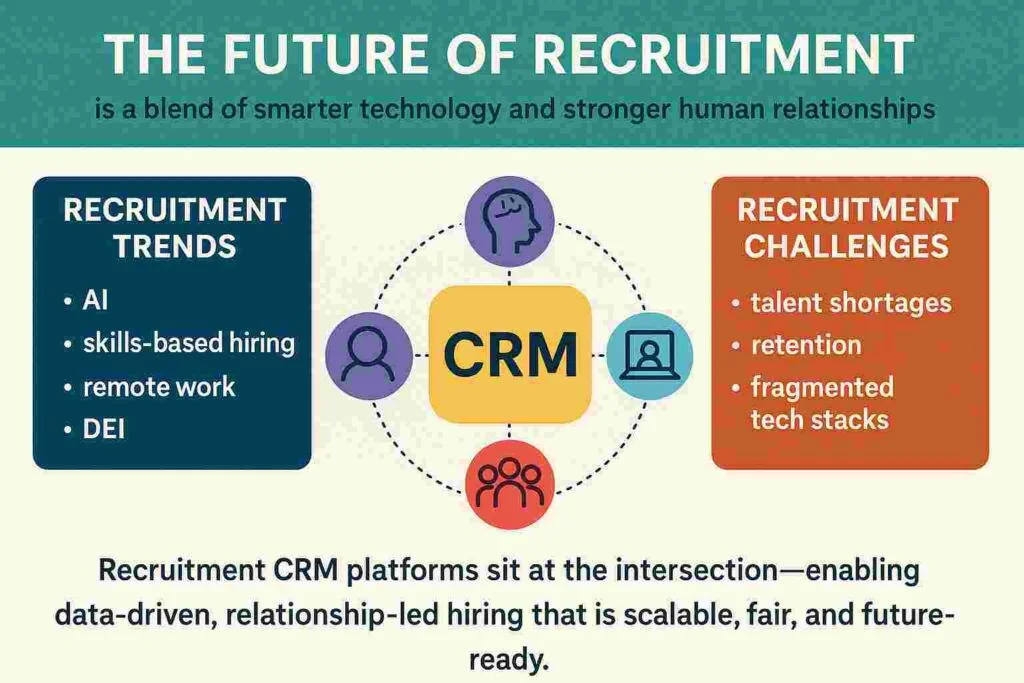
The Future of Recruitment is a blend of smarter technology and stronger human relationships: Recruitment Trends like AI, skills-based hiring, remote work, and DEI will shape how teams compete for talent, while Recruitment Challenges such as talent shortages, retention, and fragmented tech stacks will require deliberate strategy. Recruitment CRM platforms sit at the intersection—enabling data-driven, relationship-led hiring that is scalable, fair, and future-ready.
FAQ
1. What is a Recruitment CRM and how is it different from an ATS?
A Recruitment CRM builds and nurtures talent relationships and pipelines; an ATS manages active applicants and hiring workflows.
2. How quickly can a Recruitment CRM improve candidate experience and outreach?
Outreach and communications improve within days; measurable hiring gains usually appear in several weeks to months.
3. Can AI features in a CRM create bias, and how do we guard against that?
Yes , reduce risk with diverse training data, human review, regular audits, and reversible automations.
4. How does a Recruitment CRM help with internal mobility and upskilling?
It centralises skills and interests so you can tag employees, match roles, and suggest targeted learning paths.
5. Which key metrics should we track first when rolling out a Recruitment CRM?
Start with time-to-fill, source quality (ROI), candidate response rates, pipeline drop-offs, and basic diversity indicators.