Introduction
Quick Answer: Proven Candidate Sourcing Strategies for 2026: The Ultimate Guide
This guide covers the most effective strategies and best practices for proven candidate sourcing strategies for 2026: the ultimate guide. Read on for actionable tips, comparison tables, and expert recommendations to help you make better hiring decisions faster.
Let’s be honest for a second. If you are reading this, you are likely staring at an empty pipeline, a demanding hiring manager, or a metric dashboard that is glowing an angry shade of red.
We have all been there. You post a job on LinkedIn, and within an hour, you have 500 applicants. The problem? 498 of them are unqualified bots, one is your cousin asking for a favor, and the last one lives on a different continent for an on-site role.
Welcome to recruitment in 2026.
The landscape has shifted beneath our feet. The strategies that filled seats in 2023 and 2024 are now as obsolete as the fax machine. We are living in an era where candidate sourcing is no longer just a “nice-to-have” skill for the overachievers; it is the absolute lifeblood of the staffing industry.
Whether you are a temporary staffing agency trying to fill fifty nursing shifts by tomorrow morning, an executive searcher hunting for a CEO who isn’t on LinkedIn, or a corporate recruiter trying to explain to a hiring manager why “10 years of experience in a 2-year-old technology” is impossible, this guide is for you.
In this blog, we are not just going to throw a few buzzwords at you. We are going to solve the actual problems keeping you up at night. We are going to look at why your InMails are getting ghosted, why your Boolean strings are pulling up irrelevant profiles, and how Artificial Intelligence (AI) has gone from a scary sci-fi concept to your new best friend in the office.
By the time you finish this blog, you will learn:
- How to bypass the noise of job boards and find the “hidden” talent on platforms like GitHub, Slack, and Reddit.
- The exact Boolean strings that act like magic spells to reveal candidates your competitors can’t find.
- How to leverage candidate sourcing automation to do the work of ten recruiters without burning out.
- Why diversity sourcing is your secret weapon for innovation and how to do it authentically.
- How to use tools like ATZ CRM to turn chaos into a streamlined, high-revenue machine.
So, grab your coffee (or something stronger, we don’t judge), and let’s dive in.
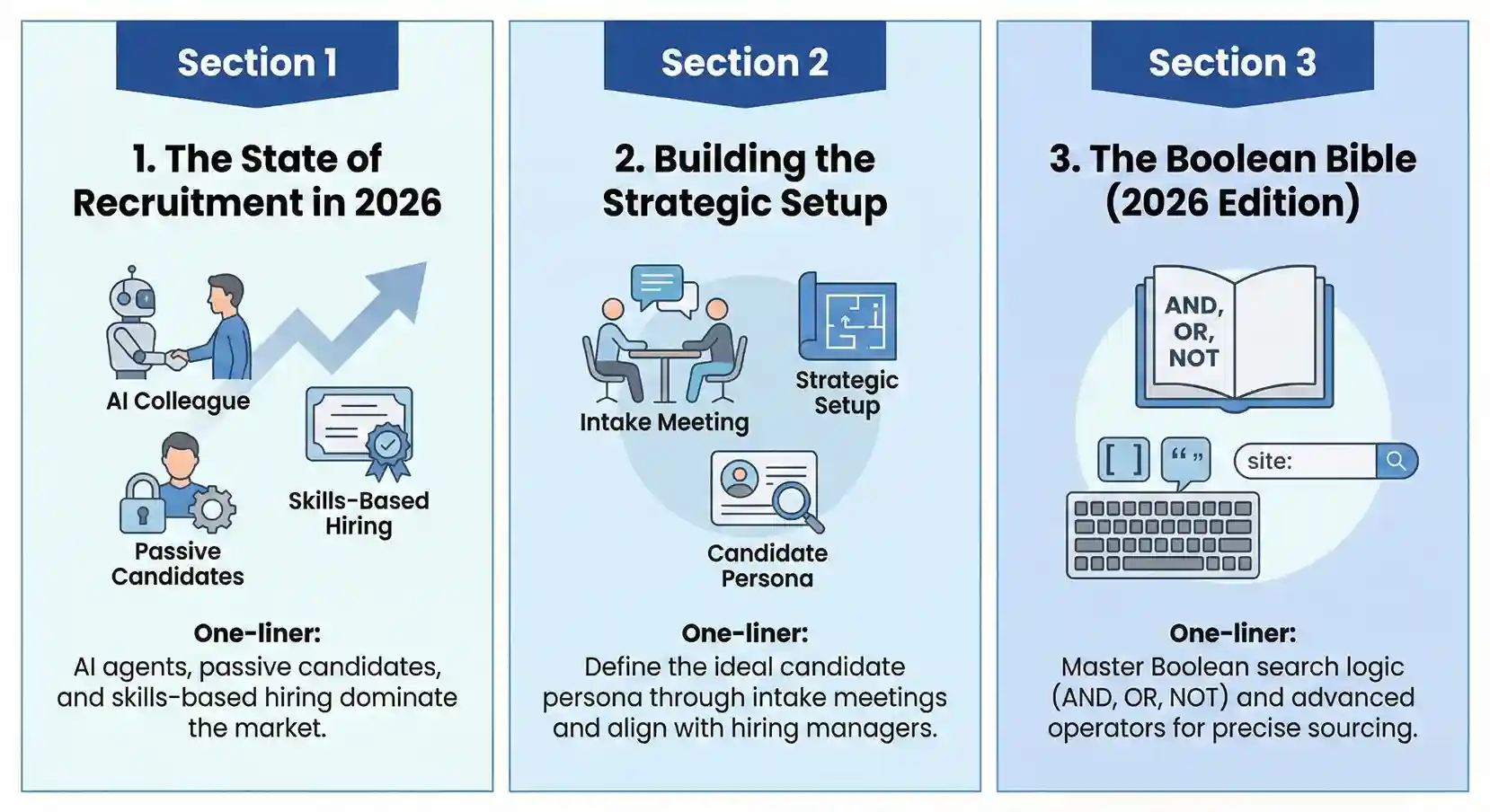
Section 1: The State of Recruitment in 2026 – Sink or Swim?
Before we start hacking the system, we need to understand the game we are playing. The recruitment market of 2026 is defined by specific, tangible shifts that have altered the physics of talent acquisition. If you are still recruiting like it’s 2022, you are playing checkers while the market is playing 4D chess.
1.1 The Rise of the AI Agent
Remember when we were worried AI would replace us? Well, the verdict for 2026 is in: AI didn’t replace recruiters, but recruiters using AI replaced those who didn’t.
Research from Korn Ferry indicates that talent acquisition looks nothing like it did a few years ago. The use of AI has snowballed, with 84% of talent leaders worldwide utilizing it in 2026.
But here is the twist: we aren’t just talking about ChatGPT writing your emails anymore. We are talking about autonomous AI agents.
In 2026, talent leaders are recruiting a new type of Agent, digital colleagues that work independently. These aren’t the clunky chatbots of the past. These agents can source candidates, screen resumes, and even conduct initial outreach without human prompting.
- The Problem: The volume of data is too high for human processing.
- The Solution: You need to move up the value chain. If an AI agent can find the candidate, your job is now to persuade the candidate. Sourcing is becoming less about “finding” and more about “engaging.”
Struggling with AI? Read Best AI & ChatGPT Prompts Every Recruiter Should Be Using to master your prompts.
1.2 The Passive Candidate Dominance
Here is a statistic that should be tattooed on every recruiter’s arm: 73% of job seekers are passive candidates.
What does this mean? It means that nearly three-quarters of the people you want to hire are not looking at your job ads. They are happily employed, doing their jobs, and ignoring the “We’re Hiring!” banners. If your entire candidate sourcing strategy relies on inbound applications, you are ignoring 73% of the market. And let’s be real—the best talent is usually the talent that isn’t looking. They are the ones crushing their targets at a competitor, not the ones refreshing Indeed every five minutes.
1.3 The “Paper Ceiling” Has Crumbled
By 2026, the obsession with university degrees will have officially faded for many industries. A significant trend is the shift toward Skills-Based Hiring. 85% of global organizations have adopted this approach.
Why? Because a Computer Science degree from 1995 doesn’t tell you if a candidate knows how to prompt an AI model or navigate the latest cloud infrastructure. This fundamentally changes how we source. We can no longer just type “Harvard” into the search bar. We have to search for evidence of skills: repositories, portfolios, certifications, and contest rankings.
1.4 The Need for Speed (and Flexibility)
In 2026, the gig economy has matured into the “fractional” economy. Small to mid-sized organizations are increasingly adopting modular, project-based engagement options. A 200-person company might not need a full-time Chief Technology Officer; they might need a fractional CTO for three months to oversee a migration.
For staffing agencies, this is a gold rush. But it requires a sourcing engine that can pivot instantly. You can’t spend three months filling a three-month contract. Speed is the currency of the realm.
Section 2: Building the Foundation – The Strategic Setup
You wouldn’t build a house without a blueprint, yet thousands of recruiters start candidate sourcing without a strategy. They jump onto LinkedIn, type “Sales Manager,” and pray. That is not sourcing; that is gambling.
To truly master candidate sourcing, we need to set the stage.
2.1 The Intake Meeting: Where Sourcing Actually Begins
The biggest bottleneck in recruitment isn’t the market; it’s the misalignment between the recruiter and the hiring manager. If you don’t know exactly what you are looking for, you will never find it.
The “Calibration” Hack: Don’t just take the job description and run. In your intake meeting, bring 3-5 diverse profiles found via a quick search. Show them to the hiring manager and ask:
- “If this person applied today, would you interview them?”
- “If yes, what specifically do you like?”
- “If no, what is the deal-breaker?”
This 10-minute exercise saves weeks of wasted time.
2.2 Constructing the Candidate Persona
A “Candidate Persona” is a semi-fictional representation of your ideal hire. It goes beyond the job title.
| Persona Element | Questions to Ask |
|---|---|
| Demographics | Where do they live? Are they remote? What is their seniority level? |
| Digital Hangouts | Do they spend time on GitHub (devs), Behance (creatives), or LinkedIn (sales)? |
| Motivations | Are they money-driven? Mission-driven? Do they want stability or startup chaos? |
| Frustrations | What do they hate about their current role? (e.g., bureaucracy, legacy tech). |
By defining these elements, you can tailor your outreach. If you know your persona hates bureaucracy, your outreach shouldn’t sound corporate and stiff.
2.3 SEO: Making the Talent Come to You
While we are focusing on proactive sourcing, we shouldn’t ignore the low-hanging fruit. Candidate sourcing is easier when candidates can find you. Search Engine Optimization (SEO) for job descriptions is critical.
- Keywords in Titles: Don’t use “Ninja” or “Rockstar.” No one searches for “Java Ninja.” They search for “Senior Java Developer.”
- The 10% Rule: Place your focus keyword (like candidate sourcing) in the first 10% of your content.
- Mobile Optimization: 67% of candidates use mobile devices to apply for jobs. If your career page isn’t mobile-friendly, you are leaking talent.
Section 3: The Boolean Bible (2026 Edition)
Welcome to the wizardry of recruitment. Boolean search is the language of databases. Even with AI tools, understanding the logic is what separates the experts from the button-pushers.
3.1 The Holy Trinity: AND, OR, NOT
If you take nothing else from this blog, learn these three operators.
- AND (The Filter):
Manager AND Sales.You want profiles containing both. - OR (The Expander):
SaaS OR Software.You are happy with either term. - NOT (The Cleaner):
Engineer NOT Intern.Remove the junk.- (Pro Tip: In Google, use the minus sign
-instead of NOT).
- (Pro Tip: In Google, use the minus sign
3.2 Advanced Operators for the Sourcing Elite
Ready to level up? Let’s look at the operators that dig deeper.
- Parentheses
( ): Crucial for grouping logic.- Example:
(SaaS OR Cloud) AND ("Sales Manager" OR "Account Executive")
- Example:
- Quotation Marks
"": Forces an exact phrase match.- Example:
"Project Manager"ensures the words appear together.
- Example:
- The Site Search
site:: The X-Ray command.- Example:
site:linkedin.com/inrestricts results to public LinkedIn profiles.
- Example:
3.3 “Purple Squirrel” Search Strings
Here are some ready-to-use strings for 2026. Copy, paste, and tweak them for your needs.
Scenario A: The Java Developer who isn’t a Junior You need a heavy hitter in Java, specifically with Spring Boot experience.
(Java OR J2EE) AND ("Spring Boot" OR Springboot) AND (Senior OR Lead OR Principal) AND (Developer OR Engineer OR Architect) NOT (Intern OR Trainee OR Junior)Scenario B: The SaaS Sales Hunter in the UK
You need a sales leader who knows software and lives in London.
("Sales Manager" OR "Account Director" OR "VP of Sales") AND (SaaS OR "Software as a Service" OR Cloud) AND (London OR UK OR "United Kingdom") -jobs -recruiterNote: The -jobs -recruiter at the end removes job postings and other recruiters from your results.
Scenario C: The ICU Nurse with an Active License
Healthcare sourcing requires precision regarding certifications.
(Nurse OR RN OR "Registered Nurse") AND (ICU OR "Intensive Care" OR Critical) AND (BSN OR MSN) AND "Active License"3.4 X-Ray Search: Seeing Through the Matrix
X-Ray search is using Google to search a website better than the website searches itself. Why do this? LinkedIn has commercial limits on how many searches you can run for free. Google does not.
The LinkedIn X-Ray Formula:
site:linkedin.com/in ("Project Manager") AND ("PMP" OR "Prince2") AND "San Francisco."The Twitter X-Ray Formula:
site:twitter.com ("java developer" OR "python developer") -jobs -recruiterWhy this works: Google indexes public profiles. By using site:linkedin.com/in, you are telling Google to ignore the rest of the internet and only look at the directory of LinkedIn profiles. This is a massive hack for bootstrapping agencies or solo recruiters operating on a budget.
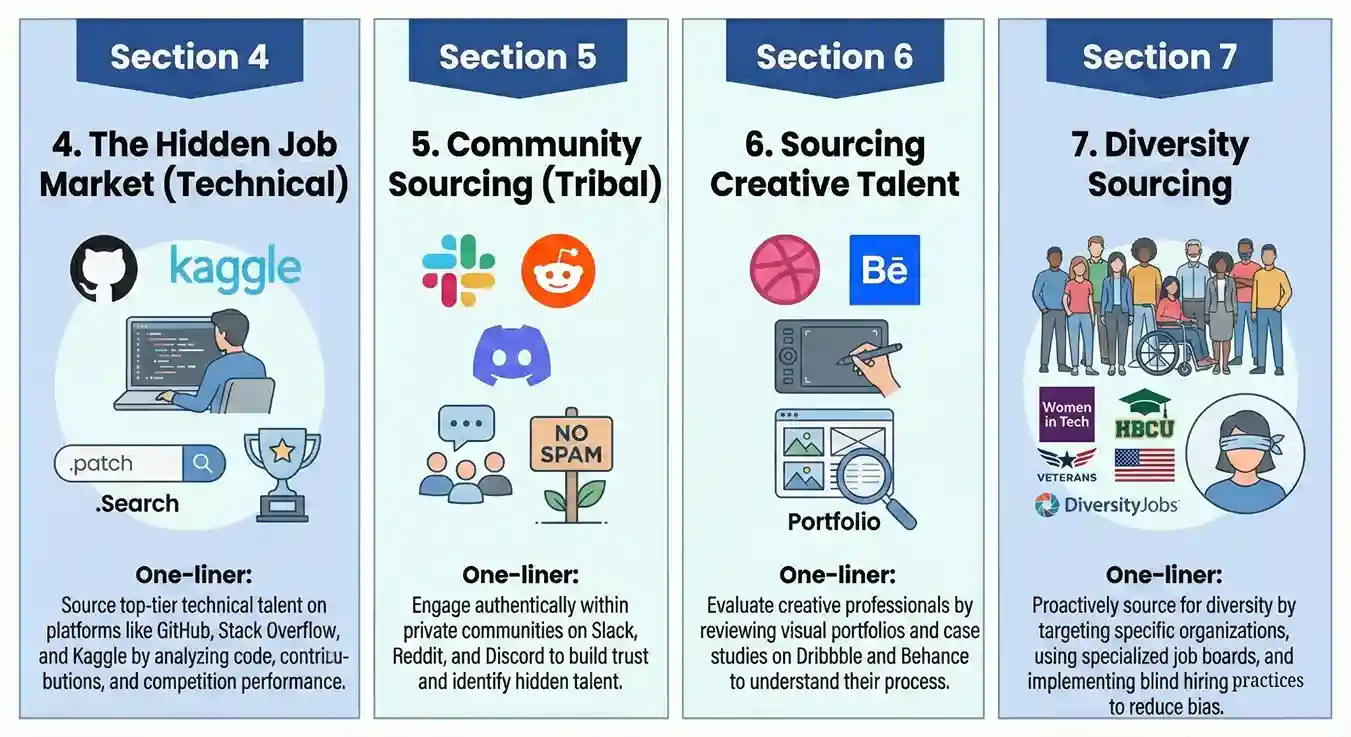
Section 4: The Hidden Job Market – Technical Sourcing
If you are looking for top-tier technical talent on LinkedIn, you are late to the party. The best developers are busy coding, not polishing their “About Me” section. To find them, you need to go where the code lives.
4.1 GitHub: The Developer’s Playground
GitHub is a hosting service for software development. It is where code lives. For a recruiter, it is a goldmine of verified skills. Unlike a resume, where someone can say they know Python, on GitHub, you can see they know Python.
How to Source on GitHub:
- Search Repositories, Not People: Use the search bar to find “repositories” (projects) written in the language you need.
- Query: language: python location: berlin followers:>10
Analyze the “Stars”: If a user’s repository has many stars, it means other developers find their code useful. This is a high-quality signal.
The “Fork” vs. “Source”: Check if the repository is a “Source” (they created it) or a “Fork” (they copied it). You want creators.
The Ultimate GitHub Hack: The .patch Method This is a classic “recruiter secret” that still works wonders in 2026 for finding email addresses.
- Go to a user’s profile and click on a “Repository.”
- Click on “Commits” (these are the updates they made to the code).
- Click on a specific commit to open it.
- Look at the URL in your browser. Add .patch to the very end of the URL.
- Press Enter.
- You will see a page of raw text data. Look for the line that says From: Name email@address.com.
- Bingo. You have their personal email address used to commit the code.
Disclaimer: Use this responsibly. When you email them, mention you saw their code. Don’t just spam.
4.2 Stack Overflow & Kaggle
Stack Overflow: Search for the problem your hiring manager is trying to solve. Find the person who provided the best answer. Reach out with flattery based on their competence.
Kaggle: The destination for Data Scientists. Look at competition leaderboards. A resume tells you they worked at Google; Kaggle tells you they built a predictive model with 99% accuracy.
Check out our guide on Retained Recruiting vs. Contingent Recruiting to see how different models impact cash flow.
Section 5: Community Sourcing – Going Tribal
In 2026, professional networking has fragmented into niche communities. The “Town Square” of LinkedIn is too noisy, so talent has retreated to the “Private Clubs” of Slack, Discord, and Reddit.
5.1 Slack Communities*
There is a Slack community for everything, from “Women in Product” to “DevOps Chat.”
- The Golden Rule: Do NOT join and immediately post “We are hiring!” You will be banned.
- The Strategy: Look for channels named #jobs. If those don’t exist, become an active participant first. Build trust, then ask.
5.2 Reddit: The Front Page of the Internet
Reddit is hostile to corporate fluff but rewarding for authentic humans.
- The Vibe: Redditors hate “Rockstar at a fast-paced company” posts.
- The Right Way: Be human. “Hey r/sysadmin, I’m a recruiter (I know, boo!), but I’m trying to figure out a fair salary for a Senior DevOps role. The data I have seems low. What are you seeing?”
- The Search: Reddit’s search bar is terrible. Use Google:
site:reddit.com (python OR django) "looking for work"
5.3 Discord: Not Just for Gamers
Discord is the home of Gen Z and the crypto/blockchain world.
Real-Time Chaos: Discord is a stream of consciousness. It moves fast.
Strategy: Join servers related to the tech stack you are hiring for. Engage in voice channels if you are brave. It is great for spotting “hidden” talent that refuses to create a LinkedIn profile.
For a look at the best tools to handle this, we’ve ranked the top contenders in our Ultimate Recruit CRM Showdown: Best ATS Ranked guide.
Section 6: Sourcing Creative Talent – Show, Don’t Tell
For roles like UI/UX Designers, Graphic Designers, or Animators, a text resume is useless. You need to see the pixels.
6.1 Dribbble: The Twitter for Designers
Dribbble allows designers to post “Shots”—small screenshots of their work.
Sourcing: Use the “Hire Designers” filter. You can search by location, skills, and availability.
Assessment: Look for a consistent aesthetic that matches your client’s brand.
Engagement: Comment on their work. “I love the typography on this dashboard design.”
6.2 Behance: The Deep Dive
Owned by Adobe, Behance features full case studies.
- Why it’s distinct: While Dribbble is about the final image, Behance shows the process. You can see the sketches, the wireframes, and the iterations. This is crucial for UX roles where the thinking is as important as the visuals.
Section 7: Diversity Sourcing – Action Over Intent
Diversity, Equity, and Inclusion (DEI) is a non-negotiable in 2026. Diverse teams drive innovation and revenue. But you can’t just “hope” for diversity; you have to source it.
7.1 Beyond the Token Search
Diversity, Equity, and Inclusion (DEI) is non-negotiable in 2026. But you can’t just “hope” for diversity; you have to source it.
Clean Data is Key: You can’t source diversely if your existing database is a mess of duplicate profiles. Learn how Resume Parsing can clean up your data and highlight diverse candidates you already have.
Don’t just add “diversity” to your search string. That doesn’t work. Instead, target organizations and institutions that support diverse professionals:
Women in Tech:
(Engineer OR Developer) AND ("Society of Women Engineers" OR "Black Girls Code" OR "Women Who Code")HBCUs:
(Finance) AND ("Howard University" OR "Spelman College" OR "Morehouse College")Veterans:
(Project Manager) AND (Veteran OR "US Army" OR "US Navy" OR "Marines" OR "Air Force")7.2 Specialized Platforms
Use job boards dedicated to specific communities:
- DiversityJobs: Aggregates jobs for various minority groups.
- Jopwell: Specifically for Black, Latinx, and Native American students and professionals.
- 70 Million Jobs: For individuals with criminal records (Second Chance hiring).
7.3 Blind Sourcing with ATZ CRM
Unconscious bias is real. ATZ CRM supports blind hiring initiatives by anonymizing profiles during submission—hiding names, photos, and universities. This forces the hiring manager to focus purely on skills, resulting in a more diverse interview pool.
- Learn More: Free Job Posting Sites for Diverse Hiring.
Section 8: The Role of AI and Automation – Your Force Multiplier
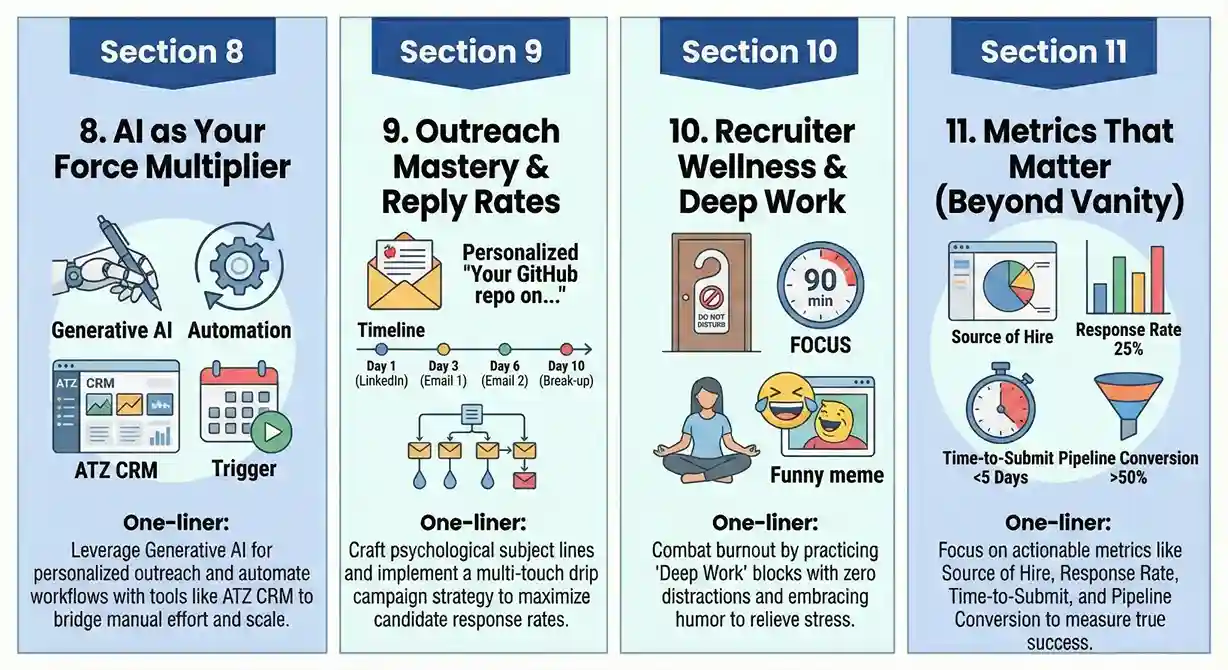
We established that AI is your new colleague. Now, let’s look at how to use it practically. This is where tools like ATZ CRM shine, bridging the gap between manual hustle and automated scale.
8.1 Generative AI for Outreach
Writer’s block is a productivity killer. Generative AI (like ChatGPT or the AI features inside ATZ CRM) can draft Boolean strings and outreach messages in seconds.
Prompt for Boolean
- “Act as a Sourcing Expert. Write a Boolean search string for a DevOps Engineer in Seattle with Kubernetes and AWS experience, excluding entry-level roles.”
title=“Prompt for Outreach
“Draft a hyper-personalized email to a candidate named Sarah. Mention her recent project on GitHub regarding ‘Neural Networks’ and explain why she would fit our AI startup. Keep it under 150 words and use a casual tone.”
Use AI to write a customized outreach message that references their specific skills. (Need help with this? Check out our Best AI & ChatGPT Prompts for Recruiters).
Need Better Tools? Compare the market in Best RecruiterFlow Alternatives for Recruiting Firms.
8.2 Automating the Funnel
Sourcing is useless if you drop the ball on follow-up.
- Workflow Automation: Set up triggers. “If a candidate applies, send an acknowledgment email. If I move them to ‘Phone Screen,’ send a Calendly link.”
- Candidate Rediscovery: Your database is full of gold you forgot about. AI can surface candidates you spoke to two years ago who are now perfect for your new role.
- Automation Hacks: Use our guide on free job posting sites for diverse hiring to find the best places to post for free.
Section 9: Outreach Mastery – How to Get a Reply
You found the candidate. You have their email. Now comes the hard part. Getting them to care.
9.1 The Psychology of the Subject Line
The subject line is the gatekeeper. If it looks like spam, it gets treated like spam.
- ❌ Bad: “Opportunity at [Company]” (Boring).
- ❌ Bad: “We are hiring!” (About you, not them).
- ✅ Good: “Your GitHub repo on Neural Networks” (Personal).
- ✅ Good: “Question about your time at [Competitor]” (Intriguing).
9.2 The Multi-Touch Strategy
One email is not enough. Data shows it takes 5-7 touchpoints to get a response from a passive candidate.
- Day 1: LinkedIn Connection Request (with a personalized note).
- Day 3: Email 1 (Personalized, value-driven).
- Day 6: Email 2 (Follow-up with a piece of content, e.g., “Thought you might find this article on our tech stack interesting”).
- Day 10: Break-up Email (“I don’t want to be a pest, so I’ll cross you off my list for now. Best of luck!”).
- Psychology trick: People hate being crossed off lists. This email often gets the highest response rate.
9.3 Drip Campaigns with ATZ CRM
You cannot manage a 7-step sequence for 50 candidates manually. ATZ CRM allows you to build Drip Campaigns that send emails, track opens, and stop automatically if the candidate replies.
Outreach Secrets: Master the art of the email with Email Campaigns for Recruiters.
Section 10: Recruiter Wellness – Don’t Burn Out
Sourcing is a grind. It is repetitive. It involves a lot of rejection. We need to talk about the human element.
10.1 The “Deep Work” Method
Multitasking is a myth. You cannot source effectively while answering Slack messages and checking your phone.
Tip: Block out 90 minutes of “Deep Sourcing” time. Turn off notifications. Close your email. Focus purely on finding talent. You will accomplish more in 90 minutes of focus than in 8 hours of distracted browsing.
10.2 Laugh a Little
Recruiting is stressful. Sometimes you just have to laugh.
Recruiter Joke: Why did the recruiter cross the road? To source the other side!
When a candidate ghosts you, don’t get angry. Send a meme. A funny GIF can sometimes break the tension and get a reply when a serious email won’t.
Section 11: Measuring Success – The Metrics That Matter
You can’t improve what you don’t measure. But are you measuring the right things? “Number of InMails sent” is a vanity metric. Here is what matters.
| Metric | Definition | Why it Matters | Benchmark Goal |
|---|---|---|---|
| Source of Hire | Where did the placement come from? | Tells you which channels (LinkedIn, GitHub, Referrals) are worth your budget. | >40% from Sourcing |
| Response Rate | % of candidates who reply to outreach. | Measures the quality of your copywriting and targeting. | 20-30% |
| Time-to-Submit | Days from opening role to submitting 1st candidate. | Measures sourcing speed and intake alignment. | < 5 Days |
| Pipeline Conversion | % of sourced candidates who pass the screen. | Measures the quality of your sourcing. | >50% |
Pro Tip: Don’t track this in Excel. Use ATZ CRM dashboards to see exactly which team member needs help or which job board is wasting your budget.
- Growing Your Agency? Sourcing candidates is great, but you need jobs to fill. Read our guide on Sourcing vs Recruitment to turn your sourcing skills into new business revenue.
Conclusion
The recruitment landscape of 2026 rewards the curious, the brave, and the proactive. The days of “posting and praying” are over. The modern recruiter is a detective, a marketer, a data analyst, and a technologist rolled into one.
We have covered a lot of ground today:
- We hacked GitHub to find email addresses.
- We wrote Boolean strings that would make a programmer jealous.
- We explored the hidden communities of Slack and Discord.
- We learned how to automate the boring stuff with AI agents.
But here is the most important takeaway: Tools are just tools. Candidate sourcing is ultimately about people. It is about finding the human being behind the profile and connecting them with an opportunity that could change their life.
Don’t let the purple squirrels get away. Equip your team with the strategy and the technology they need to win the war for talent.
Ready to supercharge your sourcing strategy?
Stop wrestling with spreadsheets and outdated ATS platforms. Experience the future of AI-driven recruitment today.
Request a Demo Now and see how we can help you source faster, hire smarter, and grow your agency in 2026.
Make the switch to ATZ CRM today.
FAQs
1. What is the difference between candidate sourcing and recruiting?
Think of sourcing as the “hunting” and recruiting as the “gathering.” Sourcing focuses on identifying, researching, and engaging potential candidates (especially passive ones) to build a pipeline. Recruiting involves the later stages: screening, interviewing, negotiating salaries, and onboarding. Sourcing feeds the funnel; recruiting closes the deal.
2. Is Boolean search still relevant in 2026 with all these AI tools available?
Absolutely. While AI can write basic strings, understanding Boolean logic allows you to troubleshoot why a search failed, refine results manually, and perform X-Ray searches on platforms like Google that AI tools might overlook or misinterpret. It gives you control over the algorithm rather than being a slave to it.
3. How can I source diverse candidates without being biased?
It starts with intentionality. Use specific Boolean strings to include organizations, colleges (like HBCUs), and sororities/fraternities associated with underrepresented groups. More importantly, use tools like ATZ CRM that offer “blind hiring” features, which can anonymize resumes during the initial screening (hiding names/photos) to reduce unconscious affinity bias.
4. What is the best free tool for finding email addresses in 2026?
While tools change often, ATZ CRM’s Chrome Extension is highly effective for finding contact info directly from social profiles. For a DIY approach, the GitHub .patch method (adding .patch to a commit URL) is a legendary free hack for developers. X-Ray search to find CVs hosted on personal websites is another powerful free method.
5. How many follow-up emails should I send to a passive candidate before giving up?
The data consistently shows the sweet spot is 3-4 emails.
- Introduction.
- Value or context (don’t just say “just bumping this”).
- Value or context.
- Polite “break-up” email. Surprisingly, the break-up email often gets the highest response rate because people fear missing out or want to be polite.