Last Updated: · ATZ CRM Editorial Team · Recruitment · 16 min read
10 Ultimate Hacks to Boost Efficiency in Contract Staffing
Inefficiency is the silent killer of contract staffing margins. While many agencies focus solely on placement volume, the real profit drain happens in the middle office. Discover 10 hacks to automate workflows and boost net revenue.
Is your staffing agency running you, or are you running your agency?
Quick Answer: 10 Ultimate Hacks to Boost Efficiency in Contract Staffing
This guide covers the most effective strategies and best practices for 10 ultimate hacks to boost efficiency in contract staffing. Read on for actionable tips, comparison tables, and expert recommendations to help you make better hiring decisions faster.
If you are a recruiter, staffing agency owner, or executive searcher, you know the specific brand of pain that comes with contract roles. You place a candidate, high-five the team, and then realize the real work has just begun: chasing timesheets, calculating complex burden rates, fighting with payroll, and praying the client pays before your cash reserves dry up.
It’s enough to make you want to scream into a pillow.
We’ve all seen the recruiter memes, but the reality is less funny when it hits your bank account:
- The sheer panic when a candidate ghosts you on the start day.
- “Urgent” requirements that turn out to be roles the client forgot to hire for 3 months ago.
- That sinking feeling when you realize your “net profit” looks more like “lunch money” after taxes and overhead.
If you are still figuring out the basics, you might want to start with our foundational guide: Contract Staffing: Playbook for Success. But if you are ready to move past the “what is it” phase and into the “how do I dominate this market” phase, you are in the right place.
This isn’t about working harder. It’s about fixing the broken “black holes” in your operations, like manual data entry and leaky candidate pipelines, that are destroying your ROI. We are going to cover 10 advanced hacks, from automating contract staffing workflows to mastering financial margins, that will turn your agency into a scalable machine.
By the time you finish this blog, you will have a blueprint to slash administrative overhead by 50%, automate your “middle office,” and finally uncover the hidden profit margins you’ve been missing.
Ready to upgrade from Rookie to Power User? Let’s dive in.
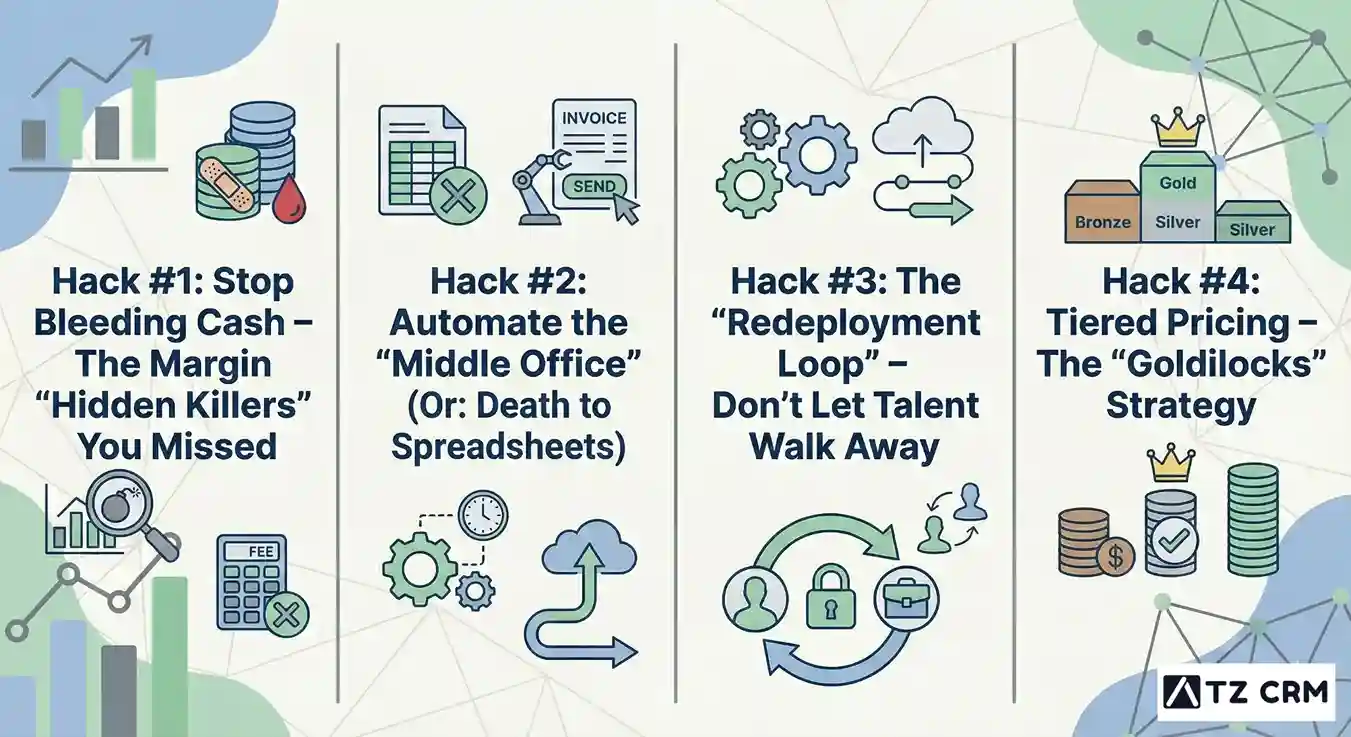
Hack #1: Stop Bleeding Cash – The Margin “Hidden Killers” You Missed
⚠️ The Bottleneck: The “Flat Rate” Trap
Let’s be real: Revenue is vanity, profit is sanity. In contract staffing, it’s terrifyingly easy to have high revenue but low profit because of one sneaky culprit: the Burden Rate.
Many agency owners calculate a simple markup and think they’re safe. But the burden rate isn’t flat. It’s a living, breathing beast that changes based on location and risk.
🛠️ The Strategy: “Burden-Plus” Pricing
Don’t just guess. Switch to a “Burden-Plus” pricing model. Instead of a flat bill rate, negotiate contracts where statutory costs (taxes, insurance, FICA) are passed through to the client at cost, plus a fixed management fee on top. This protects you if taxes hike up unexpectedly or if a specific state introduces new levies.
The “Hidden Cost” Checklist
If you aren’t auditing these specific costs, you are likely losing money on every hour billed:
- SUTA Volatility: Did you know your State Unemployment Tax rate can triple if you don’t contest invalid claims? A “flat” tax assumption here is dangerous.
- The “Holiday Pay” Trap: If you agree to pay your contractor for Christmas but the client refuses to be billed for it, that cost comes fully out of your pocket.
- Workers’ Comp Class Codes: Are you classifying that warehouse supervisor as a general laborer? You might be overpaying for insurance premiums.
🤖 The Automation Hack
Use your CRM to conduct a quarterly “Margin Stress Test.” Simulate a 5% increase in insurance premiums to see which client contracts become unprofitable, and renegotiate them proactively.
Pro Tip: Don’t just guess. Use a “Burden-Plus” pricing model. Negotiate contracts where statutory costs (taxes, insurance) are passed through to the client at cost, plus a fixed management fee. This protects you if taxes hike up unexpectedly.
For a deeper dive on how to structure fees, check out our guide on Retained Recruiting vs. Contingent Recruiting to see how different models impact cash flow.
Hack #2: Automate the “Middle Office” (Or: Death to Spreadsheets)
⚠️ The Bottleneck: The Cash Flow Gap
The “Middle Office” is the boring but critical layer between making a hire and getting paid. It’s where timesheets go to die. If you are manually emailing PDF timesheets or using paper, you are creating a cash flow gap. Every day you wait for a manager to sign a piece of paper is a day you aren’t invoicing, while your contractors still expect to be paid weekly.
🛠️ The Strategy: Digital Synchronization
You need to treat the middle office as a liquidity engine, not an admin task. Efficiency here is a liquidity strategy. By automating contract staffing workflows related to time capture, you close the gap between payout and payday.
🤖 The Automation Hack: ATZ CRM Timesheets
Power users automate this entire cycle using job shift timesheets.
- Auto-Chase: The system texts the contractor on Friday: “Submit your hours!”
- One-Click Approval: The client gets a secure link. They click “Approve.” Done.
- Auto-Invoice: The system generates the invoice instantly based on the approved hours.
- Impact: Automating this process can reduce administrative errors and “chase time” by over 90%.
For a look at the best tools to handle this, we’ve ranked the top contenders in our Ultimate Recruit CRM Showdown: Best ATS Ranked guide.
Hack #3: The “Redeployment Loop” – Don’t Let Talent Walk Away
⚠️ The Bottleneck: High Acquisition Costs
Here is a scary statistic: Staffing firms fail to redeploy 70% to 90% of their contractors.
Imagine buying a brand new car, driving it for 3 months, and then leaving it on the side of the road to go buy another one. That is what you are doing when you let a proven contractor finish an assignment and walk away. You lose the acquisition cost, the vetting time, and the relationship.
🛠️ The Strategy: The “Zero-Cost” Placement
Redeploying a known contractor is exponentially more profitable. There are no job board fees, no screening calls, and zero risk on quality. You need to shift your mindset from “filling orders” to “managing careers.”
The Economics of Redeployment
Redeploying a known contractor is exponentially more profitable than finding a new one. The “Redeployment Loop” creates a compounding effect on profitability:
- Zero Acquisition Cost: “You already found them.” There are no job board fees, no external sourcing hours, and no initial screening time required.
- Reduced Risk: The agency already knows the candidate’s work ethic, skills, and reliability. The “quality of hire” risk is virtually eliminated.
- Higher Margins: “No job board fees = pure profit.” Since acquisition costs are sunk, the net margin on the second, third, and fourth placements is significantly higher.
- Candidate Loyalty: Contractors prefer agencies that keep them consistently employed. High redeployment rates reduce churn and build a loyal workforce that acts as a brand ambassador.
- Zero Vetting Cost: You already know they are good.
🤖 The Automation Hack: End-Date Triggers
Don’t wait until the contract ends. Set up an automated Drip Feed Campaign that triggers 30 days before the assignment end date.
- Day -30: Email to Client: “John’s contract ends soon. Want to extend?”
- Day -30: Email to Contractor: “Great job on the project! Let’s line up your next gig.”
Use AI Candidate Matching to instantly shop that contractor to your other open roles. This turns your database into a revolving door of revenue rather than a leaky bucket.
Hack #4: Tiered Pricing – The “Goldilocks” Strategy
⚠️ The Bottleneck: Commoditization
Stop offering one price. It makes you a commodity.
When you go to buy software (or coffee, or movie tickets), you are used to options: Small, Medium, Large. Why not do the same for your staffing services?
Instead of offering a standard markup for all clients regardless of the service level, power users implement a tiered structure (e.g., Bronze, Silver, Gold). This approach, borrowed from the SaaS industry, clarifies expectations and allows agencies to capture more value from demanding clients.
🛠️ The Strategy: Service Tiers (SaaS Style)
Borrow a page from the software industry and offer options: Small, Medium, Large.
- Bronze (Standard): Basic sourcing, standard background checks.
- Silver (Premium): 48-hour fill guarantee, technical assessments included.
- Gold (Enterprise): Dedicated account manager, custom reporting, on-site support.
🤖 The Automation Hack: SLA Tracking
Use your CRM to track which tier a client is on. If a “Bronze” client demands “Gold” reports, you have the data to upsell them: “Happy to provide that custom report! That’s included in our Enterprise package. Shall we upgrade you?”
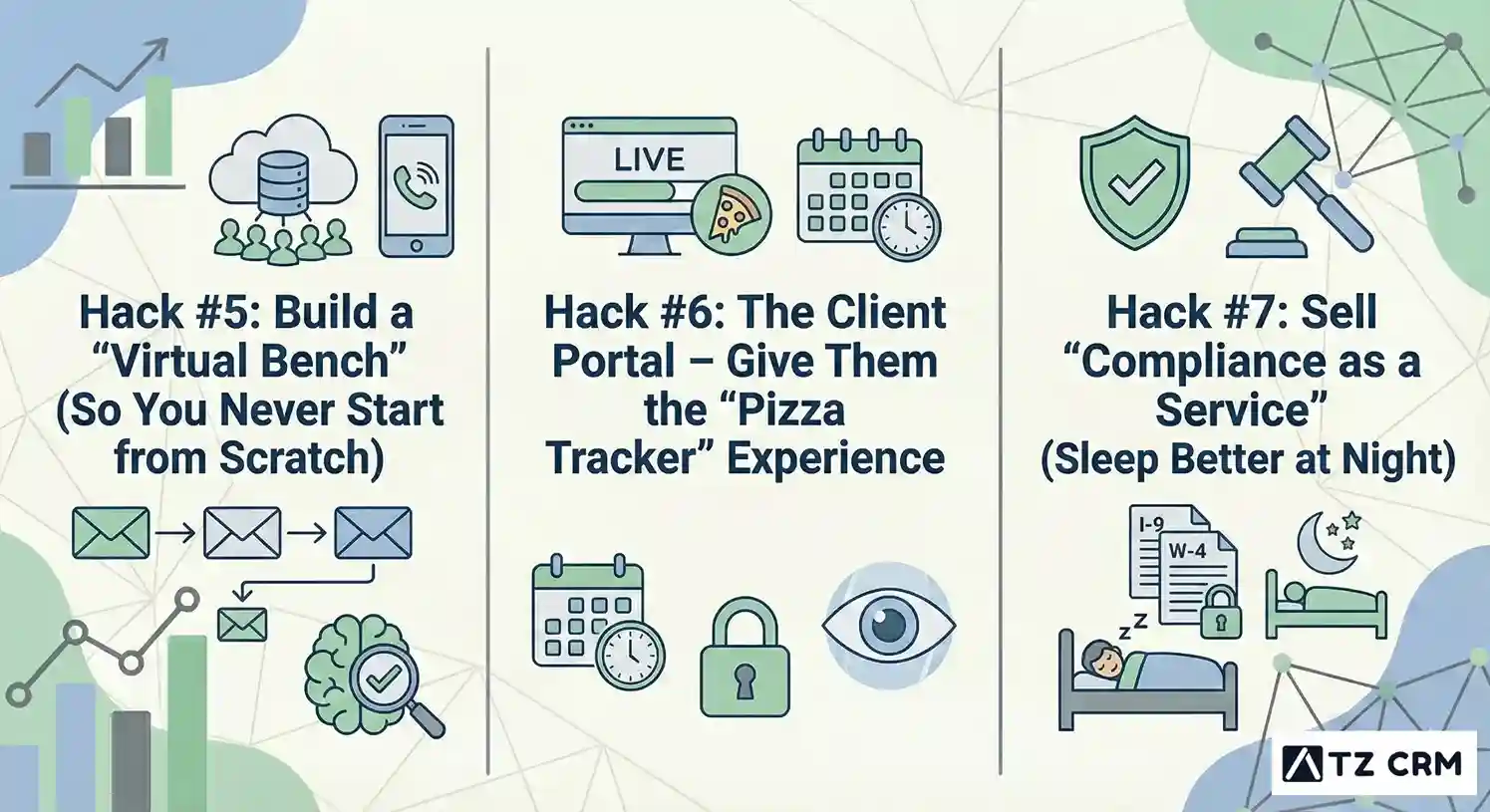
Hack #5: Build a “Virtual Bench” (So You Never Start from Scratch)
⚠️ The Bottleneck: Reactive Sourcing
In a candidate-short market, the agency with the best “Virtual Bench” wins. A virtual bench isn’t just a list of names; it’s a community of pre-vetted talent that is ready to go. But how do you keep them warm without spending all day on the phone?
🛠️ The Strategy: The “Drip” is the New Call
Cold calling is increasingly ineffective; “warm calling” is the new standard. Automated drip campaigns nurture the virtual bench so that candidates are “warm” when a recruiter reaches out.
A typical nurture sequence might look like this:
- Day 1: Automated connection request or email acknowledging their specific expertise in a niche.
- Day 3: Sharing a relevant industry article, salary guide, or white paper (value-add content, not a sales pitch).
- Day 7: Invitation to join the agency’s exclusive talent network or “VIP Bench.”
- Day 14: A specific soft check-in about upcoming job opportunities.
🤖 The Automation Hack: AI & Drip Nurture
Use AI Candidate Matching to constantly scan your database. But go a step further, use AI to generate engagement content.
- The Prompt: Use AI to write a customized outreach message that references their specific skills. (Need help with this? Check out our Best AI & ChatGPT Prompts for Recruiters).
- Try the “Lookalike” Strategy: Found a superstar Java developer? Use your CRM’s “Similar Candidate Finder” to find 10 more people just like them in your database. This is how you scale niche dominance.
This automation ensures that when a recruiter finally picks up the phone, the candidate already recognizes the agency’s brand and views them as a source of value, not just another headhunter.
Hack #6: The Client Portal – Give Them the “Pizza Tracker” Experience
⚠️ The Bottleneck: The “Status Update” Noise
We live in an on-demand world. Clients can track their Uber, their Amazon package, and their pizza. Why do they have to email you to ask, “Any updates on that candidate?” Answering these emails kills your recruiters’ productivity.
🛠️ The Strategy: Radical Transparency (Reducing the “Status Update” Noise)
A significant portion of a recruiter’s day is spent answering “Any updates?” emails and phone calls. A client portal eliminates this noise by giving clients 24/7 self-service access to the recruitment process.
- Real-Time Visibility: Clients can log in to view candidate submittals, read resumes, see recruiter notes, and watch video introductions in real-time.
- Interview Scheduling: Integrated calendars allow clients to book interview slots directly with candidates, eliminating the endless email ping-pong of scheduling.
- Order Status: Clients can see exactly how many candidates have been screened, how many are in the pipeline, and where each stands, providing reassurance that work is being done even if no submittals have been made yet.
🤖 The Automation Hack: Client Portals
Client Portals are the ultimate efficiency hack.
- Transparency: Clients log in and see exactly who you’ve screened.
- Speed: They can book interviews directly in the portal.
- Stickiness: Once a client gets used to this level of visibility, they won’t want to go back to email chaos with your competitors.
- The ROI: Agencies using client portals can see up to 19% higher revenue per staff member because recruiters aren’t wasting time on status update calls.
If you are currently using a clunky system, it might be time to look for alternatives. We’ve compared the market leaders in our RecruiterFlow alternative and Bullhorn alternative guides.
Hack #7: Sell “Compliance as a Service” (Sleep Better at Night)
⚠️ The Bottleneck: Legal Liability
Let’s talk about the scary stuff: Misclassification. The government is cracking down on the difference between a W-2 employee and a 1099 contractor. If your client gets this wrong, they could face massive fines. This fear is your opportunity.
🛠️ The Strategy: Risk Mitigation
Don’t just sell “staffing.” Sell Indemnification. Position yourself as the expert who protects the client from the IRS. Market your rigorous compliance process as a premium feature.
Selling Peace of Mind
Agencies should explicitly market this capability. The sales pitch shifts from “We find people” to “We indemnify you against classification risk.”
“We don’t just fill seats; we protect your business. Our automated compliance engine ensures 100% adherence to labor laws, so you never have to worry about a misclassification lawsuit.” This is a powerful closing argument for risk-averse enterprise clients and procurement departments.
🤖 The Automation Hack: Compliance Workflows
Turn this fear into a sales pitch. Don’t just sell “staffing.” Sell Risk Mitigation. Market your rigorous compliance process.
- Use automated workflows to collect every required document (I-9, W-4, Insurance) before the contractor starts.
- Use your CRM to “Geo-Fence” contractors so you know if they move to a state with different labor laws.
By positioning yourself as the Compliance Expert, you become a strategic partner, not just a resume vendor.
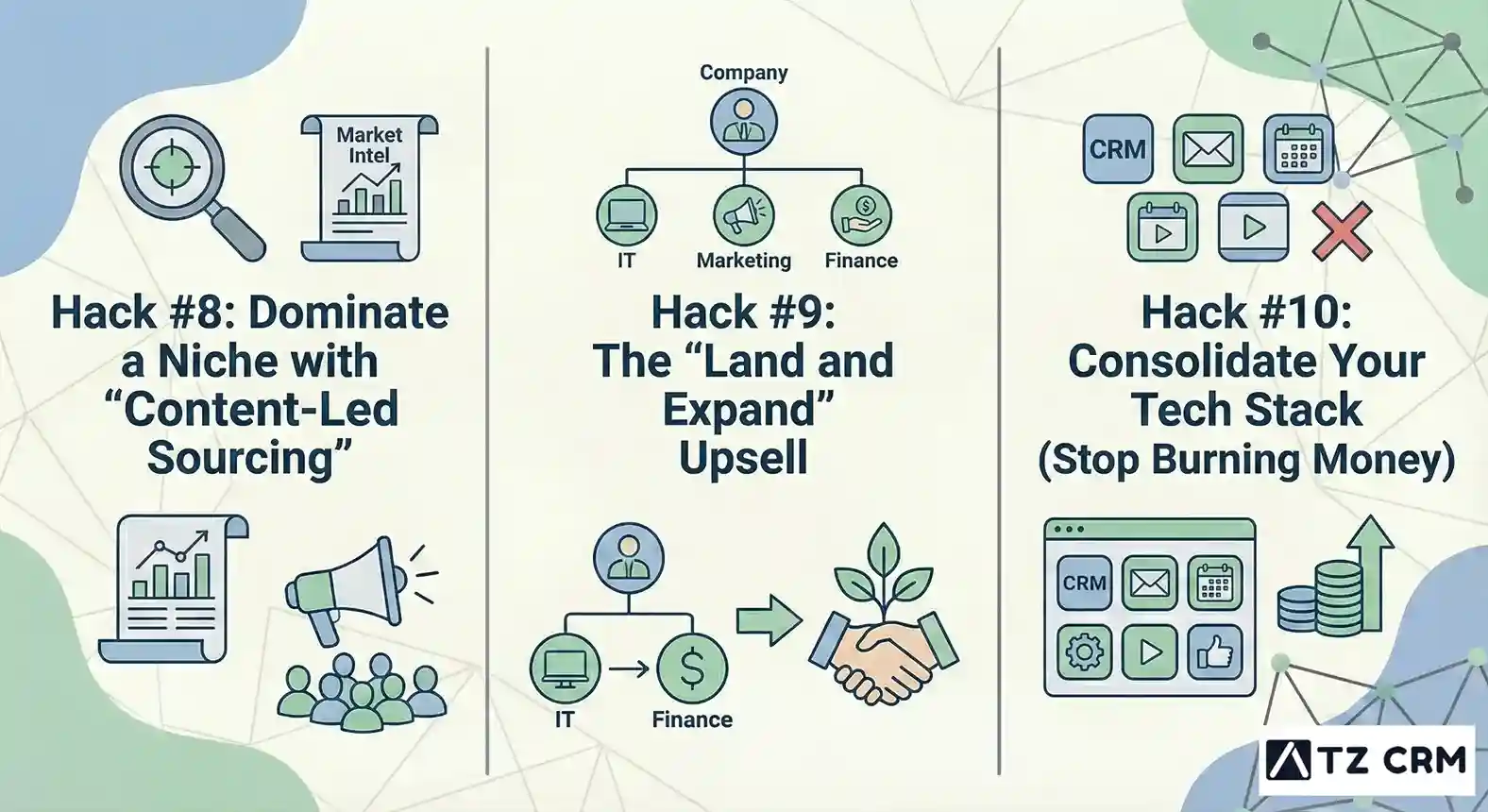
Hack #8: Dominate a Niche with “Content-Led Sourcing”
⚠️ The Bottleneck: The Generalist Trap
Generalist agencies are like The Cheesecake Factory menu—too many options, and none of them are amazing. You spend too much time learning new industries for every role.
🛠️ The Strategy: Deep Specialization
If you focus on “React Native Developers in FinTech,” you can reuse the same candidate pool over and over. A candidate rejected for Role A is perfect for Role B.
🤖 The Automation Hack: AI Content Generation
Don’t Just Post Jobs, Post intelligence.
- “We placed 50 Java devs last month. Here is exactly what they are getting paid.”
- Use the AI Job Advert Composer to write hyper-specific job descriptions that speak the language of your niche.
Need to get the word out? Don’t pay for every post. Use our guide on free job posting sites for diverse hiring to find the best places to post for free.
Hack #9: The “Land and Expand” Upsell
⚠️ The Bottleneck: Client Churn
Acquiring a new client costs 5x to 10x more than keeping an existing one. Ignoring the other departments in your current client’s company is leaving money on the table.
🛠️ The Strategy: Org Chart Mapping
You’re already staffing their IT team. Who runs Marketing? Who runs Finance? Use your foot in the door to cross-sell into other divisions.
🤖 The Automation Hack: Automated QBRs
Don’t just send an invoice. Use your CRM to generate a Quarterly Business Review (QBR) report showing how much time/money you saved them. Then, use automated email sequences to introduce yourself to other department heads: “We’ve been supporting your IT team for a year with a 98% fill rate. I’d love to share how we can help Finance.”
Hack #10: Consolidate Your Tech Stack (Stop Burning Money)
⚠️ The Bottleneck: Tool Sprawl
Are you paying for a CRM, a separate email marketing tool, a separate scheduling tool, and a separate video interview platform? “Tool Sprawl” is a budget killer and a data siloing nightmare.
🛠️ The Strategy: All-in-One Integration
Consolidation reduces costs and creates a “Single Source of Truth.” You cannot automate workflows if your data is trapped in three different systems that don’t talk to each other.
🤖 The Automation Hack: Unified Platform
Switch to an all-in-one platform like ATZ CRM.
- Single Source of Truth: Your emails, texts, resumes, and timesheets live in one place.
- Cost Savings: Case studies show agencies saving 66% on tech spend by consolidation.
If you are a smaller agency or just starting, check out free ATS for Small Businesses to see what’s possible on a budget. But for scaling agencies, you need robust Recruitment CRM Software.
Conclusion
Efficiency isn’t about working more hours; it’s about building a machine that works for you. By mastering these 10 hacks, from calculating true burden rates to automating your redeployment, you can transform your agency from a chaotic hustle into a profitable powerhouse.
The market in 2026 is going to belong to the agencies that are fast, compliant, and data-driven.
Ready to stop the chaos and start scaling? It might be time to switch to ATZ CRM.
Request a demo now! and see how we can automate your “middle office” today.
FAQs
1. What is the highest hidden cost in contract staffing?
The highest hidden cost is often the “Burden Rate” miscalculation. This includes overlooking variable costs like State Unemployment Tax (SUTA) changes, workers’ compensation class codes, and non-billable holiday pay. Ignoring these can turn a profitable placement into a loss.
2. How can I improve my contractor redeployment rate?
To improve redeployment, you need to be proactive. Use automation to trigger “end-date” alerts 30-45 days before a contract finishes. This prompts recruiters to line up the next assignment immediately, keeping the talent within your agency.
3. What is the difference between Retained and Contingent recruiting?
Contingent recruiting means you only get paid if you make a placement (success-based). Retained recruiting involves an upfront fee and exclusivity, usually for executive roles. For contract staffing, a “Burden-Plus” or exclusive model is often safer for margins.
Read more in our guide on: Retained vs Contingent Recruitment.
4. Why should I use a Client Portal?
A Client Portal reduces administrative noise by up to 90%. It allows clients to approve timesheets, view candidate statuses, and download invoices on their own, freeing up your recruiters to focus on selling rather than admin support.
5. Is it better to use niche software or an all-in-one CRM?
While niche tools are great, “tool sprawl” can fragment your data and increase costs. An all-in-one platform (like ATZ CRM) that handles sourcing, ATS, and back-office timesheets ensures data integrity and can reduce tech costs by up to 66% .
Blog Summary:
- Protect Margins and Pricing: Stop profit erosion by auditing burden rates (like SUTA and holiday pay), implementing tiered pricing to prevent scope creep, and consolidating your tech stack to reduce overhead costs.
- Automate Operations and Client Experience: Streamline the “middle office” (timesheets and invoicing) and deploy self-service client portals to close cash flow gaps, reduce administrative errors, and improve the client experience.
- Optimize the Talent Lifecycle: Eliminate acquisition costs by mastering contractor redeployment and shift to proactive sourcing by using AI to build “virtual benches” and specific content to dominate your niche.
- Expand Revenue Opportunities: Lower acquisition costs by “landing and expanding” into new departments within existing accounts and turn administrative risks into revenue by selling compliance and classification services.