Quick Answer: Social Recruiting for Modern Hiring in 2026
Key takeaway: Social recruiting uses platforms like LinkedIn, Instagram, and X (Twitter) to find, engage, and attract candidates. In 2026, 84% of job seekers use social media in their job search — making social recruiting essential, not optional, for competitive talent acquisition.
Introduction
Hiring has changed dramatically. The days when recruiters relied solely on career portals or walk-ins are long gone. Today, job seekers spend more time scrolling through Instagram Reels, TikTok videos, LinkedIn posts, and online communities than browsing job sites. And as talent behavior evolves, recruiters must evolve too.
Welcome to the era of social recruiting, where hiring merges with storytelling, branding, technology, and genuine human connection, and 91% of employers recruit via social media . This playbook will walk you through a complete, modern approach to attracting and hiring talent using the power of social media.
What Is Social Recruiting?
Social recruiting means using social media platforms not only to advertise jobs, but to build relationships, strengthen employer branding, engage passive talent, and nurture a long-term talent pipeline.
It goes beyond posting vacancy updates. It includes:
Showcasing culture and employee experiences
Sharing behind-the-scenes content
Responding to job queries and candidate comments
Connecting through communities, live sessions, and content
Personalizing candidate conversations
Put simply, social recruiting treats hiring the way brands treat marketing by meeting people where they already spend time.
Related Read: 7 Simple Job Rejection Email Templates That Save Time
Why Social Recruiting Matters in 2026
Recruiting today is competitive. Candidates are selective, informed, and purposeful. It says that 73% of millennial candidates found their last job through a social media platform. They research companies the same way consumers research products.
Here’s why social recruiting has become essential, not optional.
1. It Amplifies Employer Branding
Candidates don’t just want a job; they want meaning, connection, and alignment. When you share:
Stories of employee growth
Work culture highlights
Purpose and values
Real voices instead of corporate jargon
You attract people emotionally before they ever apply.
Related Read: Recruitment Strategies for Agencies: Proven Tactics to Attract Better Candidates
2. It Gives Access to a Wider and More Diverse Talent Pool
Just consider this: over 4.62 billion people worldwide use social media, representing more than half of the global population. For recruiters, this means one thing, talent acquisition efforts must meet candidates where they already spend their time. As a result, social platforms enable recruiters to connect with:
Passive candidates are individuals who are not actively seeking a new job but are receptive to the right opportunity if it aligns with their career goals.
Remote talent worldwide
Niche communities (like developers on GitHub or creatives on Dribbble)
This means smarter hiring, not just more applicants.
Related Read: 15 Free Job Posting Sites USA-Based Recruiters Can Use to Look for Diverse Talent
3. It Improves Candidate Experience
Social recruiting makes hiring feel conversational, not transactional. Replies, comments, and engagement signal that candidates are seen, not ignored.
This small shift builds trust and reduces drop-offs during hiring.
Related Read: Customer Relationship Management 101: Everything Important You Need to Know
4. It Lowers Cost Compared to Traditional Hiring
Instead of expensive job boards, paid campaigns on platforms like LinkedIn, Meta, TikTok, or niche communities allow precise targeting.
That means: Less spending. Better reach. Higher ROI.
Related Read: 10 Best AI & ChatGPT Prompts Every Recruiter Should Be Using
Where to Recruit: The Social Recruiting Platform Atlas
Every social platform has its own personality and purpose. The key is matching the right platform to your hiring goals.
| Platform | Best For | Example Roles |
|---|---|---|
| Professional networking, job roles, and leadership content | Corporate, tech, product, sales | |
| Employer branding, culture, short-form content | Creative, marketing, retail, customer support | |
| TikTok | Reels-style recruiting, Gen Z engagement | Entry-level roles, internships, fast-growing teams |
| Facebook Groups | Community-based hiring | Remote jobs, local hiring, volume hiring |
| X (formerly Twitter) | Industry discussions, thought leadership | Tech, content writing, strategy roles |
| Reddit, GitHub, Behance, Dribbble | Niche talent pools | Developers, designers, creators |
Related Read: 8 Best ATS+CRM Loxo alternatives for Growing teams
Core Strategies for Successful Social Recruiting
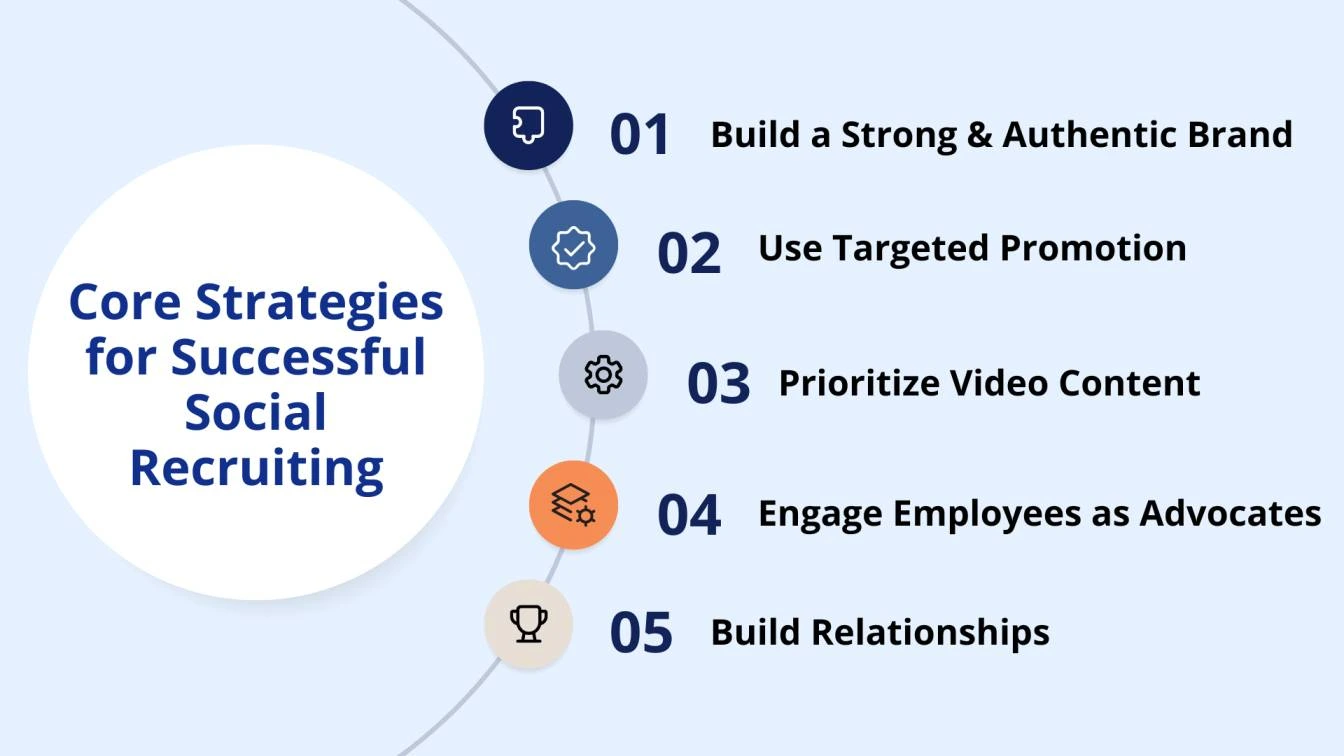
1. Build a Strong and Authentic Employer Brand
A compelling employer brand is the foundation of social recruiting. Job seekers want to know who you are beyond the job description. 21% of recruiters report that they have dismissed a candidate after reviewing the individual’s Facebook profile. This could include team stories, workplace highlights, or milestone celebrations.
A strong employer brand should:
Represent the real employee experience
Be consistent across all platforms
Connect emotionally with potential candidates
Posting relatable and human content builds trust and makes your company more memorable.
Related Read: How to Use ChatGPT for Recruiting (+3 Real-World Use Cases)
2. Use Targeted Promotion Instead of Posting Everywhere
Organic content builds awareness, but targeted ads help you reach the right talent faster. Instead of sharing job posts randomly, use a platform like ATZ CRM to target people with specific skills, locations, or career backgrounds.
Targeted hiring ads help you:
Attract relevant applicants instead of volume
Retarget users who showed interest but didn’t apply
Improve ROI by reaching defined audiences
Over time, a strategic mix of organic and paid content creates a steady talent pipeline.
Related Read: The Ultimate Recruit CRM Showdown: Best ATS Ranked
3. Prioritize Video Content in Your Hiring Strategy
Video content has become one of the most effective recruiting formats. It captures attention quickly and feels more personal than text-based posts. Candidates appreciate seeing real people and hearing directly from team members.
Useful video ideas include:
Day-in-the-life clips
Hiring manager introductions
Office tours or virtual team introductions
Authenticity matters more than production. A simple smartphone recording often performs better than a fully scripted corporate video.
Related Read: Top Recruitment CRM Solutions 2026: Improve Hiring Success
4. Engage Employees as Advocates
When employees talk about their work experience, it feels natural and credible. Employee advocacy expands your reach far beyond employer-branded profiles and helps create trust with potential candidates.
Encourage advocacy by:
Making it easy to share hiring updates
Recognizing employees who participate
Allowing personal tone rather than scripted posts
Your team members’ networks can significantly amplify awareness and attract qualified applicants.
Related Read: Best RecruiterFlow Alternatives for Recruiting Firms
5. Build Relationships Instead of Waiting for Applicants
Social recruiting is not just about filling open roles; it’s about nurturing talent over time. Instead of only posting when you are hiring, keep engaging audiences so they remain interested, informed, and connected.
Ways to maintain long-term engagement include:
Live Q&A sessions with hiring managers
LinkedIn groups or talent communities
Career development tips or industry insights
This approach creates familiarity and trust, so when a role opens, candidates already feel connected to your brand.
Related Read: Steal These Free Recruiting Email Templates That Get Responses
Tools That Support Social Recruiting
Technology plays a crucial role in making social recruiting efficient, scalable, and measurable. Instead of juggling platforms manually or switching between spreadsheets, the right tools help streamline sourcing, engagement, scheduling, analytics, and automation. While you don’t need every tool on day one, building a tech stack intentionally can significantly improve the consistency and performance of your hiring strategy.
A strong social recruiting workflow doesn’t come from collecting the most advanced platforms; it comes from selecting the right tools that support your current goals and scaling them as your strategy evolves. Research indicates that a company’s social presence influences candidate decisions.
1. Applicant Tracking Systems (ATS) and Talent CRM Platforms
An ATS or CRM like ATZ CRM serves as the operational backbone of social recruiting. It stores candidate information, tracks recruitment progress, and integrates with job boards or social platforms. More advanced systems also help nurture passive talent and track communication history so recruiters never lose context in conversations.
Popular examples include:
- ATZ CRM
- Greenhouse
- Workable
- Lever
These platforms ensure you don’t just collect applications, you manage relationships over time.
Related Read: Top 10 Free ATS Tools to Supercharge Recruitment - ATZCRM
2. Social Media Scheduling and Management Tools
Posting regularly across multiple platforms can quickly become overwhelming without automation. Scheduling tools help plan, post, and monitor recruitment content without manual repetition. They also provide engagement reports, making it easier to identify which types of content resonate with different audiences.
Commonly used tools include:
- Buffer
- Hootsuite
- Sprout Social
These tools make consistency manageable and allow recruiters to focus more on conversations rather than logistics.
Related Read: Remote Hiring In A Post Pandemic World – Tools And Practices
3. Social Listening and Brand Monitoring Tools
Candidate perception influences employer brand strength. Social listening tools help track mentions, comments, sentiment, and discussions around your company or industry. This allows you to respond faster, manage negative feedback professionally, and identify trending discussions that could inspire relevant hiring content.
Tools such as:
- Brandwatch
- Mention
- Sprinklr
can surface valuable insights, helping companies remain aware of how they’re perceived online.
Related Read: Boost Your Hiring KPIs with Atlas Recruitment in ATZ CRM
4. Video Creation and Content Design Tools
Since visual and video-based content perform significantly better in recruiting, having simple creative tools is essential. These platforms make it easy to create employee spotlight videos, culture reels, job announcement graphics, or interview tip clips, all without needing a dedicated design team.
Useful tools include:
- Canva
- CapCut
- Veed.io
- Adobe Express
Even basic templates can create polished, engaging content suitable for Instagram, TikTok, LinkedIn, or YouTube Shorts.
Related Read: Cold Call Script: Recruit Better With These 6 Free Scripts
5. Analytics and Performance Measurement Tools
To understand what’s working, what’s not, and where to improve, analytics tools are crucial. These platforms help track reach, engagement, conversions, impressions, audience demographics, and content performance trends. Data ensures your recruiting strategy is guided by evidence, not assumptions.
Platforms like:
- Google Analytics
- Meta Business Insights
- LinkedIn Campaign Manager Analytics
offer clear metrics to optimize content, refine messaging, and improve ROI over time.
Related Read: What Is Cost Per Hire? A Simple Guide for Modern Recruiters.
6. Talent Search and Outreach Tools
Finally, sourcing tools help recruiters find high-quality candidates faster, especially those who may not be actively looking. These platforms scan public profiles, analyze skillsets, and provide insights on candidate availability or engagement likelihood. Approximately 40 million people search for job opportunities on LinkedIn every week.
Examples include:
- LinkedIn Talent Insights
- GitHub Advanced Search
- Entelo (now Rival HR)
These tools expand reach beyond active job seekers, allowing companies to connect with talent earlier in their career exploration cycle.
Measuring Success: Social Recruiting KPIs
Tracking performance is essential in social recruiting because it ensures your efforts are aligned with meaningful results, not just vanity metrics. While creativity and storytelling play a major role, the true effectiveness of your strategy becomes clear only when measured through data.
Monitoring specific recruitment KPIs helps you understand whether your content resonates with the right audience, whether your messaging drives action, and whether your investment generates returns. These insights allow teams to refine their approach, improve efficiency, and make decisions rooted in evidence rather than assumptions.
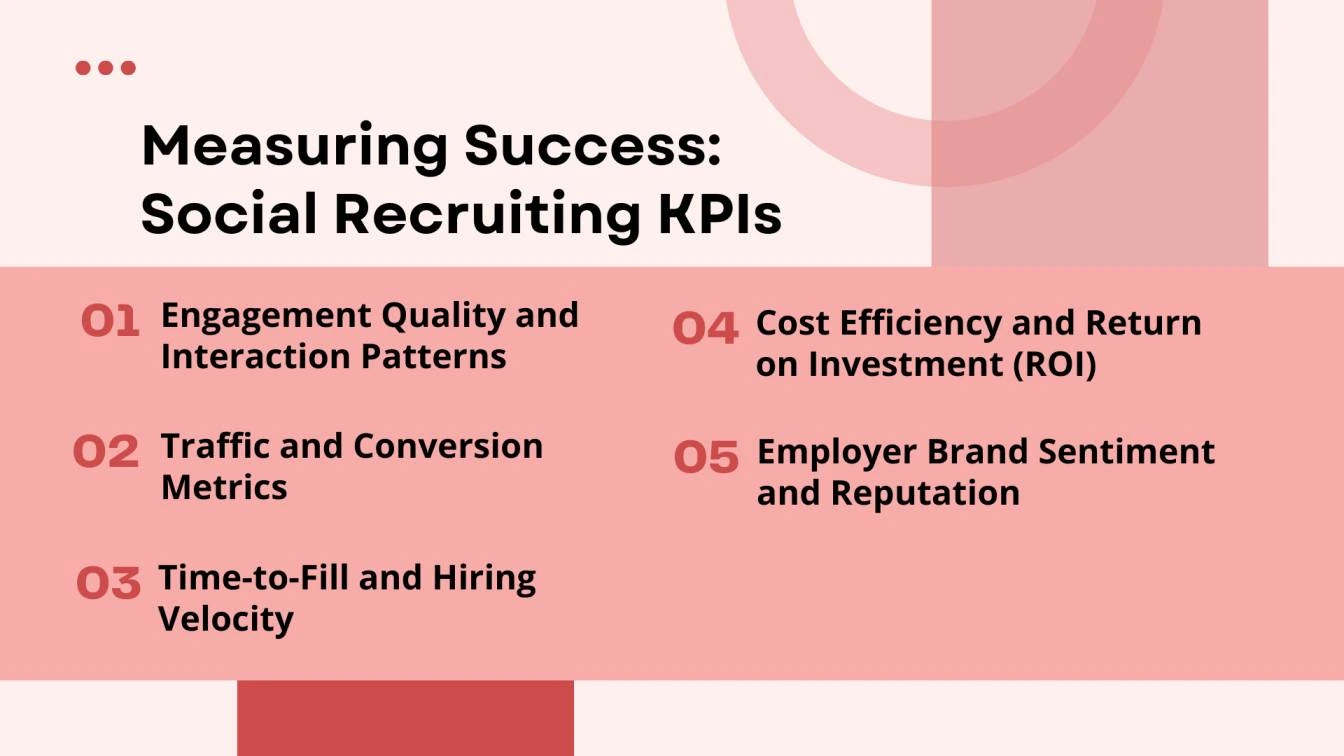
1. Engagement Quality and Interaction Patterns
Engagement is one of the earliest indicators that your content is reaching and connecting with job seekers. This includes likes, shares, comments, video watch time, profile visits, and even saved posts. Although high engagement may feel encouraging, quality matters far more than quantity. Comments that express genuine interest, thoughtful questions about the role, or requests for application details carry more weight than passive reactions.
Over time, analyzing engagement patterns will reveal which types of content, such as videos, behind-the-scenes posts, employee stories, or job openings, spark meaningful responses. These patterns help shape your ongoing content strategy.
Related Read: How AI-Powered Tools Are Transforming Candidate Screening for Better Hiring
2. Traffic and Conversion Metrics
Beyond engagement, it’s important to assess whether your social content actually drives candidates to take the next step. Metrics such as link clicks, career page visits, form submissions, and job applications indicate how effectively your content motivates action.
Conversion rate, in particular, offers a clear picture of how many people viewing or interacting with your posts progress toward applying. If click-through rates are high but very few people complete applications, it may suggest unclear expectations, confusing landing pages, or misaligned messaging. Reviewing these numbers regularly allows fine-tuning of calls-to-action, job descriptions, and candidate funnels.
Related Read: GDPR Recruitment: How to Handle Candidate Data in 2025
3. Time-to-Fill and Hiring Velocity
Another powerful indicator of social recruiting success is how quickly roles are filled once promoted. Time-to-fill reflects the efficiency of your hiring pipeline and how qualified your applicant pool is. If social recruiting efforts shorten hiring timelines compared to traditional methods, it’s a strong sign that your strategy is filtering in relevant candidates.
Consistent delays, however, may suggest targeting the wrong audience, posting inconsistently, or lacking clarity in role communication. Over time, improvements in hiring speed demonstrate that the social strategy is not only visible but effective.
Related Read: Boolean Search in Recruitment: The Complete Beginner’s Guide
4. Cost Efficiency and Return on Investment (ROI)
A significant advantage of social recruiting is cost-effectiveness, but this should be confirmed with measurable data. Cost per hire is a key metric that reflects the total investment in ads, tools, recruiter time, and content development divided by successful hires.
Lowering cost per hire without sacrificing quality indicates a healthy and scalable strategy. ROI becomes even stronger when organic content or employee advocacy drives qualified applicants without paid promotion.
Related Read: Why ATZ CRM is the Best CRM for Streamlining Your Recruitment Process
5. Employer Brand Sentiment and Reputation
Finally, social recruiting success is strongly tied to how candidates perceive your organization. Sentiment analysis, whether gathered from comments, reviews, DMs, or external mentions, reveals the emotional response your content generates.
Around 75% of candidates review an employer’s brand before submitting an application, often prioritizing it even ahead of salary or job title considerations. Listening to feedback and adapting accordingly strengthens long-term credibility and connection with potential talent.
Related Read: Insider recruitment marketing strategies to boost your hiring game!
Common Challenges in Social Recruiting and How to Avoid Them
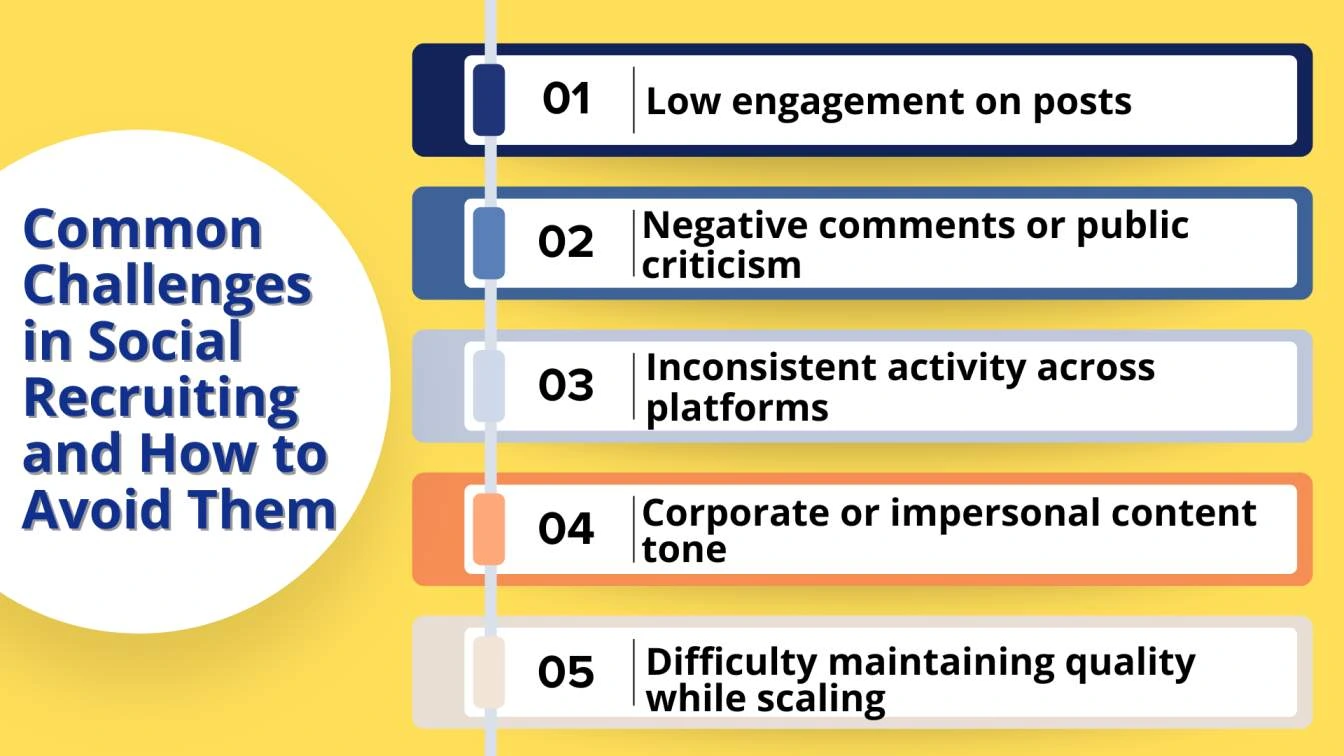
Low engagement on posts
Often caused by repetitive or overly promotional content.
Solution: experiment with diverse formats such as reels, employee stories, and educational posts.
Maintain a consistent posting schedule to stay visible.
Negative comments or public criticism
It can damage brand perception if ignored or mishandled.
Solution: respond professionally, acknowledge concerns, and offer support rather than deleting or arguing.
Shows transparency and strengthens trust with potential candidates watching quietly.
Inconsistent activity across platforms
Happens when teams lose momentum or lack a posting plan.
Solution: Use a content calendar and scheduling tools like Buffer or Hootsuite to plan ahead.
Assign internal ownership so responsibility is always clear.
Related Read: 7 Email Templates for Recruiter That Get Quick Replies
Corporate or impersonal content tone
Makes the brand feel distant, rigid, or unrelatable.
Solution: humanize content by involving employees, sharing real moments, and showing personality.
Authentic posts resonate more than polished marketing language.
Difficulty maintaining quality while scaling
Growth may lead to rushed posts or unclear messaging.
Solution: create templates, branding guidelines, and a content workflow to keep messaging consistent.
Train team members so everyone represents the brand well.
Related Read: Switch to ATZ CRM: 7 Powerful Reasons to Upgrade Now
The Future of Social Recruiting (2026–2030)
AI-Powered Talent Intelligence Will Transform Sourcing
Artificial intelligence will become deeply integrated into recruiting processes, helping identify qualified candidates long before they actively search for jobs.
Instead of manually searching profiles, AI will analyze candidate behavior, engagement patterns, skills, and online activity to recommend the most suitable matches.
Recruiters will spend less time on administrative tasks and more time building meaningful relationships with high-potential applicants. Stats on how hiring managers use social profiles to screen candidates .
Personalized Recruitment Content Will Become Standard
Generic job posts will slowly disappear as candidates expect customized communication based on their interests, location, career stage, and skills.
Messaging will become more dynamic; for example, a developer may see content tailored to engineering culture, while a designer may see portfolio-focused storytelling.
This shift will make recruitment feel more like a conversation than a broadcast.
VR and AR Will Elevate Employer Branding Experiences
Virtual reality office tours, immersive role previews, and augmented reality onboarding materials will make it easier for candidates to understand the company environment.
This technology will be especially valuable for remote and hybrid roles, where physical visits are not possible.
Candidates will be able to experience team dynamics and workplace culture before applying, reducing uncertainty and improving alignment.
Related Read: The Best Bullhorn Alternative for Effortless Hiring
Influencer-Driven Hiring Will Gain Momentum
Companies will increasingly partner with industry creators, niche experts, or micro-influencers who have trust and credibility within specific talent communities.
Employees themselves may become internal influencers, representing the brand authentically across digital platforms.
This approach will make employer branding feel more relatable and genuine.
Community-Based Recruiting Will Replace One-Time Campaigns
Instead of recruiting only when roles open, organizations will maintain ongoing relationships with talent through online communities, newsletters, and interactive forums.
Candidates who feel connected to a brand over time will apply faster and convert at higher rates when roles are advertised.
This long-term strategy will contribute to stronger talent pipelines and shorter hiring timelines.
Related Read: 12 Best Recruitment CRM Software for Recruitment Agencies
Automation Will Handle Operational Tasks So Recruiters Can Focus on Relationship-Building
Routine activities like scheduling, tracking applications, initial screening, and reminders will be automated with the help of a tool like ATZ CRM.
Recruiters will shift their focus toward strategy, storytelling, candidate experience, and culture-focused communication.
This evolution will redefine the role of recruiters from administrative coordinators to talent advisors and brand ambassadors.
Skills-Based Hiring Will Replace Traditional Degree-First Models
As more platforms build tools to verify skills digitally, employers will rely less on formal education credentials.
Public portfolios, real-time assessments, and verified project-based evaluations will serve as proof of ability.
This approach will expand access to talent and support more inclusive hiring practices.
Ethical Hiring Practices and Transparency Will Become Non-Negotiable
With more automation and data use comes a responsibility to ensure fairness, privacy, and clarity.
Candidates will expect transparency about how their data is used and where automation plays a role in hiring decisions.
Organizations that prioritize honesty and ethical use of technology will build stronger trust and reputation in the talent market.
Conclusion
Social recruiting has evolved from a trend into a foundational hiring approach, reshaping how organizations connect with talent in a digital-first world. As candidates increasingly turn to social media to evaluate company culture, career opportunities, and work environments, employers who embrace authentic storytelling and consistent engagement gain a competitive advantage. By combining content strategy, strong employer branding, and dedicated recruitment platforms, hiring becomes more meaningful and personalized.
Tools like ATZ CRM, which streamline candidate tracking, communication, and engagement workflows, make it easier for recruiters to manage relationships and build talent pipelines at scale. Instead of simply collecting applications, companies can nurture connections and create a stronger bridge between employer and candidate expectations.
Looking ahead, the recruiting landscape will continue to shift toward automation, personalization, and interactive digital experiences. Video-first communication, virtual hiring touchpoints, and intelligent recruitment technology will define how organizations attract and engage future talent.
Companies willing to innovate and integrate solutions like ATZ CRM alongside consistent social recruiting efforts will be better equipped to respond to changing candidate behaviors and hiring demands. Ultimately, successful social recruiting is not just about filling roles; it’s about building trust, fostering community, and showcasing a workplace where people genuinely want to grow.
Blog Summary
The blog explains how social recruiting has become a key part of modern hiring and why traditional methods alone are no longer effective.
It defines social recruiting and highlights how companies can use social platforms to attract talent through storytelling, brand visibility, and meaningful interaction.
Key strategies discussed include targeted ads, video-based hiring content, employee advocacy, long-term community building, and consistent online presence.
The blog also introduces useful recruitment tools, including ATZ CRM, which helps streamline hiring workflows, manage candidate relationships, and automate communication.
It outlines important metrics for measuring success, such as engagement levels, application conversions, cost per hire, and brand sentiment.
Common challenges like low engagement, negative comments, or inconsistent posting are identified with practical solutions to overcome them.
Future trends such as AI-driven sourcing, VR hiring experiences, influencer-led recruitment, and skills-based hiring are explored to show where recruitment is heading.
The blog concludes by emphasizing that social recruiting is an ongoing process focused on building connections, trust, and a strong employer reputation, not just filling open roles.