Last Updated: · ATZ CRM Editorial Team · Recruitment Tips · 13 min read
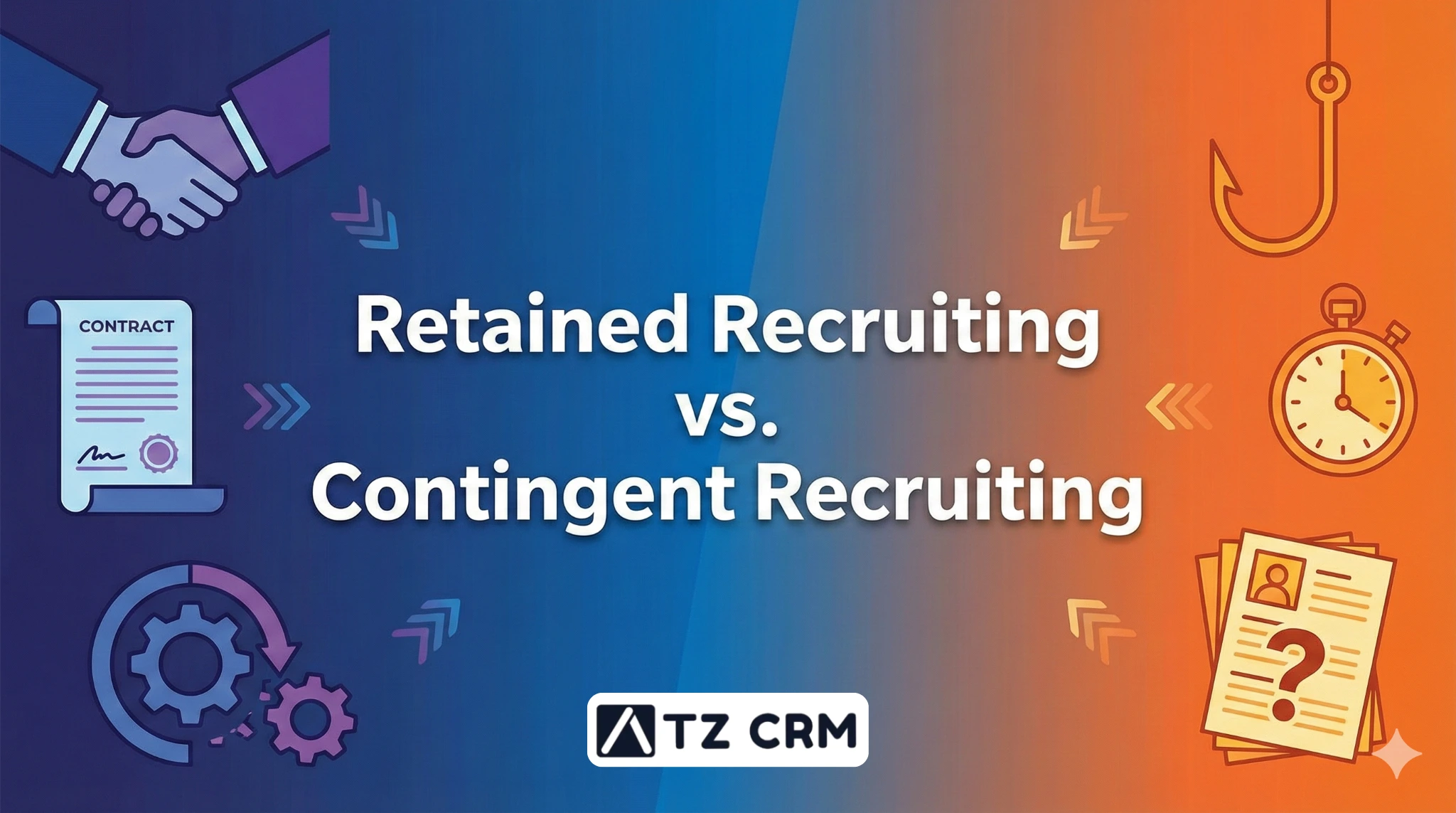
Retained Recruiting vs. Contingent Recruiting: How to Choose?
Struggling to decide between Retained Recruiting vs. Contingent Recruiting? Discover the key differences, costs, and best choices for your hiring needs in this guide.
Quick Answer: Retained vs. Contingent Recruiting: Which Is Right for You?
Quick answer: Retained recruiting (upfront fee, ~95% fill rate) is best for senior/executive roles requiring deep search. Contingent recruiting (success fee only, ~20-30% fill rate) suits high-volume, mid-level hiring where speed matters more than exclusivity. Most agencies offer both models depending on the client need.
Introduction: The Hiring Dilemma
Have you ever felt like hiring a new employee is a bit like online dating?
You swipe through hundreds of profiles, send out generic messages, and hope someone replies. Sometimes you get lucky and find “the one” immediately. Other times, you get “ghosted” right before the first date.
As a recruiter or a business owner, you likely face a massive decision every time a desk opens up: How do we fill this seat?
Do we blast the job out to five different agencies and let them race to find a resume? Or do we pay one partner upfront to scour the earth for the perfect fit? This is the core battle of Retained Recruiting vs. Contingent Recruiting.
Choosing the wrong model doesn’t just waste money; it wastes time. And in the world of recruitment, time is the one resource you can’t get back.
In this comprehensive guide, we are going to break down these two models in simple, human language. No boring jargon, just straight talk. We will help you decide which path is right for your next hire, share some laughs (because recruiters need therapy, or at least a good joke), and show you how modern tools like ATZ CRM can save you from administrative nightmares.
Let’s dive in!
What is Contingent Recruiting? (The “No Win, No Fee” Model)
Imagine you want to sell your house. You tell five different real estate agents, “Whoever brings me a buyer first gets the commission.”
That is Contingent Recruiting in a nutshell.
In this model, the recruitment agency only gets paid if its candidate gets hired. It is often called “Success-Based” recruiting.
How It Works
- Open Competition: You might give the job description to 3 or 4 agencies.
- The Race: Recruiters rush to find active candidates (people looking for jobs right now) on job boards or LinkedIn.
- Payment: You pay a fee (usually 20-25% of the salary for mid to senior roles) only when the candidate starts the job.
The “Why” Behind the Behavior
Because these recruiters are in a race, speed is their currency. They need to get a resume into your inbox before their competitor does. If they spend too much time getting to know one candidate perfectly, another agency might beat them to the punch.
This is why contingent recruiting often feels like a volume game. It’s perfect for when you need to hire quickly for mid-level roles where there are plenty of qualified people available.
Related Read: If you are running a contingent firm, you need speed. Check out our guide on Best RecruiterFlow Alternatives for Recruiting Firms to see tools that help you move faster.
What is Retained Recruiting? (The “Exclusive Partner” Model)
Now, imagine you are hiring a personal architect to build your dream home. You wouldn’t hire five architects and say, “Build me five houses, and I’ll pay for the one I like best.” That would be insane.
Instead, you pay one expert upfront to design it perfectly. That is Retained Recruiting.
How It Works
- Exclusivity: You sign a contract with one search firm. They are the only ones working on this role.
- Upfront Payment: You pay a portion of the fee (a “retainer”) before they even start looking. Usually, it’s split into three parts: 1/3 to start, 1/3 at the interview stage, and 1/3 when the hire is made.
- Deep Search: Because the recruiter has guaranteed income, they don’t rush. They map the entire market, contact “passive” candidates (people who aren’t looking for a job), and vet them deeply.
The “Why” Behind the Behavior
Since the recruiter has already been paid a portion of the fee, they are financially safe. They can afford to spend 3 weeks searching for a “Purple Squirrel” (that rare, perfect candidate). Their reputation depends on quality, not speed.
Related Read: Retained search requires deep organization. Read about the 12 Best Recruitment CRM Software for Recruitment Agencies to manage these complex relationships.
Retained Recruiting vs. Contingent Recruiting: The Core Differences
Let’s simplify this with a comparison table. This will help you visualize the battle of Retained Recruiting vs. Contingent Recruiting.
| Feature | Contingent Recruiting | Retained Recruiting |
|---|---|---|
| Payment | Entirely on success (No win, no fee). | Upfront retainer + Milestones. |
| Exclusivity | Non-exclusive (You can use many agencies). | Exclusive (One agency only). |
| Priority | Medium. (Agencies prioritize easy-to-fill roles). | High. (You have paid, so you are the priority). |
| Speed | Fast resumes, often within 48 hours. | Slower start, but higher quality shortlist (2-4 weeks). |
| Fill Rate | Lower (~20-30% of jobs get filled). | Very High (~90-100% of jobs get filled). |
| Best For | Junior to Mid-level staff. | C-Suite, VPs, Highly Specialized roles. |
The “Ghosting” Reality: Why Fill Rates Matter
Here is a scary statistic for you: Contingent recruiting fill rates often hover around 20%.
Why? Because if a role gets too hard to fill, a contingent recruiter naturally stops working on it. They have to prioritize the “low-hanging fruit” to survive. This leads to the infamous “recruiter ghosting” where you stop hearing from the agency altogether.
On the flip side, Retained Recruiting has a fill rate of nearly 95%. When you pay a retainer, you are essentially buying an insurance policy that the job will get done.
To avoid ghosting candidates yourself, you need automation.
Check out the Best Bullhorn Alternative for Effortless Hiring to see how modern tools automatically keep candidates engaged.
⚠️ Recruiter Break: Let’s Have a Laugh
Recruitment is a stressful job. Let’s take a breather with some classic recruiter humor.
The Reality Check:
Candidate: “If I had to name a weakness, it would probably be pushing myself too much.”
Recruiter: “Okay, and your second biggest?”
Candidate: “I lie about my weaknesses.”
Jokes aside, keeping morale high is important. If you are managing a team, ensure they have tools that make their lives easier, so they don’t burn out.
When to Choose Contingent Recruiting?
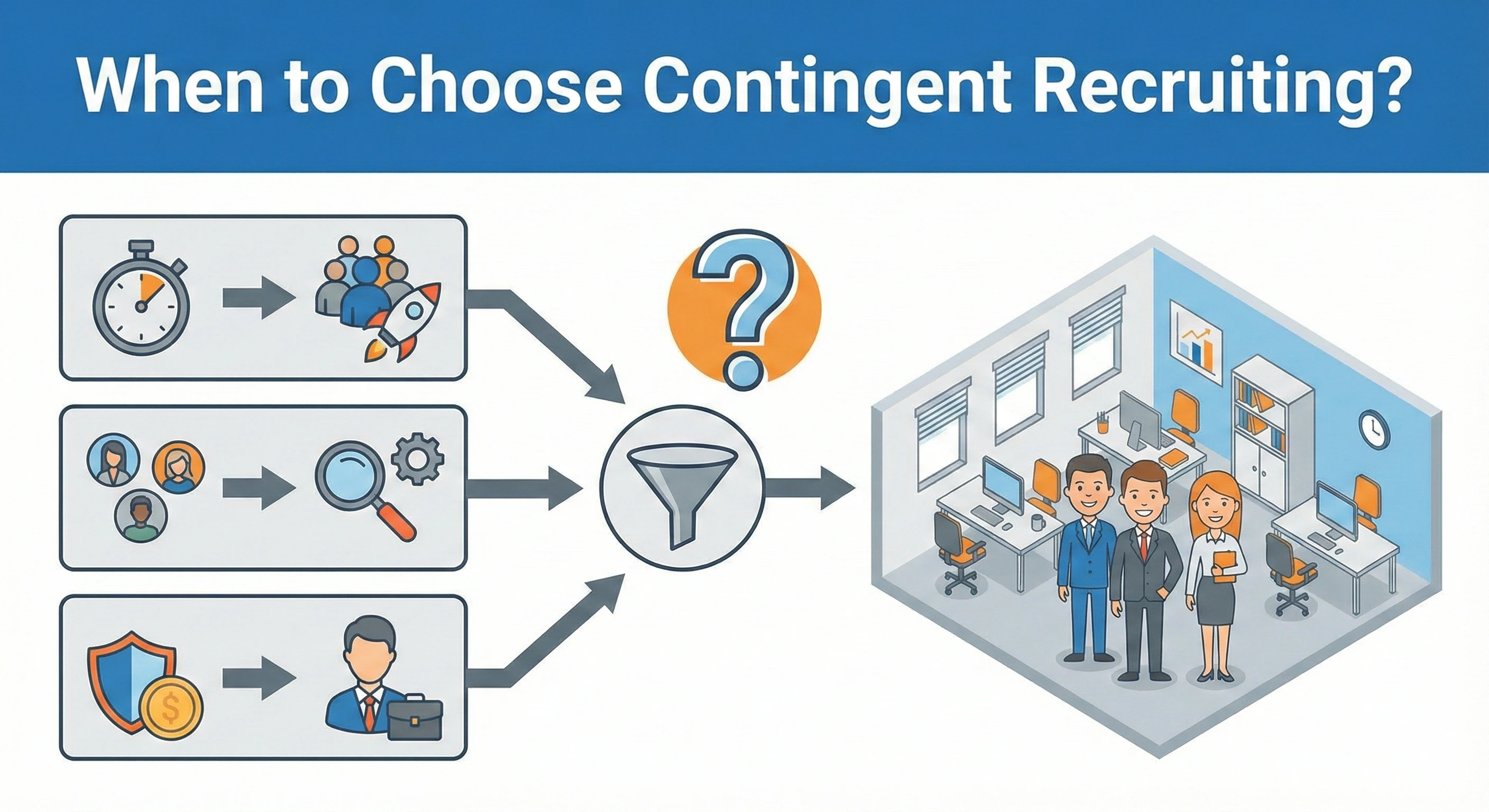 Contingent recruiting gets a bad rap sometimes, but it is the engine of the hiring world. It is fantastic for specific situations.
1. You Need Velocity
If you need 10 sales representatives to start next month, contingent is the way to go. You can engage 3 agencies and have 50 resumes on your desk by Friday.
2. The Skill Set is Common
If you are hiring a standard Java Developer or a Marketing Manager, there are thousands of active candidates. You don’t need a deep “headhunt” to find them; you just need someone to filter the noise.
3. Low Risk
If the hire doesn’t work out, it’s annoying, but it won’t bankrupt the company.
Tip: Even in contingent recruiting, don’t use too many agencies. If a recruiter knows they are competing with 10 other firms, they won’t try very hard. Stick to 2 or 3 trusted partners.
Need to save money on job posts? Check out our guide on 15 Free Job Posting Sites USA-Based Recruiters Can Use to Look for Diverse Talent.
When to Choose Retained Recruiting?
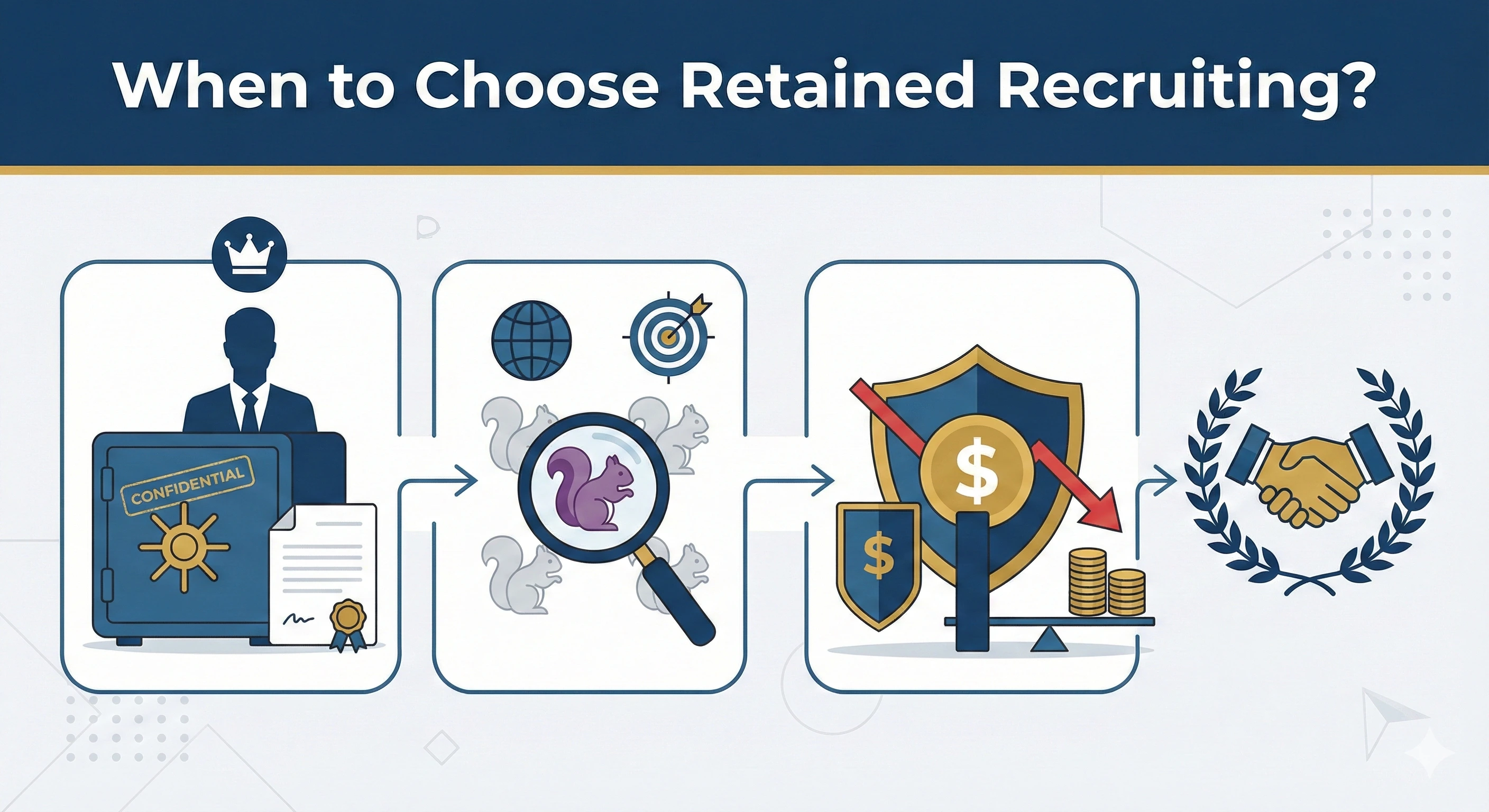 Retained search is the “Special Forces” option. It costs more upfront, but failure is not an option.
1. Executive Leadership
You cannot hire a CEO or CFO through a job board ad. These searches must be confidential. You don’t want the current CEO to know they are being replaced, and you don’t want the stock market to panic. Retained firms offer this discretion.
Related Read: What Is Executive Search? A Complete Guide
2. The “Purple Squirrel”
Do you need a “German-speaking Chemical Engineer willing to relocate to rural Alaska”? Good luck finding that on Indeed. Retained recruiters will map the market and call people working at competitors to convince them to move.
3. The Cost of a Bad Hire is Massive
If a VP of Sales fails, it can cost the company millions in lost revenue. Paying a $50k retainer fee is cheap compared to a $2M loss.
Related Read: 7 ATZ CRM Top Features to Elevate Your Hiring Efficiency
The Decision Matrix: A Simple Guide
Still confused about Retained Recruiting vs. Contingent Recruiting? Use this simple logic flow:
- Is the salary over $150k?
- Yes -> Lean towards Retained.
- No -> Lean towards Contingent.
- Is the search confidential?
- Yes -> Retained (Mandatory).
- No -> Contingent is fine.
- Is the talent pool scarce?
- Yes -> Retained (You need a headhunter).
- No -> Contingent (You need a filter).
Related Read: AI in Recruitment: Your Complete Guide to Candidate Matching
How Technology Bridges the Gap
Whether you choose Retained Recruiting vs. Contingent Recruiting, the tool you use to manage the process makes all the difference.
In the past, Retained firms used heavy databases and Contingent firms used messy spreadsheets. Today, modern AI-driven platforms like ATZ CRM are changing the game for everyone.
For Contingent Recruiters:
Speed is key. ATZ CRM allows you to:
- Parse Resumes with AI: Instantly turn a PDF resume into a searchable profile.
- One-Click Posting: Blast your job to 20+ job boards instantly.
- Automated Sequencing: If a candidate doesn’t reply to your email, the system automatically sends a follow-up email.
Discover effective AI prompts in our post about the 10 Best AI & ChatGPT Prompts Every Recruiter Should Be Using.
For Retained Recruiters:
Quality and transparency are key. ATZ CRM offers:
- AI Notetaker: Auto-records calls and attaches smart summaries directly to candidate profiles.
- True ATS + CRM: Manage both candidates and clients seamlessly in one unified dashboard.
- Flexible Automation: Streamline tasks with native triggers, Zapier, and a robust Open API.
- Native Sequencing: Nurture talent with built-in, automated email campaigns, no external tools needed.
- Smart Sourcing: Instantly parse resumes and rank candidates with smart AI matching.
- Custom Pipelines: Drag-and-drop your workflows to fit your exact process with zero coding.
If you are a small business looking for tools, check out Top 10 Free ATS Tools to Supercharge Recruitment - ATZCRM.
Cost Analysis: Is Retained Actually More Expensive?
A common myth in the Retained Recruiting vs. Contingent Recruiting debate is that retained is always more expensive.
Let’s do the math.
- Contingent Fee: 25% of a $100k salary = $25,000.
- Retained Fee: 30% of a $100k salary = $30,000.
On the surface, Retained is $5k more expensive.
However, consider the “Hidden Costs” of a failed contingent search:
- Time to Hire: A difficult contingent search might drag on for 6 months because recruiters prioritize easier roles. That’s 6 months of lost productivity.
- Bad Hires: Contingent recruiters are incentivized to “sell” you the candidate quickly. Retained recruiters are incentivized to verify the fit. A bad hire costs 2x their annual salary to replace.
If a retained search ensures you get the right person in 3 months versus the wrong person (or no person) in 6 months, the retained model is actually cheaper in the long run.
For more detail, read The Three Biggest Myths About the Contingency Recruitment Model.
Tips for Making the Switch
If you are a recruiter reading this, you might be thinking, “I want to stop racing and start getting paid upfront!”
Moving from Contingent to Retained is a great career move. Here is how to start:
- Ask for a “Container”: Instead of a full retainer, ask the client for a small upfront commitment (e.g., $3,000) to prioritize their search. It’s a baby step toward retained.
- Show Your Work: Use a CRM like ATZ CRM to show the client your data. “I have mapped 150 candidates at these 10 competitors.” This data justifies the fee.
- Specialization: It is hard to get a retainer for “General Staffing.” It is easy to get a retainer for “Cybersecurity Experts in Fintech.” Pick a niche.
Compare top tools in our guide The Ultimate Recruit CRM Showdown: Best ATS Ranked.
Conclusion: Choose Your Weapon Wisely
The battle of Retained Recruiting vs. Contingent Recruiting isn’t about one being “better” than the other. It is about choosing the right tool for the job.
You wouldn’t use a hammer to cut a steak, and you wouldn’t use a scalpel to hammer a nail.
- Use Contingent for speed, volume, and mid-level roles.
- Use Retained for precision, confidentiality, and executive leadership.
Whichever model you choose, remember that the recruitment industry is evolving. The days of messy spreadsheets and “spray and pray” emails are over. To win the war for talent, you need intelligence, automation, and a killer CRM.
🚀 Ready to Upgrade Your Recruitment Game?
Whether you are running a high-speed contingent agency or a white-glove retained firm, ATZ CRM adapts to your workflow.
- Automate your outreach so you never ghost a candidate.
- Impress clients with dedicated portals.
- Close more deals with AI-driven matching.
Migrating to ATZ CRM is 100% free and completely hands-off for you. Our expert team takes care of the entire transfer, ensuring all your candidate, client, and job data moves seamlessly from your old ATS, so you’re ready to go on day one.
Stop chasing resumes and start building relationships.
Quick Decision Guide: Which Model Should You Choose?
| Situation | Best Model |
|---|---|
| Filling a C-suite or VP-level role | ✅ Retained |
| High-volume junior or mid-level hiring | ✅ Contingent |
| Confidential search (replacing current employee) | ✅ Retained |
| You need candidates within 2 weeks | ✅ Contingent |
| Hard-to-fill niche/technical role | ✅ Retained |
| Budget is tight and success-fee model preferred | ✅ Contingent |
| You want guaranteed delivery and deep market coverage | ✅ Retained |
| Testing a new staffing partner | ✅ Contingent |
FAQs
1. Is Retained Recruiting vs. Contingent Recruiting cheaper?
Generally, Contingent Recruiting has a lower percentage fee (20-25%) compared to Retained (30-35%). However, for critical roles, the cost of a vacant seat or a bad hire can make Contingent more expensive in the long run due to lower success rates.
2. Can I use both models at the same time?
Yes, but not for the same job. You can use Contingent for your sales team hiring and Retained for your VP of Engineering. Never use both on the same role; retained firms require exclusivity.
3. Why do recruiters “ghost” in the contingent model?
Since contingent recruiters only get paid if they win the “race,” they must prioritize easy-to-fill roles. If your role becomes difficult, they often silently move on to other clients where they have a better chance of earning a fee.
4. What is a “Container” search?
A “Container” is a hybrid model. The client pays a small upfront fee (e.g., $3k-$5k) to show commitment, but the rest of the fee is contingent on success. It’s a great middle ground between Retained Recruiting vs. Contingent Recruiting.
5. How does ATZ CRM help with Retained Search?
ATZ CRM offers features like Client Portals, which allow retained recruiters to share “Long Lists” and “Short Lists” transparently with clients. This transparency is essential for justifying the upfront retainer fee.
Blog Summary:
The core difference between Contingent Recruiting (no win, no fee) and Retained Recruiting (exclusive, upfront partnership)
How each model works, why recruiters behave differently in each, and what that means for hiring outcomes
Key comparison points: payment structure, exclusivity, speed, fill rates, and ideal use cases
Why contingent recruiting often leads to low fill rates (20–30%) and occasional recruiter ghosting
Why retained search offers higher quality, deeper market mapping, passive talent outreach, and 90–100% fill rates
When to choose each model:
Contingent → speed, volume, common roles, low-risk hiring
Retained → executive roles, confidential searches, rare skill sets, costly hires
A simple decision framework using salary, confidentiality, and talent scarcity
How modern tools like ATZ CRM support both models with AI sourcing, automation, sequencing, and client portals
Cost breakdown: Why retained isn’t always more expensive when you factor in time-to-hire and risk of bad hires
Tips for recruiters shifting from contingent to retained, including container searches, specialization, and data-driven client proof
Final takeaway: Choose contingent for speed, retained for precision, and use smart tech like ATZ CRM to win the talent war