Last Updated: · ATZ CRM Editorial Team · Recruitment · 17 min read
What Is Executive Search? A Complete Guide 2026
What is Executive Search? The 2026 guide to hiring top leaders. Learn retained vs. contingent models and master the 10-step process to find the best talent.

Quick Answer: What Is Executive Search?
Quick answer: Executive search (headhunting) is a specialized recruitment service for C-suite, VP, and senior leadership roles. Unlike general recruiting, executive search firms proactively target the 70% of high-level candidates who are employed and not actively job seeking — using confidential outreach, market mapping, and deep relationship networks.
Blog Summary:
Here is a snapshot of the strategic insights covered in this guide on Executive Search:
What is Executive Search?
It is a specialized service (“headhunting”) targeting the 70% of the market who are “passive” candidates—leaders currently employed, happy, and not applying for jobs.
- The Difference: Standard recruitment is “fishing with a net” (waiting for applicants). Executive search is “spear-fishing” (hunting specific, invisible talent).
The 3 Engagement Models
- Retained (The Standard): Client pays an upfront fee. The recruiter is paid for the process and quality. Essential for C-Suite/Confidential roles.
- Contingent (The Race): “No win, no fee.” Recruiters prioritize speed over quality. Risky for executive roles as recruiters may abandon difficult searches.
- Container (The 2026 Hybrid): A small upfront engagement fee (e.g., $3k) to guarantee priority service without the full cost of a retainer.
The Process & Technology
- Deep Vetting: Unlike standard recruiting, the 10-step process includes psychometric testing, deep market mapping, and post-hire integration to ensure long-term fit.
- Privacy is King: You cannot use a standard ATS. Executive search requires a CRM with strict privacy controls to protect the identity of high-profile candidates.
Top Trends for 2026
- Fractional Executives: Companies are cutting costs by hiring part-time C-suite leaders (e.g., a Fractional CFO for 2 days/week).
- Skills Over Pedigree: A shift away from Ivy League degrees toward “skills-based hiring,” prioritizing agility and AI adaptability.
- AI Co-Pilots: Using AI to reduce bias and source candidates while keeping humans in charge of the relationship.
Introduction: How Do You Hire a CEO Who Isn’t Looking for a Job?
As a recruiter, you know the drill: post a job, wait for applications, and interview the best people. But what happens when you need to hire a CEO, a VP, or a specialized Director?
Here is the catch: The best leaders are usually not looking for work. They are already employed, happy, and paid well. They are not scrolling through job boards on a Monday morning.
So, how do you find them?
Enter Executive Search. Also known as “headhunting,” this is the special forces of recruitment. It is not about gathering resumes; it is about hunting for specific, invisible talent.
In this guide, we will break down exactly what executive search is, how it works, and why it is the secret weapon for companies seeking rapid growth.
What Is Executive Search? (And Why It’s Not Just “Recruiting”)
At its core, executive search is a specialized service used to find senior-level executives (like CEO, CFO, CTO) and board members. It is different because it is proactive. You don’t wait for candidates to come to you; you go to them.
Why is it a big deal? Hiring a bad executive is expensive. Really expensive. Studies show a bad leadership hire can cost a company up to 10 times the employee’s salary in wasted time and bad decisions. Executive search is the insurance policy against making that mistake.
What is an Executive “Headhunter”?
Imagine a company is a sports team. If they need a new player, they might put an ad in the paper. But if they need a new Captain or Coach, they can’t just wait for someone to apply. They need the absolute best person, even if that person is currently playing for another team.
That is where the Headhunter comes in. They are like high-level detectives and matchmakers combined.
How is this different from normal hiring?
Standard recruiters often look at a pile of resumes from people looking for work. A Headhunter does the opposite. Here is their process, broken down simply:
- Detective Work (Deep Research): Instead of waiting for resumes, the headhunter goes out and hunts. They look at the whole market to find the perfect person, even if that person isn’t looking for a new job. They are looking for a “hidden gem.”
- The Deep Dive (Assessment): It’s not just about “can you do the job?” It is about “who are you?” The headhunter spends hours talking to candidates to understand their personality and leadership style.
Think of it this way: A typical recruiter validates that you have the ingredients and the recipe; a headhunter determines if you can save the meal when the oven breaks down.
- The “Vibe” Check (Cultural Fit): This is the most important part. A candidate might be a genius, but if they are mean or don’t share the company’s values, they will fail. The headhunter ensures the new leader fits into the company “family” perfectly.
The Bottom Line: This isn’t a one-time transaction, like buying a car. It is a partnership. The headhunter stays involved to make sure the marriage between the company and the new leader works out for the long run.
Executive Search vs. Standard Recruitment: What’s the Difference?
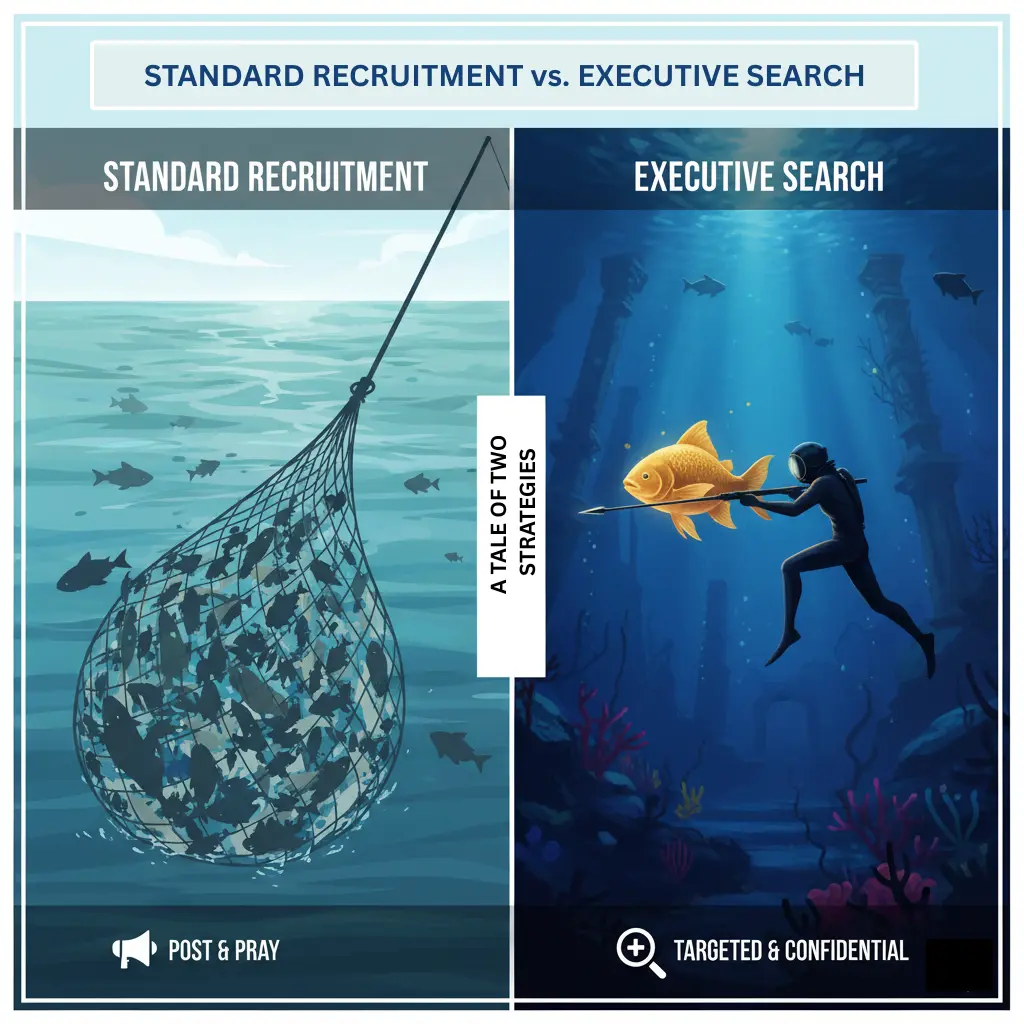
The most common mistake is confusing executive search with standard, high-volume recruitment. They are fundamentally different.
- Standard Recruitment is often reactive. A job is posted, and recruiters sift through active candidates who apply.
- Executive Search is proactive. The search firm targets the 70% of the market that is passive high-performers who are not looking for new roles.
Key Difference: Confidentiality. Imagine a company wants to replace its current CEO. They can’t post that job on LinkedIn! It would cause panic among investors and staff. Executive search happens in the shadows. It is private, confidential, and discreet.
In Short: Standard recruitment is fishing with a net; you post a job and see what you catch. Executive search is spear-fishing. It’s a targeted, patient, and precise hunt for one specific leader.
When to Post vs. When to Hunt
A broad, open, and diverse hiring strategy is crucial for most roles. For building a healthy, diverse talent pipeline at the junior-to-mid level, casting a wide net and leveraging wide-reach platforms is key.
For more on this, see our guide to 15 Free Job Posting Sites USA-Based Recruiters Can Use
However, a public job posting will fail when:
- The role is C-suite or senior-level.
- The search must be confidential.
- The required skillset is exceptionally rare.
- You are targeting a specific leader at a competitor.
This is when you must engage an executive search partner.
The Business Models: Retained, Contingent, & Container (The One You Must Get Right)
Before you begin an executive search, you must understand the two primary business models. The model you choose is the single most important factor, as it directly dictates the recruiter’s behavior and aligns (or misaligns) their incentives with your goals.
1. The Contingent Model (The Race)
This is the “No Win, No Fee” model.
- How it works: You tell 5 different recruiting agencies about the job. The first one to send you a winning resume gets paid.
- The problem: Recruiters are in a rush. They want to be first, not necessarily the best. If the search gets hard, they might give up because they aren’t guaranteed payment.
- Best for: Mid-level roles or general staff.
2. The Retained Model (The Partnership)
This is the standard for executive search.
- How it works: You pay the search firm an upfront fee (a “retainer”) to work exclusively for you. They are paid for their time and expertise, not just the final result.
- The benefit: Because they are already paid, they take their time. They map the entire market and vet every single option to find the perfect match.
- Best for: C-Suite, VPs, and confidential roles.
The payment model dictates everything. A contingent recruiter is in a high-stakes race against other firms. They are not paid for their time, only for their result. If a search is difficult, time-consuming, or highly specialized, the contingent recruiter will rationally abandon it to focus on easier-to-fill roles where they have a higher chance of getting paid.
A retained recruiter, having been paid for their process upfront, has the exact opposite incentive. Their incentive is quality and completion. This guarantee removes the need for speed and aligns them with the client’s goal: find the best person, no matter how long it takes. This is why using a contingent model for a high-level executive search is a fundamental strategic error.
Table: Retained vs. Contingent Search
| Feature | Retained Executive Search (The Partnership) | Contingent Recruitment (The Race) |
|---|---|---|
| Payment Model | Upfront fee + installments (Paid for process & expertise) | Success fee only (Paid for placement) |
| Exclusivity | Exclusive partnership with one firm | Non-exclusive; client may use multiple firms |
| Typical Roles | C-Suite, VP, Director, Specialized Leaders | Junior, Mid-Level, Generalist Roles |
| Candidate Pool | Deep market map; targets passive candidates | Primarily active candidates; database-driven |
| Process Depth | Comprehensive (10-step), consultative, high-touch | Fast, transactional, “resume-forwarding” |
| Recruiter Incentive | Quality & Fit: Find the best candidate. | Speed & Volume: Be the first candidate. |
| Success Guarantee | High; firms guarantee the process. | Low; recruiters abandon hard-to-fill jobs |
For more, explore: The Difference Between Retained and Contingent Recruiting.
3. The Container Model (The Hybrid)
Also known as “Engaged Search,” this model is gaining massive popularity in 2026 as a bridge between the two.
- How it works: You pay a small upfront engagement fee (e.g., $3,000 - $5,000 or a percentage of the final fee) to start the search. This “container” fee guarantees priority service. The remainder of the fee is paid only upon a successful hire.
- The Incentive: It creates “skin in the game” for both sides. The client shows commitment, so the recruiter prioritizes the role over their contingent work, but the client avoids the full financial risk of a large retainer.
- Best for: Senior Director, VP-level roles, or hard-to-fill niche positions where a full retainer feels like “overkill” but a contingent search isn’t producing results.
Managing the High-Touch Process
Whether retained or contingent, managing these high-value, long-term relationships with clients and candidates is impossible on a spreadsheet. A robust Recruitment CRM like ATZ CRM is essential for tracking every interaction, confidential note, and relationship history, ensuring a professional and seamless experience. A system designed specifically for this is the core of a successful agency.
Related Read: 12 Best Recruitment CRM Software for Recruitment Agencies
The 10-Step Executive Search Process: A Complete Playbook
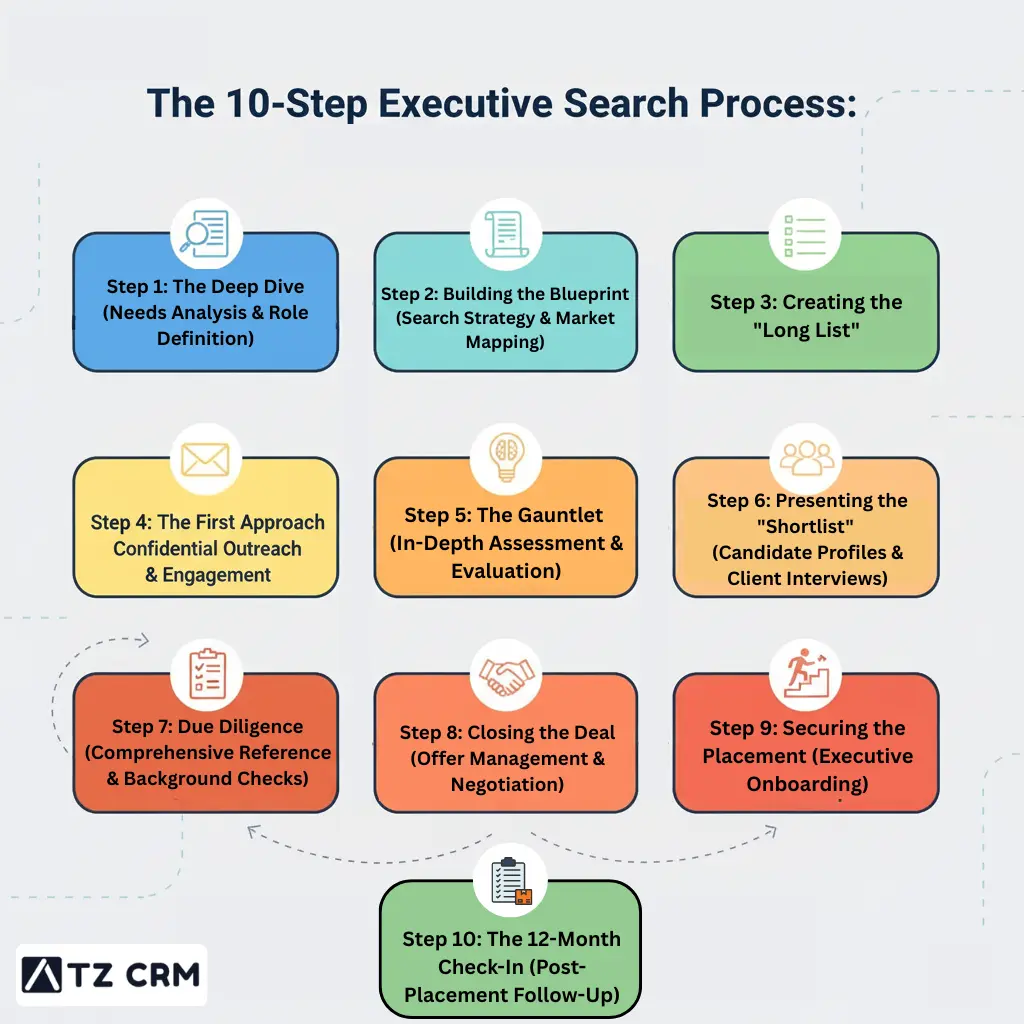
The retained executive search methodology is not an art; it’s a science. It is a meticulous, 10-step framework designed to de-risk a company’s multi-million dollar investment in a single leader. While a bad executive hire can be catastrophic, each of these steps is a mitigation strategy designed to neutralize a potential point of failure.
Step 1: The Deep Dive (Needs Analysis & Role Definition)
This is the foundation. It’s not just “getting the job description.” It’s a series of in-depth consultations with all key stakeholders, board members, C-suite executives, and HR leaders to understand the true need.
The goal is to define:
The strategic objectives of the role.
The required skills, experience, and leadership competencies.
Company culture, leadership gaps, and the “ideal candidate profile”.
Compensation benchmarks and expectations.
Recruiter tip: One of the most common reasons an executive search fails is “no internal consensus” before the search begins. This deep-dive step prevents that failure by de-risking misalignment from day one.
Step 2: Building the Blueprint (Search Strategy & Market Mapping)
Based on the deep dive, the search firm develops a tailored search strategy and a realistic timeline. A core component of this is Market Mapping. This is a systematic process of identifying “feeder companies,” target industries, and competitors. The firm maps its organizational structures to build a comprehensive, high-level map of potential candidates before any outreach is made.
Tech Tip: You can use tools like ATZ CRM to visualize these talent pools and organize candidates by company structure, ensuring no stone is left unturned.
A clear, visual “Kanban view” creates a system your team will instantly understand. You can customize every aspect of your workflow to fit your specific recruitment processes.
Step 3: Creating the “Long List” (Initial Sourcing & Research)
This is the “headhunting” phase. The research team uses the market map, proprietary databases, and deep industry networks to generate a “Long List” of 20-30+ qualified potential candidates. This list is designed to de-risk a shallow talent pool by going far beyond the obvious candidates, intentionally including emerging leaders, cross-industry talent, and diverse perspectives.
Step 4: The First Approach (Confidential Outreach & Engagement)
This is the most delicate step. The consultant makes a discreet, confidential, and highly personalized approach to the passive candidates on the long list. Instead of aggressively marketing a position, the focus is on initiating a high-level professional exchange. They present a compelling value proposition, build rapport, and gauge initial interest, all while protecting the confidentiality of both the client and the candidate.
Step 5: The Gauntlet (In-Depth Assessment & Evaluation)
Candidates who express interest move to a rigorous, multi-stage assessment. This goes far beyond a resume review and is designed to de-risk skill and culture gaps.
It includes:
- In-depth, structured behavioral interviews.
- Competency and psychometric assessments.
- Holistic evaluation of leadership style, strategic thinking, and cultural fit.
Step 6: Presenting the “Shortlist” (Candidate Profiles & Client Interviews)
The search firm narrows the long list down to a “Shortlist” of the 3-5 most qualified, interested, and well-vetted candidates. They present these candidates to the client with a detailed, confidential profile for each, outlining their strengths, weaknesses, potential concerns, and overall fit. The firm then partners with the client to facilitate all interview scheduling and logistics.
Step 7: Due Diligence (Comprehensive Reference & Background Checks)
This is a critical step to de-risk hidden personality flaws or falsified histories. The search firm conducts thorough, 360-degree reference checks. This goes far beyond the candidate’s provided list and includes confidential, off-list sources: former colleagues, board members, direct reports, and industry peers. This is paired with comprehensive background verification (education, employment history, criminal) to ensure absolute integrity.
Step 8: Closing the Deal (Offer Management & Negotiation)
The consultant acts as a neutral, third-party mediator during the sensitive offer and negotiation phase. They leverage their position of trust to manage compensation expectations, handle counter-offers, and build a “compelling offer construction” to ensure a “yes”, from the chosen candidate.
Step 9: Securing the Placement (Executive Onboarding)
The job isn’t done when the offer is signed. Top firms assist with the executive’s transition and onboarding program. This de-risks early integration failure by ensuring the new leader is set up for success from day one, helping them navigate the company’s culture and politics to secure early wins.
Step 10: The 12-Month Check-In (Post-Placement Follow-Up)
True retained executive search firms conduct post-placement follow-ups with both the client and the candidate (e.g., at 3, 6, and 12 months). This reinforces the “partnership” model and ensures long-term fit, and provides valuable feedback for future searches. The client is not just paying for a list of names; they are paying for this entire risk-management framework.
The Technology Hub for Elite Recruiters
Elite executive search firms need a centralized technology hub to manage the entire talent pipeline, from first contact to post-placement follow-up.
This system must provide a 360-degree view of all client and candidate relationships. For a comparison of top platforms, see The Ultimate Recruit CRM Showdown: Best ATS Ranked.
This technology is no longer just for enterprise firms. Powerful, accessible tools are available for boutique firms and small businesses.
Related Read: Top 10 Free ATS Tools to Supercharge Recruitment - ATZCRM
- Many firms are upgrading from older, clunky systems to gain a competitive edge. A modern, AI-powered platform is often the best Bullhorn Alternative or one of several RecruiterFlow Alternatives.
The Future of Executive Search: 4 Unstoppable Trends
The executive search landscape is rapidly changing due to four converging trends that redefine top talent and sourcing methods.
Trend 1: The AI Co-Pilot
- AI will not replace recruiters but act as an essential “Co-Pilot,” enhancing human judgment.
- It is used for Smarter Sourcing (analyzing vast datasets for non-obvious candidates) and efficiency, Predictive Analytics (forecasting performance), Bias Reduction (focusing on skills over demographics), and Efficiency (streamlining tasks like scheduling).
- AI amplifies human productivity.
- The Impact of AI on productivity is transformative: As noted in a McKinsey report on AI in the workplace, AI has the potential to amplify human agency and unlock new levels of productivity. Recruiters can start using this today.
For practical applications, see these best AI & ChatGPT Prompts for Recruiters.
Trend 2: The Rise of the “Fractional” Executive
This is the biggest structural shift in the 2025 leadership market. Companies—especially startups and scale-ups—are moving away from the rigid full-time C-suite model. Instead, they are hiring Fractional Executives (e.g., a Fractional CFO, CMO, or CTO) who work on a retainer basis for a fraction of the cost.
The Driver: According to Deloitte projections, by the end of 2025, 35% of U.S. companies will employ at least one fractional leader by late 2025.
The Benefit: It allows smaller companies to access world-class strategy—often from veterans with 15+ years of experience—without the $300k+ annual salary burden. A fractional leader might cost $8,000/month versus $25,000/month for a full-time hire.
The Impact: For recruiters, this means building a new kind of talent pool: agile leaders who can manage multiple portfolios and deliver high-impact strategy in just 1-2 days a week.
Trend 3: DEI Moves to a Core Business Imperative
Diversity, Equity, and Inclusion (DEI) is now a critical business driver, leading to greater innovation and profitability. Despite this, an “inclusion gap” persists. Executive search firms must proactively build diverse candidate pools and challenge client biases, such as overly precise criteria or masculine-coded language, to tap into all talent pools.
Recent data reveals a significant “inclusion gap,” with only 25% of executives believing their workplace is truly inclusive. This puts immense pressure on executive search firms, which have historically (and often unconsciously) relied on homogenous networks.
- Challenge Bias: Expand candidate pools by actively pushing back on masculine-coded language and overly rigid search criteria that limit diversity.
- Follow the Trends: As noted in the 2025 Talent Trends report, tapping into diverse talent is no longer optional—it is critical for filling roles.
Trend 4: The Rise of Skills-Based Hiring Over Pedigree
In a tough economic climate, companies prioritize results and verifiable Skills-Based Hiring over traditional degrees or “pedigree.”
As Forbes notes regarding C-suite hiring in 2025, the single most valuable trait is agility, the ability to embrace AI, cut costs, and pivot fast—is the most valued C-suite trait. This shift opens the door for brilliant “outsiders” who possess the necessary operational skills, regardless of their educational background.
These trends form a new, winning strategy:
The Goal is Diverse Leadership (DEI); The Method is Skills-Based Hiring; The Tool is AI to execute the strategy at scale and remove bias.
⚠️ Joke Alert!
Hiring Manager: “I’m looking for a candidate with 20 years of experience in AI-driven executive search, who is also a cultural fit, and is willing to accept a 30% pay cut.”
Recruiter: “So, you’re looking for an alien?”
Why You Need a CRM for Executive Search
Managing this process is hard. You are dealing with highly sensitive data, private notes, and relationships that last for years. You cannot do this on a spreadsheet or a basic free tool. You need a specialized Recruitment CRM (Customer Relationship Management) system.
Why?
- Privacy: You need to hide the names of confidential candidates so other team members don’t accidentally see them.
- Relationships: An executive you place today might hire you to find their team tomorrow. You need to track that long-term relationship.
- Market Mapping: You need to visualize the talent pool at target companies.
Meet ATZ CRM
This is where ATZ CRM shines. It is designed to handle the complexity of high-level search. It helps you:
- Keep confidential profiles secure.
- Map out candidates from LinkedIn directly into your system.
- Track every call, email, and coffee meeting in one place.
If you are still using messy spreadsheets or clunky old software, you are slowing yourself down.
🚀 Ready to upgrade?
When you switch to ATZ CRM, we offer 100% FREE MIGRATION from your old ATS. Our dedicated team handles the entire process, ensuring all your candidates, clients, and job data are transferred seamlessly, so you can start working from day one without missing a beat.
Book a demo now and see the difference for yourself!
FAQs
1. What is the main difference between executive search and contingency recruitment?
Executive (retained) search is an exclusive, upfront-fee partnership for senior roles, while contingency is a non-exclusive “success-fee” race for junior-to-mid-level roles.
2. How long does a typical executive search take?
A typical retained executive search takes 2 to 6 months from the initial consultation to the candidate’s start date, depending on the role’s complexity.
3. Why is executive search so expensive?
The fee (typically 30-33% of first-year compensation) covers a guaranteed, consultative process to de-risk a high-stakes executive hiring decision, not just a resume.
4. What is a “passive candidate” and why are they so important?
A passive candidate is a top-performing professional who is not actively looking for a job; they represent the majority of the top-tier talent market and must be proactively headhunted.
5. Can I use an ATS/CRM for a confidential executive search?
Yes, but you need one with specific privacy controls. ATZ CRM allows you to mark jobs and candidates as confidential, ensuring sensitive data is restricted only to authorized users.