 EN
EN DE
DE ES
ES FR
FR NL
NL PT
PTLast Updated: · ATZ CRM Editorial Team · Recruiting · 8 min read
7 Recruitment Data Management Tips Every Recruiter Should Know
Learn practical strategies for managing candidate information effectively, from centralising databases to automating data capture, to improve recruiter productivity and hiring performance.
Quick Answer: Effective recruitment data management requires seven key strategies: centralise your candidate database, standardise data fields, use tags for segmentation, automate data capture, track candidate interaction history, use reporting to guide decisions, and maintain regular data hygiene. These practices transform candidate information into a strategic hiring asset that improves time-to-fill and placement rates.
Recruiting teams rarely struggle because they lack candidates. The real challenge often lies in how candidate information is stored, organised, and used across the hiring lifecycle. When recruiters’ notes live in spreadsheets, resumes sit in inboxes, and candidate histories disappear between hiring cycles, opportunities are lost.
This is where Recruitment Data Management becomes critical. Poor data organisation slows sourcing, weakens candidate engagement, and makes it difficult for recruiters to track pipeline progress. Over time, it directly impacts time-to-fill, placement rates, and recruiter productivity.
For recruiters, staffing agencies, executive search firms, and HR teams managing dozens of open roles, effective candidate information management is no longer just an administrative task. It is a strategic capability that enables data-driven recruiting, improves visibility across the hiring process, and turns candidate data into a long-term talent asset.
This guide breaks down practical strategies recruiters can use to manage hiring data more effectively, strengthen candidate pipelines, and improve overall recruitment workflow management.
Why Recruitment Data Management Matters for Modern Recruiting Teams
Every hiring process generates a significant amount of information:
- Candidate resumes
- Interview feedback
- Skill assessments
- Communication history
- Hiring stage updates
- Offer details
Without structured hiring data management, these details become fragmented across emails, documents, and disconnected tools.
This creates several operational problems:
- Recruiters cannot easily find previously screened candidates
- Hiring managers lack clear pipeline visibility
- Duplicate candidate records appear in the system
- Reporting on hiring performance becomes difficult
A structured hiring process improves both consistency and hiring accuracy. Research and industry guidance on structured recruitment frameworks show that when organisations define clear candidate criteria, standardise interviews, and use consistent evaluation methods, recruiters make more reliable hiring decisions and maintain better visibility across the recruitment pipeline.
In recruiting environments where speed and precision matter, strong recruitment workflow management ensures candidate data remains accessible, organised, and actionable across the entire hiring process.
Related Read: International Recruiting: How to Access the Top 1% of Global Talent
What Is Recruitment Data Management?
Recruitment Data Management refers to the process of collecting, organising, storing, and analysing candidate information throughout the hiring lifecycle.
This includes managing data across multiple recruitment stages:
- Candidate sourcing
- Application tracking
- Screening and interviews
- Offer management
- Candidate relationship nurturing
A well-structured candidate database allows recruiters to track candidate interactions over time, maintain accurate records, and build long-term talent pipelines.
When supported by a recruiting CRM or talent acquisition software, this system enables recruiters to move beyond manual tracking and adopt a more strategic approach to candidate lifecycle tracking.
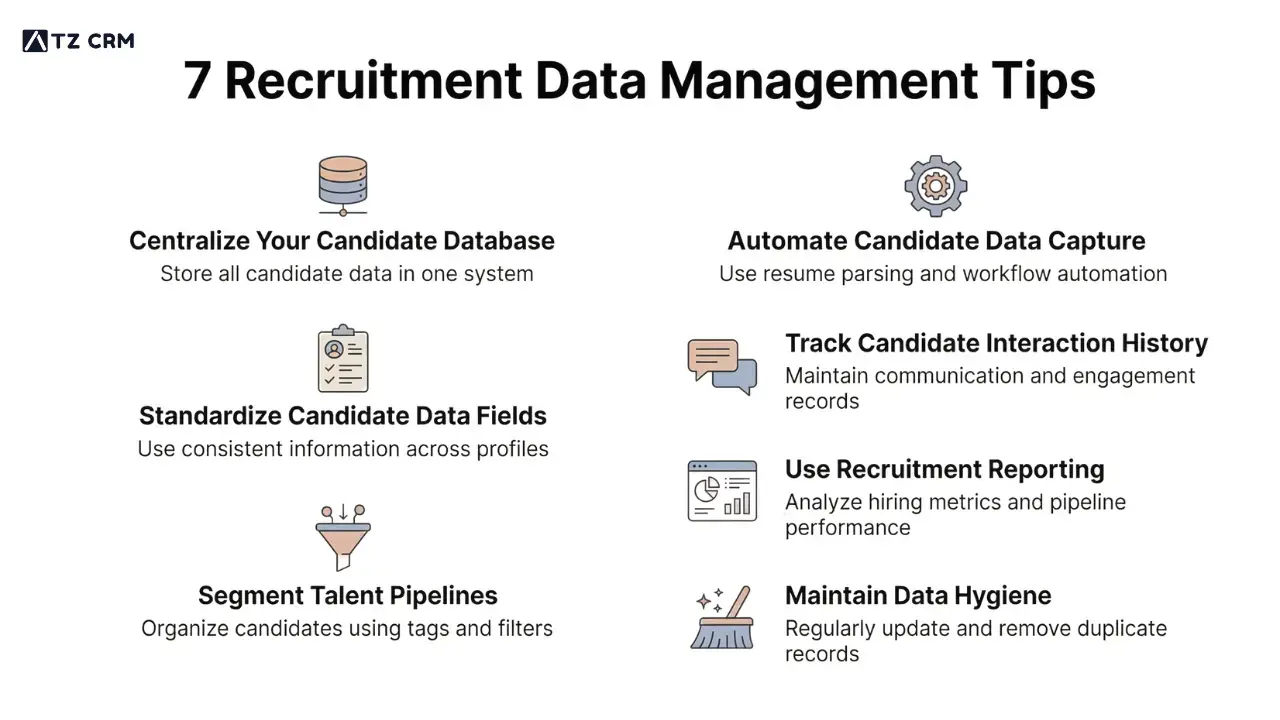
7 Recruitment Data Management Tips Every Recruiter Should Know
Effective Recruitment Data Management requires more than storing resumes. It involves structuring candidate information in ways that improve recruiter decision-making and workflow efficiency.
Below are seven practical strategies recruiters can implement.
1. Centralise Your Candidate Database
One of the most common issues in recruiting teams is fragmented candidate data.
Recruiters often manage information across:
- Spreadsheets
- Email folders
- Shared documents
- Disconnected ATS tools
Centralising all candidate data into a single candidate database improves accessibility and eliminates duplication.
A unified system allows recruiters to:
- Search candidate profiles quickly
- Review past application history
- Track interview feedback in one place
- Maintain consistent candidate records
Platforms that combine ATS capabilities with a recruiting CRM make it easier to maintain a comprehensive view of the candidate lifecycle.
2. Standardise Candidate Data Fields
Many recruiting teams collect inconsistent candidate information. One recruiter may capture skills and certifications, while another records only contact details.
Standardised data fields improve candidate information management and enable better reporting.
Examples of standardised fields include:
- Core technical skills
- Years of experience
- Location preferences
- Salary expectations
- Industry specialization
Consistent data structure improves searchability within the recruitment technology stack and helps recruiters identify suitable candidates more quickly.
3. Use Tags and Segmentation to Build Talent Pipelines
A well-organised database should function as a living talent pipeline, not just a record of past applicants.
Recruiters can segment candidates using tags such as:
- Skill category
- Industry experience
- Location
- Hiring stage
- Availability
Segmentation enables recruiters to quickly build shortlists when new roles open.
For example, when a new engineering position becomes available, recruiters can instantly filter candidates tagged with relevant technologies instead of restarting the sourcing process.
This approach strengthens candidate lifecycle tracking and improves long-term pipeline value.
4. Automate Candidate Data Capture
Manual data entry slows recruiters down and increases the risk of incomplete records.
Modern talent acquisition software reduces this friction through automation features such as:
- Resume parsing
- Automated candidate profile creation
- Email synchronization
- Interview feedback collection
Automation ensures critical data points are captured consistently while allowing recruiters to focus on higher-value activities such as candidate engagement and hiring strategy.
It also improves the overall efficiency of recruitment workflow management.
5. Track Candidate Interaction History
Recruiters frequently re-engage candidates months or even years after initial contact. Without proper interaction tracking, important context can be lost.
Tracking candidate history allows recruiters to see:
- Previous interview outcomes
- Communication history
- Role preferences
- Feedback from hiring managers
This insight improves candidate experience and strengthens long-term relationships.
Candidate engagement and clear communication significantly influence hiring outcomes. Research from PwC indicates that around 60% of candidates drop out of hiring processes due to delays or poor communication, highlighting how recruiter responsiveness directly impacts candidate engagement and employer brand perception.
Maintaining detailed candidate interaction records supports stronger engagement strategies and improves pipeline continuity.
6. Use Recruitment Reporting to Guide Hiring Decisions
Recruitment data becomes truly valuable when it supports strategic decision-making.
Effective recruitment reporting allows teams to measure key hiring metrics such as:
- Time-to-fill
- Interview-to-offer ratio
- Source-of-hire performance
- Candidate conversion rates
When recruiters understand these metrics, they can identify bottlenecks in the hiring process and adjust sourcing strategies accordingly.
Strong acquisition analytics also helps leadership teams forecast hiring needs and allocate recruiting resources more effectively.
7. Maintain Data Hygiene Regularly
Even well-structured databases require maintenance.
Over time, candidate records can become outdated due to:
- Role changes
- Outdated contact information
- Duplicate profiles
Regular data audits help maintain database quality.
Recommended practices include:
- Merging duplicate candidate profiles
- Updating outdated candidate information
- Archiving inactive records
- Validating candidate contact details
Clean data improves search accuracy and strengthens the reliability of data-driven recruiting insights.
Related Read: Recruitment Strategies for Agencies: Proven Tactics to Attract Better Candidates
How Poor Recruitment Data Management Slows Hiring
Disorganised candidate data does more than create administrative frustration. It directly impacts hiring performance.
Common consequences include:
- Recruiters repeating sourcing efforts
- Hiring managers lacking pipeline visibility
- Delayed interview scheduling
- Missed opportunities with previously qualified candidates
When candidate information is difficult to access, recruiters spend more time searching for data instead of engaging with talent.
Over time, this inefficiency slows hiring cycles and reduces recruiter productivity.
Related Read: 29 Best Tools for Remote Recruitment to Skyrocket Hiring
Manual Tracking vs System-Driven Recruitment Data Management
Many recruiting teams begin with manual processes before transitioning to technology-driven systems.
The difference between these approaches becomes more noticeable as hiring volume increases.
| Manual Data Tracking | System-Driven Data Management |
|---|---|
| Candidate data stored in spreadsheets | Centralised candidate database |
| Limited search capabilities | Advanced candidate search filters |
| Difficult collaboration between recruiters | Shared candidate profiles and notes |
| Minimal reporting capabilities | Real-time recruitment analytics |
| Higher risk of duplicate records | Automated data standardisation |
System-driven workflows allow recruiters to focus more on hiring strategy and candidate engagement rather than administrative tracking.
How Recruitment Data Impacts Hiring Metrics
Well-managed recruitment data improves several core performance indicators.
Time-to-Fill
Structured data allows recruiters to quickly identify previously screened candidates, reducing sourcing time.
Pipeline Velocity
When candidate records are organised and searchable, recruiters can move candidates through hiring stages faster.
Placement Rates
Better candidate data improves matching accuracy, increasing successful placements.
Candidate Engagement
Tracking communication history ensures recruiters maintain consistent and personalised interactions with candidates.
Over time, these improvements significantly enhance overall hiring performance.
Related Read: Best Affordable Recruitment Software in 2026
How Growing Recruiting Agencies Should Approach Data Management
Recruitment data challenges often become more visible as teams scale.
A small agency with two recruiters may manage candidate data informally. However, once the team grows to ten or more recruiters, inconsistent data practices create operational friction.
Scaling agencies should prioritise:
- Centralised candidate databases
- Standardised data fields
- Automated recruitment reporting
- Structured recruitment workflow management
These systems ensure consistent processes across teams and maintain data quality as hiring volume grows.
Related Read: Insider recruitment marketing strategies to boost your hiring game!
The Future of Recruitment Data Management
Recruitment technology is evolving rapidly. Modern platforms increasingly combine ATS functionality with CRM capabilities to support long-term candidate relationship management.
Emerging trends include:
- AI-driven candidate matching
- Predictive talent acquisition analytics
- Automated candidate engagement workflows
- Intelligent sourcing recommendations
As recruitment becomes more data-driven, teams that manage candidate information effectively will gain a competitive advantage in both speed and hiring accuracy.
Related Read: 11 AI Recruiting Tools You Can’t Afford to Ignore
Frequently Asked Questions
What is recruitment data management?
Recruitment data management involves organising, storing, and analysing candidate information across the hiring process to improve pipeline visibility, recruiter productivity, and hiring decision accuracy.
Why is recruitment data management important for recruiters?
Structured recruitment data improves candidate searchability, reduces duplicate records, enhances hiring analytics, and allows recruiters to build stronger long-term talent pipelines.
How does recruitment data improve hiring performance?
Accurate candidate data enables faster sourcing, better candidate matching, improved hiring metrics, and more efficient recruitment workflow management.
What tools help recruiters manage candidate data?
Applicant tracking systems, recruiting CRM platforms, and modern talent acquisition software help recruiters centralise candidate databases and automate data management tasks.
How often should recruiters clean their candidate database?
Recruiters should review and clean candidate data regularly, typically every few months, to remove duplicates, update candidate records, and maintain database accuracy.
Turning Recruitment Data into a Strategic Hiring Asset
Recruiting success depends not only on sourcing talent but also on how candidate information is managed throughout the hiring lifecycle. Effective Recruitment Data Management ensures recruiters can track candidate interactions, maintain organised pipelines, and make faster hiring decisions.
For teams managing complex hiring pipelines, platforms like ATZ CRM help operationalise these processes through centralised candidate databases and automated recruitment workflows. When structured data management supports recruiting operations, hiring outcomes become far more predictable.