 EN
EN DE
DE ES
ES FR
FR NL
NL PT
PT· Recruitment · 8 min read
How to Identify Genuine Skills vs. Exaggerated Experience in Job Applications
Learn how to spot real candidate skills during resume screening and interviews using structured evaluation, competency mapping, and system-driven validation for better hiring accuracy.
A polished resume can move a candidate to the top of your shortlist. A misleading one can cost you a placement, a client relationship, and weeks of pipeline velocity. For staffing agencies and internal talent teams under pressure to reduce time-to-fill, the ability to spot genuine skills quickly is no longer optional. It directly affects hiring accuracy, interview-to-offer ratios, and long-term retention.
Many hiring mistakes begin at the resume screening stage. Candidates inflate responsibilities. Titles don’t match the actual scope. Buzzwords replace evidence. If recruiters cannot reliably spot real skills early, the entire hiring workflow becomes reactive instead of strategic.
This guide breaks down how to differentiate genuine capability from exaggerated experience using structured evaluation, behavioural indicators, and system-driven validation.
Related Read: International Recruiting: How to Access the Top 1% of Global Talent
Why It’s Getting Harder to Spot Genuine Skills in Resumes
Three structural changes in the hiring market are increasing resume inflation:
1. Keyword Optimisation Culture
Candidates optimize resumes for applicant tracking systems using industry keywords without necessarily possessing depth in those skills.
2. Remote Work Ambiguity
Distributed teams make it harder to verify contribution versus collaboration.
3. AI-Assisted Resume Writing
Tools can generate strong-sounding achievements that lack measurable proof.
For recruiters, this means traditional resume screening methods are no longer enough. Identifying real candidate skills now requires layered validation, not surface-level scanning.
What Does It Mean to “Spot Genuine Skills” in Recruitment?
To spot genuine skills, recruiters must verify:
- Practical application of a skill
- Measurable outcomes tied to that skill
- Context in which the skill was used
- Behavioural consistency across interviews
- Alignment between claimed skills and competency mapping
Genuine skills show patterns. Exaggerated experience shows inconsistencies.
Skill validation is not about catching candidates out. It’s about structured evaluation that protects hiring performance.
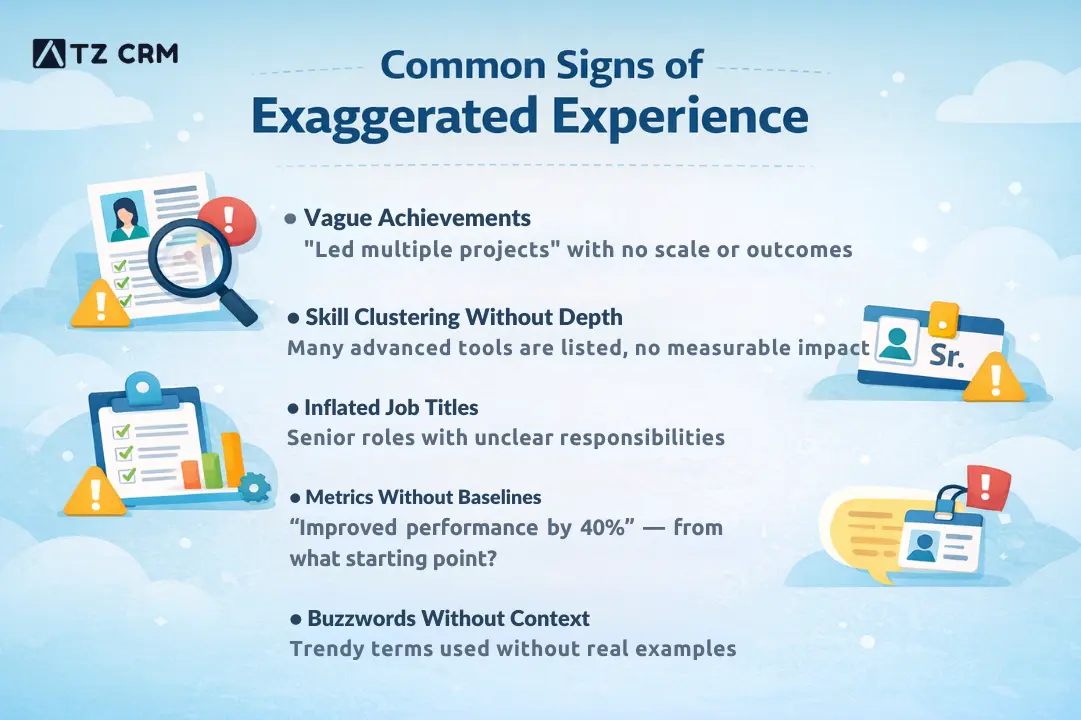
Common Signs of Exaggerated Experience During Resume Screening
When reviewing applications, look for these signals:
Vague Achievements
“Led multiple projects” without scale, team size, or outcomes.
Strong candidates usually explain the scope of responsibility. If there is no mention of budget size, cross-functional involvement, timelines, or measurable results, the claim may lack substance. Specificity reflects ownership.
Skill Clustering Without Depth
Ten advanced tools are listed with no evidence of impact.
Listing multiple platforms or technologies without explaining the application often signals surface familiarity rather than working proficiency. Genuine expertise is usually tied to clear use cases.
Inflated Job Titles
“Senior Strategist” in a two-person startup with unclear scope.
Titles in smaller companies can be misleading. Focus on responsibilities and outcomes rather than seniority labels alone.
Metrics Without Baselines
“Improved performance by 40%” — from what starting point?
Percentages without context make it difficult to assess real impact. Ask what the original metric was and over what period the improvement occurred.
Repetition of Industry Buzzwords
Heavy use of trending terminology without contextual explanation.
Overuse of buzzwords often replaces practical detail. Skilled professionals typically describe processes, challenges, and decisions instead of relying on jargon.
Resume screening should move beyond keyword matching and focus on evidence-based hiring signals.
How to Spot Real Skills During Resume Evaluation
A structured approach improves accuracy. Use a repeatable system instead of intuition.
1. Map Skills to Outcomes
For each claimed skill, ask:
- What business result did this drive?
- What was the candidate’s specific contribution?
Example: Instead of “Expert in CRM optimisation,” look for: “Increased recruiter productivity by 25% by redesigning pipeline stages.”
2. Validate Through Competency Mapping
Align skills against predefined role competencies:
- Technical proficiency
- Strategic thinking
- Stakeholder communication
- Problem-solving depth
This creates objective evaluation criteria.
3. Look for Behavioural Indicators
Behavioural indicators include:
- Ownership language (“I implemented…” vs “We supported…“)
- Process explanation
- Ability to explain decision-making
4. Identify Skills Gap Analysis
Check if career progression aligns with skill complexity. Sudden jumps without transitional growth can signal exaggeration.
Related Read: Proven Candidate Sourcing Strategies for 2026: The Ultimate Guide
How to Test Real Candidate Skills During Interviews
Interviews must function as validation tools, not conversations.
Use Structured Interview Techniques
Research shows that structured interviews, where candidates are assessed using standardised questions and consistent evaluation criteria, are far more predictive of job performance than unstructured interviews, helping recruiters improve hiring accuracy and reduce bias.
Instead of general questions:
- “Tell me about your experience.”
Use:
- “Walk me through a project where you applied [skill]. What was your process? What changed because of your work?”
Apply the Evidence Ladder Framework
Ask candidates to clarify:
- Situation
- Action
- Decision reasoning
- Quantifiable outcome
- Lessons learned
If depth decreases under probing, the skill may be inflated.
Manual Resume Screening vs System-Driven Skill Validation
| Manual Screening | System-Driven Validation |
|---|---|
| Relies on the recruiter’s memory | Centralised candidate validation notes |
| Inconsistent evaluation criteria | Structured scoring templates |
| Difficult to scale | Repeatable workflow |
| Subjective bias risk | Standardised competency tracking |
| Limited documentation | Searchable historical data |
As agencies scale from 2 to 20 recruiters, manual methods introduce inconsistencies that lead to hiring mistakes.
A structured applicant tracking system helps document skill assessments, maintain evaluation consistency, and reduce subjective bias.
Related Read: Social Recruiting: A Practical Playbook for Modern Hiring
How AI Improves Candidate Validation
AI-assisted screening enhances the ability to spot real candidate skills by:
- Identifying resume inconsistencies
- Tagging skills contextually through resume parsing
- Highlighting pattern mismatches
- Flagging inflated keyword density
- Tracking validation notes across hiring stages
Recruitment CRM platforms integrate resume parsing, workflow automation, and evaluation scoring to support predictive hiring decisions.
Instead of replacing recruiters, AI strengthens evidence-based hiring.
Related Read: How AI-Powered Tools Are Transforming Candidate Screening for Better Hiring
How Misjudging Skills Impacts Time-to-Fill and Placement Rates
Failing to verify skills early in the hiring process directly disrupts core recruitment performance metrics. What looks like a small screening oversight often turns into a measurable operational loss.
Increased Time-to-Fill
When unqualified or partially qualified candidates move past resume screening, recruiters invest additional time in interviews, client coordination, and follow-ups. Once gaps are exposed, the role must be reopened or re-shortlisted, resetting momentum and extending hiring timelines.
Lower Interview-to-Offer Ratio
Skill mismatches become visible during client interviews. This reduces submission-to-placement conversion rates and forces recruiters to rebuild shortlists, affecting pipeline velocity and recruiter productivity.
Reduced Placement Retention
Even when placements are made, exaggerated skills often surface within the first few months. Early attrition impacts guarantee periods, client trust, and long-term relationships.
According to research published by the ociety for Human Resource Management (SHRM), poor hiring decisions can lead to significant productivity loss, replacement expenses, and long-term operational costs.
Related Read: 7 Proven Ways to Streamline Full Cycle Recruiting
Building a Repeatable Skill Screening Workflow
For staffing agencies, scalability requires systemisation.
Step 1: Define Core Competencies — Create role-based competency frameworks.
Step 2: Standardise Resume Screening Criteria — Score resumes against measurable indicators.
Step 3: Implement Structured Interviews — Use uniform evaluation templates.
Step 4: Centralise Documentation — Store validation notes inside your recruitment CRM.
Step 5: Track Outcomes — Compare validated skills against placement retention and client satisfaction.
Recruitment platforms like ATZ CRM support structured candidate evaluation through workflow automation, resume parsing, and centralised candidate databases.
Related Read: Switch to ATZ CRM: 7 Powerful Reasons to Upgrade Now
Common Hiring Mistakes When Assessing Skills
Even experienced recruiters fall into traps:
- Overvaluing brand-name employers
- Assuming tenure equals competence
- Ignoring the context behind metrics
- Failing to probe soft skills
- Rushing evaluation due to placement pressure
These mistakes compound as hiring volumes increase.
Evidence-based hiring reduces emotional bias and improves predictive accuracy.
Related Read: 5 Signs Your Recruitment Tracker is Costing You Candidates (And How to Fix It)
What High-Performing Agencies Do Differently
Top-performing staffing firms approach skill validation strategically:
- Use competency mapping frameworks
- Document every evaluation stage
- Compare recruiter assessments for consistency
- Analyse placement retention data
- Continuously refine screening criteria
They treat skill validation as an operational process, not a gut decision.
Related Read: Recruitment Strategies for Agencies: Proven Tactics to Attract Better Candidates
Technology Stack Considerations for Skill Validation
To consistently spot genuine skills, agencies should evaluate:
- Applicant tracking system flexibility
- Resume parsing intelligence
- Workflow automation capabilities
- Reporting dashboards
- Candidate database search accuracy
Disconnected tools create fragmented validation.
An integrated recruitment CRM centralises evaluation and improves team alignment.
Related Read: 12 Trusted Sites for Free Resume Search and Talent Sourcing
Long-Term Impact: Predictive Hiring and Scalability
As hiring data accumulates, agencies can move toward predictive hiring models:
- Correlate validated skills with retention outcomes
- Identify skill patterns that lead to successful placements
- Reduce reliance on instinct-based decisions
- Improve client satisfaction rates
Structured data enables long-term improvement.
Recruitment becomes data-informed rather than reactive.
Strengthening Hiring Accuracy Moving Forward
The ability to spot real skills determines whether hiring remains transactional or becomes strategic. Resume screening must evolve into layered validation, supported by structured interviews, competency mapping, and centralised documentation.
When evaluation systems mature, time-to-fill improves, placement quality rises, and recruiter confidence increases. Agencies that systemise skill validation create a measurable competitive advantage because decisions are based on data, not instinct.
If your current workflow still depends on manual resume reviews and scattered notes, it may be limiting your placement performance. A structured recruitment CRM can standardise screening, document candidate validation, and align recruiters around consistent evaluation criteria.
ATZ CRM helps staffing agencies build repeatable, AI-supported hiring workflows that improve candidate assessment accuracy.
Book a demo with ATZ CRM to see how you can strengthen skill validation and improve placement outcomes.
FAQs
How can recruiters quickly spot genuine skills during resume screening?
Look for measurable outcomes, contextual explanations, and consistent career progression rather than keyword-heavy resumes. Structured evaluation criteria significantly improve screening accuracy.
Why do candidates exaggerate experience on resumes?
Competitive job markets and ATS optimization pressures encourage candidates to inflate responsibilities or overstate skill proficiency to increase interview chances.
What is the best way to validate candidate skills during interviews?
Use structured interviews with evidence-based questions that require detailed examples, decision reasoning, measurable results, and reflection on outcomes.
How does AI help identify exaggerated experience?
AI tools detect keyword stuffing, resume inconsistencies, unusual progression gaps, and context mismatches while organising validation data across hiring stages.
How does poor skill validation impact staffing agencies?
It increases time-to-fill, lowers placement retention, damages client trust, and reduces recruiter productivity through repeated re-screening and failed interviews.