 EN
EN DE
DE ES
ES FR
FR NL
NL PT
PTLast Updated: · ATZ CRM Editorial Team · Recruitment · 15 min read
5 Non-Negotiable Features in Enterprise Applicant Tracking Systems
Discover the essential features that make Enterprise Applicant Tracking Systems effective for large-scale hiring, from advanced pipeline management to AI-powered automation and recruiting analytics.
Quick Answer: 5 Essential Features of Enterprise Applicant Tracking Systems
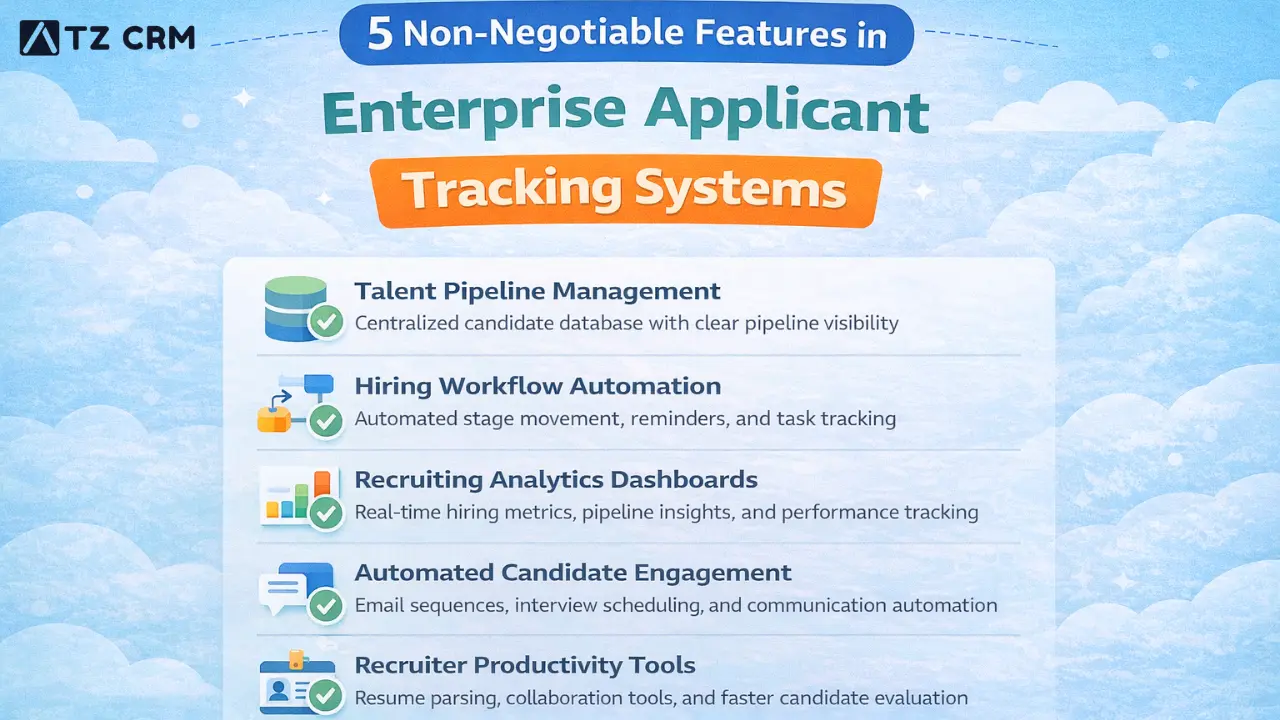
Enterprise ATS platforms differ from basic tools by offering advanced pipeline management (long-term talent pools), hiring workflow orchestration (automated stages), automated candidate engagement (consistent communication), deep recruiting analytics, and AI-powered productivity tools. These features are non-negotiable for large-scale hiring because they directly reduce time-to-fill, improve candidate experience, and provide visibility into complex recruitment operations.
Large recruitment teams rarely struggle with finding candidates. The real challenge is managing the complexity of hiring at scale.
When hundreds of applications arrive across multiple roles, regions, and hiring managers, even experienced recruiters begin losing visibility. Candidate conversations get scattered across emails. Interview stages stall. High-quality applicants slip through the cracks.
The result is familiar: longer time-to-fill, declining placement rates, and frustrated hiring teams.
This is exactly why Enterprise Applicant Tracking Systems have become a foundational technology for modern talent acquisition teams. Unlike basic ATS tools built for small hiring needs, enterprise systems are designed to coordinate large recruiting operations, automate workflows, and give leadership real visibility into hiring performance.
However, not all ATS platforms truly support enterprise-level recruiting.
Some offer surface-level automation but fail when hiring volumes increase. Others track applications but provide little insight into pipeline health, recruiter productivity, or hiring bottlenecks.
For enterprise hiring teams, certain capabilities are no longer optional.
This article breaks down five non-negotiable features in Enterprise Applicant Tracking Systems and why they directly impact hiring efficiency, recruiter productivity, and long-term talent acquisition strategy.
Related Read: ATS for Recruiters Streamline Recruitment Efficiency
What Makes Enterprise Applicant Tracking Systems Different
An Enterprise ATS is designed for organisations where recruiting involves multiple stakeholders, high candidate volume, and structured hiring workflows.
Unlike entry-level ATS software that focuses mainly on application tracking, enterprise platforms provide deeper operational capabilities, such as:
- Talent pipeline management
- Recruiting workflow orchestration
- Automated candidate engagement
- Recruiting analytics dashboards
- Integration with broader talent acquisition technology
These systems act as a central operating platform for hiring, connecting recruiters, hiring managers, and leadership through one unified workflow.
Research on modern hiring practices shows that organisations using structured recruitment processes achieve more consistent and objective candidate evaluations compared with fragmented or manual hiring approaches.
Enterprise recruiting technology helps teams move from reactive hiring to structured talent acquisition operations.
1. Advanced Talent Pipeline Management
Most ATS tools focus on tracking applications for open roles. Enterprise hiring teams need something more powerful: a dynamic talent pipeline.
Talent pipeline management allows recruiters to build and maintain a long-term candidate database, not just process applications for current vacancies.
Why This Feature Matters
Enterprise recruiters often handle:
- Multiple hiring campaigns simultaneously
- Specialised or hard-to-fill roles
- Ongoing hiring needs across departments
Without pipeline management, recruiters repeatedly start from scratch every time a new role opens.
A strong Enterprise ATS enables recruiters to:
✅ Tag and segment candidates – Organize by skill, industry, or experience.
✅ Re-engage past applicants – Instantly surface quality talent for new roles.
✅ Build long-term relationships – Maintain a warm pool of pre-qualified candidates.
✅ Maintain talent pools – Prepare for future hiring needs before they become urgent.
Operational Impact
Instead of sourcing new candidates for every vacancy, recruiters can activate pre-qualified pipelines instantly.
This significantly reduces:
- Time-to-source
- Time-to-fill
- Recruiter workload
For enterprise teams handling high-volume hiring, pipeline visibility often becomes the difference between fast placements and hiring delays.
2. Hiring Workflow Orchestration
Enterprise hiring involves far more than collecting applications.
A single candidate journey might include:
- Screening
- Multiple interview rounds
- Hiring manager evaluations
- Skill assessments
- Offer approvals
Without a structured system, these steps quickly become chaotic.
This is where workflow orchestration becomes a critical feature of Enterprise Applicant Tracking Systems.
What Workflow Orchestration Enables
An enterprise ATS should allow organisations to design structured recruiting workflows, including:
- Automated stage progression
- Interview scheduling coordination
- Candidate status updates
- Hiring manager feedback collection
- Approval workflows for offers
Instead of relying on emails, spreadsheets, and reminders, the system automatically manages hiring stages.
Manual Process vs System-Driven Workflow
Recruiting processes can vary significantly depending on whether teams rely on manual coordination or a structured workflow system. The comparison below highlights how enterprise recruitment platforms streamline hiring operations compared to traditional manual processes.
| Manual Recruiting | Enterprise Workflow System |
|---|---|
| Recruiters manually track candidate stages | Automated pipeline stage tracking |
| Interview coordination happens via email | Integrated scheduling tools |
| Feedback gets delayed or lost | Centralised hiring manager feedback |
| Hiring visibility is limited | Leadership sees full pipeline status |
Workflow automation ensures that every candidate moves through the process consistently and efficiently.
This improves both candidate experience and recruiter productivity.
3. Automated Candidate Engagement
Recruiting delays often happen because candidate communication slows down.
When recruiters are managing hundreds of applicants, timely follow-ups become difficult. Candidates wait days for responses, and top talent frequently accepts offers elsewhere.
Enterprise ATS platforms address this through automated candidate engagement systems.
Key Engagement Capabilities
A strong Enterprise ATS should support:
- Automated email responses
- Interview reminders
- Status update notifications
- Talent pool re-engagement campaigns
- Personalised communication templates
These systems ensure candidates remain informed and engaged throughout the hiring process.
Why Engagement Automation Matters
Research from LinkedIn’s talent acquisition insights shows that candidate experience plays a significant role in shaping employer brand perception and can directly influence whether candidates ultimately accept job offers.
Automation helps recruiters maintain consistent communication without increasing manual workload.
Instead of spending hours sending emails, recruiters can focus on screening, interviewing, and relationship building.
4. Recruiting Analytics and Performance Dashboards
Many recruitment teams collect hiring data but struggle to turn it into actionable insight.
Enterprise hiring leaders need visibility into metrics such as:
- Time-to-fill
- Candidate pipeline conversion rates
- Source-of-hire performance
- Recruiter productivity
- Interview-to-offer ratios
This is where recruiting analytics dashboards become essential.
Why Analytics Matter in Enterprise Hiring
Without analytics, hiring teams operate on assumptions instead of data.
For example:
- Are delays happening during screening?
- Which sourcing channels produce the best candidates?
- Are certain roles consistently slow to fill?
Enterprise ATS platforms provide real-time recruitment dashboards that answer these questions instantly.
Metrics That Enterprise Recruiters Monitor
Key recruiting metrics include:
- Time-to-fill
- Time-to-hire
- Pipeline velocity
- Offer acceptance rate
- Candidate drop-off rate
Data-driven recruiting allows organisations to continuously optimise hiring workflows and resource allocation.
5. AI-Powered Automation and Recruiter Productivity Tools
Enterprise recruiting teams often handle thousands of applications each month.
Manual screening alone can overwhelm even experienced recruiters.
This is why modern Enterprise Applicant Tracking Systems increasingly include AI-driven automation capabilities.
How AI Improves Recruiting Operations
AI tools within an ATS can assist with:
- Resume parsing and candidate ranking
- Automated screening questions
- Candidate-job matching
- Predictive pipeline insights
- Workflow automation
These features reduce repetitive administrative work and allow recruiters to focus on decision-making rather than data entry.
Real Workflow Improvement
Instead of manually reviewing every resume, AI can:
✅ Analyse candidate profiles – Extracts key skills and experience automatically.
✅ Match against requirements – Scores candidates based on job fit.
✅ Prioritise high-fit talent – Surfaces the best candidates first.
✅ Flag potential matches – Identifies talent within existing pipelines for new roles.
This significantly increases recruiter productivity and screening speed.
How These Features Impact Hiring Performance Metrics
When implemented correctly, enterprise ATS capabilities produce measurable improvements in hiring operations.
Faster Hiring Cycles
Automated workflows and pipeline visibility reduce delays across hiring stages, improving time-to-fill metrics.
Higher Placement Rates
Better pipeline management ensures recruiters consistently engage qualified candidates rather than restarting sourcing cycles.
Improved Recruiter Productivity
Automation reduces administrative workload, enabling recruiters to focus on high-value activities such as candidate assessment and relationship building.
Stronger Candidate Experience
Consistent communication and structured hiring stages create a more transparent and professional candidate journey.
Organisations that adopt enterprise recruiting technology often see measurable gains in both efficiency and hiring quality.
Related Read: 11 AI Recruiting Tools You Can’t Afford to Ignore
Common Mistakes When Choosing an Enterprise ATS
Not every ATS labelled “enterprise-grade” actually supports large-scale recruiting operations.
Common evaluation mistakes include:
Choosing Software Without Workflow Flexibility
Some platforms impose rigid hiring processes that cannot adapt to different teams or roles.
Ignoring Integration Capabilities
Enterprise recruiting systems must integrate with HR platforms, communication tools, and hiring portals.
Underestimating Data and Analytics Needs
Leadership teams increasingly require real-time hiring intelligence, not just application tracking.
Overlooking Recruiter Experience
If the system is difficult to use, recruiters revert to spreadsheets and manual processes.
Selecting the right platform requires evaluating how well it supports real recruiting workflows, not just software features.
How Growing Recruitment Teams Should Approach Enterprise ATS Adoption
Enterprise recruiting technology becomes especially valuable as hiring teams scale.
A small recruiting team might initially manage workflows manually. But once hiring expands across departments or regions, coordination complexity increases rapidly.
Growing organisations should evaluate ATS systems based on:
- Workflow scalability
- Talent pipeline capabilities
- Automation features
- Data visibility
- Integration flexibility
Teams transitioning from small hiring operations to enterprise-level recruiting need systems that can support both current needs and future growth.
Related Read: Recruitment Strategies for Agencies: Proven Tactics to Attract Better Candidates
Why Enterprise ATS Integration Capabilities Matter for Modern Recruiting Technology Stacks
Enterprise recruiting does not operate in isolation.
Large organisations typically rely on a complex technology ecosystem that includes HRIS platforms, background screening services, video interview tools, and onboarding systems.
If an Applicant Tracking System cannot integrate seamlessly with these systems, recruiters are forced to perform repetitive manual tasks such as exporting candidate data or re-entering information across multiple platforms.
This leads to data fragmentation and operational inefficiency.
High-quality Enterprise ATS software solves this by offering robust integration capabilities through APIs and pre-built connectors.
Common integrations include:
- HRIS platforms for employee data management
- Background check providers
- Job boards and sourcing platforms
- Video interview tools
- Candidate assessment platforms
- Email and calendar systems
When integrations function properly, candidate information flows automatically between systems.
For example, a candidate who receives an offer inside the ATS can be automatically transferred into the organisation’s HRIS system for onboarding, eliminating duplicate data entry.
Similarly, interview scheduling tools can sync with recruiters’ calendars, reducing the time spent coordinating interviews.
Integration capability becomes especially important for organisations scaling their recruiting operations.
Without connected systems, recruiters spend too much time managing tools rather than focusing on candidate evaluation and relationship building.
Enterprise Applicant Tracking Systems designed for large organisations must therefore act as a central hub connecting the entire hiring technology stack.
Related Read: 7 Proven Ways to Streamline Full Cycle Recruiting
What Security and Compliance Features Should Enterprise ATS Platforms Provide?
Enterprise hiring involves handling sensitive candidate information such as resumes, personal contact details, and employment history.
For global organisations, recruitment systems must also comply with strict data protection regulations.
Security and compliance, therefore, become critical considerations when evaluating Enterprise Applicant Tracking Systems.
Key security capabilities enterprise platforms should provide include:
Role-based access control
Recruiting teams often include multiple stakeholders such as recruiters, hiring managers, HR staff, and executives. Access permissions ensure each user only sees information relevant to their role.
Data encryption and secure storage
Candidate information must be protected through encryption protocols and secure cloud infrastructure.
Audit trails and activity logs
Enterprise ATS platforms should track all system actions, allowing organisations to monitor who accessed candidate data and when.
Compliance with global data regulations
Organisations hiring internationally must follow regulations such as GDPR and other regional data protection laws.
These safeguards help organisations maintain candidate trust and legal compliance while managing large-scale hiring operations.
Security features may not directly improve recruiting speed, but they protect organisations from serious legal and reputational risks associated with mishandled candidate data.
For enterprise organisations, security is not an optional feature — it is a core requirement of recruitment technology infrastructure.
Related Read: 8 Best ATS+CRM Loxo alternatives for Growing teams
How Enterprise ATS Platforms Support High-Volume and Multi-Location Hiring
Recruiting complexity increases dramatically when organisations operate across multiple regions, departments, or business units.
Global enterprises often run simultaneous hiring campaigns across several locations, each with unique role requirements and hiring processes.
Basic ATS systems struggle to manage this level of complexity.
Enterprise-level platforms are designed to support high-volume, distributed hiring environments.
Key capabilities include:
Multi-location job management
Recruiters can manage openings across different offices or regions from a single platform.
Custom workflows by department or region
Hiring processes can vary depending on local compliance requirements or internal organisational structures.
Centralised reporting across global hiring operations
Leadership teams can monitor recruitment performance across multiple locations in real time.
Bulk candidate management
High-volume hiring often involves thousands of applications. Enterprise ATS tools allow recruiters to filter, sort, and process candidates efficiently.
These features ensure hiring teams maintain organisational consistency while still allowing regional flexibility.
Without a scalable ATS infrastructure, global organisations risk losing visibility into hiring performance across departments and locations.
Enterprise Applicant Tracking Systems help organisations manage complex recruiting operations without sacrificing coordination or transparency.
Related Read: Temporary vs Permanent Recruitment: Your Ultimate New Year Guide
How Enterprise ATS Systems Improve Candidate Experience at Scale
Candidate experience has become a critical factor in modern recruiting.
Job seekers increasingly evaluate employers based on communication quality, hiring transparency, and application simplicity.
However, maintaining a positive candidate experience becomes difficult when hiring volumes increase.
Enterprise ATS platforms help organisations maintain consistency by structuring the entire candidate journey.
Key improvements include:
Streamlined application processes
Candidates can apply easily through structured portals rather than complicated application forms.
Transparent hiring stages
Candidates receive updates about where they are in the hiring process.
Faster response times
Automated communication ensures candidates are not left waiting for weeks without updates.
Consistent interview coordination
Interview scheduling tools reduce delays and confusion around meeting logistics.
These improvements strengthen employer branding and help organisations attract stronger talent.
In competitive labour markets, a well-designed ATS helps organisations maintain a professional and responsive hiring experience even during high-volume recruitment cycles.
Enterprise Applicant Tracking Systems, therefore, influence not only internal recruiting efficiency but also how candidates perceive the organisation as an employer.
Building a Scalable Recruiting Technology Stack
Enterprise ATS platforms typically sit at the centre of a broader talent acquisition technology stack.
Common integrations include:
- Recruitment CRM platforms
- Candidate portals
- HRIS systems
- Interview scheduling tools
- Background screening services
A well-integrated system reduces data silos and manual handoffs, improving operational efficiency across the hiring process.
Organisations implementing platforms like ATZ CRM often focus on creating a unified recruitment workflow that connects pipeline management, candidate engagement, and analytics within one platform.
This approach helps recruiting teams maintain both speed and structure as hiring operations scale.
Related Read: Best Affordable Recruitment Software in 2026
How Enterprise Applicant Tracking Systems Support Workforce Planning and Forecasting
Enterprise recruiting is not just about filling open roles. It is about anticipating future hiring needs before talent shortages impact business growth.
Modern Enterprise Applicant Tracking Systems increasingly support workforce planning by connecting hiring data with long-term talent strategy.
Instead of reacting to job vacancies, recruiting teams can analyse historical hiring trends and predict future demand for specific skills.
Enterprise ATS platforms enable this through:
- Historical hiring analytics that reveal patterns in time-to-fill, sourcing performance, and candidate quality
- Talent pipeline tracking that shows how many qualified candidates exist for upcoming roles
- Role demand forecasting based on business expansion or department growth
- Skills gap identification across departments
For example, if hiring data shows that senior engineering roles consistently require 60 days to fill, recruiters can begin sourcing earlier before new projects launch.
Without forecasting capabilities, recruiting teams often operate in a reactive hiring cycle, scrambling to find talent after a position opens.
Enterprise ATS platforms shift this approach toward a predictive hiring strategy, allowing talent acquisition teams to align recruiting timelines with business planning.
This improves workforce readiness and prevents project delays caused by talent shortages.
For organisations scaling rapidly, workforce planning tools inside ATS software can transform recruiting from a strategic business partner.
What Implementation Challenges Do Companies Face When Deploying Enterprise ATS Platforms?
While Enterprise Applicant Tracking Systems offer powerful capabilities, implementation can present challenges if organisations underestimate the complexity of recruiting operations.
Large organisations typically involve multiple recruiting teams, departments, and hiring workflows. Migrating these processes into a centralised ATS requires careful planning.
Common implementation challenges include:
Process standardization
Different departments may follow completely different hiring workflows. Aligning these processes inside one system requires organisational coordination.
Data migration from legacy systems
Historical candidate data, resumes, and job records often exist across spreadsheets, older ATS tools, or email archives.
Recruiter adoption and training
Even the best recruiting software fails if recruiters revert to manual tracking methods because they are unfamiliar with the system.
Integration configuration
Connecting ATS platforms with HRIS systems, job boards, and background screening providers requires technical setup.
Successful enterprise ATS deployment, therefore, requires structured onboarding and workflow planning.
Best practices include:
- Mapping existing recruiting workflows before system configuration
- Training recruiters and hiring managers early in the process
- Implementing automation gradually rather than all at once
- Establishing internal champions who support system adoption
When implementation is handled strategically, enterprise ATS platforms quickly become the operational backbone of recruiting teams.
Without structured adoption, however, organisations risk investing in technology that remains underutilised or poorly integrated into daily recruiting workflows.
The Future of Enterprise Recruiting Technology
Enterprise talent acquisition is evolving rapidly as organisations adopt automation, AI, and data-driven hiring strategies.
Future ATS platforms will increasingly focus on:
- Predictive hiring insights
- Automated pipeline nurturing
- AI-assisted screening
- Real-time recruiting intelligence
- Integrated talent ecosystem platforms
Recruiting is shifting from a transactional hiring function to a strategic workforce capability.
Technology that supports structured hiring workflows and scalable candidate engagement will play a central role in this transformation.
Related Read: Switch to ATZ CRM: 7 Powerful Reasons to Upgrade Now
Strengthening Hiring Operations with the Right Enterprise ATS
Recruiting at scale requires more than simply tracking applications.
Enterprise hiring teams need systems that support pipeline visibility, workflow automation, candidate engagement, and data-driven decision making.
The five features explored here — pipeline management, workflow orchestration, engagement automation, analytics, and AI-driven productivity tools — have become foundational capabilities in Enterprise Applicant Tracking Systems.
Organisations evaluating enterprise recruiting technology should focus on how well a platform supports real hiring operations, not just software features.
Solutions like ATZ CRM are designed to help recruitment teams coordinate complex hiring processes while improving visibility and efficiency across the entire talent acquisition workflow.
As hiring demands continue to grow, the right technology can transform recruiting from a reactive process into a structured, scalable system for building high-performing teams.
FAQs
What are Enterprise Applicant Tracking Systems?
Enterprise Applicant Tracking Systems are advanced recruiting platforms designed to manage large-scale hiring operations, automate workflows, track candidates, and provide analytics for enterprise-level talent acquisition teams.How is an Enterprise ATS different from regular ATS software?
Enterprise ATS platforms offer advanced capabilities such as pipeline management, automation, analytics dashboards, and integrations that support complex hiring workflows across large organisations.Why do large organisations need an Enterprise ATS?
Enterprise hiring involves high candidate volume, multiple recruiters, and complex approval workflows. An Enterprise ATS helps coordinate these processes and improves hiring speed and efficiency.What metrics can an Enterprise ATS track?
Common metrics include time-to-fill, pipeline conversion rates, candidate engagement levels, recruiter productivity, source-of-hire performance, and interview-to-offer ratios.How does AI improve Enterprise ATS platforms?
AI helps automate resume screening, prioritise candidates, identify matching skills, and provide predictive insights that improve recruiter productivity and hiring outcomes.