 EN
EN DE
DE ES
ES FR
FR NL
NL PT
PT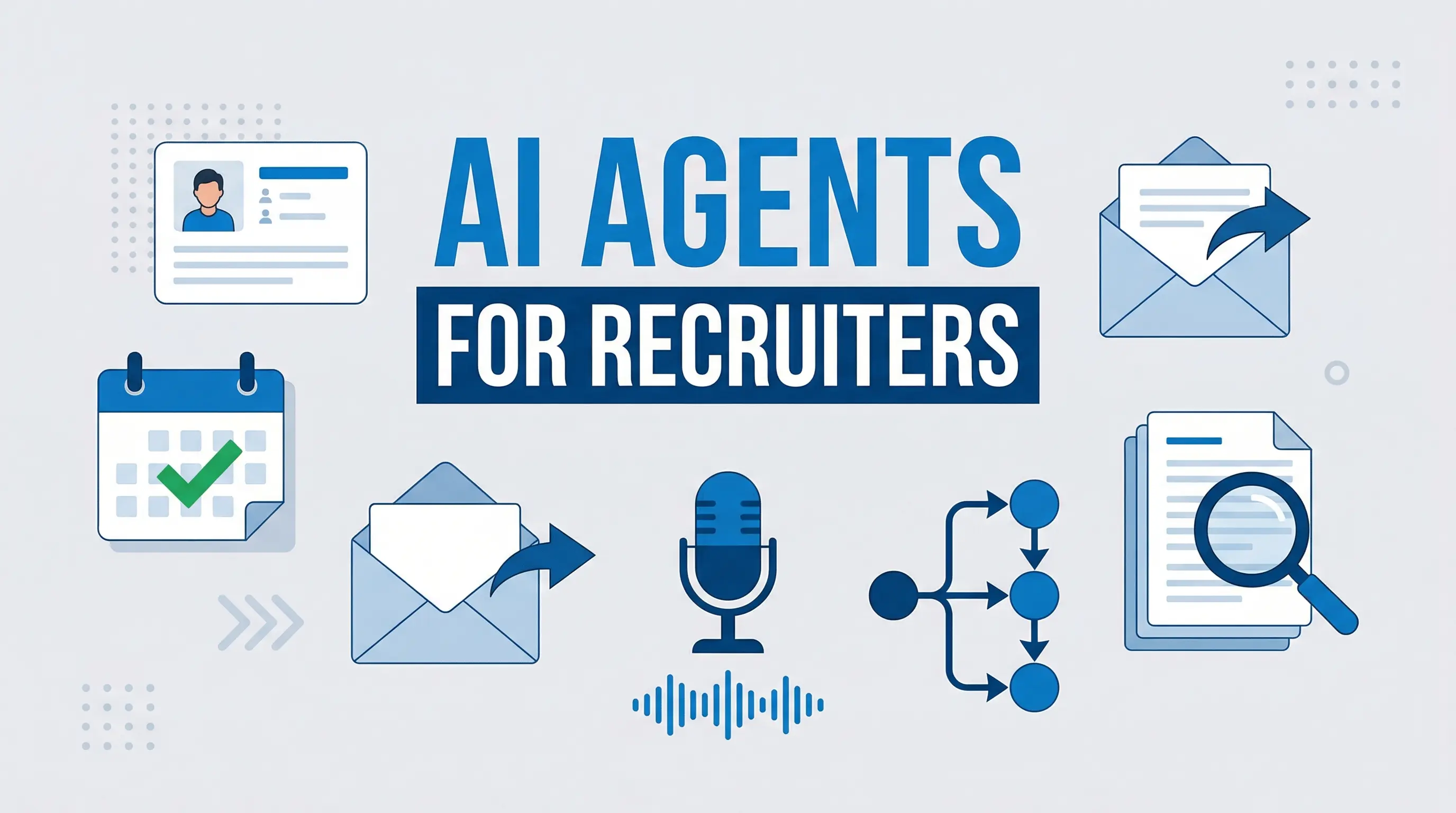



Quick Answer: An AI agent for recruitment is an autonomous program that handles multi-step hiring tasks, from screening resumes to scheduling interviews, without waiting for a human trigger at each step. Unlike basic automation rules or chatbots, AI agents make decisions, chain actions together, and adapt based on context. The most widely adopted use cases include resume screening, candidate sourcing, personalized outreach, interview scheduling, AI-led initial interviews, candidate nurturing, job description generation, and end-to-end agentic hiring workflows.
You probably spend more time managing your process than actually recruiting. Screening hundreds of applications. Chasing calendar slots for interviews. Sending the same follow-up to candidates who have gone quiet. Recruiters spend the majority of their working time on tasks like these, not on the conversations and placements that drive revenue.
AI agents for recruitment are built to change that ratio. Not by replacing what you do, but by taking autonomous ownership of the repeatable, multi-step work that fills your day. This guide covers 8 use cases of AI agents in recruitment that agencies are applying right now, with real data and a clear picture of where the technology still needs you in the loop.
What Is an AI Agent in Recruitment?
There is a meaningful difference between an AI agent and a basic AI feature or a chatbot. A chatbot answers a specific question. A basic automation rule fires when a trigger condition is met. An AI agent does more: it chains multiple actions together, evaluates information, makes decisions, and completes an entire workflow segment without a human prompting it at each step.
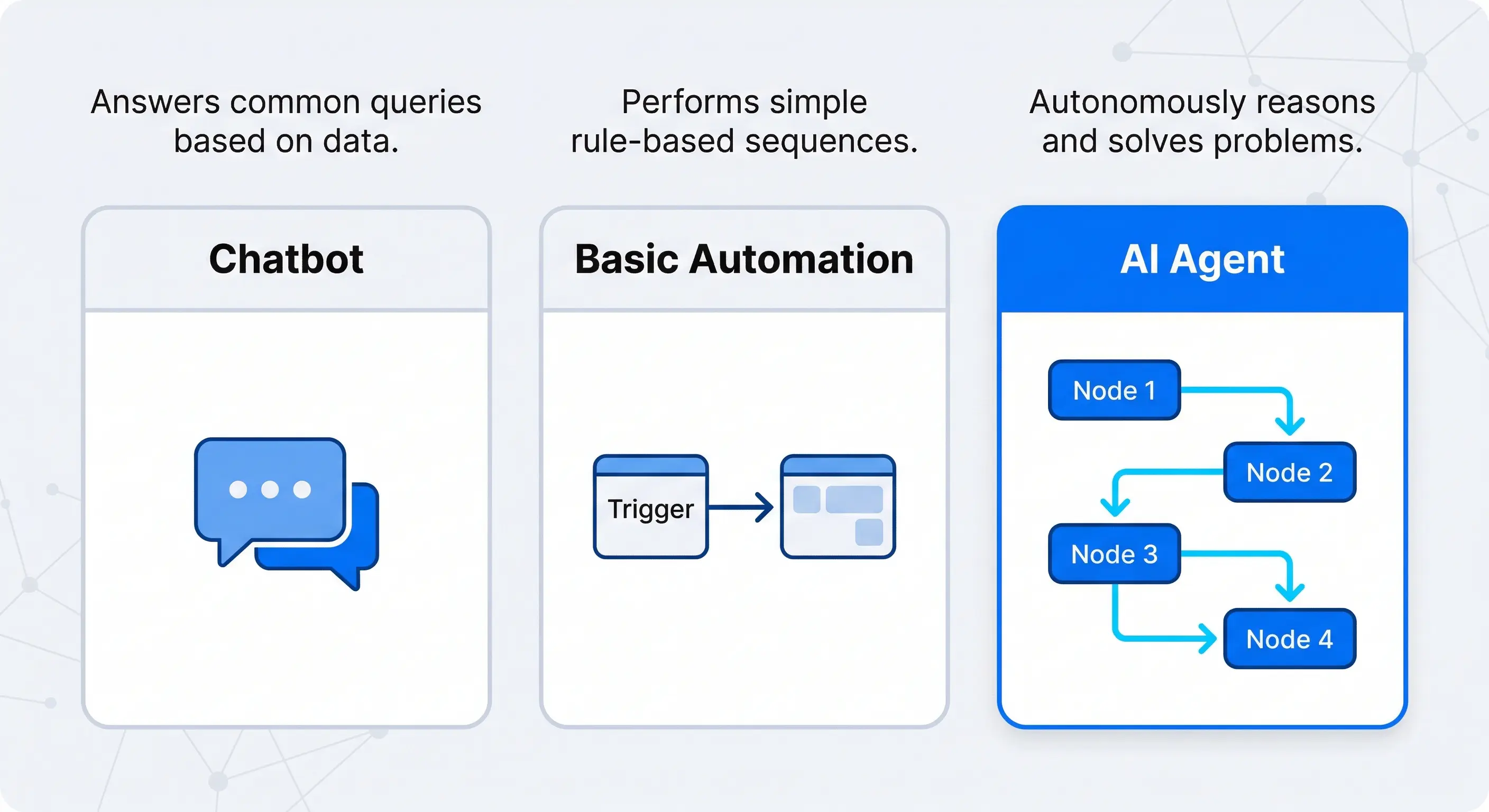
In a recruiting context, that means an AI agent can receive a job brief, search your database for matching profiles, draft personalized outreach, follow up based on candidate responses, schedule a screening call, and deliver a prioritized shortlist to you, all without a manual action in between. It’s the difference between a tool that waits for instructions and one that acts on its own.
| Capability | AI Agent | Basic Automation | Chatbot |
|---|---|---|---|
| Completes multi-step tasks | Yes | No (single trigger) | No (single input) |
| Makes decisions in context | Yes | No | Limited |
| Adapts to new information | Yes | No | Partially |
| Initiates actions proactively | Yes | Reactive only | Reactive only |
| Requires manual setup per action | No | Yes | Yes |
Why Recruitment Agencies Are Adopting AI Agents Now
Adoption has accelerated sharply. AI use among HR professionals rose to 72% in 2025, up from 58% in 2024, according to Staffing Industry Analysts. That is not a gradual shift, it is structural change moving at speed.
The reason is straightforward: agencies running AI-assisted workflows handle more roles with the same headcount. Those that do not are operating at a real capacity disadvantage. The window for early adoption advantage is still open, but it will close as AI-native recruiting becomes the baseline expectation.
8 Use Cases of AI Agents for Recruiters
These are the use cases delivering measurable results for agencies and staffing firms today.
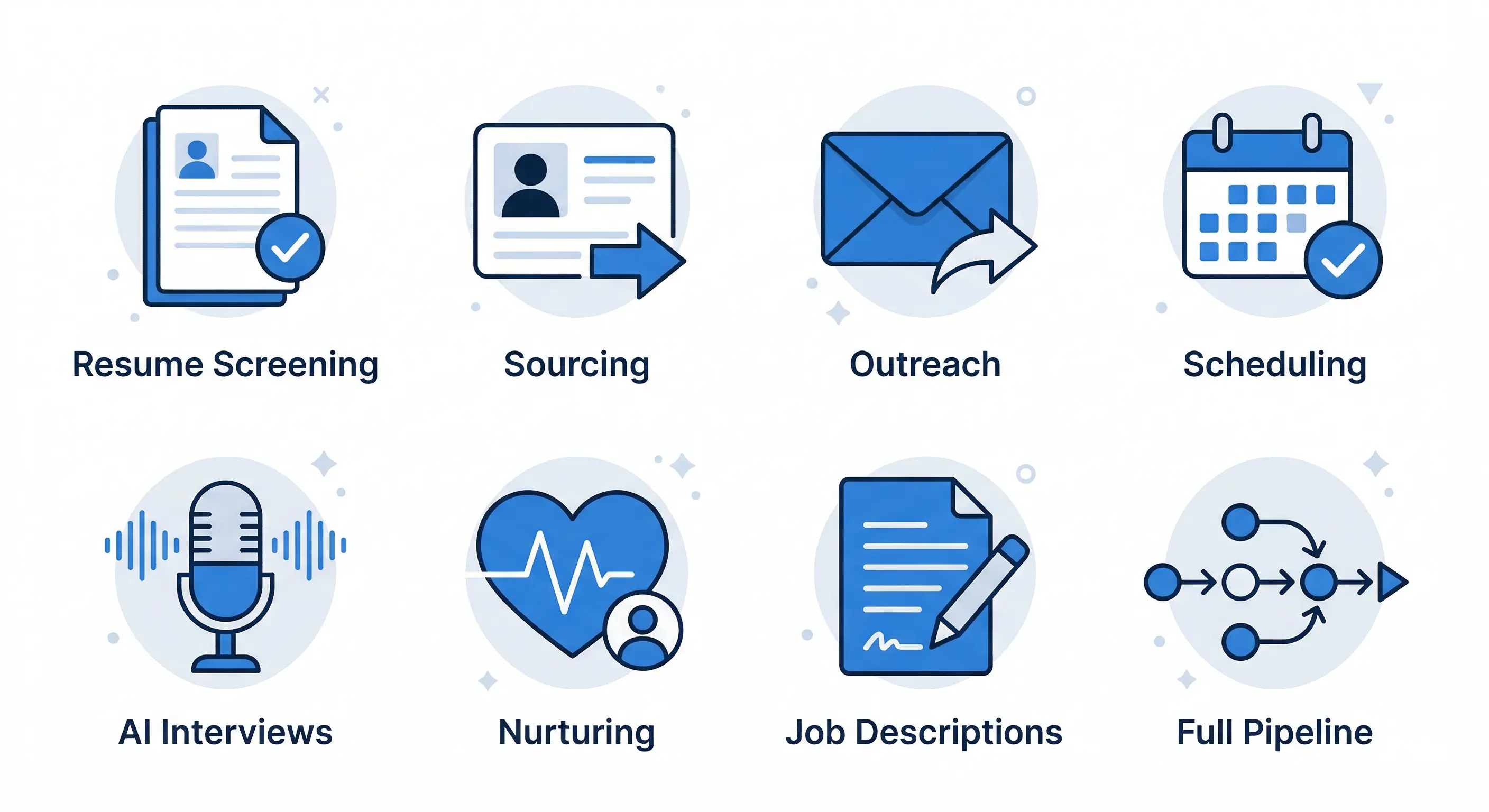
Resume Screening and Candidate Shortlisting
AI screening agents scan incoming applications, apply semantic matching to understand implied skills and experience, rank candidates by fit, and surface a prioritized shortlist. They work at a volume and consistency that manual review cannot match, especially during high-intake periods.
Companies using AI screening report up to 75% faster shortlisting and 59% better job matching accuracy, according to Hyreo’s 2025 recruitment industry analysis. In one documented retail deployment, AI screening cut time-to-hire from 12 days to 4, while the application completion rate rose to 85%.
ATZ CRM’s AI candidate matching and auto-screening scores applicants and surfaces the best fits against each open role automatically, running inside your existing pipeline with no separate tool required.
Candidate Sourcing Across Channels
AI sourcing agents search LinkedIn profiles, internal databases, job boards, and talent communities simultaneously. They apply skill inference to surface candidates whose experience fits the role even when their profile does not use the exact keywords you are searching for.
Agencies that have adopted AI sourcing report significant reductions in the time spent building candidate pools. LinkedIn’s Hiring Assistant data shows early adopters reviewing 62% fewer profiles per role while maintaining hire quality. A logistics company using AI-assisted sourcing filled more open driver roles in the same hiring window with no increase in headcount.
The ATZ CRM Chrome extension lets you pull LinkedIn profiles directly into your candidate database with one click. The AI sourcing feature lets you describe your ideal candidate in plain language and surfaces matches from your existing pool instantly.
Personalized Outreach at Scale
AI outreach agents draft personalized messages based on candidate profile data and send them across email, LinkedIn, or WhatsApp. They follow up autonomously based on engagement signals, and each message reads as individual even when you are running outreach across dozens of candidates simultaneously.
LinkedIn’s 2025 Hiring Assistant release data shows a 69% improvement in InMail acceptance rates among early adopters. AI-personalized outreach consistently outperforms generic templates across every measured response metric.
ATZ CRM’s automated email sequences and LinkedIn/WhatsApp messaging integration handle multi-channel outreach with variable personalization fields. You set the logic once and the platform handles the execution.
Interview Scheduling Without Back-and-Forth
Interview coordination traditionally consumes a large share of a recruiter’s working week. AI scheduling agents match candidate availability against interviewer calendars, send confirmations, manage time zones, handle rescheduling requests, and send reminders, with no manual involvement required.
Mastercard has publicly documented a significant reduction in scheduling overhead after implementing AI-assisted coordination. In documented enterprise deployments, the majority of interviews are scheduled with zero recruiter touchpoints. ATZ CRM’s interview scheduling automation handles multi-party calendar coordination directly from within the candidate record.
AI-Led Initial Interviews
AI voice and video agents conduct structured first-round screening interviews, evaluate responses against competency frameworks, and generate summaries for the hiring team. This is not about removing human judgment from hiring. It is about applying it at the right stage.
The research on outcomes is substantial. A study of over 70,000 job applicants by the University of Chicago Booth School of Business found that AI-conducted interviews produced 12% more job offers, 18% more job starters, and 16% higher 30-day retention rates compared to traditional human-led screening calls.
When given the choice, 78% of candidates opted for the AI voice interview over a human screener, according to TestGorilla’s 2025 candidate preference research. The framing that works: position this as the first-round screening call, with a human making every final decision.
Automated Candidate Nurturing and Follow-Up
AI nurturing agents keep your pipeline warm between stages. They send relevant content at the right intervals, respond to candidate questions, and trigger follow-ups based on time elapsed or pipeline status changes, without you manually tracking each conversation thread.
The business case is direct: candidates who experience long gaps in communication during the hiring process are far more likely to withdraw, particularly during the offer period when ghosting risk peaks. Automated nurturing closes that gap at exactly the right moment. ATZ CRM’s automated email sequences and status update automation handle this from inside your existing pipeline.
Job Description and Content Generation
AI content agents draft job descriptions, interview question sets, outreach copy, and assessment briefs from a short role brief. This is currently the most widely adopted AI use case in HR: 70% of companies using AI or generative AI in their recruitment process use it for content creation, per Hyreo’s 2025 analysis.
The practical impact is real: 61% of job seekers report that AI-written job descriptions are easier to understand than traditionally written ones. For agencies posting across multiple roles simultaneously, AI content generation removes a meaningful block of writing time from every week.
ATZ CRM’s AI Content Generator produces job descriptions and outreach templates directly from your role and candidate data, without switching to a separate writing tool.
End-to-End Agentic Hiring Workflows
This is where the individual use cases above combine into a single autonomous pipeline. The agent receives a job brief, sources candidates, drafts and sends outreach, handles replies, screens applicants, schedules interviews, and delivers a prioritized shortlist for your final review and decision.
Early adopters of LinkedIn’s agentic Hiring Assistant saved 4 hours per role, reviewed 62% fewer profiles, and recorded a 60-70% jump in recruiter productivity. This is not a future scenario. It reflects what best-performing recruitment agencies are already building toward.
ATZ CRM’s workflow automation connects the steps of your hiring process into a single, configurable automated flow, without a separate integration layer or technical build.
ATZ CRM’s AI features, including Smart Auto-Matching, AI Candidate Sourcing, and automated outreach sequences, put several of these use cases to work from your first day on the platform. Start your free trial with no credit card required and see how much admin you can take off your plate this week.
What Results Are Agencies Actually Seeing?
The results from real deployments go well beyond incremental efficiency gains.
Unilever’s AI-assisted hiring program is one of the most documented cases in enterprise recruitment. The company saved tens of thousands of hours of screening time, cut time-to-hire from months to weeks, and improved candidate diversity across a global hiring operation. These were not pilot outcomes; they were sustained results at scale.
Certis, a global security services firm, went from building candidate shortlists over multiple days to producing them in minutes after adopting LinkedIn’s AI agent, with no additional headcount required.
The pattern holds across firm sizes. Agencies running workflow automation fill significantly more jobs per recruiter than those handling the same process manually. That is a structural change in capacity, not a marginal efficiency gain.
Where AI Agents Still Need Human Oversight
AI agents handle volume well. They do not replace recruiter judgment, and they should not.
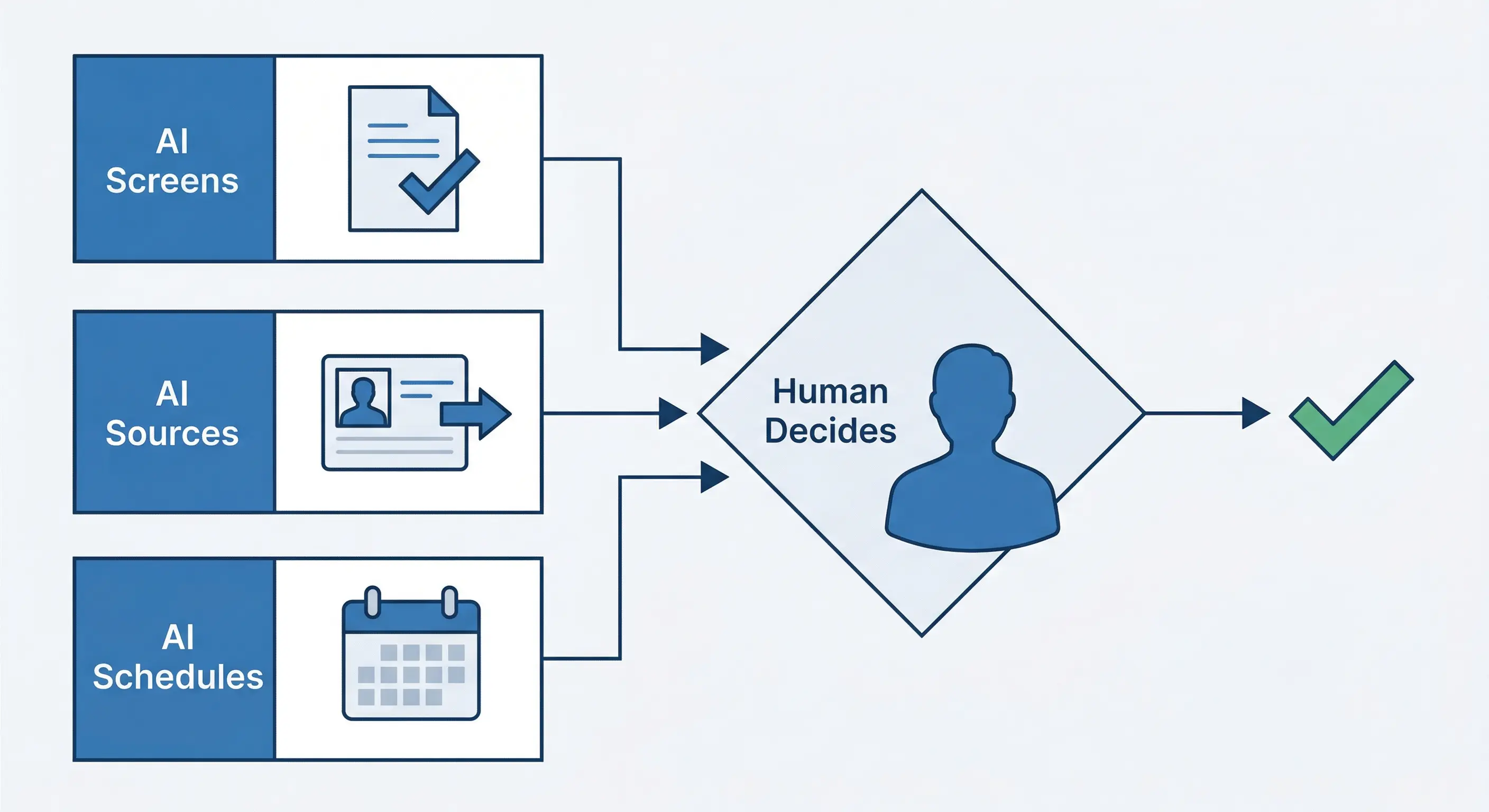
Final hiring decisions. The call on who gets hired belongs to you and the hiring manager. Hiring decisions carry legal, cultural, and relational weight that no AI system fully accounts for. The agent surfaces the best candidates; the decision is yours.
Bias auditing. AI models can replicate patterns from historical training data, including patterns you would not want repeated. If your past shortlists underrepresented certain candidate profiles, an AI trained on that data will continue the pattern. Regular output audits are a requirement, not optional.
GDPR and data compliance. AI agents processing candidate data at scale require human governance over consent workflows, data retention rules, and deletion requests. Compliance does not automate itself, and the legal responsibility stays with your agency.
High-touch candidate relationships. For executive search and senior roles, the quality of your relationship with candidate and client is part of the service you provide. AI handles the administrative work; the relationship stays with you.
Research consistently shows that candidates accept AI in early-stage screening when a human makes the final hiring decision. Build your workflows with that expectation maintained clearly.
How to Start Using AI Agents in Your Recruitment Workflow
You do not need to overhaul everything at once. Starting with one well-chosen use case and measuring it properly is more effective than a broad rollout.
- Find your biggest time drain. Track where your team loses the most hours each week. Screening, scheduling, and candidate follow-up are the most common culprits in agency environments.
- Pick one use case and prove it. Resume screening or interview scheduling deliver the highest ROI with the lowest implementation complexity for most agencies. Master one before expanding to others.
- Stay inside your existing stack. Standalone AI agents that operate outside your ATS or CRM create data fragmentation and extra admin. Look for platforms where AI features are native to the workflow, not bolted on from outside.
- Set a monthly review cadence. Review shortlist accuracy, outreach response rates, and scheduling error rates. AI agents improve with feedback, but only when someone is reviewing the outputs and adjusting the inputs.
The recruitment automation guide covers how automation layers across the full hiring funnel, which gives useful context before you build your rollout plan.
Frequently Asked Questions
What is an AI agent in recruitment?
An AI agent in recruitment is an autonomous program that handles multi-step hiring tasks without requiring a human trigger at each step. Unlike a chatbot or a basic workflow rule, an AI agent chains actions, makes contextual decisions, and completes entire workflow segments independently. Common examples include screening agents, sourcing agents, scheduling agents, and outreach agents.
How is an AI agent for recruitment different from a standard ATS?
An applicant tracking system (ATS) tracks and manages candidates through a structured pipeline. It’s a database and workflow tool, not an autonomous actor. An AI agent built on top of or inside an ATS takes actions: it sources candidates, evaluates fit, drafts messages, and schedules meetings without manual prompting. The ATS records what happens; the AI agent makes things happen.
Are AI agents safe to use in the hiring process?
Yes, when used in the right parts of the process. AI agents are well-suited for screening, sourcing, scheduling, and outreach. They should not make final hiring decisions. You also need to audit AI outputs for bias regularly and ensure your data handling is GDPR-compliant.
Which use case should a recruitment agency start with?
For most agencies, resume screening delivers the fastest measurable return because it reduces the most time-consuming daily task directly. If interview coordination is your bigger bottleneck, start there instead. Identify where your team loses the most hours and use that as your starting point, then measure results for 30 days before expanding.
Will AI agents replace recruiters?
No. AI agents remove the administrative and logistical load from recruiting, not the judgment. The work that matters most in recruitment, understanding what a client actually needs, assessing whether a candidate will succeed in a specific culture, and building relationships that generate repeat business, requires experience and trust that AI cannot replicate. AI agents make you more productive, not redundant.
The Shift Is Already Underway
The agencies pulling ahead right now are not waiting for AI agents to become mainstream. They’re building one use case at a time, measuring the results, and expanding from there. The opportunity is not to replace what you’re good at. It’s to stop spending the majority of your day on tasks that software handles faster and more consistently than any person can.
ATZ CRM gives you the AI features to make that shift, from smart candidate matching and automated outreach to full workflow automation, starting at $12 per user per month with an unlimited free trial. Book a demo and see how it works inside a live recruitment environment.