 EN
EN DE
DE ES
ES FR
FR NL
NL PT
PTLast Updated: · ATZ CRM Editorial Team · Recruiting · 8 min read
How Recruiters Can Create a Strategic Hiring Framework in 30 Days
Build a structured Strategic Hiring Framework that transforms reactive recruiting into a repeatable system with defined workflows, talent pipeline planning, and measurable hiring performance.
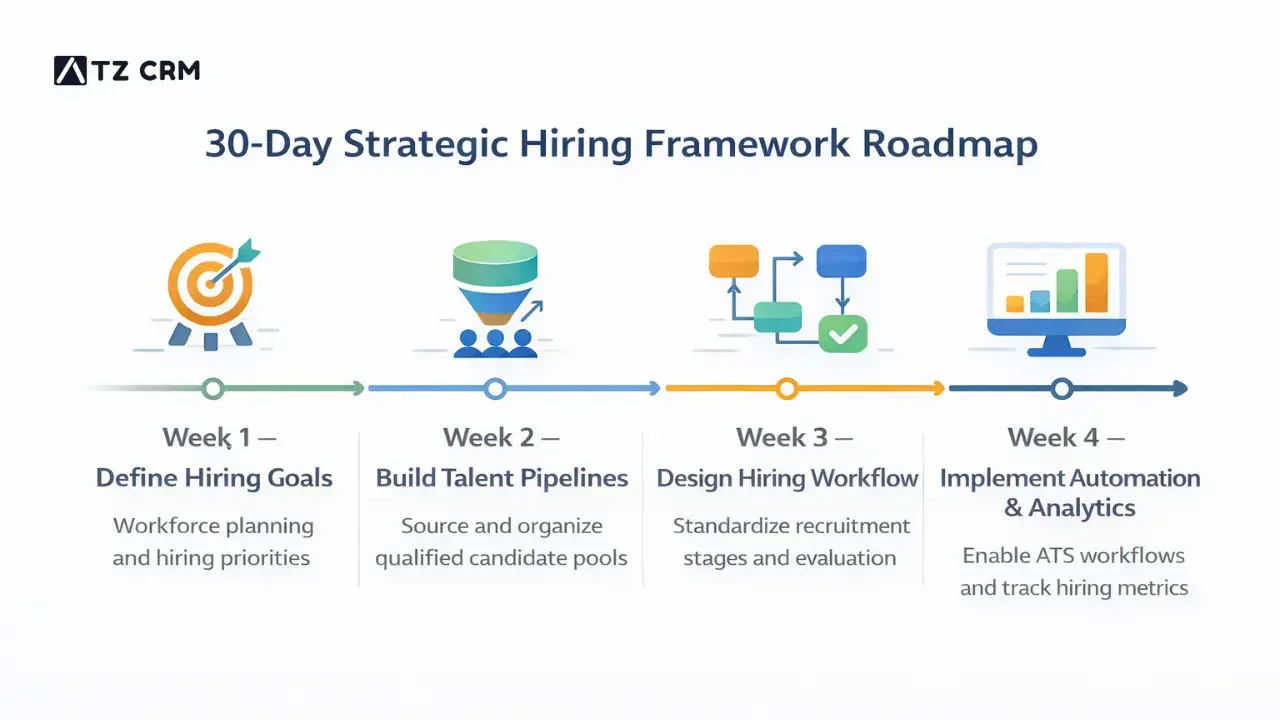
Quick Answer: A Strategic Hiring Framework can be built in 30 days by following a four-week process: Week 1 - Define hiring objectives and workforce needs, Week 2 - Build talent pipeline strategy, Week 3 - Design structured recruitment workflows, Week 4 - Implement recruiting automation and analytics. This transforms reactive hiring into a repeatable, data-driven system.
Recruiters rarely struggle because they lack sourcing skills. The real problem is the operational structure. Many recruiting teams work role-by-role, reacting to urgent vacancies instead of running a structured hiring operation. When pipelines are unorganised, and workflows rely on spreadsheets or email threads, delays quickly appear—interviews get rescheduled, candidate feedback is lost, and time-to-fill stretches longer than expected.
This is where a Strategic Hiring Framework becomes critical. A structured framework transforms hiring from a reactive activity into a repeatable system. Instead of starting from scratch for every role, recruiters operate with a defined process that supports talent pipeline planning, recruiting automation, and measurable hiring performance.
For staffing agencies, executive search firms, and internal HR teams, building a Strategic Hiring Framework within 30 days is achievable when the process is broken into clear operational stages. The key is aligning hiring strategy, workflow management, technology, and recruiting metrics into one structured system.
Why Recruiting Teams Struggle Without a Strategic Hiring Framework
Many recruiting teams assume hiring inefficiencies come from limited candidate supply. In reality, the issue often lies in workflow structure.
Without a defined framework, hiring typically looks like this:
- Recruiters manually track candidates in spreadsheets
- Hiring managers provide inconsistent feedback timelines
- Interview scheduling depends on email coordination
- Candidate pipelines lack visibility
- Leadership cannot forecast hiring capacity
The result is operational friction across the hiring process.
Research from the Society for Human Resource Management(SHRM) shows that structured recruitment methods help organisations evaluate candidates more consistently, reduce bias, and improve hiring efficiency across interview and decision-making stages.
For recruiters, this translates directly into operational pressure:
- Slower time-to-fill
- Lower placement rates
- Inconsistent candidate experience
- Unpredictable pipeline performance
A structured framework replaces reactive recruiting with data-driven recruiting operations.
What Is a Strategic Hiring Framework in Recruitment?
A Strategic Hiring Framework is a structured system used by recruiters to plan, manage, and optimise hiring through defined workflows, talent pipeline management, recruiting automation, and measurable hiring metrics.
Instead of relying on ad-hoc recruiting efforts, the framework creates repeatable processes that support consistent hiring performance.
A well-designed framework includes several operational pillars:
1. Talent Pipeline Strategy
Recruiters continuously source and nurture candidates before roles open.
2. Recruitment Workflow Management
Every stage—from sourcing to offer—follows a standardised hiring process.
3. Hiring Technology Integration
ATS software and recruiting CRM systems manage candidate tracking and workflow automation.
4. Data-Driven Decision Making
Recruitment analytics measure performance indicators like time-to-fill and interview conversion rates.
5. Candidate Experience Strategy
Communication, scheduling, and feedback are structured to maintain engagement.
Together, these elements transform hiring into a predictable operational system rather than a reactive process.
Related Read: Insider recruitment marketing strategies to boost your hiring game!
How to Build a Strategic Hiring Framework in 30 Days
Recruiters often assume building a hiring framework requires months of planning. In practice, a focused four-week implementation cycle can establish the core structure.
Week 1: Define Hiring Objectives and Workforce Needs
The first week focuses on aligning hiring with organisational goals.
Recruiters should analyse:
- Upcoming hiring demand
- Business growth projections
- Priority roles and departments
- Recruiter capacity
Key actions include:
- Identifying recurring roles that require continuous pipelines
- Defining hiring success metrics
- Mapping stakeholder responsibilities
This step ensures the hiring strategy supports strategic workforce planning rather than short-term recruitment.
Week 2: Build a Talent Pipeline Strategy
Once hiring priorities are clear, recruiters must develop a talent pipeline for recurring roles.
Instead of sourcing only when a vacancy opens, recruiters build candidate communities around high-demand skills.
Effective pipeline strategies include:
- Proactive candidate sourcing
- Talent pool segmentation by role type
- Candidate relationship management through recruiting CRM platforms
- Automated candidate engagement campaigns
Recruiters who build pipelines early significantly reduce sourcing time when positions open.
Research from LinkedIn hiring insights shows that candidate experience plays a major role in employer perception and offer acceptance decisions, with candidates significantly more likely to accept job offers when they have a positive application and interview experience.
Week 3: Design a Structured Recruitment Workflow
The third week focuses on operational execution.
Recruiters define every stage of the hiring process so that candidates move through a consistent evaluation pipeline.
A typical structured hiring workflow includes:
- Candidate sourcing
- Resume screening
- Recruiter interview
- Hiring manager interview
- Technical assessment
- Final interview
- Offer stage
A clear workflow structure enables hiring process optimisation and prevents delays between stages.
At this stage, recruiters also define:
- Feedback deadlines for hiring managers
- Interview evaluation criteria
- Candidate communication protocols
This ensures all stakeholders follow the same process.
Week 4: Implement Recruiting Automation and Analytics
The final stage involves enabling the framework with technology.
Modern recruiting teams rely on enterprise recruitment systems to manage hiring workflows.
These systems provide:
- Automated candidate tracking
- Interview scheduling tools
- Recruiting analytics dashboards
- Collaboration tools for hiring managers
Recruiting automation reduces administrative workload and allows recruiters to focus on candidate evaluation and relationship building.
At this point, the hiring framework transitions from planning to operational execution.
Related Read: Recruitment Strategies for Agencies: Proven Tactics to Attract Better Candidates
How a Strategic Hiring Framework Improves Recruiting Metrics
Recruiting performance is ultimately measured through operational metrics.
A structured hiring framework directly improves several key indicators:
Time-to-Fill
Standardised workflows reduce delays between interview stages.
Pipeline Velocity
A consistent talent pipeline ensures recruiters always have qualified candidates available.
Candidate Conversion Rates
Structured interviews improve candidate evaluation accuracy.
Recruiter Productivity
Automation reduces manual administrative tasks.
Offer Acceptance Rate
Improved candidate experience increases offer acceptance likelihood.
By tracking these metrics through recruiting analytics dashboards, recruiters gain visibility into hiring performance and identify process improvements.
Manual Recruiting vs Strategic Hiring Framework
Many organisations still rely on manual recruiting workflows. This creates operational inefficiencies that slow hiring performance.
Related Read: How to Identify Genuine Skills vs. Exaggerated Experience in Job Applications
| Manual Recruiting | Strategic Hiring Framework |
|---|---|
| Recruiters track candidates in spreadsheets | Centralised ATS pipeline tracking |
| Interview coordination via email | Integrated interview scheduling |
| Feedback often delayed | Structured evaluation timelines |
| Limited pipeline visibility | Real-time recruiting analytics |
| Hiring decisions inconsistent | Standardised hiring criteria |
Moving from manual recruiting to structured hiring systems improves workflow efficiency and hiring consistency.
Related Read: Best Affordable Recruitment Software in 2026
Common Mistakes When Building a Hiring Framework
Recruiting teams often attempt to build frameworks but overlook operational details.
Common mistakes include:
Ignoring Workflow Standardisation
Without clear stages, recruiters revert to ad-hoc hiring practices.
Lack of Hiring Metrics
Recruiting performance cannot improve without measurable KPIs.
Poor Hiring Manager Alignment
If hiring managers do not follow defined processes, the framework breaks down.
Over-Reliance on Manual Tools
Spreadsheets cannot support scalable recruitment operations.
Avoiding these mistakes ensures the framework remains sustainable as hiring demand grows.
Related Read: Top 10 background check sites for recruiters for better Hiring
How AI and Recruiting Automation Strengthen Hiring Frameworks
Artificial intelligence is increasingly shaping how recruiters manage hiring workflows.
AI tools enhance strategic hiring frameworks through:
- Automated resume parsing
- Candidate ranking algorithms
- Interview scheduling automation
- Predictive hiring analytics
Recruiters benefit by reducing time spent on repetitive tasks while gaining deeper insight into hiring performance.
AI also improves candidate experience strategy by enabling automated communication workflows that keep candidates informed throughout the process.
As recruiting volumes increase, automation becomes essential for maintaining consistent hiring operations.
Related Read: 11 AI Recruiting Tools You Can’t Afford to Ignore
How Growing Agencies Should Implement Hiring Frameworks
Growing recruiting agencies experience operational challenges as teams expand.
A framework that works for two recruiters may break down when the team grows to twenty.
Scaling hiring operations requires:
- Standardised recruiting workflows
- Centralised candidate databases
- Automated task management
- Consistent reporting metrics
When agencies implement these systems early, they avoid operational chaos during periods of rapid growth.
Platforms such as ATZ CRM help recruiting teams manage candidate pipelines, workflow automation, and recruiting analytics within one platform, making it easier to maintain structured hiring operations as teams scale.
Related Read: Recruiting Chatbot: A Quick Guide, +8 Best Tools
What High-Performing Recruiting Teams Do Differently
Top recruiting organisations treat hiring as an operational system rather than an administrative task.
They focus on:
- Proactive talent pipeline management
- Clearly defined hiring workflows
- Data-driven recruiting decisions
- Consistent candidate engagement
- Automation-driven productivity improvements
This approach allows recruiting teams to manage higher hiring volumes without sacrificing candidate quality or recruiter efficiency.
Over time, the strategic hiring framework becomes a competitive advantage.
Related Read: International Recruiting: How to Access the Top 1% of Global Talent
Frequently Asked Questions
What is a strategic hiring framework?
A strategic hiring framework is a structured system that defines hiring workflows, talent pipeline management, recruitment metrics, and technology usage to improve hiring consistency and recruiting performance.
How long does it take to build a hiring framework?
Most recruiting teams can establish a foundational hiring framework within 30 days by defining hiring goals, building talent pipelines, designing workflows, and implementing recruiting automation tools.
Why do recruiters need a hiring framework?
A structured framework improves hiring efficiency, reduces time-to-fill, strengthens candidate pipelines, and enables data-driven recruiting decisions across hiring teams.
What role does technology play in hiring frameworks?
ATS platforms and recruiting CRM systems automate candidate tracking, manage hiring workflows, and provide analytics that help recruiters optimise hiring performance.
Can small recruiting teams use strategic hiring frameworks?
Yes. Even small recruiting teams benefit from structured workflows and talent pipeline management, especially as hiring demand increases and recruitment operations scale.
Building a Recruitment System That Delivers Consistent Results
Recruiting success rarely comes from sourcing alone. It comes from operational structure. A well-designed Strategic Hiring Framework aligns hiring strategy, workflow management, recruiting automation, and analytics into a repeatable system that improves both recruiter productivity and hiring outcomes.
For teams managing complex hiring pipelines, platforms like ATZ CRM help operationalise these frameworks through centralised candidate management and automated workflows. When the right technology supports the right structure, recruiting becomes far more predictable.