 EN
EN DE
DE ES
ES FR
FR NL
NL PT
PT
Quick Answer: RevOps (Revenue Operations) connects your sales, delivery, and finance teams through shared metrics, unified tools, and aligned accountability. Instead of operating in silos, your BD team, recruiters, and finance work from the same pipeline data, making revenue predictable rather than accidental. Most staffing agencies can build a functional RevOps foundation within 60-90 days.
You’ve built a staffing agency that works. You’re winning clients, placing candidates, and billing consistently. But somewhere between the BD team closing a job order and the finance team closing the month, things get messy. Revenue feels unpredictable. Recruiters and account managers are pulling in different directions. Month-end surprises become the norm.
This is exactly the problem that RevOps for staffing agencies is designed to solve.
Revenue operations for recruitment agencies work the same way — it’s a framework built around one goal: getting your sales and delivery alignment right so revenue becomes predictable, not accidental. It started in SaaS, but the principles translate directly to staffing. If anything, staffing agencies need it more because the revenue cycle is faster, the dependencies are tighter, and the margin for error is smaller.
This blog breaks down what RevOps actually means in a staffing context, why most agencies are operating without it, and how to build the foundation — step by step.
What Is RevOps - And Why Staffing Firms Should Care
RevOps stands for Revenue Operations. The core idea is simple: instead of letting your sales team, delivery team, and finance team operate in separate silos, you connect them through shared metrics, shared tools, and shared accountability.
In a typical B2B SaaS company, RevOps spans Marketing, Sales, and Customer Success. In a staffing firm, those three functions look different — but the logic is identical.
Your revenue depends on three things happening in sequence:
- A client gives you a job order (Sales)
- You fill it with the right candidate on time (Delivery)
- You get paid correctly and on schedule (Finance)
If any of these breaks down — or if they don’t talk to each other — you lose money. Not dramatically, usually. Just quietly, consistently, in ways that are hard to trace.
RevOps closes those gaps. It creates a connected system where every team sees the same data, operates from the same pipeline, and works toward the same revenue targets.
It Started in SaaS. Here’s Why It Applies to You Too.
According to Forrester, organizations that deployed a RevOps model grew revenue nearly three times faster than those that didn’t — and achieved up to 28% more profitability.
In SaaS, the problem is this: Marketing generates leads that Sales can’t convert. Sales closes deals that Customer Success can’t retain. And Finance has no visibility into where revenue will come from next quarter.
In staffing, the version of this problem looks like:
- BD brings in job orders that Recruiting can’t fill on time
- Recruiting fills roles that don’t match the original brief
- Finance is forecasting billing from a spreadsheet that’s three weeks out of date
Same dysfunction, different industry. A structured staffing firm revenue growth strategy built on RevOps fixes it the same way — by aligning the teams, standardising the data, and building visibility into the revenue cycle end to end.
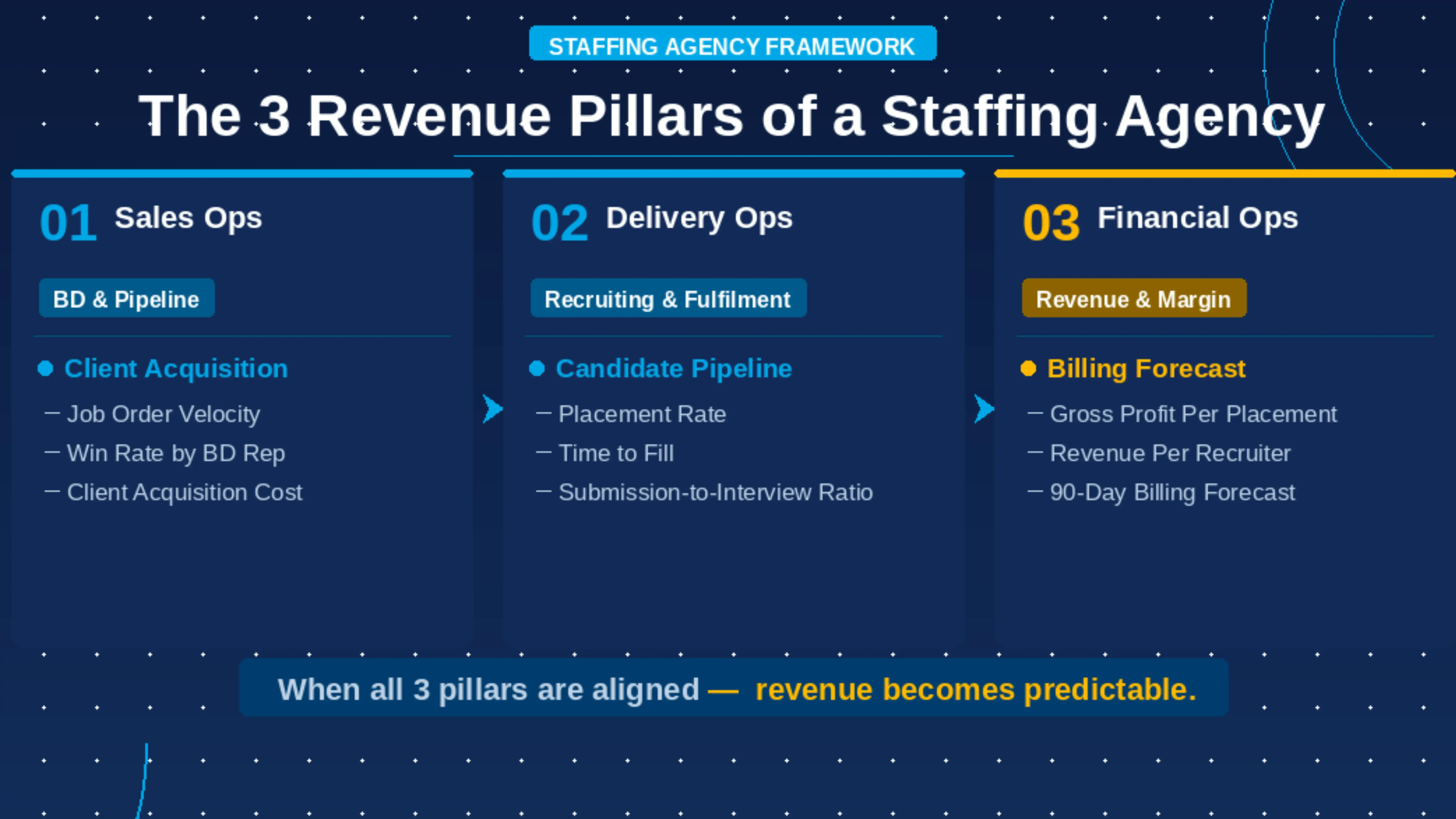
The 3 Revenue Pillars of a Staffing Agency
The classic RevOps model has three pillars. Here’s what they mean in staffing language.
Pillar 1 - Sales Ops: Client Acquisition and Job Order Flow
This is your business development function. It covers everything from prospecting a new client to receiving a confirmed job order.
The metrics that matter here:
- Client acquisition cost — how much does it cost to win a new account?
- Job order velocity — how quickly do job orders move from ‘received’ to ‘active’?
- Win rate by BD rep — what percentage of pitches convert?
- Job order source — which channels or relationships bring the highest-value clients?
Most staffing agencies track some of this informally. The RevOps approach is to make it systematic — CRM pipeline alignment in staffing means defined stages, consistent data entry, and reports that show exactly where deals are stalling.
Without this, you can’t forecast. You’re waiting to see what lands, rather than knowing what’s coming.
Pillar 2 - Delivery Ops: Candidate Pipeline and Placement Rate
This is where most staffing agencies have the most complexity — and the least visibility. Delivery Ops covers the journey from ‘job order active’ to ‘candidate placed and billing’.
Key metrics:
- Placement rate by recruiter — who’s converting, and who isn’t?
- Time to fill — how long from job order to accepted offer?
- Candidate pipeline contribution — how many qualified candidates are ready to deploy per role?
- Submission-to-interview ratio — are your shortlists landing?
The connection between Sales Ops and Delivery Ops is the handoff. When a job order is confirmed, does the right recruiter get it immediately? Do they have context — rate card, client preferences, previous hires? Or does that information live in someone’s inbox?
That handoff is where most agencies quietly lose money.
Pillar 3 - Financial Ops: Billing Forecast and Gross Profit Tracking
Revenue isn’t real until it’s billed and collected. Financial Ops brings discipline to the back end of your revenue cycle.
This pillar covers:
- Billing cycle forecasting — what’s expected to bill this week, this month, next quarter?
- Gross profit per placement — are you hitting your margin targets per role?
- Revenue per recruiter — how much billable revenue does each team member generate?
- Contractor billing vs perm fees — how is your revenue mix shifting over time?
Without this, finance is always reactive. Chasing timesheets, reconciling rates, and discovering billing errors after the fact. RevOps makes this proactive — billing forecasts are built from live CRM and ATS data, not from memory.
Related Read: Switch to ATZ CRM: 7 Powerful Reasons to Upgrade Now
What Breaks When These 3 Pillars Are Misaligned
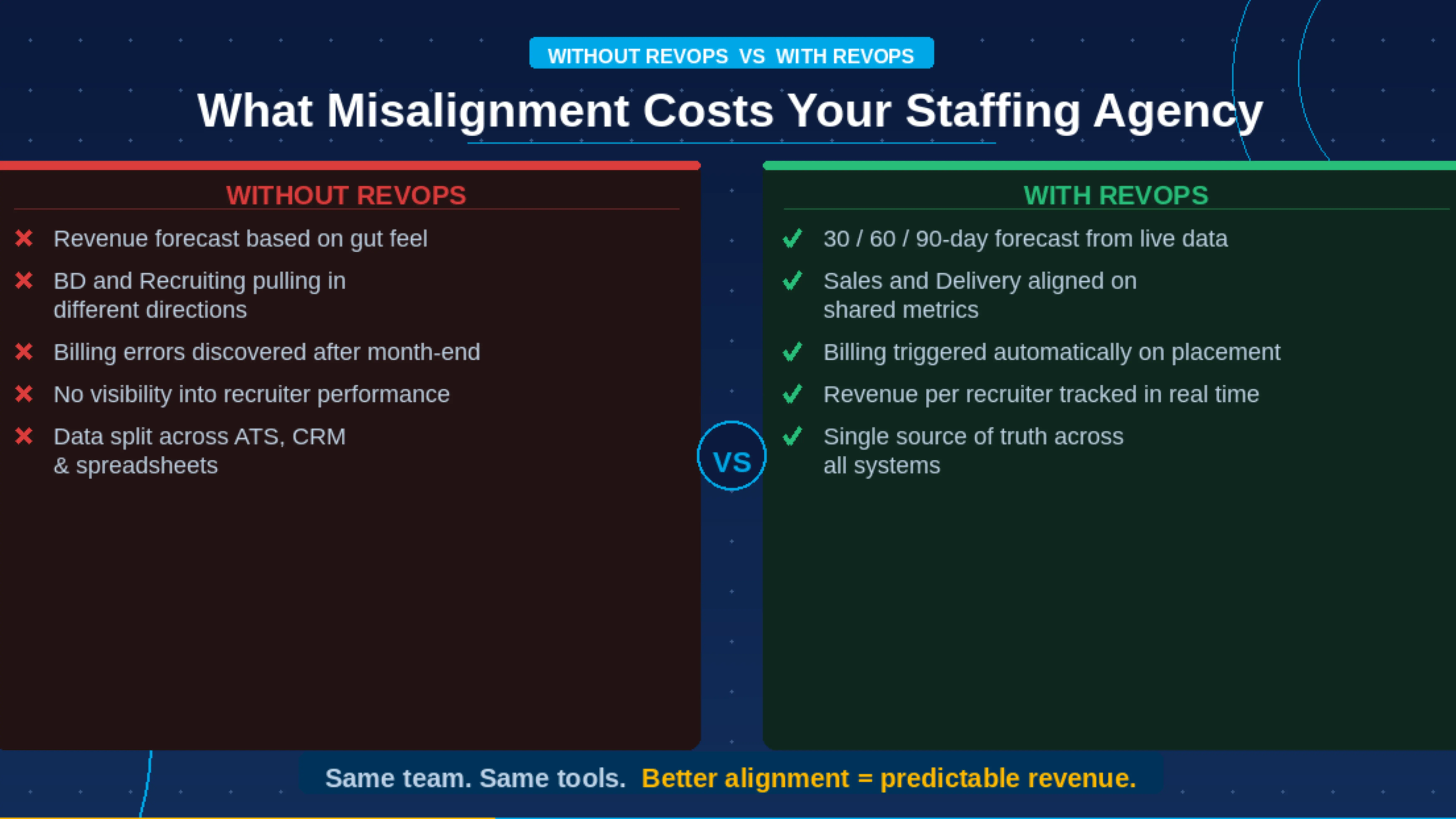
Misalignment between these three areas is the root cause of most staffing revenue problems. It rarely shows up as one catastrophic failure. It shows up as consistent friction — small leaks that, together, cost you significant gross profit every month.
The Forecasting Problem
Ask most staffing agency owners what revenue they’re expecting next month. Most will give you a number — but when you dig into it, that number is based on gut feel, not data.
A RevOps approach changes this. When your CRM tracks job order stages, your ATS tracks submission progress, and your billing system records contractor hours — you can build a genuine 30/60/90-day revenue forecast. Not a guess. A pipeline.
Staffing agency billing forecast accuracy — driven by live ATS data, not spreadsheets — is a genuine competitive advantage. Agencies that can forecast reliably can hire ahead of demand, commit to clients with more confidence, and make investment decisions without crossing their fingers.
The Accountability Gap
When Sales and Delivery operate independently, accountability gets fuzzy. A BD rep brings in a job order, hands it over, and moves on. If it doesn’t get filled, whose problem is it?
In a RevOps model, shared metrics create shared accountability. If the placement rate by recruiter is tracked and visible, everyone knows where the bottlenecks are. If job order velocity is measured from first contact to active, it becomes clear whether the issue is in sales, delivery, or the handoff between them.
This isn’t about blame. It’s about knowing where to focus.
The Data Silo Problem
This is the most common problem in staffing firms, and the most damaging. Your ATS has candidate data. Your CRM has client data. Your spreadsheet has billing data. And they don’t talk to each other.
ATS data governance — having clean, consistent, connected data across your systems — is foundational to RevOps. Without it, you can’t track revenue per recruiter, because the recruiter is in the ATS, but the revenue is in the billing sheet. You can’t measure client acquisition cost because the pitch is in the CRM, but the outcome is in someone’s email.
A single source of truth for your recruitment business isn’t a nice-to-have. It’s the operating system that makes everything else possible.
How to Build a RevOps Foundation in Your Staffing Agency
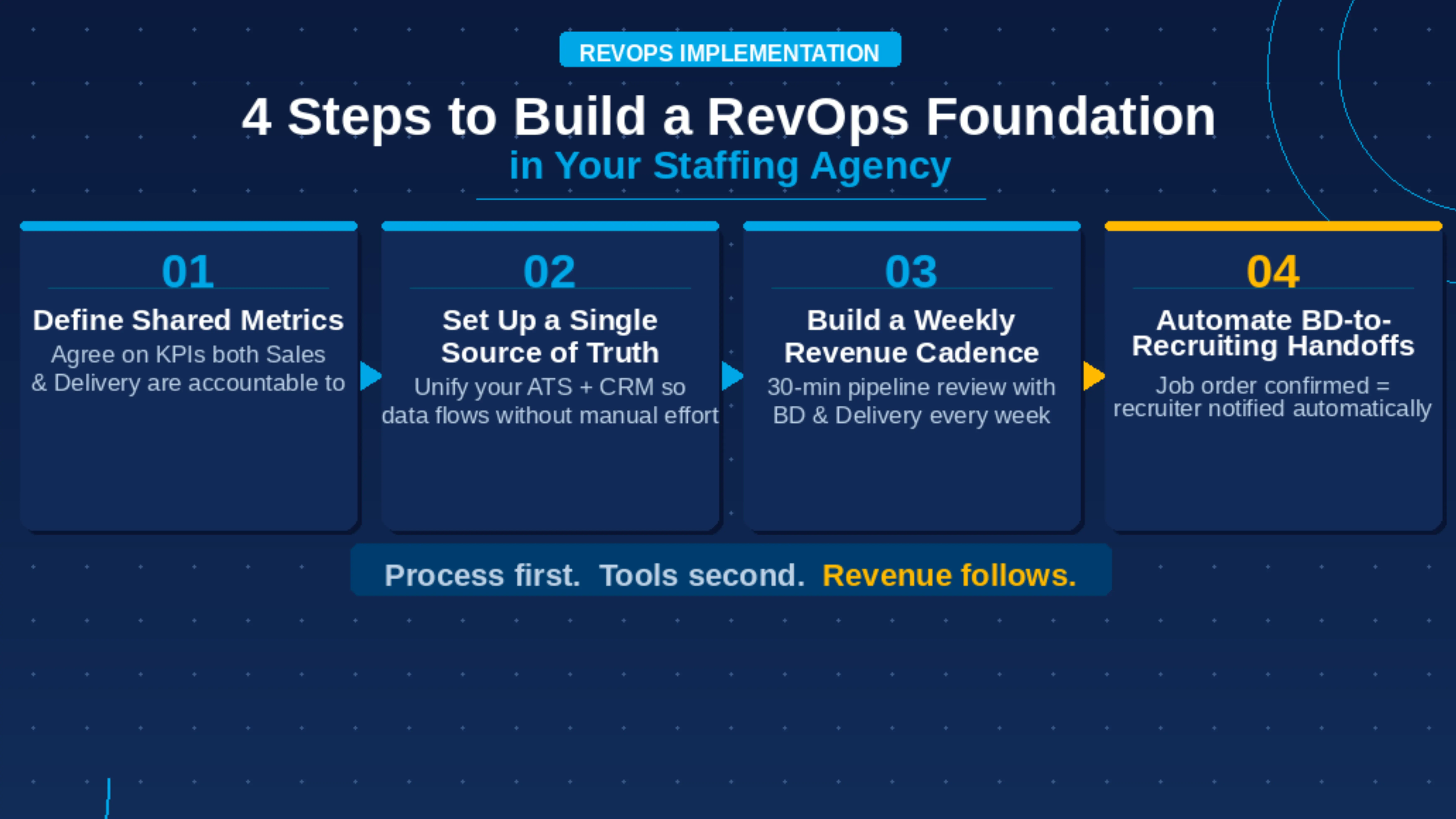
You don’t need a RevOps director or a six-figure consultancy to start. You need four things done well.
Step 1 - Define Shared Metrics Across Sales and Delivery
Start by agreeing on the numbers that both your BD team and recruiting team are accountable for. Not separate KPIs for each function — shared metrics that reflect the health of the whole revenue cycle.
A good starting list:
- Job order fill rate (targets Sales AND Delivery)
- Time to first submission (Delivery is accountable, Sales sets expectations)
- Revenue per recruiter (bridges delivery performance and financial outcomes)
- Gross profit per placement (ties every action back to margin)
Define these clearly. Document what counts as ‘filled’. Agree on what stage a job order moves to ‘active’. Shared definitions are as important as the metrics themselves.
Step 2 - Set Up a Single Source of Truth (Your ATS + CRM)
Your ATS and CRM need to function as one system, not two parallel systems with separate logins and disconnected data.
This is the technical foundation of RevOps. Harvard Business Review notes that companies with integrated data systems make faster, more accurate decisions. In staffing, that means: when a job order is created in the CRM, your ATS should reflect it. When a candidate is submitted, the CRM should update the pipeline stage. When a placement is confirmed, billing should be triggered automatically.
This integration is what turns your tech stack into a revenue engine instead of a data storage problem.
Step 3 - Build a Weekly Revenue Cadence
RevOps isn’t just a tech setup — it’s a rhythm. Set a fixed weekly meeting (30 minutes is enough) where BD and Delivery review the pipeline together.
Cover:
- Job orders in progress and their current stage
- Submissions in the last 7 days and outcomes
- Placements made and billing triggered
- Any job orders at risk of stalling or being lost
This meeting uses your CRM data as the agenda. Not status updates from memory — actual pipeline data. Over time, it becomes the most important meeting in your agency.
Step 4 - Automate Handoffs Between BD and Recruiting
Manual handoffs are where information dies. When a job order is confirmed, the recruiter assigned to it should receive an automatic notification with the full brief — rate, requirements, client preferences, and start date.
When a candidate reaches a key stage (interview confirmed, offer made, offer accepted), the BD rep should be notified automatically. This keeps them informed without requiring a separate update call.
Automating these handoffs reduces errors, reduces delays, and makes recruitment agency sales operations visible end-to-end — which is exactly what RevOps requires.
Related Read: 10 Ultimate Hacks to Boost Efficiency in Contract Staffing
How RevOps for Staffing Agencies Should Work - And What Tech Makes It Possible
RevOps in staffing lives or dies based on the quality of your tools. Not the number of tools — the quality and integration of them.
The core requirement is a platform that functions as both an ATS and a CRM, with pipeline management built in. When these systems are separate, you’re manually bridging a gap that should not exist. When they’re unified, the data flows naturally — from first contact to billing.
This is where ATZ CRM is purpose-built for the problem. It combines ATS and CRM functionality in a single platform, designed specifically for staffing agencies. Job orders, candidate pipelines, client accounts, BD activity, and billing data all live in one place — which means your RevOps setup doesn’t require expensive integrations or data reconciliation.
When evaluating your tech stack for RevOps, ask these questions:
- Can I see the job order stage and candidate status in the same view?
- Does a new placement automatically update billing forecasts?
- Can I track revenue per recruiter without exporting to a spreadsheet?
- Do BD activity and recruiting activity share a single timeline per client?
If the answer to any of these is ‘no’ or ‘not without manual effort’, your tech stack is creating friction instead of removing it.
Related Read: 10 Proven Recruiting Apps that make Hiring Shockingly Easy
RevOps Readiness Checklist for Staffing Agencies
Use this checklist to assess where your agency stands. Honest answers will tell you exactly where to start.
- Shared metrics defined — Sales and Delivery agree on the same KPIs
- CRM pipeline stages documented — Every stage is named, defined, and consistently used
- ATS and CRM integrated or unified — No manual bridging between candidate and client data
- Job order velocity tracked — You know the average time from order received to active
- Placement rate by recruiter visible — Each recruiter’s fill rate is measurable
- Gross profit per placement tracked — Margin is calculated per role, not just in aggregate
- Billing forecast in the CRM — Next 30/60/90-day billing is visible without a spreadsheet
- Automated BD-to-Recruiting handoff — Job order confirmed = recruiter notified automatically
- Weekly revenue cadence in place — BD and Delivery review pipeline together weekly
- Revenue per recruiter reportable — You can pull this number in under 60 seconds
- Client acquisition cost tracked — You know what it costs to win a new account
- ATS data governance policy exists — Everyone enters data the same way, every time
If you checked fewer than 8, you’re running on intuition, not infrastructure. RevOps would make an immediate, measurable difference.
If you checked 8-10, you have the foundation. Now it’s about tightening the system and making forecasting reliable.
If you checked 11-12, your RevOps foundation is strong. Focus on refining metrics and scaling with confidence.
Related Read: Temporary Staffing 101: The Ultimate Guide to Scaling Workforce
The Hidden Cost of Sales and Delivery Misalignment in Staffing
There’s a specific cost that most staffing agencies don’t measure — the revenue lost between job order received and job order filled.
Think about it this way: your BD team works hard to bring in a job order. That job order has a value. If it’s not filled, that value disappears. If it’s filled late, you may lose the client’s confidence. If it’s filled with the wrong candidate and results in an early exit, you may need to fill it again at no additional fee.
Headcount scaling vs. revenue scaling is one of the most persistent challenges in staffing. Agencies add recruiters expecting revenue to grow proportionally — but without RevOps, each new hire also adds complexity. More handoffs. More data silos. More inconsistency.
RevOps reverses this. As your headcount grows, the system keeps everyone aligned. New recruiters plug into the same process. New BD reps follow the same pipeline. Finance sees the same forecast data regardless of team size.
That’s how you scale without chaos.
How Staffing Agencies Can Use RevOps to Improve Client Retention
Most staffing agencies think about revenue as a client acquisition problem. Get more job orders, fill more roles, and bill more. But the agencies with the most stable revenue aren’t necessarily winning the most new clients — they’re losing fewer existing ones.
Client retention in staffing is directly tied to delivery consistency. A client stays when you fill roles on time, at the right rate, with candidates who stick. They leave when you miss a deadline, send poor-fit submissions, or make them feel like they’re chasing you for updates.
RevOps gives you the data to catch retention risk before it becomes a lost account.
Here’s what to track per client account:
Fill rate trend — is your placement rate with this client going up or down over the last 90 days?
Time to fill trend — are you getting slower with this client? That’s a warning sign they’re shopping around.
Candidate tenure — how long do your placements stay? Short tenure signals a briefing problem or a culture mismatch that will erode the relationship.
Job order frequency — how often does this client send new orders? A drop in frequency before a formal churn is almost always visible in the data first.
When your CRM tracks all of this at the account level, your BD team can act on declining signals before the client makes the call to switch. That’s a revenue protection mechanism most staffing agencies don’t have — because they’re not measuring it.
The staffing firm’s revenue growth strategy that compounds fastest is one that wins new clients and keeps the ones it already has. RevOps makes both possible from the same system.
What Good Recruiter Activity vs Revenue Attribution Looks Like
One of the most common frustrations for staffing agency owners is this: you have a busy team, everyone looks active, but revenue doesn’t reflect the effort. The link between recruiter activity and revenue is invisible.
RevOps fixes this by building attribution into your workflow — connecting specific recruiter actions to specific revenue outcomes.
Here’s what that looks like practically:
Step 1 — Define revenue-contributing activities. Not all recruiter activity drives revenue. Sourcing candidates, submitting to clients, conducting interviews, and managing offers are revenue-linked. Inbox management and internal meetings are not. Your CRM should track the former with timestamps.
Step 2 — Map activities to outcomes. Which recruiter’s submission led to the placement? Which sourcing method produced that candidate? When you can answer these questions from CRM data — not from asking the recruiter — you have attribution.
Step 3 — Build a weekly activity-to-revenue report. This doesn’t need to be complex. A simple table showing each recruiter’s submissions, interviews arranged, placements made, and revenue generated in the last 7 days tells you everything. Who’s converting? Who’s busy but stuck at the submission stage? Who needs support?
Step 4 — Use attribution to coach, not just measure. If one recruiter has a high submission rate but a low interview conversion, the problem is shortlisting. If another has strong interviews but low offer acceptance, the problem is offer management or candidate prep. Attribution makes these patterns visible so you can solve the right problem.
This level of visibility was once only available to large agencies with dedicated analytics teams. With a well-configured CRM and ATS, any agency can run it. The data is already there — it just needs to be structured and surfaced.
Related Read: Recruitment Strategies for Agencies: Proven Tactics to Attract Better Candidates
RevOps Across Multiple Offices: Why It Matters More as You Scale
A single-office staffing agency can run on relationships and informal processes for a long time. The owner knows every client. The lead recruiter knows every active candidate. Things get done through conversations.
The moment you open a second office — or hire a second delivery team — that model breaks. You can’t be in two places. Conversations don’t scale. And if each office is running its own version of the pipeline, with its own CRM practices and its own reporting, you’re not running one agency. You’re running two separate businesses under the same brand.
This is where RevOps pays its biggest dividends for growing staffing firms.
Standardised pipeline stages across offices. Every office uses the same job order stages, the same candidate stages, the same naming conventions. When a senior leader pulls a pipeline report, it reflects the whole business — not two different data models bolted together.
Shared performance benchmarks. When recruiter activity vs. revenue attribution is tracked consistently across offices, you can benchmark performance fairly. Which office has the faster fill rate? Which has a higher gross profit per placement? Without RevOps, these comparisons are impossible — or misleading.
Centralised billing forecast visibility. Finance doesn’t want to aggregate two spreadsheets at month-end. RevOps means the billing forecast is always live, always accurate, and always drawn from a single source — regardless of which office generated the revenue.
Cross-office candidate sharing. This is an underused advantage. When your ATS is the single source of truth across all offices, a candidate sourced in one location can be surfaced for a role in another. Without a unified system, that candidate sits invisible in one ATS while another office spends money resourcing from scratch.
Agencies that implement RevOps before they scale avoid the painful, expensive work of rebuilding processes mid-growth. Those that don’t often reach a headcount where the informal systems collapse, and spend six to twelve months fixing infrastructure instead of generating revenue.
Related Read: Contract Staffing: The Ultimate Agency Playbook for Success in 2026
Common RevOps Mistakes Staffing Agencies Make (And How to Avoid Them)
If you’re starting to implement RevOps, be aware of the mistakes that slow most agencies down.
Tracking Too Many Metrics at Once
RevOps requires focus. If you try to measure 20 things, you’ll act on none of them. Start with 4-5 metrics that directly connect your three pillars — job order fill rate, time to fill, gross profit per placement, revenue per recruiter, and billing forecast accuracy.
Add more once the core metrics are running cleanly.
Implementing Tools Before Defining Processes
Buying a new CRM won’t fix a misaligned team. The process has to come first — what stages does a job order move through? Who’s responsible at each stage? What data is required to move forward? Once that’s defined, the tool enforces it.
Tools automate processes. They don’t replace them.
Treating RevOps as a Finance Project
RevOps is not a reporting exercise. It’s an operational model. Finance will benefit from it — better forecasting, cleaner billing data, more predictable gross profit — but the change has to happen at the Sales-Delivery interface, not at the spreadsheet level.
If you delegate RevOps to finance without changing how BD and recruiting interact, you’ll get better reports on the same broken process.
Related Read: 5 Signs Your Recruitment Tracker is Costing You Candidates (And How to Fix It)
FAQs
What is RevOps in the context of a staffing agency?
RevOps aligns your sales, delivery, and finance teams around shared data and goals, making revenue more predictable and scalable.
How is RevOps different from regular sales operations in recruitment?
Sales ops covers BD only. RevOps connects sales, recruiting, delivery, and billing into one integrated, data-driven revenue system.
What metrics should a staffing agency track for RevOps?
Track job order fill rate, time to fill, gross profit per placement, revenue per recruiter, and 90-day billing forecast accuracy.
Do I need special software to implement RevOps at my staffing firm?
You need an integrated ATS CRM. Separate tools with manual bridging create the data silos that RevOps is designed to eliminate.
How long does it take to build a RevOps foundation in a staffing agency?
With the right system and team alignment, most agencies can build a functional RevOps foundation within 60 to 90 days.
You Don’t Need a RevOps Hire. You Need the Right System.
RevOps for staffing agencies is not a headcount decision. You don’t need to hire a Head of Revenue Operations. You need your existing teams to operate from a shared system, with shared visibility, toward shared goals.
The agencies that grow consistently — without the revenue rollercoaster, without the month-end surprises, without the chaos of scaling — aren’t necessarily bigger or better staffed. They’re just better connected. Their BD team knows what Delivery can handle. Their Delivery team knows what Finance needs. Their Finance team has a forecast they can actually rely on.
That’s what RevOps delivers. And in a staffing business where margins are tight and relationships move fast, it’s not a luxury. It’s the infrastructure that makes growth possible.
ATZ CRM is built specifically for staffing agencies navigating exactly this challenge — bringing together ATS functionality, CRM pipeline management, and billing visibility in one place.
If you’re ready to see what a RevOps-ready system looks like in practice, it’s worth a conversation.