 EN
EN DE
DE ES
ES FR
FR NL
NL PT
PT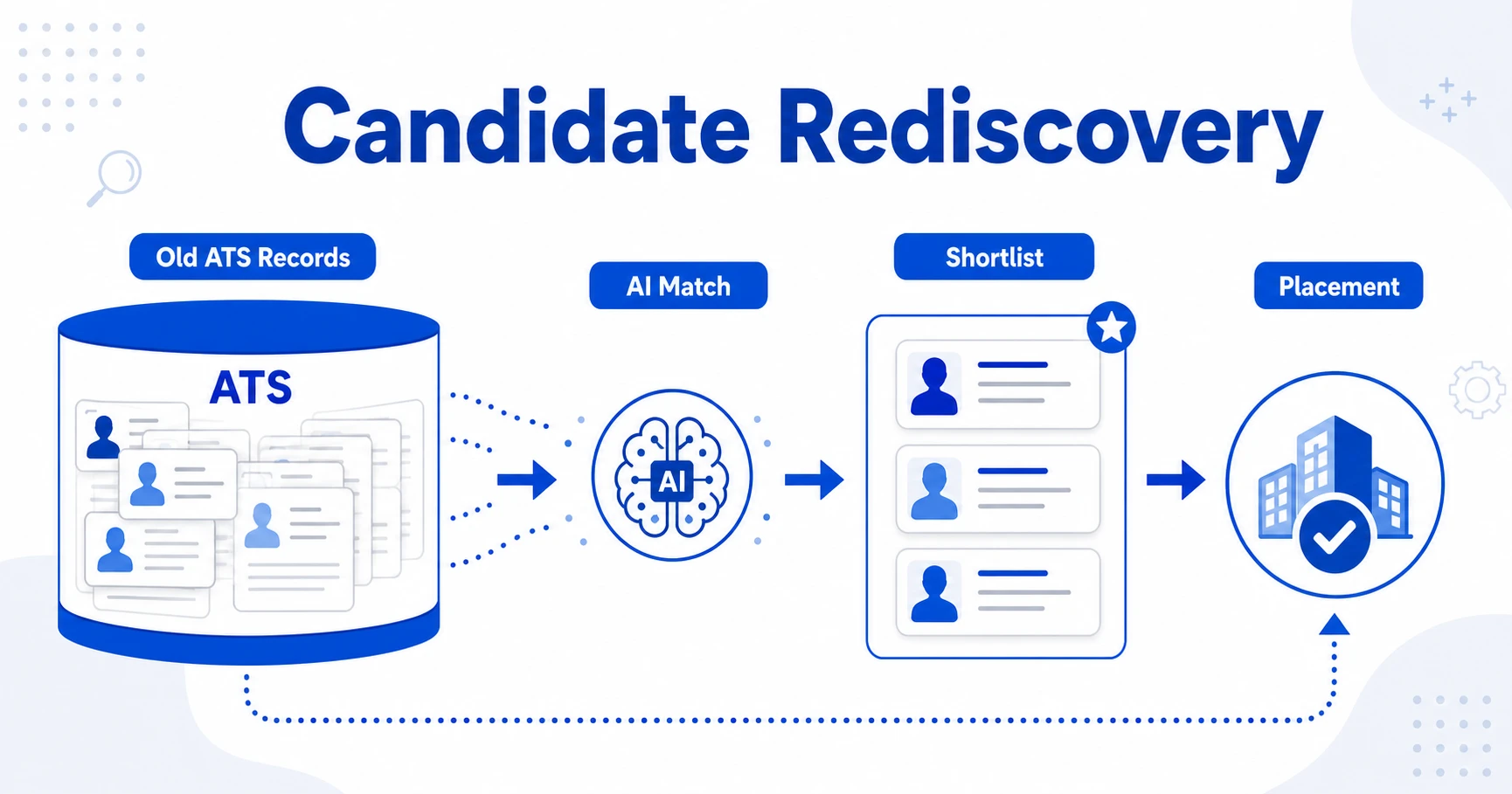




Quick Answer: Candidate rediscovery is the process of matching people already in your Applicant Tracking System (ATS) or recruitment database to new open roles before starting a cold search. For recruitment agencies, it turns past applicants, silver medalists, inactive profiles, and warm candidates into faster shortlists by combining clean data, AI matching, and personalized re-engagement.
What Is Candidate Rediscovery?
Rediscovery means searching your existing talent database before you look outside it. Instead of starting every job order with a fresh LinkedIn search or another job ad, you ask a better first question: who do we already know who could fit this role?
For agencies, that question is powerful. Your database contains past applicants, silver medalists, referred candidates, previous placements, people who went quiet, and candidates who were strong but not right for the role at the time.
Rediscovery is not the same as basic keyword search. Keyword search finds exact phrases. A stronger workflow looks for fit across skills, experience, notes, past conversations, location, timing, and similarity to candidates who have worked well before.
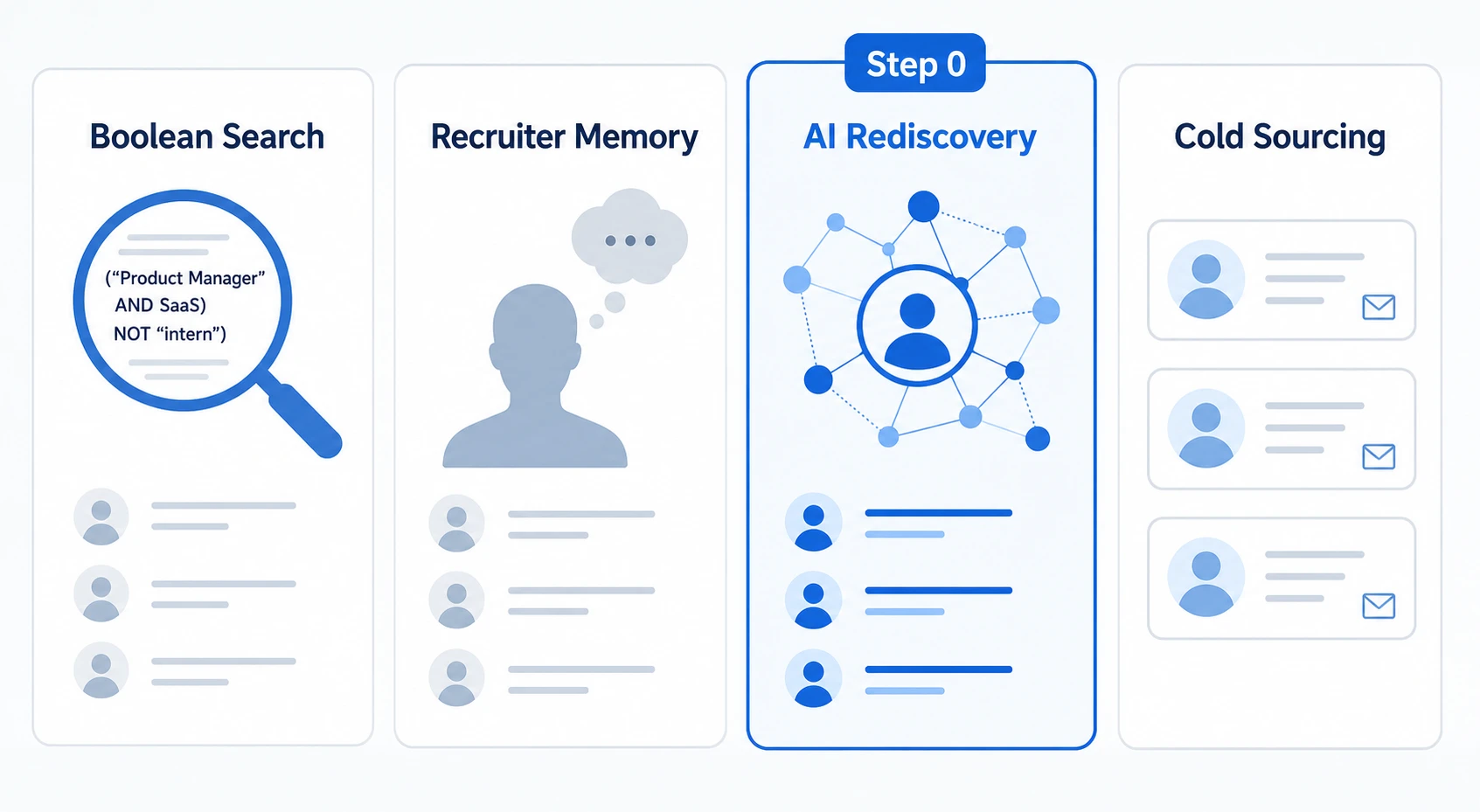
| Approach | What it searches | Strength | Weakness | Best use |
|---|---|---|---|---|
| Boolean database search | Exact keywords and fields | Precise when data is clean | Misses adjacent skills and outdated titles | Narrow technical searches |
| Manual recruiter memory | People the recruiter remembers | Relationship context | Does not scale across teams | Boutique shortlists |
| AI talent rediscovery | Skills, context, notes, similar profiles | Finds hidden fit faster | Needs clean data and human review | Step 0 for every new job order |
| Cold sourcing | External profiles and job boards | Expands reach | Slower and colder | When the database has no fit |
Why Recruiters Miss Strong Candidates Already in the ATS
Recruiters miss candidates for ordinary reasons. The profile is old. The title changed. The resume used different wording. The recruiter who knew the person left the agency. The note that explained the candidate’s real strengths lives in a field nobody searches.
That creates waste. Your agency may pay for new sourcing while strong candidates sit inside the ATS with no recent activity.
Data quality makes the problem worse. TestGorilla reported that IT recruiters cited outdated candidate data at 44% and tool integration gaps at 48% as major sourcing frustrations in its sourcing research. Even tech-heavy teams struggle when candidate information is stale or scattered.
Agencies feel this sharply because they work across multiple clients. A candidate rejected for one client may be excellent for another. A candidate who lacked one skill last year may have gained it since. A runner-up from a final interview may become the first call for a similar role.
How AI Talent Rediscovery Changes Database Search
AI-assisted rediscovery changes the search from “who has this exact phrase on a resume?” to “who looks relevant to this role, even if their profile uses different language?” That is a meaningful shift.
For example, a recruiter searching for a “customer success manager” might miss candidates titled account manager, implementation consultant, client onboarding lead, or renewals specialist. AI matching can identify the overlap in skills, responsibilities, and career patterns.
SHRM reports that AI use in HR is most common in recruiting at 27%, ahead of HR technology, learning and development, and employee experience in its 2026 AI in HR report. The same report notes that common AI use cases include resume parsing, interview scheduling, and candidate-job matching.
That does not mean AI should decide who gets submitted. Recruiters still need to judge motivation, salary fit, availability, client culture, and whether the candidate actually wants the move. AI should shorten the path to the right shortlist, not remove human judgment from the process.
The Step 0 Rediscovery Workflow for Every New Job Order
Rediscovery works best when it becomes a required first step. Before anyone posts the role, buys sourcing credits, or starts a cold search, run the database.
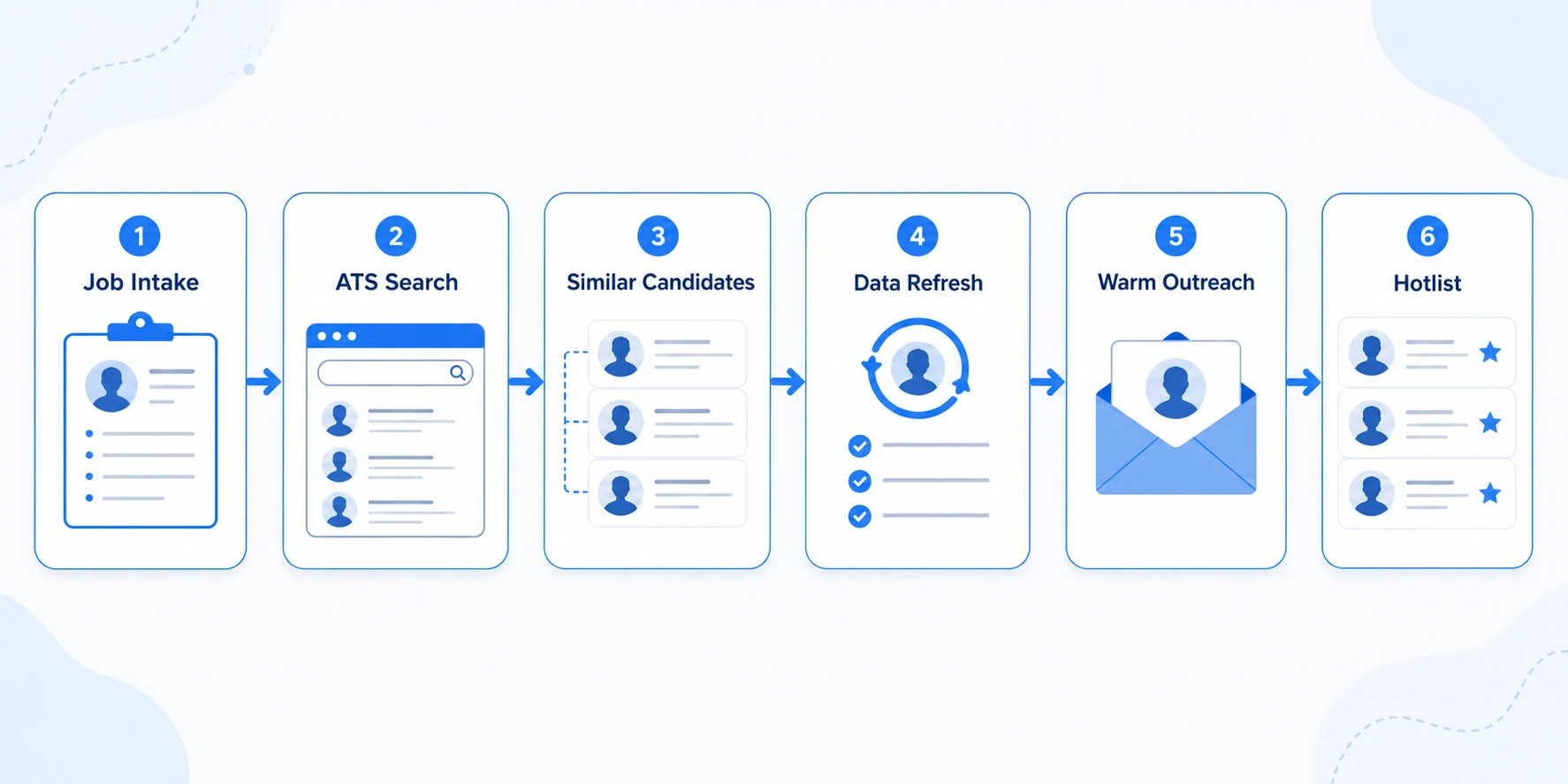
Use this workflow:
- Convert the job order into must-have skills, nice-to-have skills, location, salary, availability, and client-specific preferences.
- Search the existing ATS first using semantic or AI matching, not only Boolean keywords.
- Pull similar candidates from known strong profiles.
- Refresh outdated data with enrichment and recent activity checks.
- Segment candidates into ready now, warm nurture, and archive.
- Send personalized re-engagement based on the role, not a generic checking-in message.
- Save strong matches into a hotlist for future roles.
- Track rediscovery-to-submission and rediscovery-to-placement rates.
This workflow is especially useful for repeat roles. If your agency often fills nurses, developers, accountants, salespeople, drivers, or customer support roles, the database should become smarter each time you run a search.
LinkedIn’s 2025 Future of Recruiting report surveyed 1,271 recruiting professionals, including 252 search and staffing professionals according to its survey methodology. That matters because rediscovery is not only a corporate TA workflow. Search and staffing teams are part of the same shift toward more data-driven recruiting.
For agency teams, the operational value is simple: rediscovery gives delivery a head start while business development is still qualifying the role. If the client intake reveals a known profile, a similar past placement, or a warm candidate pool, your recruiter can talk about market supply with more confidence.
It also creates better intake discipline. When your team knows the database will be searched first, recruiters ask sharper questions about must-have skills, salary flexibility, remote policy, interview timing, and deal-breakers. Those details make both AI matching and human review more useful.
Before your next cold sourcing sprint, use ATZ CRM’s AI candidate matching to surface relevant profiles and similar candidates already in your database.
What Data to Clean Before Rediscovering Past Candidates
AI matching is only as useful as the data it can read. If your ATS is full of duplicate profiles, missing contact details, stale titles, and empty notes, rediscovery will disappoint you.
Start with the fields that directly affect reachability and fit:
- Current job title
- Core skills
- Location and remote preference
- Salary or rate expectations
- Availability
- Contact details
- Consent and communication preference
- Source history
- Recent notes
- Duplicate profile status
Do not wait for a perfect database. Clean as you go. Each time a recruiter touches a candidate profile, they should update the fields that help the next search.
Data enrichment for recruiters can help refresh stale records, but process still matters. If recruiters do not log useful notes after conversations, AI has less context to work with later.
How to Re-Engage Rediscovered Candidates Without Sounding Generic
Rediscovered candidates are warmer than cold prospects, but only if your message proves you remember why they mattered. A bland “just checking in” message wastes the advantage.
Use a simple structure:
- Remind them how you know them.
- Explain why this role connects to their background.
- Name the relevant skill, market move, salary band, or career step.
- Ask a low-friction question about timing or interest.
For example: “We spoke last year when you were leading onboarding projects in healthcare SaaS. I have a client opening now that needs someone who has handled complex implementation timelines, and your background stood out. Are you open to a quick conversation this week?”
That message works because it is specific. It does not pretend the candidate is just another row in a database.
Candidate nurturing workflows help when the candidate is not ready now. Put strong profiles into warm nurture, keep the relationship alive, and return when the timing improves.
How ATZ CRM Helps Recruiters Rediscover Candidates Faster
ATZ CRM brings rediscovery into the same workspace your team already uses for sourcing, pipeline management, outreach, and client delivery. That matters because database search fails when candidate data lives in too many places.
Use candidate sourcing tools and the CV library for recruiters to centralize candidate history. Then use AI Candidate Matching to rank relevant profiles against new jobs and Similar Candidate Finder to expand from a known strong candidate.
Once your team finds a fit, save candidates into hotlists. A hotlist turns a one-off search into a reusable talent pool for the next client with a similar need.
Teams evaluating dedicated rediscovery workflows can also compare how Candidate rediscovery tools surface prior applicants, refresh stale profiles, and turn older ATS records into warmer outreach lists.
The goal is not to automate the recruiter out of the workflow. The goal is to stop making recruiters start from zero when the database already contains people worth calling.
Frequently Asked Questions
What is talent rediscovery in recruiting?
Talent rediscovery is the process of matching people already in your ATS or recruitment database to new open roles. It helps recruiters find past applicants, silver medalists, inactive profiles, and warm candidates before starting a cold sourcing search.
How is rediscovery different from candidate sourcing?
Candidate sourcing usually means finding new people from external channels such as LinkedIn, job boards, referrals, or talent databases. Rediscovery starts inside your own ATS and asks whether someone you already know could fit the new role. Strong agencies use both, but rediscovery should happen first.
Can AI rediscover candidates without replacing recruiter judgment?
Yes. AI can rank likely matches, surface similar profiles, and search beyond exact keywords, but recruiters still need to review motivation, timing, compensation, client fit, and relationship context. The best workflow uses AI to shorten the search, then uses recruiter judgment to decide who should be contacted.
What candidate data should recruiters clean first?
Start with contact details, current job title, location, skills, salary expectations, availability, consent status, duplicate records, and recent notes. These fields have the biggest impact on whether rediscovered candidates are reachable, relevant, and safe to contact.
How do you re-engage a past candidate?
Reference the candidate’s history, explain why the new role is relevant, and make the message specific to their skills or career direction. Avoid generic check-ins. A strong re-engagement message feels like a recruiter remembered the person, not like a database campaign.
Which metrics prove talent rediscovery is working?
Track rediscovered candidates reviewed, rediscovered candidates contacted, reply rate, shortlist rate, submission rate, interview rate, placement rate, and time saved before external sourcing. If rediscovery is working, you should see faster shortlists and more warm conversations from your existing database.
Conclusion
Talent rediscovery is not a side tactic. For agencies with years of candidate history, it should be the first move on every new job order.
Cold sourcing still matters, but it should not be the default when your ATS already holds candidates who applied, interviewed, placed, referred, or almost made the cut before. Clean the data, run the match, review the shortlist, and contact the people who already know your agency.
ATZ CRM helps recruiters turn old ATS records into live shortlists with AI matching, similar candidate search, data enrichment, hotlists, and candidate nurturing workflows. Book a demo to see how your team can rediscover stronger candidates before starting another cold search: request an ATZ CRM demo.