Last Updated: · ATZ CRM Editorial Team · Recruitment · 12 min read
How to Use ChatGPT for Recruiting (+3 Real-World Use Cases)
Discover how ChatGPT can streamline your recruitment process with practical examples for email templates, interview questions, and job advertisements.

Quick Answer: How to Use ChatGPT for Recruiting in 2026
Best use cases: Writing job descriptions (save 2+ hours per role), crafting personalized outreach emails, generating interview questions, creating Boolean search strings, and drafting rejection emails. ChatGPT works best as a drafting assistant — always review and personalize the output before sending.
Introduction
ChatGPT, an automated artificial intelligence developed by OpenAI, is a tool that uses large language models (LLM) to help various individuals do a variety of tasks, and recruiters often use it for an efficient workflow, especially the requirement system.
Recruiting is a systemized process that lets the employer get in touch with new candidates to hire, and so it should be streamlined. Starting from the job listing itself to the various in-betweens of the recruitment process, like sourcing the candidates or maintaining an outreach conversation to generating interview questions and even integrating ChatGPT in the workspace. That is why employers should use ChatGPT for recruiting.
Various Uses of ChatGPT for Recruiting
Before delving deep into how it is used or how to generate the perfect prompt, this is a list of the various tasks where recruiters can use ChatGPT for recruiting to best utilize the AI’s ability to make the recruitment process streamlined and efficient.
Related Blog : The Ultimate Guide to Building and Managing Talent Pipeline
From even the smallest of tasks to even the tedious ones, recruiters and employers can use ChatGPT for recruiting through:
Finding meaningful keywords for the job description: AI models like ChatGPT can utilize their complex language models to identify the perfect keywords that are fit for the open role provided by the recruiter.
Crafting the perfect job description: AI can not only just help in finding the keywords but also can help craft them in sentences that create an impression on the candidate.
Response and outreach messaging: Client-to-employee, recruiter-to-candidate, employee-to-manager, etc., conversations can be easily maintained with pre-automated answers with AI generators. ChatGPT for recruiting is an excellent tool as it can even produce instantaneous replies to any queries, building trust between the two parties involved.
Email generation and template recreation: These are added benefits to AI’s LLM models; not only the response and messaging but also business emails can be created, alongside pre-automated emails.
Interview question generation: Interview question generation can also be done through the help of ChatGPT in the workspace, where recruiters can generate candidate-resume-specific and job-specific questions, perfect for each role.
Not only these, but recruiters often use ChatGPT for recruiting while drafting policies, conducting the market research, categorizing and selecting perfect candidates, generating informative surveys and questionnaires, and more.
Related Blog : Best RecruiterFlow Alternatives for Recruiting Firms
A strong grasp on the ability to craft the perfect prompt combined with AI like ChatGPT, alongside employee resources, makes the workflow spontaneous and smooth. This process of ease makes ChatGPT for recruiting, the perfect tool.
Creating the Perfect Prompt for Any Task
Creating a perfect prompt is quite essential for recruiters to integrate ChatGPT as a part of their daily workflow. A perfect prompt usually is considered as descriptive but devoid of unnecessary jargon, or complicated requests without prior context. The response of the ChatGPT output is directly correlated to the type of prompt that a recruiter uses; hence a straightforward command goes a long way.
Related Blog : 10 Best AI & ChatGPT Prompts Every Recruiter Should Be Using
Here are a few tricks on how to create the perfect prompt based on your requirements, and fully utilise the benefits of ChatGPT for recruiting:
Specific Commands
These are just as important to maintain any business relationship as creating a prompt. ChatGPT is based on language recognition through information provided by the prompt hence it is necessary for it to be within contexts.
The prompt must be crisp, clear, and concise with certain keywords.
The descriptive length also affects the quality of the response; hence, various recruiters and employers aim for 50-100 words. This length ensures that all the necessary information is included while being details-oriented and not relying on ambiguities.
The prompt must include necessary information related to the task, the context, or the background of the business/firm/employer (vague descriptions or too much information are a no-go).
Special requirements to be mentioned within the prompt, for example a list of skills and qualifications. Sometimes even details about the workspace environment, to set the tone of the message.
Related Blog : Remote Hiring In A Post Pandemic World – Tools And Practices
Breaking Down Complexities
Similar to specific commands, complexities must always be broken down into simpler terms and smaller prompts, breaking them down into parts instead of just one sentence.
The prompt length could be an average of 70 words but separated into sections. The prompt should be broken into categories and sub-categories.
Context of the prompt shall be in a different section than the main request. Broader topics to be broken into two or three different prompts.
For example, sections can be made based upon the skillset required in the analysis of the resumes submitted, with the sub-section of soft skills and hard skills.
The ChatGPT through this straightforward command will analyse the recruiter’s requirements, hence recruiters should try ChatGPT for recruiting as a tool.
Related Blog : The Ultimate Recruit CRM Showdown: Best ATS Ranked
Revising Responses
ChatGPT on its own is effective till the time it is needed to pick out the best response. The best prompt would give a few different outputs, and it’s the recruiter’s job to pick the best out of the given options.
Sometimes however, there are alterations needed, hence the recruiter must revise the responses.
The recruiter should give examples for the AI to follow along with the main command. Pointing out any portions missed and asking for a re-evaluation is a must if the response is not satisfactory.
Recruiters should emphasise on which parts of the output you wish to keep and which you wish for the AI to rewrite.
Related Blog : Top Recruitment CRM Solutions 2026: Improve Hiring Success
Bonus tip: Describing a particular tone based on the need is often very helpful.
These are the few key ways to make the perfect prompt for the perfect result with maximum efficiency making ChatGPT a beneficial tool.
Not just that, here are some real life case studies and examples.
Real-World Use Cases
ChatGPT helps in various ways— from drafting generic messages, being integrated into a system, to running its own special tasks, it’s a must-use tool for all recruiters helping in efficient workflow.
As laid out earlier, ChatGPT needs a driving force, which is the perfect prompt that recruiters can provide for optimal accuracy of the task; this is done through refining ideas and contemplating which tasks to prioritise and which tasks require special commands.
The specific commands (like special requests and mentioning details), breaking down complexities (simplifying jargon and providing context), revising responses (evaluating and selecting the needed parts), and etc., were a few ways which ease out the task of even creating the prompt in the first place.
Related Blog : The Best Bullhorn Alternative for Effortless Hiring
To further help the process of creating these commands, here are a few real world examples of commands:
1. Generating Email Formats/Templates
Replying to every email individually can get very tedious and monotonous over time, which is why it is often recommended to recruiters to draft an email template by using ChatGPT (or often by using integrated AI models in a CRM like ATZ CRM itself).
Related Blog : 7 Simple Job Rejection Email Templates That Save Time
Let’s suppose a recruiter needs a template for a confirmation e-mail stating that they have received/acknowledged the candidate’s resume, alongside their acceptance or rejection. Here the recruiter can provide the following information to ChatGPT:
Basics like— the candidate’s email, their biodata, and an introductory note of the business, company, or the employer/recruiter.
Sometimes even the documents they provided for evaluation can be helpful for both the parties involved. A special note can be added mentioning the characteristics liked or disliked in the resume, and an acceptance or rejection paragraph for approval. Using ChatGPT for recruiting here serves as a writer for the recruiter.
Related Blog : Cold Call Script: Recruit Better With These 6 Free Scripts
Example Prompt:
Generate an email reply template to "Mr. Joey" from XYZ11 company, writing their acceptance into the firm. The email is joeyxyz@email.com, providing an empty space for attaching their resume file.

In the body of the email, provide some reasons and qualities (related to their resume) like their experience and skills in coding / data management, and other software skills.

In the end add the contact details of the company.

Keep the tone professional, and the email should be short and crisp.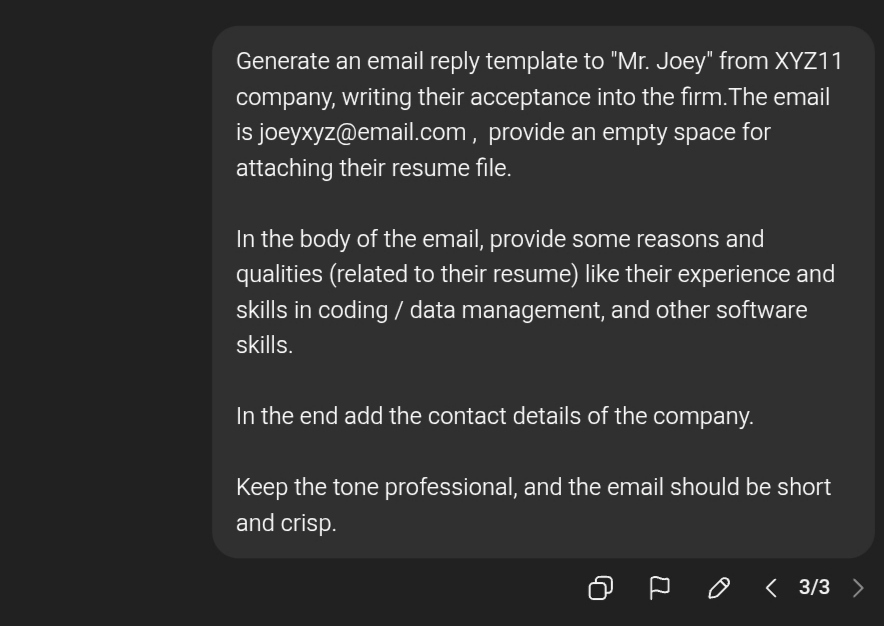
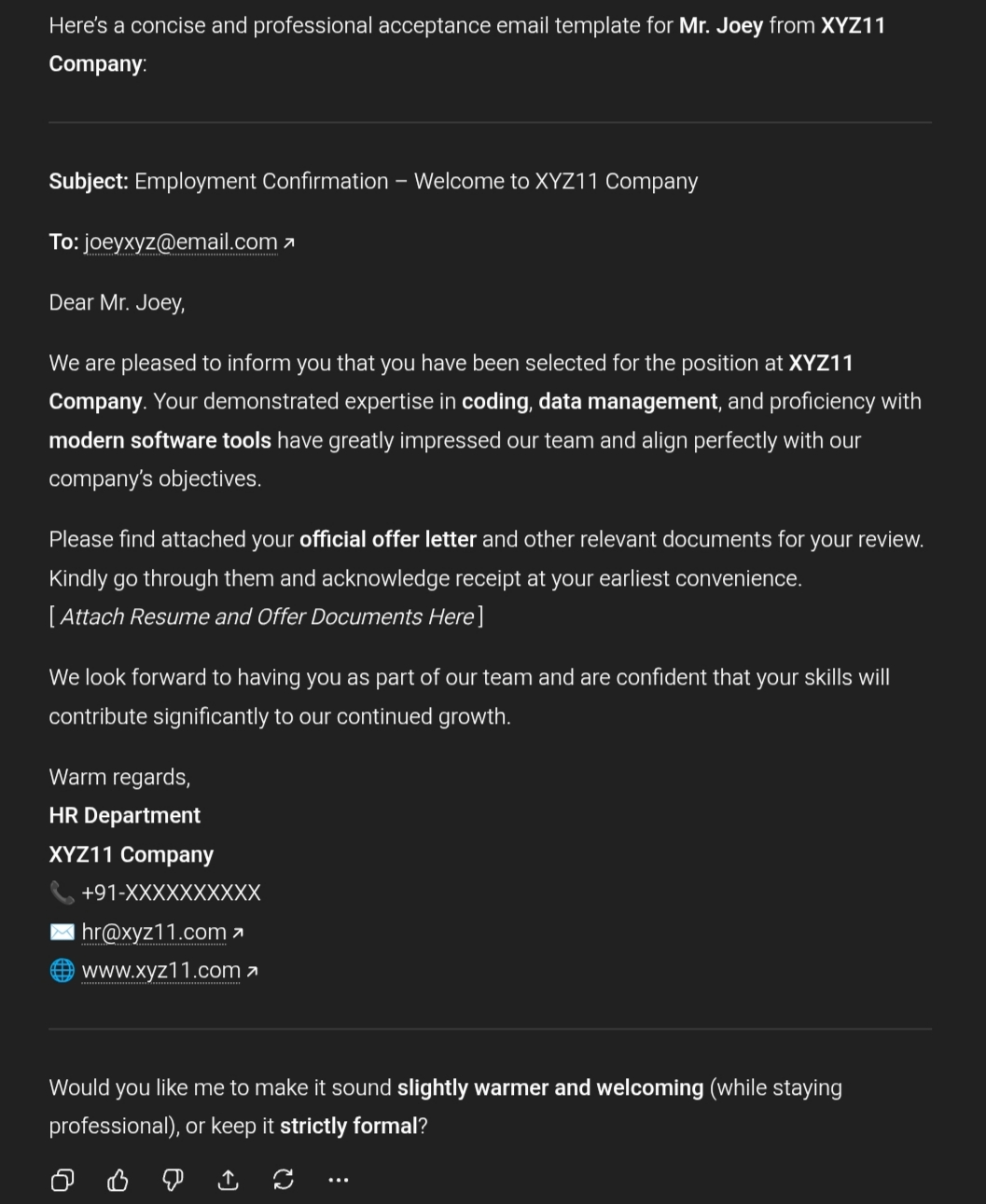
The response:
Revised version of the same:
Make a revised version, now for "Ms. Ella" confirming their acceptance into the firm, keeping the same style, referencing their experience with coding and AI models.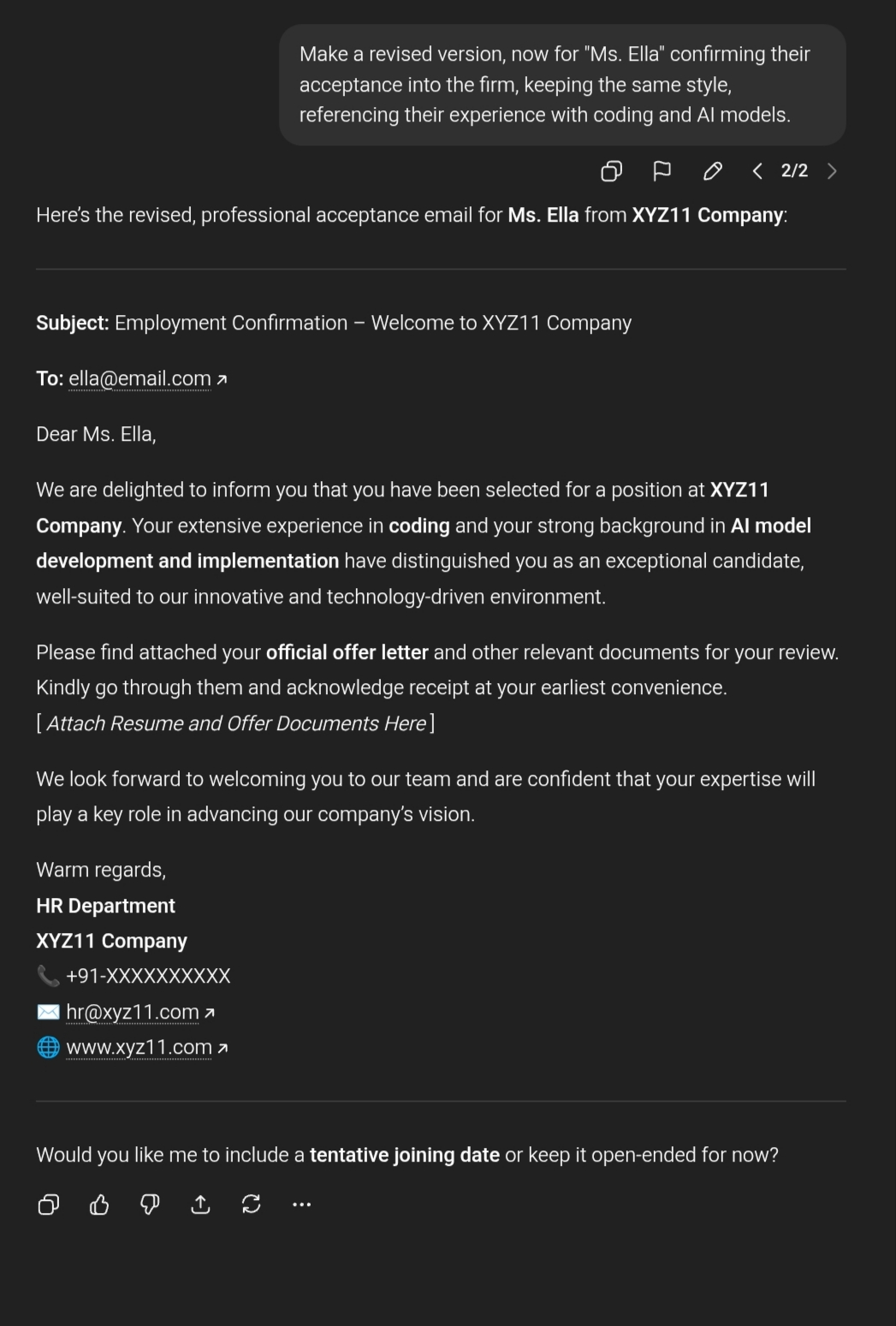
Assuming that the details about the firm or the recruiter is already provided (and not hypothetical unlike the example), the result will provide an even more accurate response.
Just one prompt, saving hours writing individual e-mails!
Related Blog : 12 Best Recruitment CRM Software for Recruitment Agencies
2. Creating a Template for Interview Round
The acceptance letter would only arrive once the interview round is completed, well, ChatGPT can help even in that case!
Recruiters can make their work easier by asking ChatGPT to create some sample questions which they can further modify or use variations of while interviewing candidates. Using ChatGPT for recruiting here would serve the function of an analytic making the perfect interview questions.
Related Blog : Customer Relationship Management 101: Everything Important You Need to Know in 2026
For example, a hiring manager wants to know a series of questions from the candidate relevant to their experience and their commitment towards the firm (provided that the description of the business/employer is already provided, or attached in a file).
Example Prompt:
[Attach a document about the job role and the job description]

According to the job description listed in the document, provide a list of sample interview questions for candidates applying to ABC firm.

Questions should be related to content writing and content development considering the requirements of the firm, and ask about their experience as well.

The questions should be in a professional tone, keeping a few objective questions and a few subjective questions.
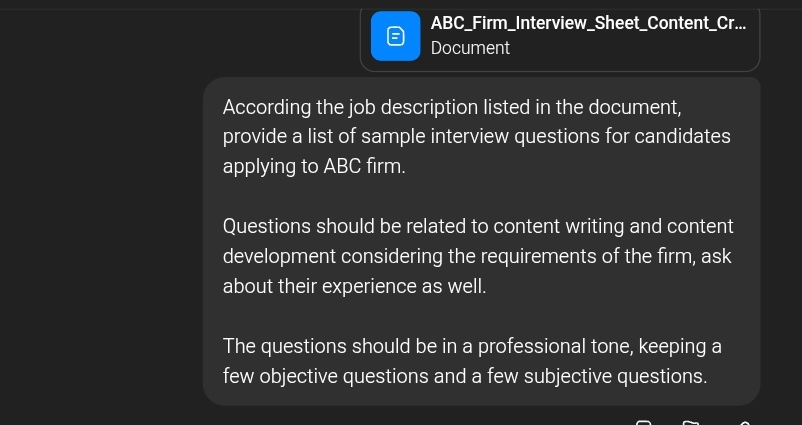
The response:
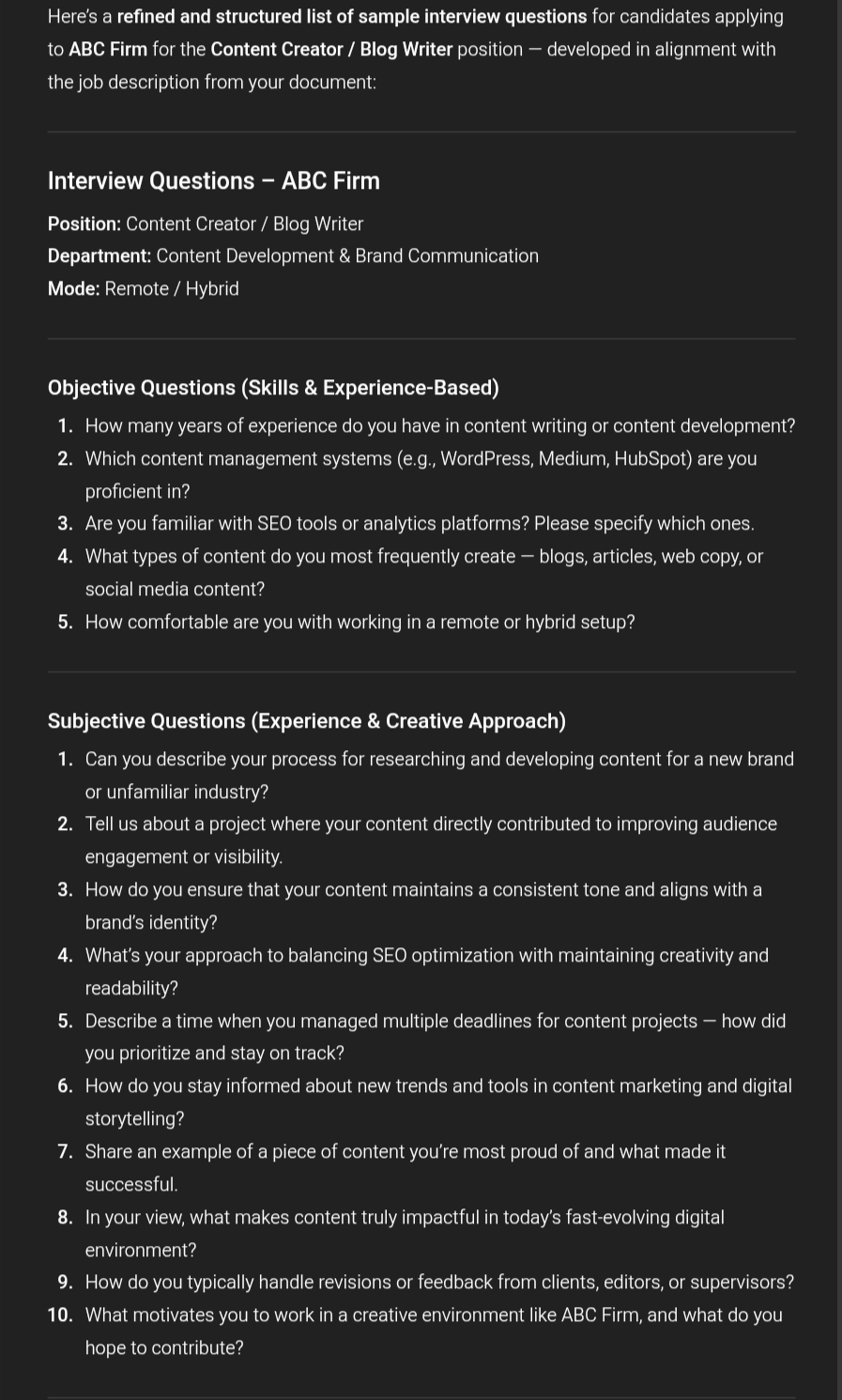
Additional Request:
Structure them in an interview sheet format for HR files as well.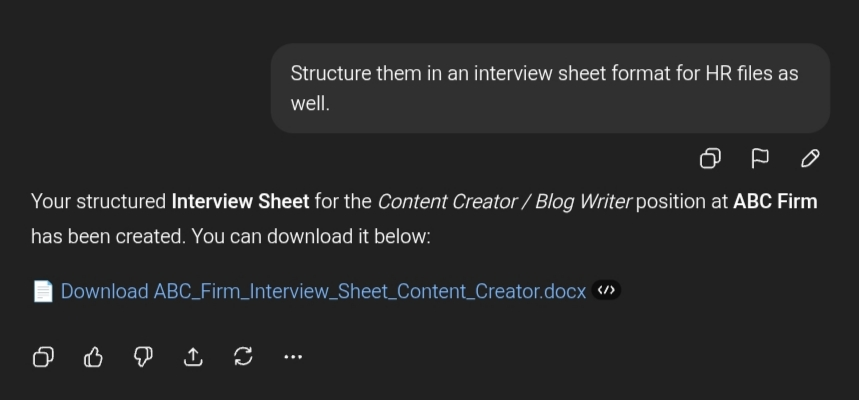
As needed, the questions are well formatted and structured, fitting to the role in two formats— one being a list of questions and the other being a document.
Related Blog : Top 10 Free ATS Tools to Supercharge Recruitment - ATZ CRM
3. Generating an Advertisement for Recruiting
ChatGPT for recruiting has no bounds, apart from the post recruiting process, recruiters can even use it to create advertisements for their job.
Creating a compelling advertisement is no joke, it might consume quite some time which really isn’t efficient. ChatGPT can even be used as a guide or even as a reference point of view for the job.
Example Prompt:
Compose a job advertisement for a content developer position at a new emerging PQRS firm who is looking for social media growth.

The ad should include a compelling headline, an overview of the role, key responsibilities, necessary skills and qualifications, and the benefits for working at this firm.

The tone should be professional yet inviting, targeted to candidates with minimum 1 year of experience.

Make it crisp and concise.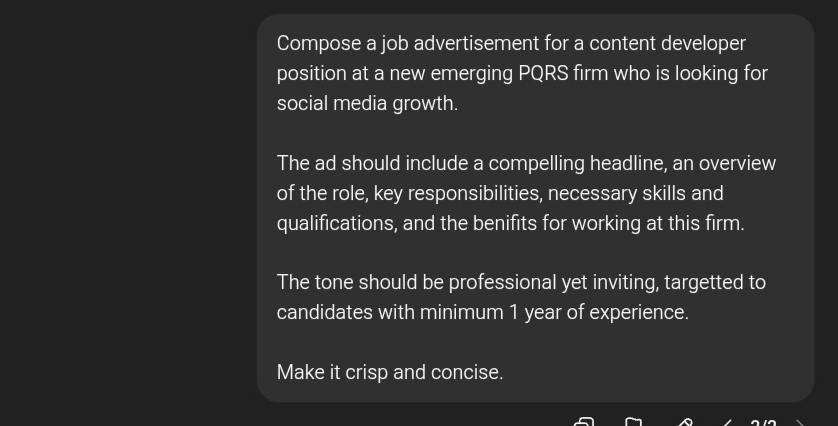
The response:
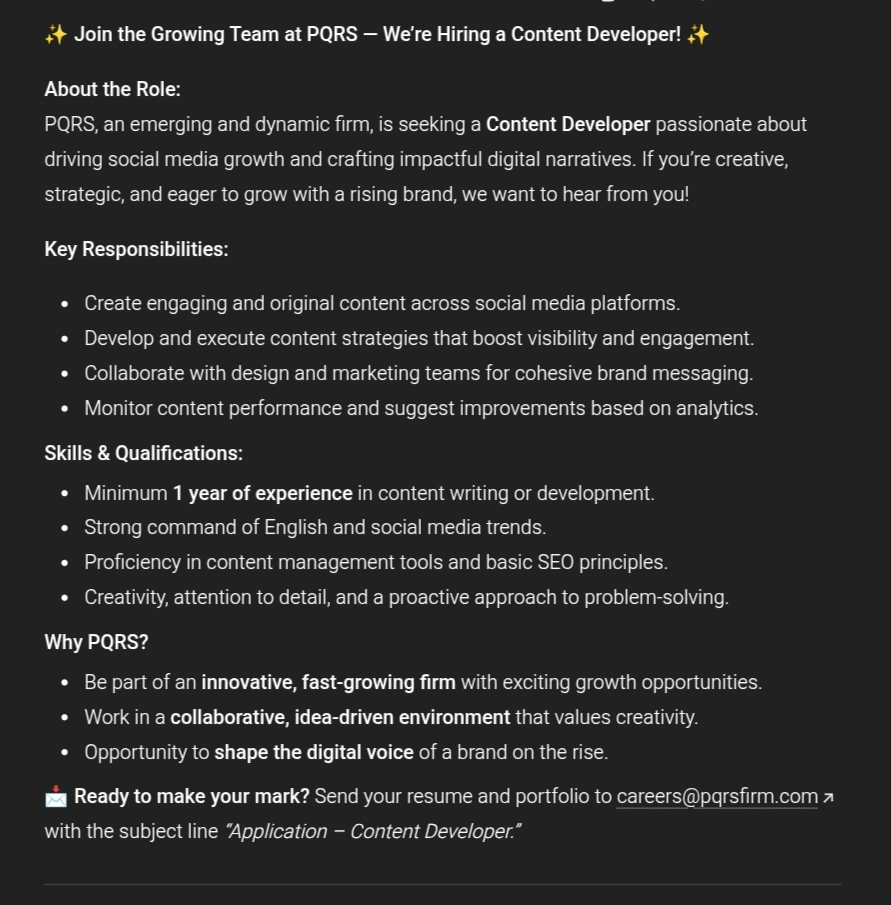
Though this being a simple job description, it is helpful for recruiters to have a streamlined idea, or an outline before they craft their own job advertisement.
Related Blog : 15 Free Job Posting Sites USA-Based Recruiters Can Use to Look for Diverse Talentatzcrm.com/blog/
FAQs
Q1. Can ChatGPT replace human recruiters?
No. ChatGPT is a productivity tool, not a replacement. It handles repetitive writing tasks — job descriptions, outreach emails, interview questions — so recruiters can focus on relationship-building, judgment calls, and negotiation. Human intuition and empathy remain irreplaceable.
Q2. Is it safe to paste candidate resumes into ChatGPT?
Be cautious. Avoid pasting identifiable personal data (name, contact details) into public ChatGPT interfaces. For resume analysis, use anonymized versions or enterprise tools with data privacy guarantees. Always follow your company’s data handling policies.
Q3. What types of prompts work best for sourcing passive candidates?
Prompts that generate personalized outreach messages work best. Include the candidate’s specific background, the role, and a clear value proposition. Example: “Write a 150-word LinkedIn InMail for a senior data engineer who worked at [Company X], for a remote ML role at a fintech startup.”
Q4. How can ChatGPT help speed up the hiring process?
ChatGPT can instantly draft job postings, generate Boolean search strings, create screening question sets, and write follow-up sequences — tasks that previously took hours. Combined with an ATS like ATZ CRM, recruiters can automate most of the administrative hiring workflow.
Q5. Does ATZ CRM integrate with AI tools like ChatGPT?
Yes. ATZ CRM supports GPT integration, using optimized prompts internally to generate job descriptions, outreach emails, and candidate summaries directly within the platform — no copy-pasting required.
Conclusion
ChatGPT, a diverse tool, is helpful in the smallest to the largest of tasks. Using ChatGPT for recruiting will not only save time but also the effort which can now be redirected into the mainstream work.
Blog Summary
Recruiting can be systemized with the help of ChatGPT, an automated artificial intelligence developed by OpenAI, and it is very helpful to maintain an efficient flow in the workspace.
ChatGPT is for recruiters, because recruiters can use it for— finding relevant keywords, creating a job description, generating response or outreach messages, e-mail generation, interview questions generation, and more!
Recruiters do not need to run aimless, the tips to create the perfect prompts are to be understood.
Specific commands help ChatGPT create a perfect response. Recruiters should use specifications in their prompts.
Breaking down complexities within the prompt is a must as it helps the AI connect with the recruiter’s intentions.
Revising responses by ChatGPT can be helpful as well. It ensures that the response is satisfactory to the recruiter.
This blog also lists out various prompts that recruiters can use as reference. It provides real world use cases which can be understood as an example.
Some real world use cases mentioned in the blog are— E-mail template generation (with revised prompts), interview questions generation (with revised prompts), and advertisement generation.
Simple examples like these help recruiters stay ahead in the upcoming world of AI .