Quick Answer:
The 5 most costly executive search mistakes: (1) Rushing the market mapping phase, (2) Presenting candidates before fully vetting their motivations, (3) Neglecting the counter-offer risk conversation, (4) Poor candidate preparation for board-level interviews, (5) Weak onboarding support after placement. Each one can turn a successful placement into a failed hire within 12 months.
Blog Summary
Executive Search is a specialised recruitment process used to hire senior-level leaders who shape organisational strategy and long-term growth.
The article explains the most frequent Executive Search Mistakes that slow down hiring, weaken candidate pipelines, and create poor candidate experiences.
Many searches fail due to unclear role definitions, narrow sourcing channels, inconsistent evaluations, slow communication, and a lack of data-driven decision-making.
Recruiters benefit from defining clear leadership competencies, aligning stakeholders early, and creating structured evaluation frameworks.
Broader sourcing strategies, talent mapping, multi-channel outreach, and diversity-focused pipelines ensure stronger and more competitive candidate pools.
Consistent communication and timely follow-ups improve senior-level candidate engagement and strengthen the employer brand.
Data and insights play a major role in refining Executive Search; analytics help recruiters identify bottlenecks, compare candidates objectively, and improve accuracy.
Industry trends highlight the rise of data-driven hiring, leadership diversity, and the growing expectations executives have for structured, transparent processes.
Practical recommendations include improving candidate experience, building long-term leadership networks, optimising sourcing channels, and standardising evaluation practices.
ATZ CRM, an integrated ATS + CRM platform, helps recruiters avoid these Executive Search Mistakes with features like smart filters, talent pools, automated communication, collaboration tools, and advanced analytics.
The platform unifies sourcing, evaluation, communication, and reporting, enabling faster placements, stronger decision-making, and a more efficient Executive Search workflow.
Introduction
Executive Search is the process of finding, evaluating, and hiring senior-level leaders for an organisation. Unlike regular hiring, it involves deeper research, targeted outreach, and a more strategic approach. The stakes are high because the roles influence growth, culture, and long-term decisions. When something goes wrong in Executive Search, the effects ripple across the company.
Executive Search Mistakes often cost organisations time, money, and credibility. A delayed leadership hire can slow down major projects. A mis-hired executive can impact morale. A poor candidate experience can hurt the employer brand. These are issues no recruiter or talent acquisition leader wants to deal with.
Today’s recruitment landscape is more competitive than ever. Executive talent is limited, highly selective, and constantly approached by multiple companies. Even minor errors in your search process can result in losing top candidates. That is why having a structured, consistent, and technology-supported approach is essential. At every step, you will also learn how tools like ATZ CRM, an integrated ATS + CRM platform, remove friction, improve workflow, and help you run more successful senior-level hiring processes.
Here’s a 10 Actionable Checklist for avoiding executive search mistakes for hiring:
Actionable Checklist: Avoiding Executive Search Mistakes
Use this checklist to strengthen leadership hiring decisions:
Clearly define cultural and leadership expectations
Use behavioural interviews and competency frameworks.
Expand sourcing channels beyond traditional methods.
Engage passive talent proactively.
Integrate modern CRM systems for better process management.
Maintain consistent communication with candidates.
Train interviewers for structured evaluation.
Conduct thorough reference and background checks.
Create leadership-specific onboarding plans.
Review and refine hiring strategies regularly.
In this detailed guide, we will explore the five most frequent executive search mistakes companies make, why they occur, and how to avoid them using structured, modern, and evidence-backed practices.
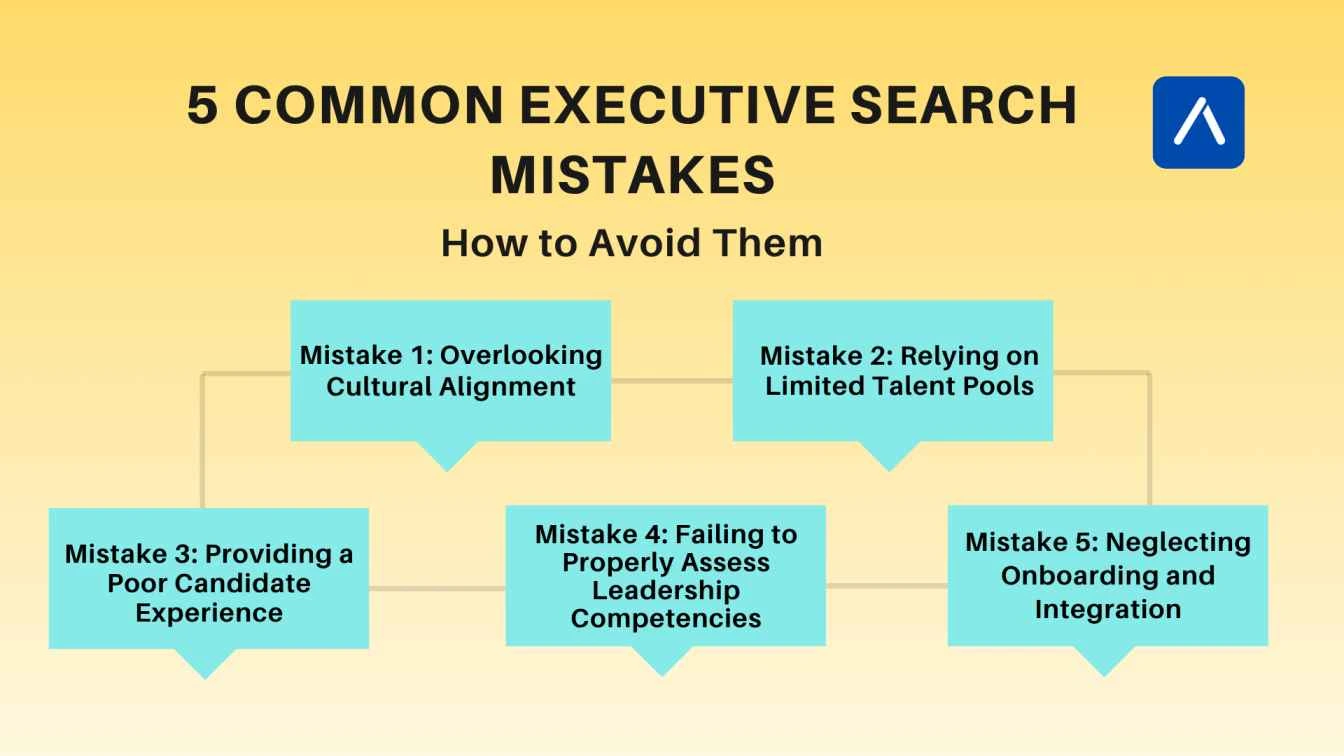
Mistake 1: Overlooking Cultural Alignment
Many organisations place enormous emphasis on credentials, industry experience, and past achievements. While these factors certainly matter, they rarely predict success on their own. One of the most damaging executive search mistakes is failing to evaluate how well a leader aligns with the company’s cultural DNA.
Related Read: 7 Simple Job Rejection Email Templates That Save Time
Why This Mistake Happens
Pressure to hire quickly: When a senior role is vacant, companies often rush the process and prioritise technical expertise over personality and leadership style.
Bias toward pedigrees: Teams may be overly impressed by candidates from marquee companies or top universities, assuming past prestige equals future success.
Lack of clarity on culture: Some organisations have not defined their values or leadership expectations clearly enough to use them in hiring.
Assumption that executives will adapt: Recruiters may assume senior leaders naturally adjust to any work environment, which is often not the case.
Related Read: Recruitment Strategies for Agencies: Proven Tactics to Attract Better Candidates
The Impact
When cultural misalignment occurs at the leadership level, the consequences ripple across the organisation. A leader who does not share the company’s values may unintentionally damage teamwork, slow decision-making, or disrupt established workflows. Employees often feel disconnected or frustrated when leadership behaviour contradicts the organisation’s culture. Over time, this can lead to confusion, distrust, increased turnover, and stalled performance. Cultural misalignment is one of the leading causes of executive failure, making it one of the most avoidable yet repeated executive search mistakes.
How to Avoid This Mistake
Define your culture before hiring: Establish a clear description of values, behaviours, and leadership expectations.
Use behavioural interviews: Explore real-life scenarios that reveal how candidates make decisions, manage conflict, and lead teams.
Involve multiple stakeholders: Leaders, peers, and direct reports should weigh in on cultural fit through structured feedback.
Assess adaptability: Even if the culture is strong, leaders should demonstrate the ability to evolve alongside the organisation.
Conduct culture-specific reference checks: Ask targeted questions about collaboration style, communication habits, and people management approach.
Mistake 2: Relying on Limited Talent Pools
Another major contributor to executive search mistakes is depending too heavily on traditional hiring channels, such as job boards or internal networks. While these methods can support mid-level hiring, they are insufficient for leadership roles requiring deep expertise and nuanced skill sets.
Related Read: 15 Free Job Posting Sites USA-Based Recruiters Can Use to Look for Diverse Talent
Why This Mistake Happens
Comfort with familiar processes: Teams fall back on the same sourcing practices they use for other roles.
Underestimating the executive market: Recruiters may not realise that most strong executive candidates are passive and not actively searching for opportunities.
Lack of specialised networks: Internal HR teams may have limited reach when it comes to senior-level talent.
Budget constraints: Companies sometimes avoid using external search partners due to cost considerations and end up limiting their pool of qualified candidates.
The Impact
When companies use narrow sourcing channels, they often miss out on high-performing leaders who are quietly excelling in their roles elsewhere. The result is a shallow candidate pool, longer hiring cycles, and a higher likelihood of settling for “best available” rather than “best fit.” Over time, this affects competitiveness, innovation, and leadership stability.
Such sourcing limitations are among the executive search mistakes that hinder long-term organisational success and strategic execution.
Related Read: Customer Relationship Management 101: Everything Important You Need to Know in 2025
How to Avoid This Mistake
Expand your reach: Use industry associations, leadership forums, and specialised communities to identify top-tier talent.
Leverage passive talent strategies: Build long-term relationships with executives, not just job seekers.
Utilise external partners when needed: Executive search firms bring deep networks and market intelligence that internal teams may lack.
Modernise sourcing with CRM systems: Tools like ATZ CRM help track candidate engagement, nurture passive relationships, and streamline communications across multiple touchpoints.
Adopt data-driven sourcing: Use market mapping and talent intelligence to identify leaders with high strategic alignment.
Mistake 3: Providing a Poor Candidate Experience
Senior-level candidates expect professionalism, transparency, and respect throughout the hiring process. Unfortunately, many companies falter in creating a thoughtful candidate experience, making this one of the more subtle yet damaging executive search mistakes.
Related Read: 10 Best AI & ChatGPT Prompts Every Recruiter Should Be Using
Why This Mistake Happens
Unstructured interview process: Multiple stakeholders with conflicting priorities create inconsistencies in messaging.
Slow decision-making: Leadership roles involve multiple approvals, which can elongate the timeline.
Lack of communication: Candidates are often left waiting for updates, leading to frustration.
Overly complex processes: Panels, case studies, and repeated assessments can overload candidates if not planned carefully.
The Impact
Executives are highly selective about where they invest their time. A poorly managed candidate experience can cause them to withdraw from the process or accept another offer. Additionally, they may form a negative impression of the company, which can affect brand reputation within the leadership community. This is one of the underrated executive search mistakes because its impact is subtle but long-lasting.
Related Read: 8 Best ATS+CRM Loxo alternatives for Growing teams
How to Avoid This Mistake
Set clear timelines: Establish expectations and stick to them.
Communicate proactively: Provide updates even when there is no decision yet.
Train interviewers: Ensure consistent communication and messaging.
Showcase your strengths: Present the company’s vision, culture, and future opportunities clearly.
Personalise the process: Tailor interviews to the candidate’s background to show respect for their time and experience.
Mistake 4: Failing to Properly Assess Leadership Competencies
A common assumption in hiring is that past success automatically predicts future performance. However, leadership effectiveness depends on context, adaptability, and emotional intelligence factors that aren’t always obvious from a résumé. This makes competency assessment one of the most crucial areas where executive search mistakes occur.
Related Read: How to Use ChatGPT for Recruiting (+3 Real-World Use Cases)
Why This Mistake Happens
Overreliance on achievements: Companies may focus on outcomes rather than on how results were achieved.
Lack of structured leadership assessment tools: Not all organisations use frameworks to evaluate competencies.
Inconsistent evaluation criteria: Different interviewers assess candidates based on their own preferences or biases.
Assumption that technical expertise equals leadership ability: This overlooks soft skills like communication, conflict resolution, and vision setting.
The Impact
When organisations hire executives without assessing leadership competencies, they risk placing someone in a role they are not fully prepared for. This can lead to poor decision-making, disengaged teams, strategic misalignment, and operational breakdowns. These consequences highlight why competency evaluation failures are among the most serious executive search mistakes.
Related Read: The Ultimate Recruit CRM Showdown: Best ATS Ranked
How to Avoid This Mistake
Use leadership frameworks: Models such as situational leadership or competency grids provide structure.
Incorporate real-world simulations: Case exercises or role-play scenarios reveal decision-making patterns.
Evaluate emotional intelligence: Tools like 360-degree feedback or personality assessments help uncover behavioural tendencies.
Align expectations early: Define the leadership profile needed for the role and evaluate consistently against it.
Check adaptability: Ask candidates to share examples of leading through change, crisis, or ambiguity.
Mistake 5: Neglecting Onboarding and Integration
The executive hiring process does not end at the offer stage. One of the most overlooked executive search mistakes is assuming that seasoned leaders can integrate seamlessly without structured support. Even the most qualified executive requires time and guidance to understand the organisation’s culture, processes, and expectations.
Related Read: Top Recruitment CRM Solutions 2025: Improve Hiring Success
Why This Mistake Happens
Assumption that experience equals independence: Companies may believe senior leaders do not require onboarding.
Lack of structured transition plans: Many organisations do not have leadership onboarding frameworks.
Miscommunication among stakeholders: Different leaders may have varying expectations of the new executive.
Limited support systems: No designated mentors or transition partners to guide the new hire.
The Impact
Executives who are not set up for success can quickly feel disconnected or overwhelmed. This affects their confidence, decision-making, and relationship-building. Poor onboarding is a major driver of early executive turnover and is frequently cited among the most costly executive search mistakes.
Related Read: Best RecruiterFlow Alternatives for Recruiting Firms
How to Avoid This Mistake
Create a 90-day integration plan: Outline goals, key relationships, and strategic priorities.
Assign executive mentors: A trusted internal guide accelerates cultural understanding.
Facilitate strategic introductions: Ensure the new leader meets key stakeholders early.
Provide feedback touchpoints: Schedule monthly check-ins to support adjustment.
Align expectations: Ensure clarity on performance metrics and organisational goals.
Real-World Case Study: How One Company Corrected Its Hiring Errors
A fast-growing logistics technology firm was preparing to expand into two international markets. The leadership team decided to hire a Chief Operating Officer to manage global expansion. Despite their urgency, they unknowingly repeated several executive search mistakes that nearly cost them their growth momentum.
Initially, as you find and interview candidates for open positions, take the opportunity to learn how they’re searching for jobs. If you notice new trends emerging, you can use this information to adjust how you source candidates moving forward.
Related Read: Steal These Free Recruiting Email Templates That Get Responses
Recognising the shortcomings, the company paused the process and restructured its approach. They redefined cultural expectations, expanded to passive talent pools, and conducted deeper leadership competency evaluations. Within six weeks, they identified a candidate whose profile aligned strongly with their strategic vision and company values.
This shift helped them avoid repeated executive search mistakes and resulted in a successful hire who later led their expansion into three global regions.
Studies show that nearly 40% of newly hired executives fail within the first 18 months , not because they lack capability but because the hiring process failed to evaluate alignment, adaptability, and leadership style. This statistic alone illustrates how critical it is to understand and avoid the most common executive search mistakes. By examining these pitfalls more closely, recruiters and hiring managers can make smarter, more informed decisions and build leadership teams that actually elevate performance.
Why Strategic Planning Matters in Executive Hiring
Leadership hiring today is far more than a process of reviewing resumes and conducting interviews; it is a forward-looking strategy that determines how effectively a company can grow, adapt, and compete. Organisations that view executive recruitment as a long-term investment rather than a quick fix tend to make significantly better decisions.
Related Read: Top 10 Free ATS Tools to Supercharge Recruitment - ATZCRM
This involves understanding how the role will evolve, anticipating future business needs, and aligning leadership expectations with the company’s strategic direction. When organisations slow down and adopt a thoughtful, structured approach, they drastically reduce the risk of repeating executive search mistakes and set the foundation for leadership success that lasts well beyond the first year.
Related Read: Remote Hiring In A Post Pandemic World – Tools And Practices
Industry Insights & Emerging Trends
The executive hiring landscape is undergoing rapid transformation. To avoid common executive search mistakes, recruiters and HR leaders must stay ahead of emerging industry trends.
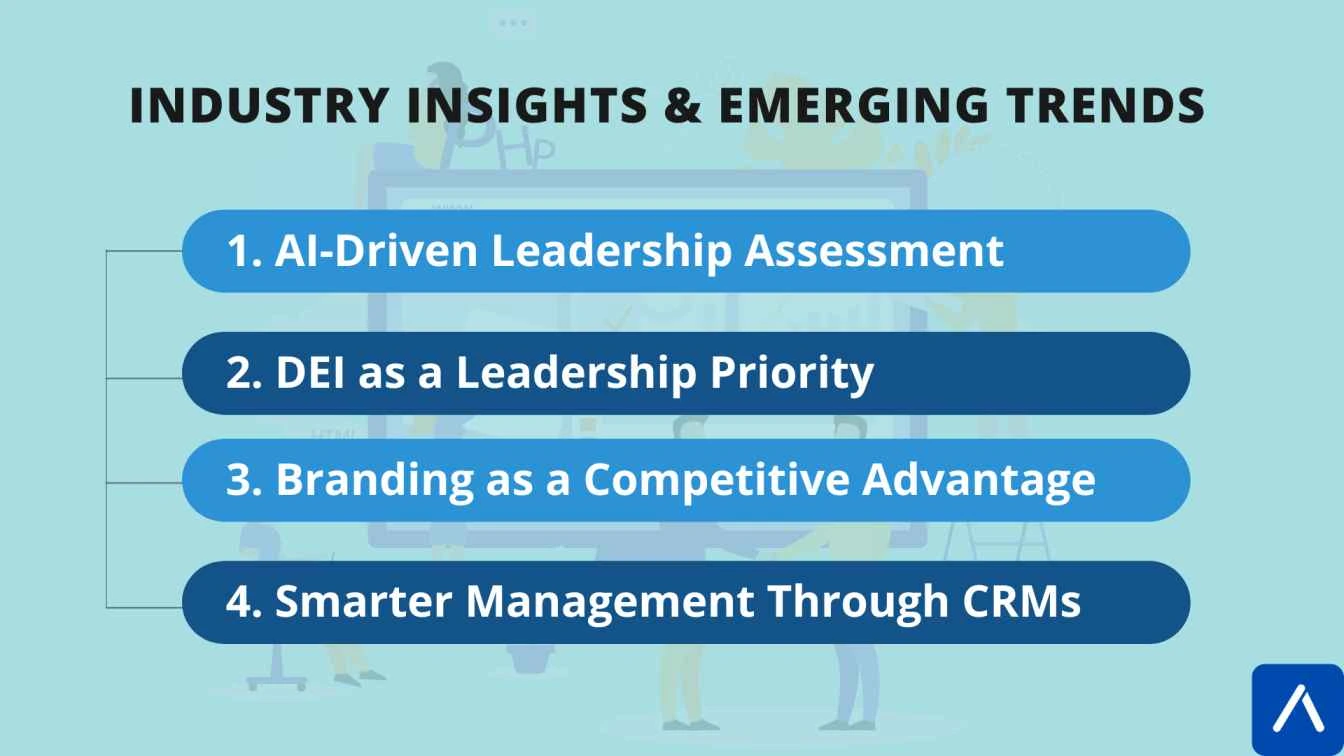
1. AI-Driven Leadership Assessment
Organisations are increasingly using data analytics, behavioural algorithms, and predictive models to evaluate leadership traits. These tools help reduce bias and provide insights that traditional interviews may miss.
Related Read: Boost Your Hiring KPIs with Atlas Recruitment in ATZ CRM
2. DEI as a Leadership Priority
Diversity is no longer a box-checking exercise; companies now seek executives who can champion inclusive cultures. Effective leadership hiring integrates DEI metrics early in the process.
Related Read: Cold Call Script: Recruit Better With These 6 Free Scripts
3. Employer Branding as a Competitive Advantage
Executives evaluate brand reputation, culture, and long-term stability before considering a move. Strong employer branding helps attract top-tier leaders.
Related Read: What Is Cost Per Hire? A Simple Guide for Modern Recruiters.
4. Smarter Candidate Management Through CRMs
Advanced systems like ATZ CRM streamline workflows, organise candidate information, track engagement, and support strategic communications. In an era where candidate experience matters, such systems minimise operational errors and reduce the likelihood of process-related executive search mistakes.
Recruiter-Focused Best Practices for Executive Search Success
Running a successful Executive Search requires more than just sourcing great candidates. It demands a structured, disciplined approach that actively prevents the most common Executive Search Mistakes, such as unclear role definitions, narrow pipelines, inconsistent evaluations, and poor communication. Recruiters who want to elevate their leadership hiring outcomes must combine strategic planning with modern tools and a consistent process.
The following recommendations provide actionable steps to strengthen your Executive Search workflow and minimise avoidable errors:
1. Build a role-specific competency framework before sourcing begins
Many Executive Search Mistakes originate from misaligned expectations. A clear competency model ensures everyone understands what “great” looks like in the role. Outline leadership traits, technical capabilities, behavioural expectations, and measurable success criteria early on to eliminate confusion.
Related Read: How AI-Powered Tools Are Transforming Candidate Screening for Better Hiring
2. Develop a long-term talent mapping strategy, not just a reactive search
Relying solely on immediate sourcing often leads to shallow pipelines. Creating ongoing talent maps helps you identify, track, and nurture potential executives months before a role opens, dramatically reducing time-to-fill and avoiding repeated pipeline shortages.
Related Read: GDPR Recruitment: How to Handle Candidate Data in 2025
3. Strengthen your executive-focused employer value proposition (EVP)
Executives evaluate employers differently from mid-level candidates. Highlight vision, culture, autonomy, and long-term opportunities. This reduces drop-offs and prevents one of the most damaging Executive Search Mistakes: losing top candidates because the value proposition was unclear.
Related Read: Boolean Search in Recruitment: The Complete Beginner’s Guide
4. Use diversified outreach to minimise pipeline gaps
To avoid sourcing-related Executive Search Mistakes, expand beyond your usual channels. Explore industry associations, exclusive leadership networks, alumni groups, and international talent pools. A diverse multi-channel approach produces stronger, more innovative leadership options.
Related Read: Why ATZ CRM is the Best CRM for Streamlining Your Recruitment Process
5. Make data your primary decision-making tool
Subjective impressions often lead to inconsistent evaluations, one of the most common Executive Search Mistakes. Track interview performance, sourcing quality, candidate communication history, and time-in-stage metrics. Data clarifies patterns and helps you refine the process.
6. Prioritise executive-level candidate experience
Senior candidates judge organisations based on how structured, respectful, and responsive the hiring process feels. Use clear timelines, thoughtful communication, and proactive engagement to avoid the common mistake of losing interest due to slow or irregular follow-ups.
Related Read: Insider recruitment marketing strategies to boost your hiring game!
7. Use automation and centralised technology to maintain process consistency
Manual workflows often cause delays, missed communication, and scattered notes. Using platforms like ATZ CRM ensures automation, organisation, and consistency, preventing operational Executive Search Mistakes that slow down or derail leadership hiring.
8. Keep stakeholders aligned throughout the entire search
Executive hiring typically involves multiple leaders with different viewpoints. Consistent alignment meetings prevent shifting expectations, unclear evaluations, and delayed decisions, issues that commonly disrupt Executive Search.
Related Read: 7 Email Templates for Recruiter That Get Quick Replies
9. Prepare interviewers with structured question sets and evaluation rubrics
Unstructured interviews frequently lead to biased or incomplete assessments. Assign specific evaluation areas to interviewers to avoid repetitive or misaligned questioning and ensure a fair, consistent process.
Related Read: Switch to ATZ CRM: 7 Powerful Reasons to Upgrade Now
10. Reflect on search performance after every placement
A short review helps identify bottlenecks, miscommunications, or process gaps. This continuous improvement mindset ensures you avoid repeating the same Executive Search Mistakes in future searches and steadily improve your overall leadership hiring strategy.
These practical strategies help recruiters run a more predictable, organised, and data-driven Executive Search process, one that avoids common mistakes, elevates candidate experience, and delivers stronger leadership placements.
Related Read: The Best Bullhorn Alternative for Effortless Hiring
Key Benefits of Avoiding Executive Search Mistakes
Higher-quality leadership hires: You attract and select executives who genuinely align with your company’s culture, mission, and long-term strategy.
Reduced turnover at the top level: When leaders are a strong fit from the start, the risk of early failure or misalignment decreases significantly.
Stronger organisational stability: Effective leadership transitions minimise disruption and maintain consistency across teams and workflows.
Faster time-to-productivity: Proper assessments and onboarding ensure executives contribute meaningfully in a shorter amount of time.
Enhanced employer reputation: A thoughtful and structured hiring process leaves candidates impressed, even those not selected, boosting your brand.
Better decision-making across the organisation: Strong leaders elevate problem-solving, communication, and collaboration.
Improved long-term performance: Leadership that fits well drives innovation, operational excellence, and employee engagement.
Cost savings: Avoiding executive hiring errors helps prevent the financial and operational costs associated with replacing failed leadership hires.
More competitive talent pipelines: Expanding networks and improving processes attract passive executives who bring fresh perspectives and expertise.
Stronger alignment with business goals: Leaders selected through strategic evaluation contribute directly to growth, transformation, and future readiness.
Related Read: 12 Best Recruitment CRM Software for Recruitment Agencies
Conclusion
Executive Search is one of the most critical recruitment functions because senior leaders shape the future of an organisation. Avoiding Executive Search Mistakes is essential for achieving better hiring outcomes, improving candidate experience, and building long-term leadership strength. Even small issues, such as unclear role definitions or inconsistent communication, can slow the search and lead to costly hiring decisions.
A strong Executive Search process requires structure, clarity, collaboration, and the right tools. Recruiters who combine strategic planning with reliable technology perform faster, more accurate searches and offer a more professional experience to candidates and stakeholders.
When you combine thoughtful strategy with the power of ATZ CRM, you create an Executive Search process that is clearer, faster, and far more effective, helping organisations secure the leaders who will drive their long-term success.