· Recruitment · 15 min read
Temporary Staffing 101: The Ultimate Guide to Scaling Workforce
Master temporary staffing in 2026! From compliance to scaling, discover how to use temporary staffing to grow your agency. Read our ultimate guide.
Why did the recruiter bring a ladder to work? Because they wanted to take their career to the next level!
Okay, okay, I know what you’re thinking. Please, stick to the staffing advice and leave the comedy to the professionals. But let’s be honest for a second, recruitment is a tough gig. If we can’t laugh at the fact that we spend half our day chasing candidates who ghost us and the other half explaining to hiring managers why they can’t find a “Purple Squirrel” for minimum wage, we’d go crazy.
Welcome to the wild world of 2026 recruitment. If you are reading this, you are probably looking for a better way to handle the rollercoaster of workforce demand. Maybe you are a startup founder trying to survive your first scaling phase, or perhaps you are a seasoned agency owner looking to pivot from permanent placements to the high-volume, high-adrenaline world of temporary staffing.
Whatever brought you here, you are in the right place. This isn’t just another dry report; this is your playbook. We are going to break down everything you need to know about temporary staffing, from the “boring but necessary” legal compliance to the “exciting and profitable” scaling strategies using AI.
So, grab your coffee (or your third energy drink of the day, we don’t judge), and let’s dive into Temporary Staffing 101.
Part 1: What is Temporary Staffing? (And Why Should You Care?)
Let’s start with the basics, but let’s keep it interesting.
Temporary staffing is essentially the “Netflix subscription” of the employment world. Instead of buying the DVD (hiring a permanent employee with all the long-term commitment, severance packages, and awkward breakups), companies “subscribe” to talent for a specific period to get a job done.
For recruitment agencies, this is where the magic happens. Unlike permanent recruitment, where you place a candidate, get a one-time fee, and wave goodbye, temporary staffing creates a recurring revenue stream. You place a worker, and every single hour they work, you make money. It’s the gift that keeps on giving.
The Shift to the “Liquid Workforce”
Why is everyone talking about this now? Because the world has changed. We are living in the era of the “Liquid Workforce.”
According to recent data from Staffing Industry Analysts (SIA), the US staffing market is projected to see significant cumulative growth through 2030. Why? Because businesses in 2026 are terrified of commitment. Economic volatility means companies want the ability to scale up fast when things are good and scale down instantly when things slow down. They can’t do that with a bulky permanent workforce.
If you are an agency owner, this is your golden ticket. By offering temporary staffing solutions, you become the safety valve for your clients. You aren’t just selling people; you are selling agility.
Part 2: Temporary vs. Permanent Recruitment – The Great Debate
Before we go any further, we need to clear up the confusion. Many recruiters think “Temp” is just “Perm” but faster. Wrong. They are completely different business models, almost like different sports.
Think of it this way:
Permanent recruitment is like a marriage, while temporary recruitment is like dating. In permanent recruitment, you are looking for a long-term commitment where everyone meets the parents. In temporary recruitment, you need a reliable partner for the weekend who won’t ghost you.
The “Headhunter” vs. The “Staffing” Model
Permanent Recruitment (The Headhunter):
- The Model: You act as a consultant. You find the talent, the client hires them directly, and you charge a one-time fee (usually 15-25% of the annual salary).
- The Payday: Big, lump-sum checks. Great for cash spikes, bad for predictability.
- The Risk: If the candidate leaves within 90 days, you might have to refund the fee.
Temporary Recruitment (The Staffing Agency):
- The Model: You are often the legal Employer of Record (EOR). You hire the worker and “lease” them to the client.
- The Payday: Recurring revenue. You make a margin on every single hour the temp works.
- The Risk: You carry the payroll burden. If the client doesn’t pay you for 60 days, you still have to pay your temps next Friday.
Understanding these nuances is critical for your agency’s survival. The workflows, the software you need, and the cash flow management are totally different.
For a deep dive into the pros, cons, and specific strategies for each model, check out our detailed guide on Temporary vs Permanent Recruitment: Your Ultimate New Year Guide.
Part 3: The Economics of Temporary Staffing (Show Me The Money)
Recruiters love people, but agency owners love margins. Let’s talk about the math behind the madness.
The Cost of Vacancy (COV)
When a client balks at your bill rate, do you know how to counter them? You need to educate them on the Cost of Vacancy. A study suggests that the average daily cost of an unfilled position can be around $98 for general roles, and significantly higher for specialized positions.
Here is a simple way to break it down for your clients:
“Mr. Client, you might save $5 an hour by not using an agency, but this empty chair is costing you $500 a day in lost productivity. Does that math work for you?”
Understanding the Markup
If you are new to the temp game, pricing can be confusing. Unlike the flat % fee in executive search, temp staffing works on a “markup” over the hourly pay rate. In 2025/2026, standard markups typically range from 25% to 40%, depending on the role and industry.
Here is the formula:
Bill Rate = Pay Rate × (1 + Markup %)
- Pay Rate: What the worker takes home (e.g., $20/hr).
- Markup: Covers the “Burden” (taxes, insurance, benefits) + Your Profit.
Pro Tip: Never let a client negotiate your markup down until you explain the Burden. Roughly 15-20 out of 100 of that markup isn’t profit; it’s mandatory government costs (FICA, FUTA, SUTA, Workers Comp). If you cut your markup too low, you are paying the client to employ your worker. Don’t be that agency.
Decoding Agency Markups and Bill Rates
Transparency is key. When you receive a bill from a staffing agency, what are you actually paying for? Currently, temporary staffing markups generally range from 25% to 40%.
Table 1: The Anatomy of a Markup
| Component | Pay Rate (In Percent) | Description |
|---|---|---|
| Worker Pay | 100 | The base hourly wage goes to the talent. |
| Statutory Burden | 12 - 20 | FICA, FUTA, SUTA, Workers’ Comp, General Liability. |
| Recruiting Costs | 5 - 10 | Job board fees, background checks, drug screens. |
| Agency Profit | 10 - 15 | The margin that keeps the agency lights on. |
Insight: “Cheap” agencies often cut corners on the “Burden” (by misclassifying workers) or the “Recruiting Costs” (by skipping background checks). This exposes the client to massive liability. A reputable partner using robust software like ATZ CRM ensures that every dollar of markup is accounted for in compliance and quality vetting.
The Hidden ROI: Benefit Avoidance
Beyond the COV, temporary staffing offers a direct reduction in overhead.
- Benefit Savings: Benefits (healthcare, 401k, PTO) typically cost an employer 3/10 of a base salary. With a temp, the agency carries this burden.
- Separation Costs: Terminating a permanent employee can involve severance, legal counsel, and unemployment insurance hikes. Ending a temporary assignment costs $0.
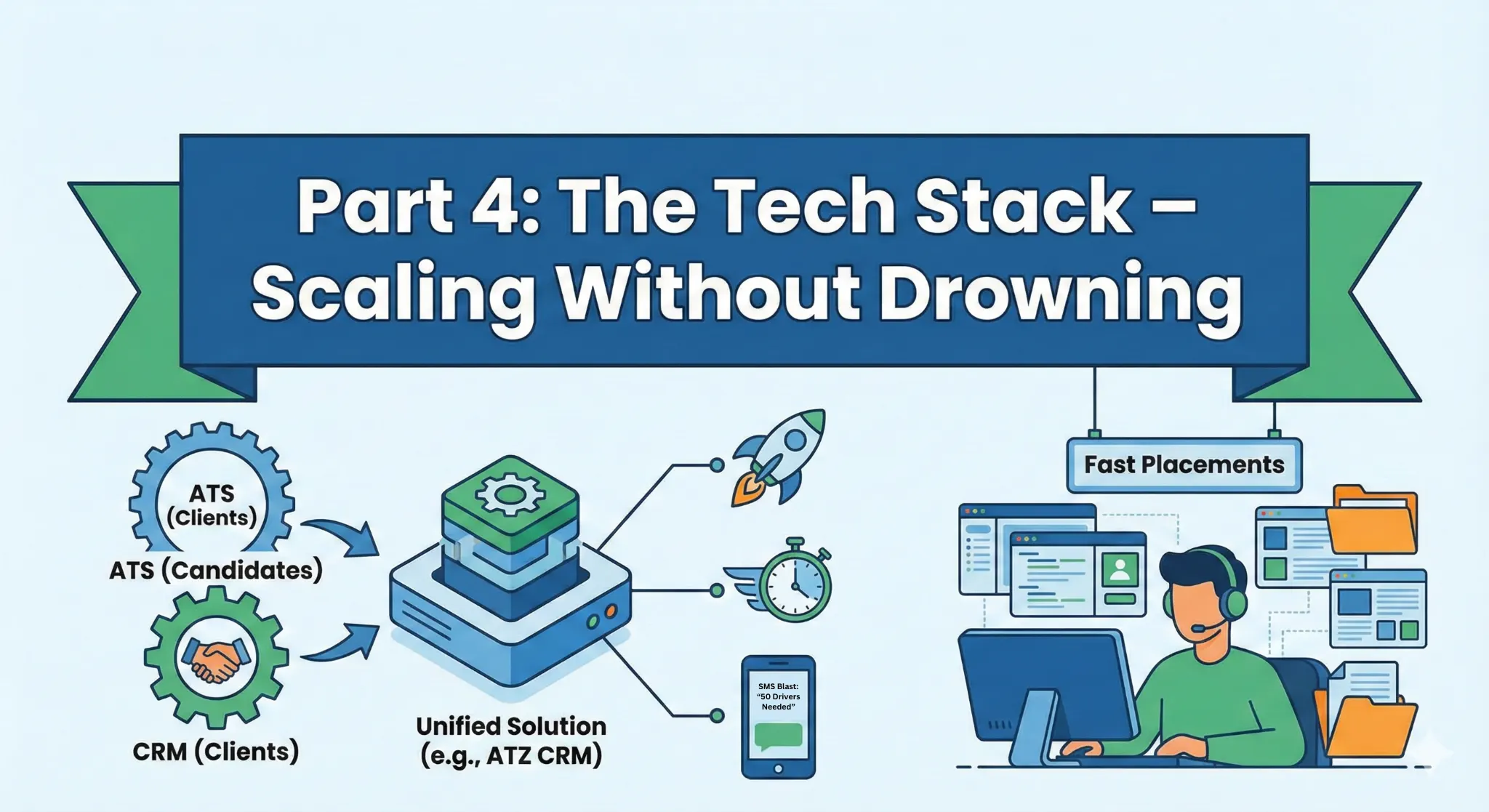
Part 4: The Tech Stack – Scaling Without Drowning
You cannot run a high-volume temp desk with sticky notes and Excel spreadsheets. Well, you can, but you will likely cry yourself to sleep every night. To scale, you need technology that moves as fast as you do.
The Power of the Unified ATS & CRM
In the old days, you had an Applicant Tracking System (ATS) for candidates and a Customer Relationship Management (CRM) for clients. They didn’t talk to each other. It was like Romeo and Juliet—kept apart by bad architecture.
Today, you need an all-in-one solution. This is where ATZ CRM shines. It combines the candidate management of a top-tier ATS with the sales power of a CRM.
Why does this matter for temp staffing? Speed.
When a client calls needing 50 forklift drivers for tomorrow morning, you don’t have time to switch tabs. You need to run a search, filter by “Available Now,” blast out an SMS, and fill the order in minutes.
If you are still shopping around for software, you might want to check out this comparison on the 12 Best Recruitment CRM Software for Recruitment Agencies.
AI: Your New Best Friend
Artificial Intelligence isn’t here to replace you; it’s here to do the boring stuff so you can be human.
- AI Sourcing: Instead of spending hours on LinkedIn, tools like ATZ CRM’s AI sourcing engine can identify candidates that match your job description instantly.
- AI Note Taking: Have you ever interviewed a candidate and forgotten to write down their availability? ATZ CRM has an AI Notetaker that joins your calls (Zoom, Meet, Teams), transcribes them, and summarizes the key points. It’s a lifesaver.
For more on how AI can help you, read our guide on the 10 Best AI & ChatGPT Prompts.
Part 5: Sourcing Strategies – Finding the Needle in the Haystack
Okay, you have the tech, and you have the order. Now, where are the people? In temporary staffing, volume is king. Here is how to keep your pipeline full.
1. Programmatic Job Advertising
Post and pray is dead. Programmatic advertising uses software to buy job ads automatically, targeting the right people at the right price. It ensures you aren’t wasting budget on job boards that don’t deliver.
2. The “Free” Job Board Hustle
Never underestimate the power of free traffic. There are dozens of sites where you can post for free. We actually compiled a massive list of these for you. Check out our blog on Free Job Posting Sites USA-Based Recruiters Can Use.
3. Talent Rediscovery (The Goldmine)
The best candidate is often one you already know. Most agencies have thousands of resumes sitting in their database gathering dust. This is called “Dark Data.”
Using a smart system like ATZ CRM, you can use AI to scan your existing database for candidates who match new roles. They are already vetted, they know your brand, and they cost $0 to acquire.
Part 6: Legal Landmines (And How to Avoid Them)
Disclaimer: I am an AI, not a lawyer. Always consult with a legal professional.
The legal landscape for temporary staffing changed significantly in 2025. The Department of Labor (DOL) has been flip-flopping on Independent Contractor rules, and you need to be careful.
W-2 vs. 1099
This is the biggest trap.
- W-2 (Employee): You control how they work, when they work, and provide equipment. You pay taxes.
- 1099 (Independent Contractor): They are in business for themselves.
In May 2025, the DOL issued guidance that returned to a version of the “Economic Realities Test.” Basically, if a worker is economically dependent on you, they are likely an employee.
Risk: If you misclassify a temp as a contractor to save on taxes, you could face massive fines. When in doubt, classify as W-2.
Co-Employment Risk
If your client treats your temp workers exactly like their own employees (inviting them to the holiday party, giving them performance reviews directly), they might be considered a “co-employer.” This opens them up to liability.
Solution: Coach your clients. You (the agency) should handle all discipline, pay discussions, and termination.
For a deeper dive into different recruiting models, look at our comparison of Retained Recruiting vs. Contingent Recruiting: How to Choose?
Part 7: Managing Your Temporary Workforce
Placing the temp is only half the battle. Keeping them happy (and showing up) is the other half.
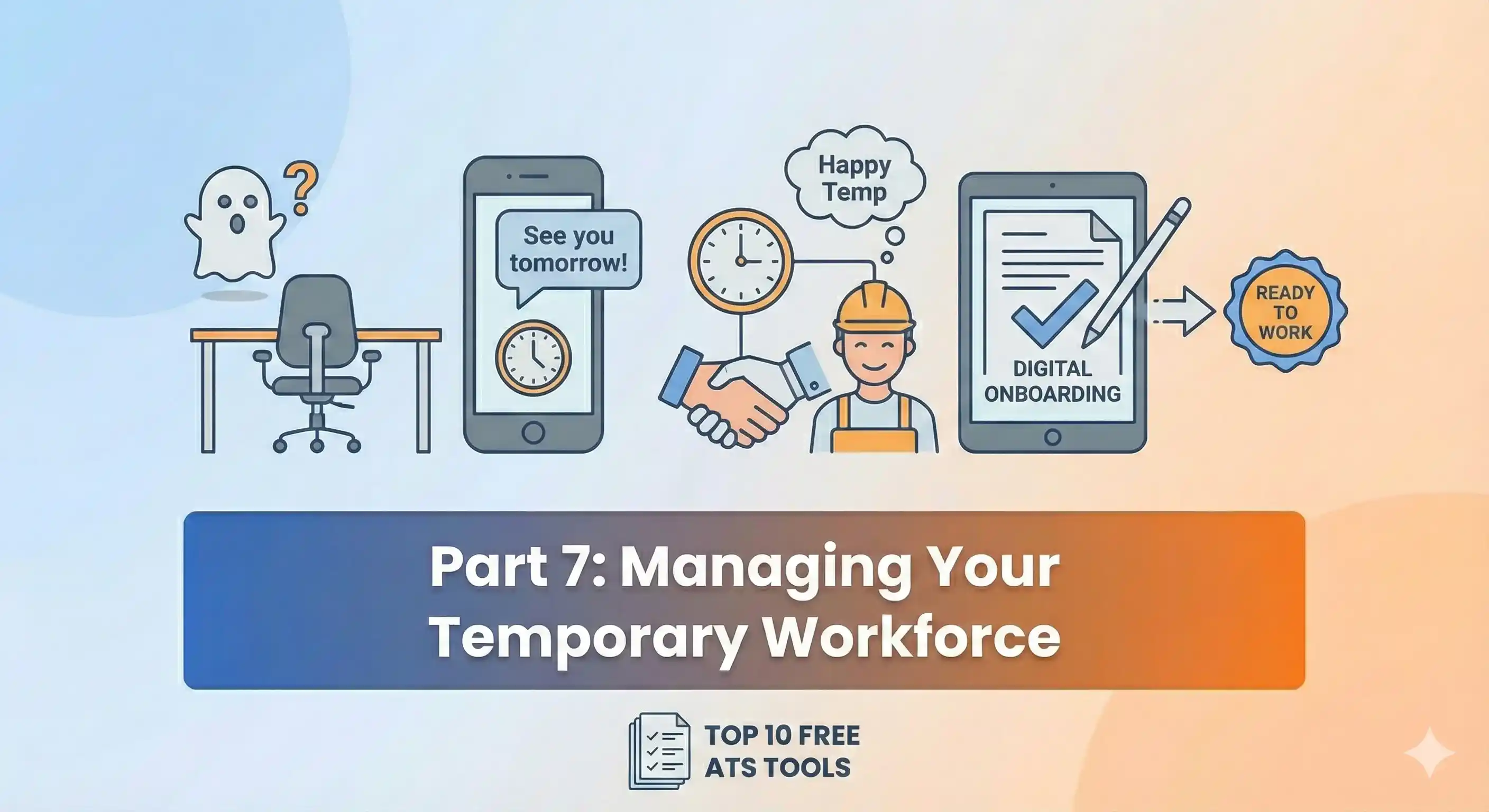
The “Ghosting” Epidemic
We’ve all been there. Recruiter: “See you Monday at 9 AM!” Candidate: “Absolutely!” Monday 9 AM: Crickets
To reduce ghosting, you need engagement.
- Automated Reminders: Use your CRM to send automated SMS reminders the night before the start date. “Hey John, good luck tomorrow! Here is the address again.”
- The First-Day Check-in: Call them at lunchtime on Day 1. It shows you care.
Onboarding Speed
Temps are often looking for work now. If your onboarding process takes 3 days of paperwork, they will take another job. Use digital onboarding tools. ATZ CRM integrates with various platforms to make document signing a breeze. You want them from “Applied” to “Ready to Work” in 24 hours.
If you are a small agency trying to keep costs low, you might be interested in our list of Top 10 Free ATS Tools to Supercharge Recruitment.
Part 8: A Recruiter’s Survival Guide (Humor Section)
Let’s take a break from the serious stuff. If you have been in this industry for more than a week, you will relate to these.
The 5 Stages of Recruiter Grief:
- Denial: “They definitely saw my email; they are just busy.”
- Anger: “Why would they update their LinkedIn status to ‘Open to Work’ if they aren’t going to reply?!”
- Bargaining: “If this candidate accepts the offer, I promise I will never complain about Monday meetings again.”
- Depression: “I should have been a baker. Bread doesn’t talk back.”
- Acceptance: “Okay, next call.”
Top 3 Lies Candidates Tell:
- “I’m flexible on salary.” (Narrator: They were not.)
- “I’m looking for a long-term home.” (Narrator: They will leave in 3 months for $1 more an hour.)
- “I have intermediate Excel skills.” (Narrator: They know how to open the program.)
For more laughs, check out some of the great recruiter meme collections online!
Part 9: Screening and AI - The Human/Machine Hybrid
Once the applications pour in, how do you screen them without drowning? You need to leverage Artificial Intelligence.
ChatGPT for Recruiters
Generative AI tools like ChatGPT are force multipliers. They can draft emails, write job descriptions, and even prepare interview questions.
Here are some impactful ChatGPT prompts to streamline your process:
- For Boolean Strings: “Act as a technical recruiter. Write a Boolean search string to find a Java Developer in Seattle with experience in Spring Boot and Microservices, excluding candidates who have only done internships.”
- For Rejections: “Write a polite, empathetic rejection email for a candidate who reached the final round but wasn’t selected. Give them constructive feedback that they lacked ‘Project Management’ experience.”
- For Screening: “I am hiring a temporary administrative assistant. What are the 5 key behavioral questions I should ask to assess their reliability and adaptability?”
Pro Tip: ATZ CRM often integrates similar AI capabilities directly into the workflow, meaning you don’t even have to leave the tab to generate these assets.
The AI Note Taker
During the interview, the recruiter should be focused on the human, not the notepad. ATZ CRM offers an AI Meeting Notetaker that joins your Zoom/Teams calls, records the conversation, transcribes it, and generates a summary of key points.
Benefit: You never miss a detail. If a client mentions, “We need them to start at 7:00 AM sharp,” the AI captures it. This reduces the “he said/she said” errors that plague staffing.
Part 10: Culture and the Human Element
Building a “Recruiter-First” Culture
If you run an agency, you must protect your recruiters from burnout.
- Humor: Embrace the absurdity. Share the “Memes of the Week.” It builds camaraderie.
- Empathy: Understand that rejection is part of the job.
- Tools: Give them the best ATS and CRM tools (like ATZ CRM), so they aren’t fighting their software. A frustrated recruiter is an unproductive recruiter.
Marketing to Candidates
Treat candidates like customers. In a gig economy, they have choices.
- Brand Voice: Be engaging. Don’t post boring job descriptions. Ask engaging questions: “Are you ready to build the future?” or “Do you want to work for a boss who actually listens?”
- Feedback Loops: Ask your temps how you are doing. They are your eyes and ears on the client site.
Scaling to the Moon with ATZ CRM
So, how do you put this all together to build a 7-figure agency? You need a system that scales. ATZ CRM isn’t just software; it’s your growth engine.
- Unlimited Free Trial: We are so confident you will love it that we let you try it for free. No credit card required.
- Affordability: Plans start at just $10/user. That is unheard of in this industry.
- Chrome Extension: Source candidates directly from LinkedIn into your pipeline with one click.
- Automation: Set up email sequences to nurture candidates while you sleep.
Ready to stop doing manual data entry and start making placements? You should seriously consider making the switch. Check out Switch to ATZ CRM: 7 Powerful Reasons to Upgrade Now.
Conclusion:
The 9-to-5 is dying. The future of work is flexible, dynamic, and project-based. As a recruiter, you are the architect of this new reality. Temporary staffing isn’t just a service line; it’s the engine that powers the modern economy.
It requires hustle, resilience, and a sense of humor. But with the right strategies and the right technology, the sky is the limit. Don’t let outdated software hold you back. If you are ready to streamline your workflow, automate your busy work, and scale your agency faster than ever before, it’s time to upgrade your toolkit.
Ready to Scale? Stop drowning in spreadsheets and start closing more deals. Request a Demo and see how we can help you build the staffing agency of the future.
P.S. If you are still debating which software is best, check out our blog The Ultimate Recruit CRM Showdown: Best ATS Ranked to see how we stack up against the competition.
FAQs
1. What is the difference between temporary and contract staffing?
While often used interchangeably, “temporary” usually implies short-term, entry-level, or seasonal work (weeks/months). “Contract” staffing often refers to higher-level, project-based professional roles (IT, Engineering) that may last 6-12 months.
2. How much should I charge for temporary staffing services?
The industry standard markup is between 25% and 40%. However, for niche, high-skill roles, markups can go higher. Always calculate your burden cost first to ensure you are profitable.
3. Do I need special insurance for a temporary staffing agency?
Yes! You absolutely need General Liability and Workers’ Compensation insurance. Since you are the legal employer of the temp workers, you are responsible if they get hurt on the job.
4. Can I use AI to write job descriptions?
100%. In fact, you should. It saves time and helps optimize for SEO. ATZ CRM has built-in AI content generation tools to help you write engaging job posts in seconds.
5. How do I handle payroll for temp workers?
You have two options: run it in-house (complex, risky) or use a “Back Office” provider or “Employer of Record” (EOR) service. They handle the paychecks, taxes, and compliance for a fee, allowing you to focus on recruiting.