· Recruitment · 8 min read
Temporary vs Permanent Recruitment: Your Ultimate New Year Guide
Discover the critical differences between temporary recruitment and permanent placement. Learn which model boosts agency revenue, key 2025 trends, and how to master both with ATZ CRM.
Introduction:
Ever felt like recruitment is just professional matchmaking?
In permanent recruitment, you’re looking for a marriage, a long-term commitment where everyone meets the parents.
In temporary recruitment, you’re looking for a reliable date for the weekend who won’t ghost you.
For agency owners and recruiters, understanding the nuances between these two worlds isn’t just about terminology; it’s about survival. Whether you are a seasoned veteran or just starting your agency journey, the battle between “Perm” and “Temp” determines your cash flow, your daily workflow, and your sanity.
Here is a joke to kick things off:
Why did the recruiter sleep well during the hiring freeze?
Because they finally had some peace and quiet!
But in all seriousness, the market is shifting fast. With the gig economy booming and economic uncertainty lingering, temporary recruitment is taking center stage.
In this comprehensive guide, we will break down the key differences, pros, and cons, and show you how to leverage tools like ATZ CRM to master both desks.
What is the Core Difference?
At a high level, the distinction seems obvious.
Permanent recruitment involves finding full-time employees (FTEs) who join a company on a long-term basis.
Temporary recruitment involves supplying workers for a specific period, project, or season.
But for an agency, the difference goes much deeper than just the contract length. It changes your business model entirely.
1. Permanent Recruitment: The “Headhunter” Model
In this model, you act as a consultant. You find the talent, the client hires them directly (usually on a W2 basis), and you charge a one-time fee, typically 15-25% of the candidate’s first-year salary.
- The Vibe: High stakes, slower pace, relationship-heavy.
- The Payday: Big, lump-sum checks (Lumpy cash flow).
- The Risk: If the candidate leaves within 90 days (the “rebate period”), you might have to refund the fee or replace them for free.
Debating between exclusive partnerships or volume-based searches? Dive deeper into the financial nuances in our comparison of Retained vs Contingent Recruiting.
2. Temporary Recruitment: The “Staffing” Model
Here, you are often the legal employer (Employer of Record). You hire the worker and “lease” them to the client. You pay the worker an hourly rate and bill the client a higher hourly rate. The difference (the “spread” or “margin”) is your profit.
- The Vibe: Fast-paced, high volume, logistical.
- The Payday: Recurring revenue. You make money for every hour the temp works.
- The Risk: You carry the payroll burden. If the client doesn’t pay you for 60 days, you still have to pay your temps next Friday.
Tip for Recruiters: Don’t view these as opposing forces. The best agencies often run a “Hybrid” or “Dual Desk” model to balance the quick cash flow of temps with the high margins of perm placements.
The Rise of Temporary Recruitment in 2025
Why should you care about temporary recruitment right now? The data tells a compelling story.
Historically, permanent roles were the default. However, recent trends show a massive shift. In 2024, the temporary and contract segment was predicted to account for nearly 89% of the US recruitment market activity, while permanent placements faced headwinds.
Why the shift?
- Economic Caution: Companies are hesitant to add fixed overheads (permanent salaries). Temporary recruitment allows them to scale up and down without long-term commitment.
- The Gig Mindset: Younger workers (Gen Z and Millennials) increasingly value flexibility over tenure, fueling the supply side of the temp market.
- Speed: The average time to fill a permanent role has crept up to 44 days. In contrast, temp roles can often be filled in 24-48 hours.
If your agency isn’t offering temporary recruitment solutions, you are leaving money on the table.
A Short Story: The Car Chase
A Permanent Recruiter and a Temp Recruiter decide to go see a horror movie together.
Halfway through the movie, the main character is running away from a zombie and spots an old, rusty getaway car with the engine running.
The Permanent Recruiter screams at the screen: “Don’t get in! You haven’t checked the Carfax! What if the transmission fails in 5 years? You need a vehicle with a solid long-term maintenance history!”
The Temp Recruiter jumps up and yells: “Who cares?! The car is available to start IMMEDIATELY! Just get in the seat and drive until the wheels fall off!”
Key Differences: A Deep Dive
Let’s break down the specific challenges and opportunities in each model.
1. Speed and Urgency
Temporary recruitment is a race. Clients usually need a temp yesterday. You don’t have time to search for the perfect “purple squirrel.” You need a “warm bench,” a pool of pre-vetted candidates ready to go.
Permanent recruitment is a marathon. It involves multiple rounds of interviews, culture fit assessments, and negotiations.
Need to speed up your sourcing? Check out our guide on Free Job Posting Sites for Diverse Hiring to build your pipeline faster.
2. Candidate Psychology
- Temp Candidates: They prioritize pay rates, location, and immediate start dates. They are often juggling multiple gigs.
- Perm Candidates: They care about long-term career growth, benefits, company culture, and stability.
3. The Money (Cash Flow vs. Margins)
- Temp: You need cash in the bank. You are essentially a bank for your client, fronting payroll costs. However, this builds the value of your business. Recurring revenue businesses typically sell for higher multiples than transactional (perm) businesses.
- Perm: High margin with zero capital risk (you don’t pay the candidate), but highly unpredictable. One bad month can ruin your quarter.
4. Legal Liability
Temporary recruitment comes with “Co-Employment” risks. Since you are the employer of record, you are responsible for:
- Payroll taxes.
- Workers’ compensation.
- Compliance with labor laws (e.g., OSHA safety training).
At a Glance: Temp vs. Perm Comparison Table
| Feature | Temporary Recruitment | Permanent Recruitment |
|---|---|---|
| Primary Goal | Flexibility & Speed (Gap filling) | Stability & Long-term Growth |
| Cost Structure | Hourly Rate (Pay-as-you-go) | One-time Placement Fee (% of Salary) |
| Legal Employer | The Agency (Employer of Record) | The Client (Direct Hire) |
| Time-to-Fill | 24 - 48 Hours (Average) | 44+ Days (Average) |
| Cash Flow | Requires “Float” (Pay weekly, bill monthly) | Lumpy (Large checks upon placement) |
| Candidate Focus | Rate, Schedule, Flexibility | Career Path, Culture, Benefits |
| Top Risk | Co-Employment Liability & Cash Flow | Refunds/Rebates (Bad Hires) |
Curious about tools? Check out our list of the Best Recruitment CRM Software for Recruiters.
How to Manage Both Desks Without Losing Your Mind
Running a hybrid desk is tough. You have to switch gears constantly between the transactional speed of temporary recruitment and the consultative depth of permanent placement.
Here are 3 Tips for Hybrid Recruiters:
- Time Blocking: Dedicate your mornings to the “urgent” (filling temp shifts) and your afternoons to the “important” (headhunting for perm roles).
- Tech Stack Consolidation: Don’t use one spreadsheet for temps and a separate ATS for perms. Use a unified system.
- Automate the Busy Work: Use AI to handle candidate outreach and screening so you can focus on closing deals.
Struggling with what to say to candidates? Use these Best AI & ChatGPT Prompts for Recruiters to craft better messages.
The Role of Technology: Why ATZ CRM Wins
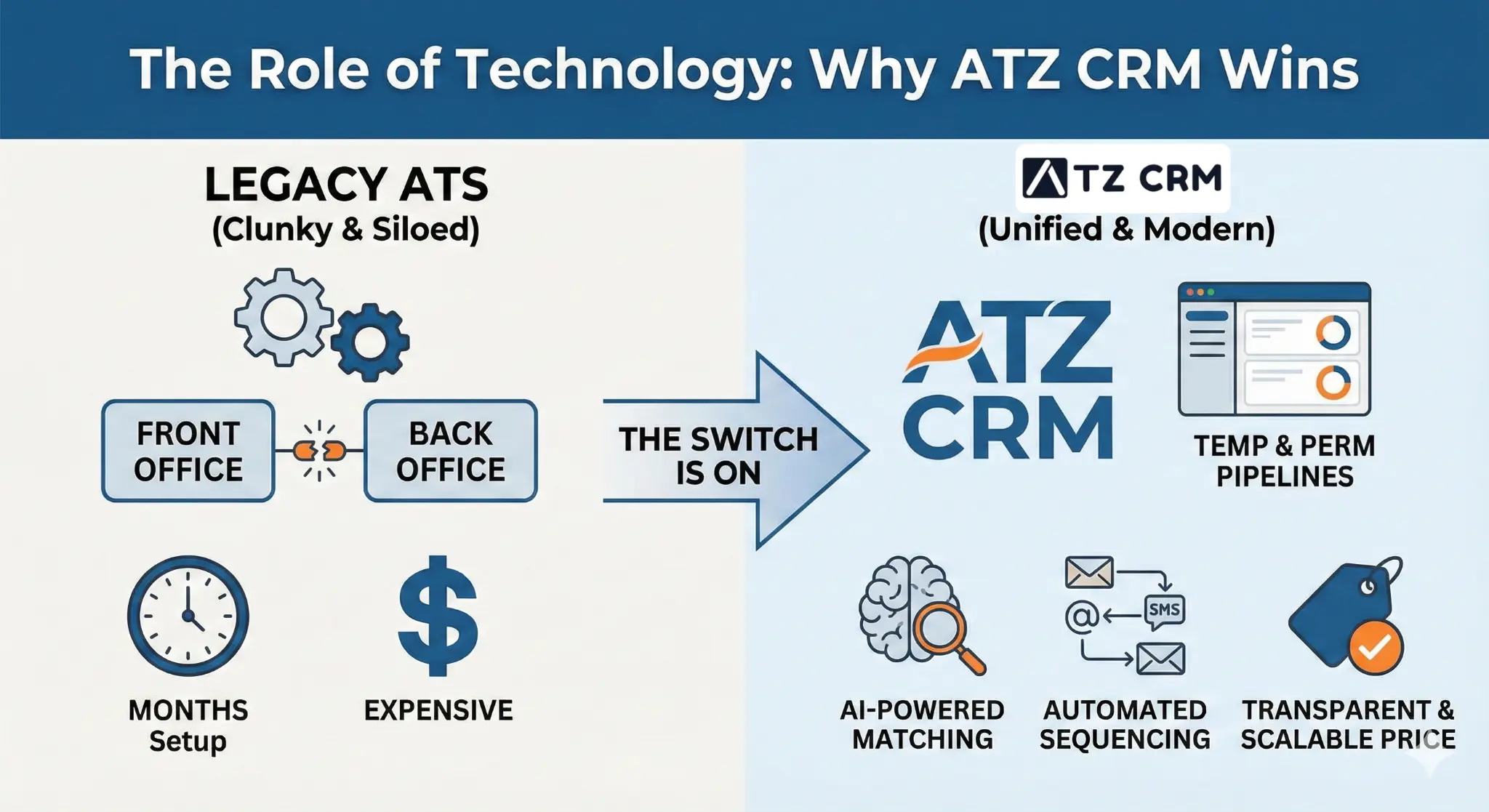
Whether you are focusing on temporary recruitment, permanent placement, or both, your software can make or break you. Legacy systems are often clunky and separated into “Front Office” and “Back Office” silos.
ATZ CRM changes the game by offering an All-in-One Recruitment Operating System.
Why ATZ CRM is the Best Choice for Modern Agencies:
- Unified Pipeline: Manage your high-volume temp rosters and your executive search pipelines in one dashboard.
- AI-Powered Matching: Our AI instantly matches candidates to open requisitions based on skills and availability, crucial for the speed of temporary recruitment.
- Automated Sequencing: Nurture your passive perm candidates with automated email drips until they are ready to move.
- Cost-Effective: Unlike expensive legacy giants, we offer enterprise features at a price that scales with you.
Thinking about moving away from clunky legacy systems? Read why agencies are choosing to switch to ATZ CRM or check out our comparison on the Best Bullhorn Alternative for Hiring.
Conclusion
The recruitment landscape of 2025 demands flexibility. By understanding the mechanics of temporary recruitment, you protect your agency from market downturns while keeping the upside of high-fee permanent placements.
Don’t let outdated technology hold you back from scaling your temp desk. The right tools can turn a logistical nightmare into a profitable machine.
Ready to streamline your recruitment process?
Stop juggling spreadsheets and start closing more deals.
👉 Book a Demo Now and see how our AI-powered platform can handle your Temporary and Permanent needs seamlessly.
Frequently Asked Questions (FAQs)
1. Which model is more profitable: temporary or permanent recruitment?
Permanent recruitment has higher profit margins per placement (often 20%), but temporary recruitment offers more consistent, recurring revenue, which builds greater business value over time.
2. What is the biggest risk in temporary recruitment?
Cash flow is the biggest risk. You must pay your temporary workers weekly, but your clients might take 30, 60, or 90 days to pay you. You need sufficient working capital to cover this “float.”
3. Can I use the same contract for both temp and perm clients?
No. A permanent placement contract focuses on the fee and guarantee period (rebate). A temporary recruitment contract must cover hourly bill rates, overtime rules, liability insurance, and co-employment clauses.
4. How does the “Temp-to-Perm” model work?
In this hybrid model, a candidate starts as a temporary worker for a trial period. If the client wants to hire them permanently, they pay a “conversion fee” to the agency. This is a great way for clients to reduce hiring risk.
5. Do I need different software for temporary recruitment?
Ideally, yes, or a unified system like ATZ CRM. Temporary staffing requires features like shift scheduling, time-sheet management, and payroll integration, which standard “headhunting” ATS platforms lack.