 EN
EN DE
DE ES
ES FR
FR NL
NL PT
PT





Quick Answer:
To build an effective recruiter incentive structure in 2026, use a 60/40 split (60% base salary, 40% commission) paired with tiered accelerators that increase the payout percentage once billing milestones are met. To ensure quality, tie bonuses to candidate retention by paying a portion of the commission only after the new hire completes a 90-day probationary period. Finally, supplement cash rewards with automation tools like ATZ CRM to eliminate burnout-inducing paperwork and keep your team focused on high-value placements.
Introduction
Ever wondered why your top biller, the one who practically breathes placements, just handed in their notice to join a competitor for a “slightly better” deal? Or why your team is spending 40 hours a week “sourcing” but only coming up with the same three candidates everyone else already found on LinkedIn?
If you are a staffing agency owner, an executive searcher, or a talent acquisition leader, you aren’t just fighting a talent war; you are fighting a systems war. In 2026, the global recruiting market is projected to reach a staggering $690.3 billion. Yet despite this growth, 90% of companies still miss their hiring goals.
The problem is simple: outdated motivation and “post-and-pray” sourcing. The solution? A high-performance incentive structure for recruiters that breeds loyalty and a tech-forward sourcing strategy that finds the “invisible” talent.
In this ultimate guide, you are going to learn:
- How to design an incentive structure that actually works.
- The “Agentic AI” sourcing hacks cut manual work by 80%.
- Why “Skills-First” hiring is the only way to survive the 2026 talent shortage.
- Regional commission benchmarks (US, UK, Japan) to keep your offers competitive.
- How to use ATZ CRM to reclaim 38% of your recruiters’ time.
Whether you are a solo recruiter or a global staffing giant, this guide is your roadmap to the “Strategic Stabilization Phase” of 2026. Let’s get to work!
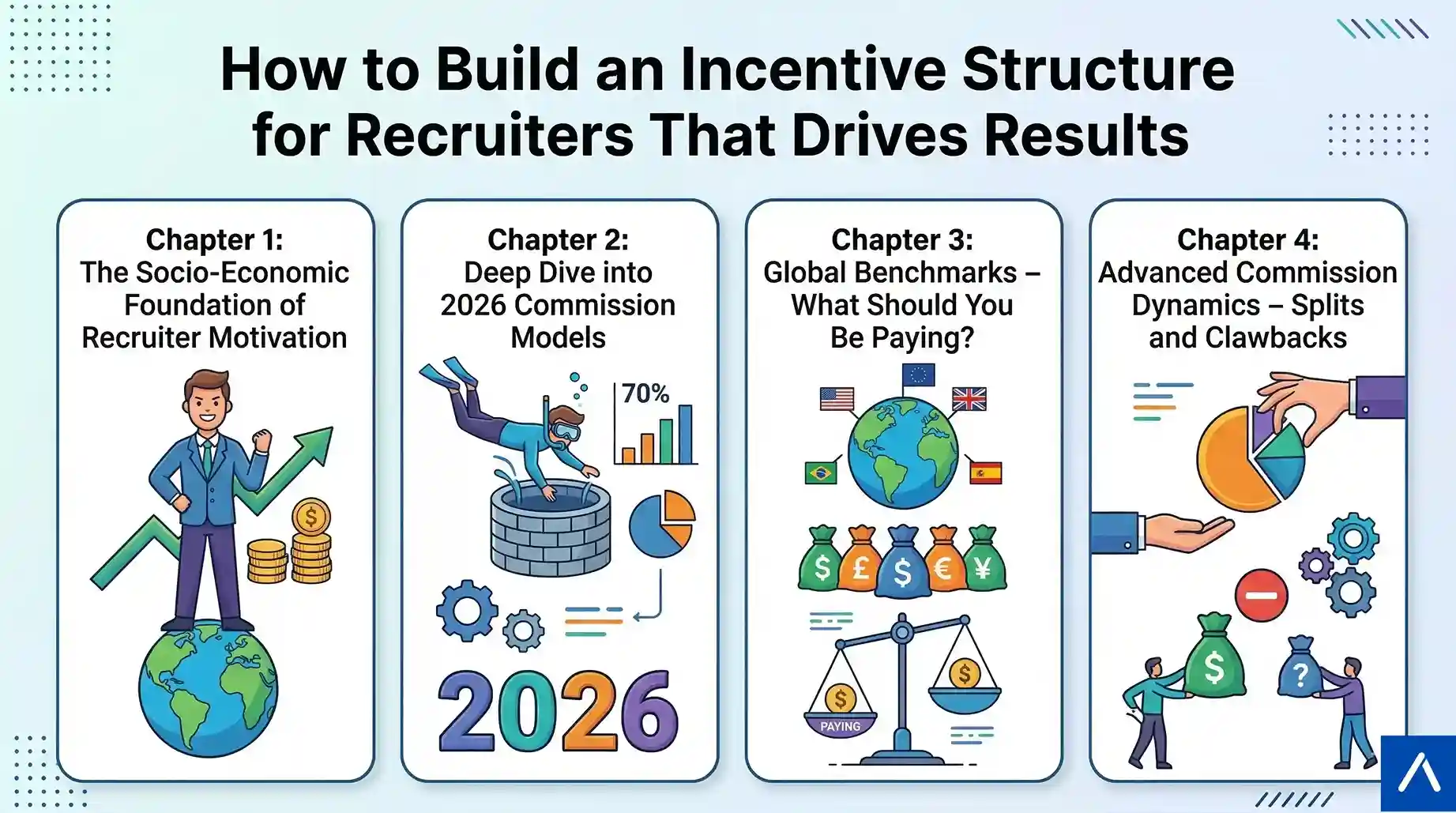
Chapter 1: The Socio-Economic Foundation of Recruiter Motivation
The foundational element of any profitable recruitment firm is its compensation philosophy. A well-defined incentive structure for recruiters does more than just facilitate payroll; it serves as a psychological engine that aligns individual ambition with firm-wide profitability.
Why Your Current Structure is Failing
A recruiter without a good incentive is like a car without fuel; it looks great in the driveway, but it isn’t going anywhere. In 2026, the “one-size-fits-all” model has been replaced by sophisticated, data-driven schemes that reward quality, long-term retention, and client acquisition alongside raw placement volume.
The Psychology of High Performance
Recruiters are naturally competitive. If your plan is too complex, they won’t trust it. If it’s too flat, they won’t push for it. Evidence shows that 53% of workers in 2026 would switch jobs purely for better financial incentives, such as bonuses and stock options.
The “Total Compensation” Package
A modern structure must account for more than just the monthly check. Data indicates that while financial “carrots” are the primary motivator, 60% of employees cite flexible work arrangements as a major reason for staying with a firm. For agencies utilizing AI tools, tracking these performance-based rewards becomes seamless, as the platform logs every interaction, placement, and revenue milestone in real-time.
Want to learn how to find candidates that support a more inclusive workplace? Check out our guide here: 15 Free Job Posting Sites USA-Based Recruiters Can Use to Look for Diverse Talent
Chapter 2: Deep Dive into 2026 Commission Models
To construct a competitive incentive structure for recruiters, it is necessary to analyze prevailing market rates and structural archetypes. Most modern agencies utilize a variation of the “Base Salary plus Commission” model, typically maintaining a 60:40 ratio.
1. The Standard Base + Commission
This is the “bread and butter” of the industry. It provides a safety net (base) while incentivizing the hustle. In 2026, the base is often set to cover the recruiter’s “cost of seat,” ensuring the agency doesn’t lose money on underperformers.
2. Tiered Commission (The Accelerator Model)
To motivate top-tier performers, a robust structure should feature tiered accelerators. These triggers increase the commission percentage once specific revenue targets are surpassed.
- Tier 1: 10% on the first $100,000 billed.
- Tier 2: 15% on revenue between $100,000 and $200,000.
- Tier 3: 20% on everything above $200,000.
This “hockey stick” growth in potential earnings ensures that high-performers do not plateau once they have achieved their basic quota.
3. The “Draw” System (Recoverable vs. Non-Recoverable)
Popular in high-stakes markets like Japan and Executive Search, the draw is an advance on future earnings.
- Recoverable Draw: If a recruiter is paid a $5,000 draw but only earns $3,000 in commission, they “owe” the house $2,000 from their next placement.
- Non-Recoverable: The recruiter keeps the draw even if they don’t hit their targets, but persistent failure usually leads to a “performance review.”
4. Revenue vs. Profit-Based Incentives
Most agencies pay based on total revenue billed. However, for senior roles, profit-based incentives (where recruiters manage some variable costs like travel or advertising spend) are becoming the new gold standard. This encourages recruiters to act like business owners.
Struggling to write outreach that candidates actually answer? You need these: 10 Best AI & ChatGPT Prompts Every Recruiter Should Be Using
Chapter 3: Global Benchmarks - What Should You Be Paying?
You cannot build a winning structure in a vacuum. If you underpay, your best people will switch to a better agency.
The United States Market
In the US, entry-level recruiters typically receive base salaries between $45,000 and $60,000. Specialized sectors like tech and IT often see higher numbers.
| Level of Hire | Base Salary Range | Commission Range |
|---|---|---|
| Entry-Level | $45,000 - $60,000 | 15% - 25% |
| Experienced | $55,000 - $75,000 | 20% - 30% |
| Executive Search | $70,000 - $110,000 | 25% - 35% |
The United Kingdom Market
The UK market often uses “Cumulative Net Fee Income” (NFI) bands:
- Junior: £20k - £30k Base | 10% - 20% Commission.
- Director Level: £60k - £70k+ Base | 15% - 50% Commission.
The Japan Market
Japan is unique due to its heavy reliance on the “Draw” system and complete commission “Lone Wolf” roles, which are popular for high-risk, high-reward recruiters who can keep up to vast majority of their placement fee.
See how ATZ CRM stacks up against the competition in our massive ranking: The Ultimate Recruit CRM Showdown: Best ATS Ranked
Chapter 4: Advanced Commission Dynamics - Splits and Clawbacks
The era of the “lone wolf” recruiter has evolved into a collaborative model where specialized roles work in tandem.
Managing Commission Splits
When a placement involves both a recruiter (finding the candidate) and an account manager (managing the client), the commission is usually split.
- Recruiter & Account Manager (50:50 or 60:40): Balances client acquisition with candidate delivery.
- Junior & Senior Consultant (1/3 to 2/3): Reflects the mentorship and closing expertise of the senior.
- Sourcing Specialist & Recruiter (20:80): Sourcing provides the pipeline; recruiters manage the conversion.
Protecting Agency Profitability: Clawbacks
A clawback is a provision where a recruiter must return a portion of their commission if a placed candidate leaves within 60-90 days.
Alternatively, many agencies utilize a “Retention Bonus” model: 7/10 is paid upon the start date, and 3/10 is disbursed once the candidate successfully completes their probationary period. This aligns the recruiter’s interests with the long-term success of the client.
Running a lean startup? Don’t break the bank on software: Top 10 Free ATS Tools to Supercharge Recruitment - ATZCRM
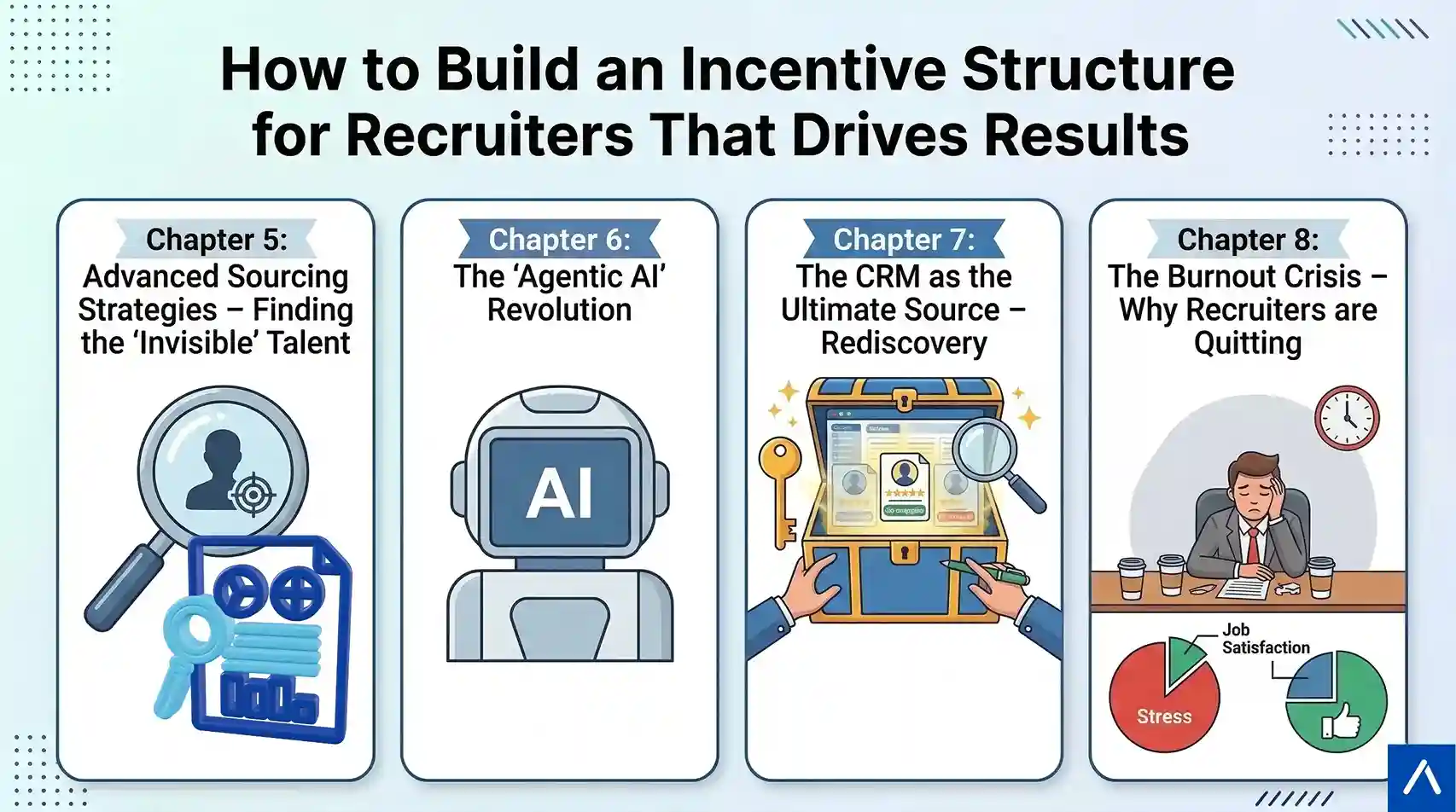
Chapter 5: Advanced Sourcing Strategies - Finding the “Invisible” Talent
If the incentive structure is the engine, candidate sourcing is the fuel. In 2026, simply broadcasting job postings on traditional boards is no longer a viable strategy. With the average time-to-fill stretching to 42 days, recruiters must adopt a proactive approach.
The 2026 Sourcing Shift: Skills-First Hiring
The most significant trend of the current era is the shift from “credential-based” to “skills-based” hiring. Major global employers like IBM and Google have pioneered this movement. By focusing on demonstrated competencies rather than university degrees, you expand your talent pool by up to 6.1x.
Leveraging Semantic Search and AI
In 2026, semantic search has effectively replaced rigid Boolean search strings. While Boolean relies on exact textual matches, semantic search interprets context and intent. A recruiter utilizing AI Recruiting tools can search for a “Java developer from a high-growth startup,” and the AI will understand that “startup” implies a specific work environment, while “Java” includes related frameworks like Spring Boot.
| Sourcing Technology | Core Benefit | Impact on Efficiency |
|---|---|---|
| AI Resume Parsing | Instantly extracts data from CVs. | Saves 5-10 hours per week. |
| Semantic Matching | Ranks candidates on “transferable skills.” | Delivers Higher-quality shortlists. |
| Automated Sequencing | Sends personalized follow-ups. | Triple response rates. |
Check out the top 12 tools that are changing the game this year: 12 Best Recruitment CRM Software for Recruitment Agencies
Chapter 6: The “Agentic AI” Revolution
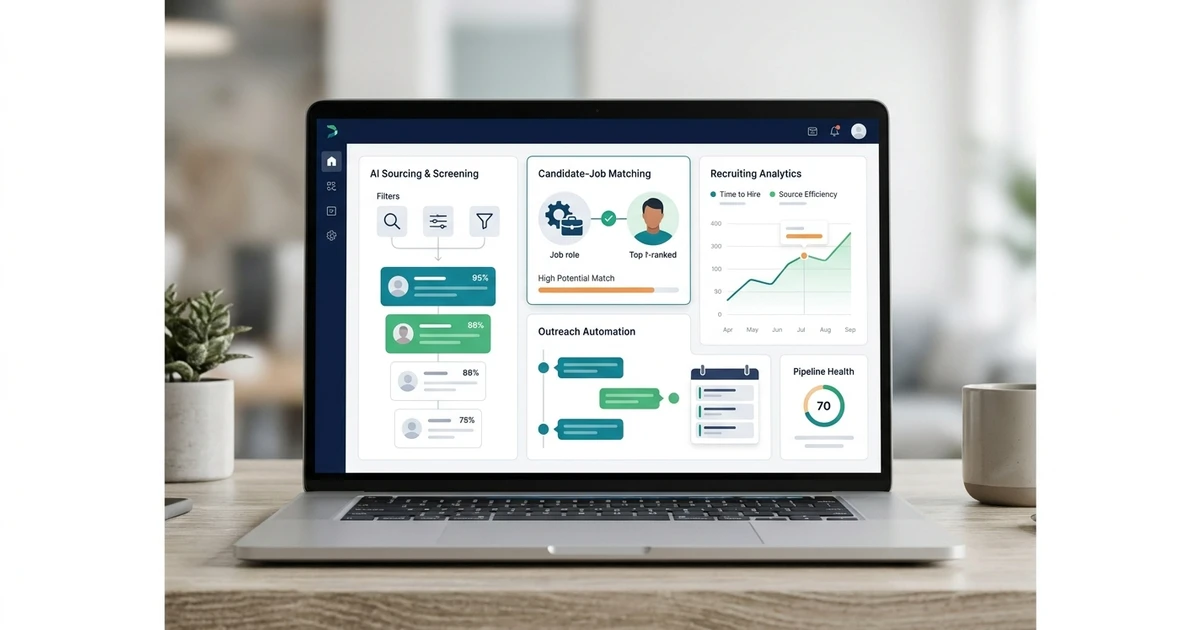
To master candidate sourcing, one must embrace “Agentic AI”—autonomous agents capable of managing entire recruitment workflows without constant human prompting.
The Role of the Digital Recruiter
More than 50% of talent leaders plan to integrate autonomous AI agents into their teams by late 2026. Unlike simple chatbots, these agents can:
- Monitor platforms 24/7.
- Identify top-fit candidates.
- Initiate the initial round of generative AI-powered outreach.
This liberation allows the human recruiter to focus on “critical thinking” and “judgment calls”, skills that TA leaders rank as their top recruiting priority for 2026.
Training Your AI Agents
You can use specialized AI prompts to train your agents to:
- Draft personalized outreach that gets a higher response rate.
- Generate Boolean search strings that find niche talent on GitHub.
- Analyze behavioral signals to predict when a candidate is “ready to move”.
Looking for a better way to manage your team than Bullhorn? Read this: The Best Bullhorn Alternative for Effortless Hiring
Chapter 7: The CRM as the Ultimate Source - Rediscovery
An often-overlooked sourcing strategy is the “Rediscovery” of talent. Research indicates that 46% of sourced hires in 2026 originate from candidates already existing in an agency’s CRM.
The Power of Silver Medalists
Often, the ideal candidate for today’s role was the “silver medalist” for a position filled months ago. Instead of paying for new LinkedIn InMails, use ATZ CRM’s AI-candidate matching to uncover these candidates by comparing new job descriptions against the historical database. This ensures you never pay twice for the same lead.
Nurturing Passive Candidates
Active job seekers constitute only a small fraction of the total talent market. To excel, your sourcing strategies must prioritize the talent pool that is “passive.” Nurturing these individuals requires a long-term engagement model, sharing industry insights or company culture updates to ensure your agency remains “top of mind.”
Time to move on from Recruiterflow? We’ve got you covered: Best RecruiterFlow Alternatives for Recruiting Firms
Chapter 8: The Burnout Crisis - Why Recruiters are Quitting
Recruiting is high-pressure. 83% of recruiters feel at least some degree of burnout in 2026. But it’s not the “talking to people” part that burns them out, it’s the “paperwork tax.”
The 38% Productivity Leak
Recruiters spend 38% of their working time just scheduling interviews. That is nearly two days a week wasted on “calendar tag.” When your team is drowning in admin, they aren’t making placements, and their incentive structure becomes a source of frustration rather than motivation.
Using Humor to Combat Workplace Stress
To survive the “Talent War,” maintaining a sense of humor is vital. Consider these common industry scenarios:
- The Responsibility Paradox: A recruiter informs a candidate that the role requires someone who is highly responsible. The candidate replies, “That’s me! In my last job, whenever anything went wrong, they said I was responsible!”
- The Invisibility Issue: Why did the Invisible Man decline the job offer? He simply couldn’t see himself doing it.
- The Mirror Career: A recruiter notes they might transition to cleaning mirrors, as it’s something they could really “see themselves doing.”
Operational Solutions to Burnout
- Automate the Mundane: Use AI notetakers to record and transcribe calls, removing the need for manual data entry.
- Define Communication Boundaries: The majority of candidates drop out due to slow response times. Set automated triggers that provide clear timelines.
- No-Meeting Days: Implement “Focus Fridays” where the team just hunts and doesn’t sit in Zoom calls.
Ready to reclaim your time and boost your billing? Switch to ATZ CRM: 7 Powerful Reasons to Upgrade Now
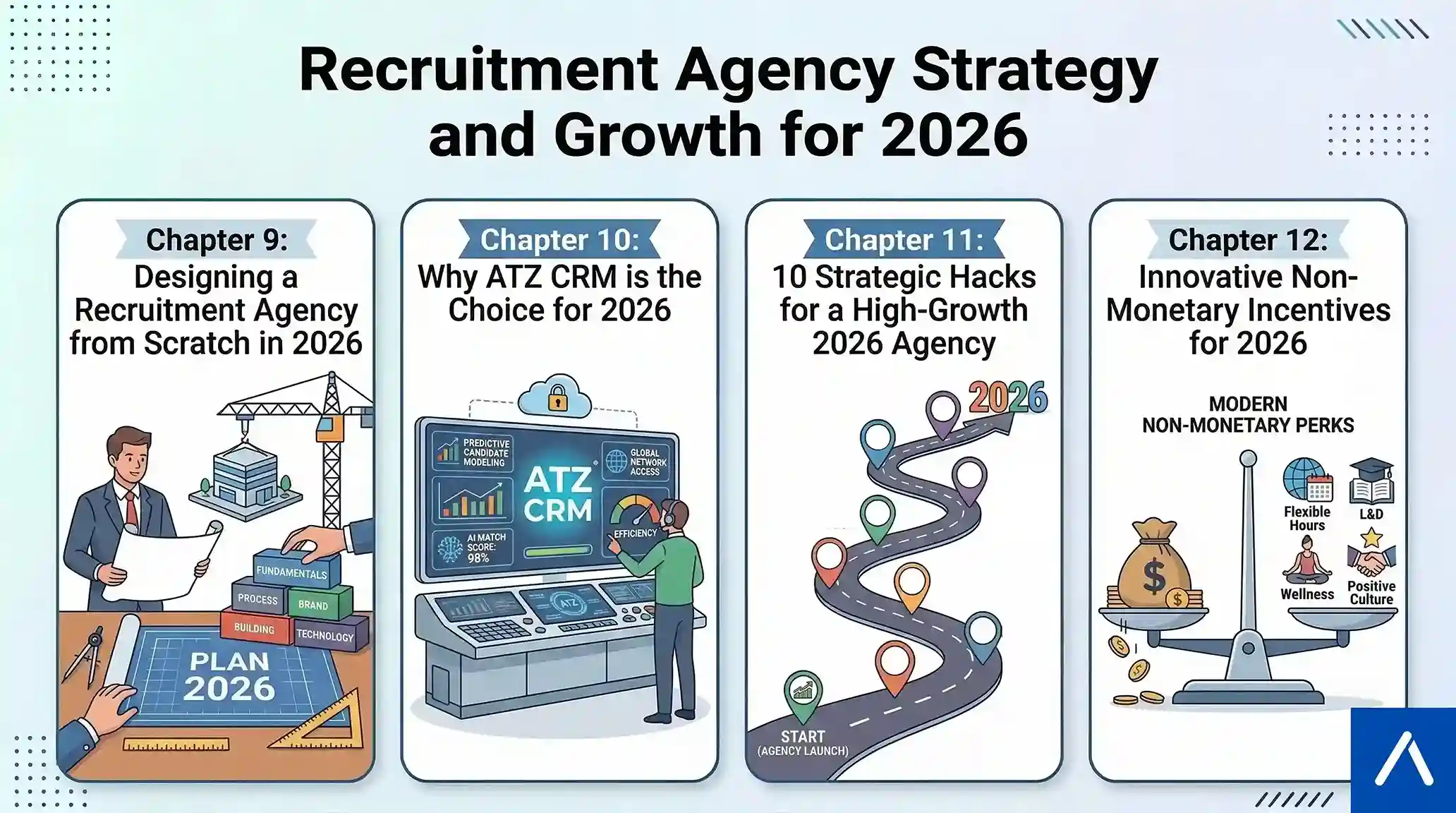
Chapter 9: Designing a Recruitment Agency from Scratch in 2026
Thinking about starting your own firm? You aren’t alone. Many people are looking for a leaner, AI-first model to compete with the giants.
Step 1. Pick a Niche:
Generalist agencies are dying. Niche agencies (Fintech, Green Energy, AI Healthcare) command higher fees and build better talent pools. If you know everyone in a specific niche, you don’t need to “source”; you just need to “connect.”
Step 2. Build Your Tech Stack:
You need a “Unified Operating System.” Don’t buy five different tools that don’t talk to each other. You need a system that handles:
- ATS: For tracking active applicants.
- CRM: For winning new clients.
- Sourcing Tool: For one-click LinkedIn capturing.
Step 3: Set Your Fees
In 2026, you have options:
- Contingency: 15% - 25% of salary (Standard “No win, no fee”).
- Retained: 30% - 35% (Exclusive, paid upfront). This provides better cash flow.
- RPO/Subscription: A fixed monthly fee for ongoing volume hiring.
What exactly is Executive Search? Find out here: What Is Executive Search? A Complete Guide
Chapter 10: Why ATZ CRM is the Choice for 2026
If you are currently using legacy systems, you might be feeling the “complexity creep.” High costs and limited AI are the top reasons firms are looking for alternatives.
Unified Pipeline and Client Management
The primary drain on recruiter productivity is “context switching”, the act of moving between a standalone ATS for tracking and a CRM for sales. ATZ CRM synthesizes these functions into a single operating system.
| Feature | ATZ CRM Advantage | Operational Benefit |
|---|---|---|
| Unified ATS/CRM | Single source of truth. | Eliminates manual data sync. |
| Client Portals | Secure environment for feedback. | Accelerates decision cycles. |
| AI Scoring | Automated ranking of applicants. | Prioritizes high-potential talent. |
| Budget Efficiency | $10-$12 per user/month. | Enterprise features at startup cost. |
Fully Customizable Workflows
Every recruitment niche has unique requirements. ATZ CRM provides customizable workflows, enabling agencies to adapt the platform to everything from high-volume temporary staffing to highly confidential executive search.
Should you go Retained or Contingent? Let’s break it down: Retained Recruiting vs. Contingent Recruiting: How to Choose?
Chapter 11: 10 Strategic Hacks for a High-Growth 2026 Agency
To hit the big numbers, your structure needs to be backed by these 10 tactical hacks:
- Speed to Shortlist: Top candidates are off the market in 10-14 days. Use AI to shortlist in minutes, not hours.
- Salary Transparency: Put the salary range in the job post. It’s not just a trend; in 2026, it’s a legal requirement in many places.
- The “Batman” Test: Use real-world assignments instead of generic interview questions to see who actually has the skills.
- Omnichannel Outreach: Don’t just email. Use the nurturing workflows to hit them on LinkedIn, SMS, and WhatsApp.
- Referral Rewards: Referred candidates stay 45% longer. Incentivize your employees with cash or extra PTO.
- Benchmark Granularly: Use supply data to tell your clients why that “Purple Squirrel” candidate will take 4 months to find, not 4 weeks.
- Diversity First: Use inclusive job posting sites to widen your reach and beat the skills gap.
- Automate Follow-ups: TA leaders say increased touchpoints are the biggest change in 2026. Let the CRM handle the “Checking in” messages.
- Nurture Passive Talent: The majority of the workforce is passive. Don’t just “pitch”, share valuable industry content to build trust.
- Analyze Quality of Hire: Don’t just track who you hired; track how long they stayed. This is the ultimate metric for agency reputation.
Chapter 12: Innovative Non-Monetary Incentives for 2026
Money is great, but lifestyle perks are the “secret sauce” for retention. Workers stay at a company for flexible work arrangements.
Creative Ideas for Your Team:
- Work-From-Anywhere Months: Let your team work from Bali or Italy for 30 days.
- Pet-Friendly Offices: Because who doesn’t want a “Chief Happiness Officer” with four legs?
- Learning Stipends: Pay for their AI certifications or industry workshops.
- “No-Meeting” Days: Give them the gift of uninterrupted time.
- Subscription Perks: Pay for their gym membership, Spotify, or Headspace.
FAQs
1. What is the most effective incentive structure for recruiters in 2026?
The most effective model is a base salary (60%) plus a tiered commission (40%) with accelerators that increase the percentage payout once billing milestones are achieved.
2. How do I find candidates for specialized “skills-first” roles?
Use AI-powered sourcing tools like ATZ CRM to search for “Semantic Matches” and “Hidden Talent” within your existing database. Sourced candidates are 8x more likely to be hired than inbound applicants.
3. Why is my recruiter turnover rate so high?
It’s often due to burnout caused by unmanageable workloads and administrative friction. In 2026, recruiters spend 38% of their time scheduling interviews. Automating these tasks is key to retention.
4. When should I use a “Retained” vs. “Contingent” model?
Use a retained model for executive-level roles (salaries >$150k) or confidential searches. Use contingent for high-volume, mid-level hiring where speed and volume are the priorities.
5. How does ATZ CRM compare to Bullhorn or Recruiterflow?
ATZ CRM is built for 2026, offering integrated “Agentic AI” tools, unified pipelines, and transparent pricing ($10-$12/user) that is significantly more affordable than traditional “legacy” systems.
Conclusion:
Success in 2026 requires a shift in both psychology and technology. To lead the market, your agency must move beyond “post-and-pray” methods and embrace a strategy that rewards high-value behaviors while finding talent where others aren’t looking.
By implementing the incentive structures and AI-driven sourcing strategies outlined in this guide, you can:
- Escape the “Black Hole”: Use ATZ CRM for AI-augmented discovery to find hidden, high-quality talent instantly.
- Kill the “Administrative Tax”: Automate the 38% of the day currently wasted on manual tasks and scheduling.
- Focus on Humans: Reclaim your time to build the deep relationships that truly define the recruitment industry.
Ready to revolutionize your workflow? Switch to ATZ CRM. Request a demo today and let’s build the future of hiring together.