· Recruitment · 12 min read
International Recruiting: How to Access the Top 1% of Global Talent
Ready to master international recruiting? Discover how to access the top 1% of global talent, navigate compliance, and scale your agency with ATZ CRM.

Introduction
Here’s a question for you: If the perfect candidate for your open role lived 5,000 miles away, would you be able to find them, hire them, and pay them before your competitor does?
Let’s be honest, hiring locally has become a battle royale. You’re fighting over the same pool of candidates as every other company in your zip code. But what if you could snap your fingers and expand that pool to the entire planet?
That is the power of international recruiting.
We aren’t just talking about outsourcing to save a few bucks. We are talking about accessing the “Top 1%”, the elite developers in Poland, the creative geniuses in Brazil, and the operational wizards in the Philippines. These are professionals who can transform your business, but only if you know how to reach them.
In this guide, we are going to ditch the boring textbook definitions. We’ll cover the real strategies you need to win at international recruiting in 2026, from the tech stack you need (hello, ATZ CRM!) to the jokes that will break the ice on a Zoom call.
Ready to go global? Let’s dive in.
Why International Recruiting is No Longer Optional
Remember when “remote work” was something only freelancers did? Fast forward to today, and the world has fundamentally changed.
The Talent Shortage is Real
In major hubs like New York, London, and San Francisco, the demand for specialized skills, especially in tech and AI, far outweighs the supply. If you limit yourself to local hiring, you are fishing in an empty pond. International recruiting opens up the ocean.
According to recent data, 86% of job seekers say culture and values matter most , and the top talent is increasingly looking for global opportunities that offer flexibility. By ignoring the global market, you aren’t just missing out on volume; you’re missing out on quality.
The “Remote-Native” Advantage
The top 1% of global talent are “remote-natives.” They didn’t just adapt to Zoom; they were born in it. They possess a unique set of skills:
- Asynchronous Mastery: They communicate clearly in writing, so you don’t have to wake up at 3 AM for a meeting.
- Self-Discipline: They manage their own output without a manager hovering over their shoulder.
- Global Perspective: They bring diverse ideas that can help your product appeal to a wider audience.
Where to Find the Top 1% (It’s Not Just LinkedIn)
If you are relying on the “post and pray” method, where you post a job and pray someone applies, you are going to struggle with international recruiting. The best candidates are passive. They are busy working, not scrolling job boards.
1. Regional Hotspots
Different regions have different superpowers. Here is a quick cheat sheet:
- Eastern Europe (Poland, Ukraine, Romania): The go-to hub for high-level engineering, algorithms, and AI. Developers here consistently rank in the top tiers on coding challenges.
- Latin America (Brazil, Mexico, Argentina): Perfect for US companies due to time zone alignment. Great for full-stack developers and creative roles.
- Asia (Philippines, India): The leaders in scale. The Philippines is unmatched for English-proficient support and design roles, while India remains a powerhouse for SaaS and enterprise software.
2. Smart Sourcing Channels
Don’t just stick to the paid boards. There are incredible free resources out there.
- GitHub & Stack Overflow: For developers. Look at their code repositories, not just their CVs.
- Behance & Dribbble: For designers. Their portfolios speak louder than a resume ever could.
- Free Job Boards: Yes, they exist! We compiled a massive list of free job posting sites for diverse hiring that you can leverage to cast a wider net without blowing your budget.
3. Executive Search Techniques
For senior roles, you need to think like a headhunter. This means “market mapping,” identifying every potential candidate at competitor firms in a specific region, and reaching out directly. If you are new to this high-touch approach, check out our guide on what executive search is to get started.
The Tech Stack: Your Secret Weapon
You cannot manage international recruiting with a spreadsheet and a prayer. You need a system that handles time zones, currencies, and complex workflows.
Why You Need a CRM, Not Just an ATS
Traditional Applicant Tracking Systems (ATS) are passive. A Recruitment CRM (Candidate Relationship Management) is active; it helps you build relationships with talent before they apply.
This is where ATZ CRM shines. It is built for the modern, global recruiter. Here is why agencies are flocking to switch to atzcrm:
- AI-Powered Sourcing: Stop manually searching. Our AI agents can scan global databases to find candidates who match your exact criteria (e.g., “Python dev in Brazil with Fintech experience”).
- Automated Sequencing: You can’t be awake 24/7. ATZ CRM lets you schedule emails and LinkedIn messages to land in your candidate’s inbox at their 9 AM, even if it’s your 2 AM.
- Resume Parsing: International resumes come in all shapes and sizes. ATZ CRM normalizes them into a standard format so you can compare apples to apples.
If you are currently using older software and feeling stuck, you might want to read our comparison on the best bullhorn alternative. And for those of you looking for automation, check out our analysis of recruiterflow alternatives.
Pro Tip: If you are a small business just starting, you might be tempted to go for a free tool. While ATZ CRM offers unbeatable value, you can explore other options in our guide to Discover free ats for small businesses.
Recruiter Joke Break!
Recruiter: “What is your biggest weakness?”
Candidate: “I can be uncomfortably honest.”
Recruiter: “I don’t think that’s a weakness.”
Candidate: “I don’t give a damn what you think!”
Okay, back to business!
Engaging the Top 1%: Culture and Communication
 When you find that top 1% candidate, how do you win them over?
1. Cultural Intelligence (CQ)
A standard American interview style (direct, sell yourself) might fail in Japan (where humility is prized).
- Low-Context Cultures (USA, UK, Germany): Be direct. “Yes” means yes.
- High-Context Cultures (Asia, Brazil): Read between the lines. “Yes” might just mean “I hear you.”
If you are unsure how to phrase things, AI can be a lifesaver. We have put together a list of the Best AI & ChatGPT Prompts for recruiters to help you draft culturally sensitive emails and interview questions.
2. Asynchronous Interviews
Scheduling a live interview across a 12-hour time difference is a nightmare. Enter Asynchronous Video Interviews.
- How it works: You record questions; the candidate records answers on their own time.
- Why it’s great: It respects their time zone and tests their ability to use remote tools, a crucial skill for international recruiting.
3. Value-Based Pay
Don’t try to lowball international talent. The top 1% know their worth. If you try to pay “local market rates” that are peanuts compared to the value they bring, they will leave for a company that pays better. Adopt a “Value-Based Pay” model—pay for the output, not the location.
The Legal Stuff: EOR vs. PEO (Simplified)
This is the part that scares most people about international recruiting, but it’s actually simple if you know the acronyms.
What is an EOR?
Employer of Record (EOR).
Use this when you don’t have an office in the candidate’s country.
- The EOR (companies like Deel or Remote) legally hires the person.
- They handle taxes, compliance, and payroll.
- You just manage the employee’s work.
What is a PEO?
Professional Employer Organization (PEO).
Use this only if you already have a legal entity in that country but want help with HR admin.
The Golden Rule: Never hire a full-time employee as an “Independent Contractor” just to save money. Governments are cracking down on this (it’s called “misclassification”), and the fines are massive.
If you are dealing with executive roles, the stakes are even higher. Understanding the difference between retained and contingent recruiting is critical when you are engaging search firms to find these leaders.
Common Mistakes to Avoid while International Recruiting (And What to Do Instead)
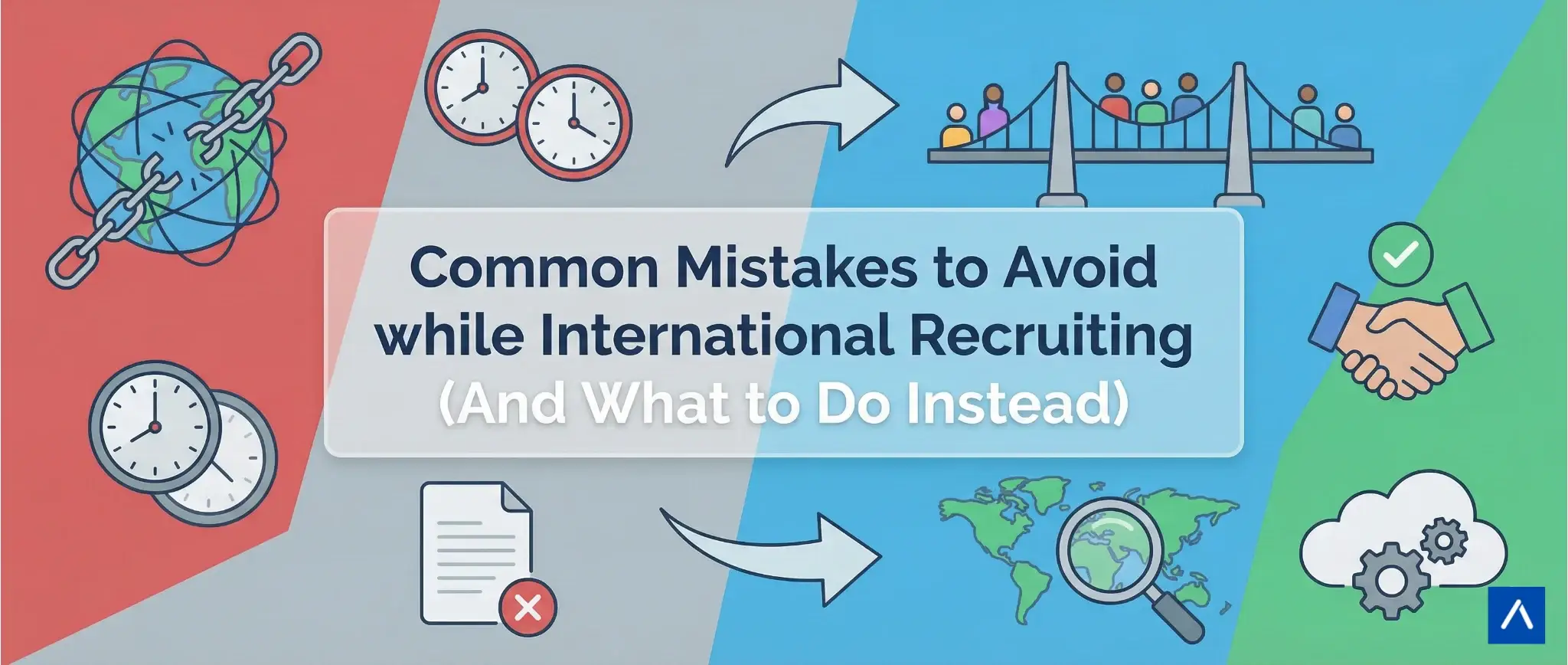 We’ve all been there: you think you’ve hired the perfect developer in Argentina, only to find out you can’t legally pay them, or worse, you offend them in the first week. Here are the most common traps recruiters fall into, and how to fix them.
The “Forever Contractor” Trap
- The Mistake: Hiring everyone as an independent contractor to avoid paperwork.
- The Risk: Governments globally are cracking down on this. If your “contractor” works 40 hours a week, uses your equipment, and reports to a manager, they are legally an employee. Misclassification fines can bankrupt a small agency.
- The Fix: Use an EOR (Employer of Record) to hire them compliantly as full-time employees. It costs a bit more, but it’s significantly cheaper than a lawsuit.
The “Copy-Paste” Contract
- The Mistake: Sending a standard US or UK employment contract to a hire in Germany or Brazil.
- The Risk: It’s likely legally void. Did you know notice periods in some European countries are 3 months, not 2 weeks? Or that non-competes are illegal in certain regions?
- The Fix: Don’t assume. Localize every offer. Work with legal partners who understand the specific labor laws of the candidate’s country.
Ignoring “Ghost” Holidays
- The Mistake: Scheduling a mandatory all-hands meeting on Diwali or Lunar New Year because it’s a regular Tuesday in your office.
- The Risk: You alienate your new team members and show a lack of respect for their culture.
- The Fix: Add international holidays to your company calendar before you hire. Being proactive about this earns you massive respect points.
The Time Zone Math Fail
- The Mistake: “Let’s meet at 2 PM EST.” (Which is 3 AM in Manila).
- The Risk: Your new hire burns out in a month because they are living on a vampire schedule.
- The Fix: Adopt asynchronous workflows. Use recorded videos and detailed notes so people can work when the sun is up where they live.
Underestimating the Onboarding Gap
- The Mistake: Treating international onboarding the same as local.
- The Risk: Without casual “water cooler” talk, remote international hires often feel isolated and disengaged within the first 90 days.
- The Fix: Create a “Pre-boarding” experience. Send them swag, set up a virtual coffee with a “culture buddy,” and ensure they have access to all tools (like ATZ CRM) on Day 1.
Why Automation is Your Best Friend
To scale international recruiting, you need to automate the busy work. You cannot manually track 500 candidates across 10 time zones.
ATZ CRM offers features that make this seamless:
- Visual Pipelines: See exactly where every candidate is in the process.
- Client Portals: Share candidate profiles with your clients instantly, allowing them to provide feedback without the need for endless email chains.
- Integrated Calling: Call candidates directly from the CRM and have the call transcribed automatically.
If you are still debating which software to use, our ranking of the 12 best recruitment CRM software for recruitment breaks down the top players.
We also have a deep dive into the Ultimate recruit crm best ATS ranked, to help you decide.
Conclusion
The world is full of incredible talent. The only thing standing between you and the top 1% is your willingness to look beyond your borders.
International recruiting is not just a trend; it is the future of work. By leveraging the right strategies, understanding cultural nuances, and arming yourself with powerful tools like ATZ CRM, you can build a dream team that never sleeps.
Don’t let geography limit your growth. The talent is out there, go get them!
Book a Demo Now
Ready to take your international recruiting game to the next level? Stop wrestling with spreadsheets and start recruiting with intelligence.
FAQs
1. What is the biggest challenge in international recruiting?
Compliance. Navigating different labor laws and tax codes is tricky. Using an Employer of Record (EOR) is the safest way to hire internationally without setting up a legal entity in every country.
2. How do I handle time zone differences for interviews?
Use Asynchronous Video Interviews. Let candidates record their answers on their own time. For live meetings, try to rotate the inconvenience; sometimes you stay up late, sometimes they get up early.
3. Which countries are best for hiring software developers?
Poland and Ukraine are top-tier for complex engineering and AI. Brazil and Mexico are excellent for US-based teams due to time zone alignment. India offers the largest pool of diverse tech talent.
4. Can I use a free ATS for international recruiting?
You can, but it might lack features like automated scheduling across time zones or multi-currency support. Check out our guide on Discover free ats for small businesses, but consider upgrading to a robust CRM like ATZ CRM as you scale.
5. How do I know if a candidate is fluent in English?
Don’t just rely on their CV. Use a standardized test (like C1 Advanced) or, better yet, conduct a short video interview. Tools like ATZ CRM allow you to transcribe calls to review language proficiency objectively.
Blog Summary:
- Global vs. Local: Moving beyond the local “battle royale” for talent allows companies to access the top 1% of elite, self-disciplined “remote-natives” rather than just outsourcing for lower costs.
- Strategic Sourcing Hubs: Recruiters should target Eastern Europe (Poland, Ukraine) for engineering/AI, Latin America (Brazil, Mexico) for US time-zone alignment, and Asia (Philippines, India) for scale.
- Smart Channels: Effective sourcing moves beyond standard job boards to niche platforms like GitHub for developers, Behance for creatives, and market mapping for executive searches.
- The Tech Stack: ATZ CRM is recommended over a standard ATS because it helps “hunt” talent using AI sourcing, resume parsing, and automated scheduling based on the candidate’s local time.
- Cultural Intelligence (CQ): Hiring teams must adapt interview styles to fit the candidate’s culture (high-context vs. low-context) and utilize asynchronous video interviews to test communication skills.
- Value-Based Compensation: To retain top talent, pay should be determined by output and value rather than strictly by location, avoiding the tendency to lowball international hires.
- Legal Compliance: Companies should use an Employer of Record (EOR) if they lack a local legal entity, or a PEO if they have one, while strictly avoiding the “Forever Contractor” trap to prevent fines.
- Contract Localization: Offers must be localized to respect specific notice periods and labor laws, rather than using a “copy-paste” approach from the headquarters.
- Operational Respect: Management must account for “Ghost Holidays” (local festivals) and avoid scheduling meetings at unreasonable hours by adopting asynchronous workflows.
- Onboarding Success: To prevent isolation, companies should implement “pre-boarding” processes and assign “culture buddies” to integrate new remote hires effectively.
- Conclusion: Achieving global scale requires a combination of the right mindset, strong legal partners (EOR), and specialized technology like ATZ CRM.