 EN
EN DE
DE ES
ES FR
FR NL
NL PT
PT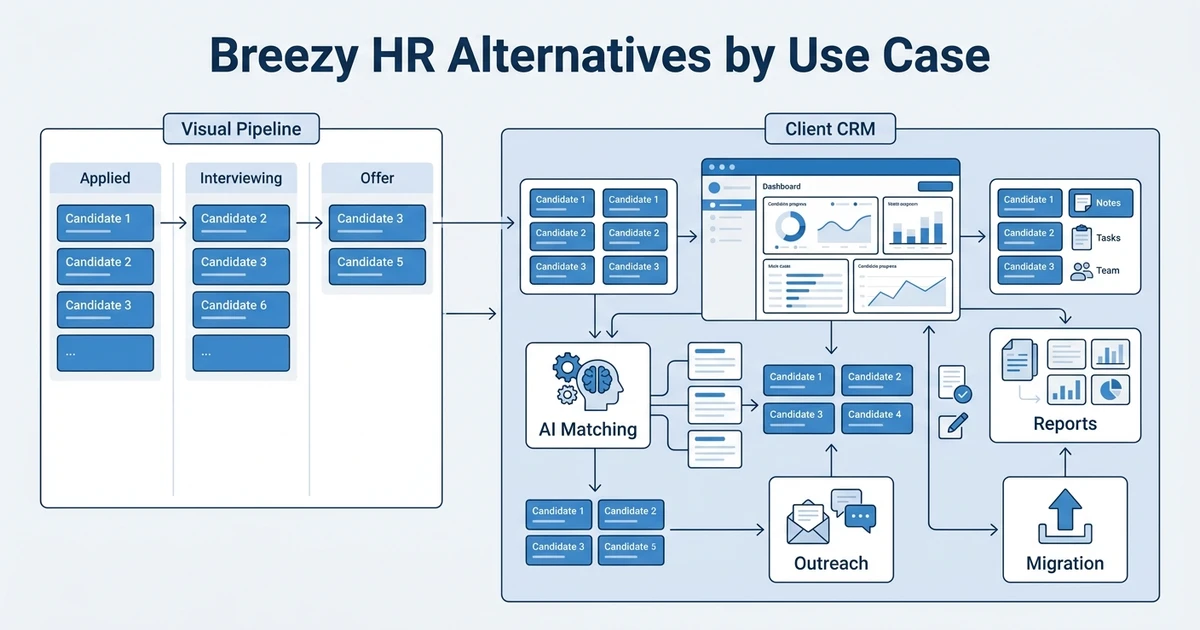



Quick Answer: The best Breezy HR alternatives depend on whether your team needs a simple visual ATS, stronger reporting, better automation, deeper CRM, or a recruiting workspace built for agency growth. This guide ranks options by use case so you can compare ease of setup, ATS depth, CRM depth, pricing visibility, and migration risk.
Breezy HR alternatives usually become relevant when a simple hiring pipeline stops being enough. That can happen fast.
At first, a visual ATS feels perfect. You can post jobs, move candidates through stages, and keep hiring conversations in one place.
Then the workflow grows. You need client records, sourcing, outreach, AI matching, reporting, candidate history, and better handoff between recruiters. For agencies and staffing firms, that is the moment to compare a basic ATS with a full ATS + CRM platform.
This guide ranks 20 options by use case so you can choose a tool that matches your next stage, not your last one.
Why teams compare Breezy HR alternatives
Teams compare Breezy HR alternatives when simplicity starts creating hidden work. A visual pipeline can help small hiring teams, but it does not always support the deeper workflow recruiters need as volume, clients, and reporting demands grow.
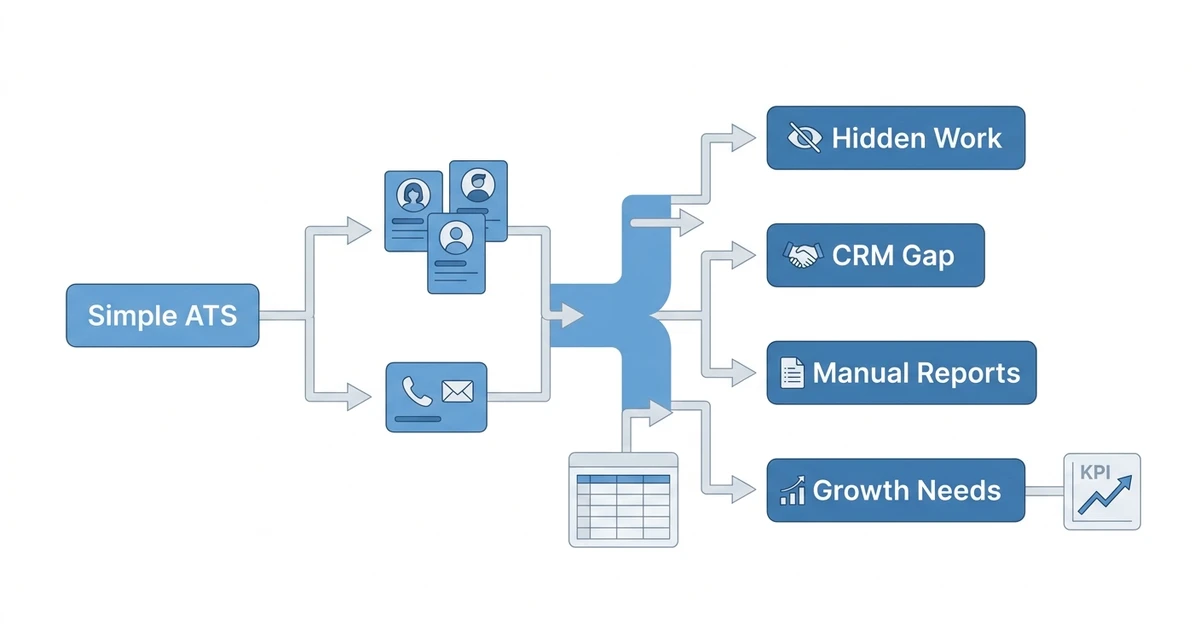
For agencies, the gap is usually CRM. Recruiters need to track candidates and client relationships together. If those workflows live in different tools, notes get scattered and reporting becomes less reliable.
Hiring challenges make that worse. SHRM reports that 51% of organizations face too few applicants, 50% struggle with losing talent to competitors, and 41% cite candidate ghosting in its State of Recruiting 2025 analysis. When candidates are harder to keep engaged, recruiters need better follow-up and cleaner data.
AI is another reason teams reconsider lightweight ATS tools. SHRM found that AI adoption in HR tasks increased to 43% in 2025 from 26% in 2024 in its 2025 Talent Trends research. But AI only helps if it is tied to candidate matching, outreach, pipeline movement, and reporting.
You may need to move beyond a simple ATS if:
- Recruiters use spreadsheets for client or candidate follow-up.
- Reporting takes manual cleanup.
- Candidate sourcing happens outside the ATS.
- Client communication is not connected to jobs.
- Outreach is hard to personalize or automate.
- Your team cannot see recruiter activity by job, client, or source.
- Data migration feels risky because records are inconsistent.
The question is not whether Breezy HR is simple. The question is whether simple still matches your recruiting operation.
How we evaluated the best Breezy HR alternatives
This ranking looks at the common reason teams choose Breezy HR in the first place: ease of use. But it also measures what happens when ease of use is not enough.
Recruitment agencies should not choose an ATS only because it looks clean. They need to know whether the platform supports CRM, submissions, candidate rediscovery, outreach, client feedback, and revenue visibility.
We evaluated each option using these criteria:
- Ease of setup for small and growing teams.
- ATS depth for jobs, stages, notes, interviews, and applications.
- CRM depth for clients, contacts, deals, and follow-ups.
- Automation for email, status updates, and recruiter tasks.
- AI support for matching, sourcing, messaging, and scoring.
- Reporting for pipeline, activity, sources, clients, and revenue.
- Pricing visibility before a demo.
- Migration effort from a lightweight ATS.
- Fit for recruitment agencies, staffing firms, and in-house hiring teams.
LinkedIn reports that companies using AI-assisted messaging the most are 9% more likely to make a quality hire than those using it least in its Future of Recruiting 2025 research. That matters because small ATS tools often handle applicants well but do not always support smarter outbound communication.
Gartner says AI and cost pressure are two major forces shaping talent acquisition in 2026 in its recruiting trends note. The best alternative should help you grow without making cost or implementation feel vague.
Quick comparison of the top Breezy HR alternatives
Use this table to move from a long list to a practical shortlist.
| Rank | Tool | Best for | Ease of setup | CRM depth | Automation | Reporting | Pricing visibility |
|---|---|---|---|---|---|---|---|
| 1 | ATZ CRM | Simple agency ATS plus CRM | High | High | Strong | Strong | Public pricing |
| 2 | Workable | SMB hiring with quick setup | High | Low | Moderate | Moderate | Public plans available |
| 3 | JazzHR | Lean budget hiring teams | High | Low | Basic | Basic | Public plans available |
| 4 | Recruitee | Collaborative hiring | High | Low | Moderate | Moderate | Public plans available |
| 5 | BambooHR | HR suite with hiring included | High | Low | Basic | Basic | Package-dependent |
| 6 | Zoho Recruit | Zoho ecosystem users | Medium | Medium | Moderate | Moderate | Public plans available |
| 7 | Manatal | Affordable AI recruiting | High | Medium | Moderate | Moderate | Public plans available |
| 8 | Teamtailor | Employer branding | High | Low | Moderate | Moderate | Not publicly listed |
| 9 | Pinpoint | Candidate experience | High | Low | Moderate | Moderate | Not publicly listed |
| 10 | Greenhouse | Structured hiring at scale | Medium | Low | Moderate | Strong | Not publicly listed |
| 11 | Lever | Candidate relationship management | Medium | Medium | Moderate | Moderate | Not publicly listed |
| 12 | Ashby | Startup recruiting operations | High | Medium | Strong | Strong | Not publicly listed |
| 13 | SmartRecruiters | Global enterprise hiring | Medium | Low | Strong | Strong | Not publicly listed |
| 14 | Recruiterflow | Agency automation | Medium | High | Strong | Moderate | Public plans available |
| 15 | Loxo | Sourcing-heavy teams | Medium | Medium | Strong | Moderate | Not publicly listed |
| 16 | Crelate | Relationship-focused agencies | Medium | High | Moderate | Moderate | Public entry point |
| 17 | JobAdder | Established agency ATS CRM | Medium | High | Moderate | Moderate | Not publicly listed |
| 18 | Bullhorn | Enterprise staffing | Medium | High | Strong | Strong | Not publicly listed |
| 19 | CEIPAL | Staffing workforce workflows | Medium | Medium | Moderate | Moderate | Package-dependent |
| 20 | iCIMS | Compliance-heavy enterprise hiring | Medium | Low | Strong | Strong | Not publicly listed |
Top 20 Breezy HR alternatives by use case
1. Best for simple agency ATS plus CRM
Tool reviewed: ATZ CRM.
Overview: ATZ CRM is the best first choice for agencies that want to move beyond a simple visual pipeline without losing usability. It combines applicant tracking system for recruiting teams, recruitment CRM for client pipelines, AI matching, outreach, reporting, and migration support.
This makes it a strong fit when your recruiting workflow includes candidates and clients. Instead of treating CRM as a side process, ATZ CRM puts candidate delivery and client follow-up in the same workspace.
Pros:
- ATS + CRM designed for recruitment agencies and staffing teams.
- AI matching, outreach automation, reporting, and client workflows.
- Public pricing and unlimited free trial.
- Easier growth path than stitching a simple ATS to separate CRM tools.
Cons:
- Not a general HRIS suite.
- Teams that only hire occasionally may not need the full workflow depth.
Pricing: ATZ CRM pricing starts at $12/user/month for Pro, with Business at $24/user/month and Enterprise at $60/user/month on annual billing. Annual billing saves 20%, and an unlimited free trial is available on the pricing for recruitment teams page.
Best fit: Recruitment agencies, staffing firms, and small recruiting teams that want simple adoption plus deeper workflow coverage.
2. Best for SMB hiring with quick setup
Tool reviewed: Workable.
Overview: Workable is a strong Breezy HR alternative for SMB hiring teams that need a quick ATS setup, job posting workflows, and basic collaboration. It is often a practical option when hiring is internal and relatively straightforward.
For agencies, Workable should be tested against CRM requirements. If recruiters need client records, submissions, sales follow-up, and revenue reporting, a simple SMB ATS may not be enough.
Pros:
- Fast setup for small hiring teams.
- Good job posting and applicant tracking basics.
- Public plans make early budget screening easier.
Cons:
- Limited CRM depth.
- Agency workflows may require extra tools.
Pricing: Public plans are available. Confirm the plan that matches your users, jobs, automation, and integrations.
Best fit: SMB in-house hiring teams that want a quick ATS rollout.
3. Best budget ATS for lean hiring teams
Tool reviewed: JazzHR.
Overview: JazzHR is a budget-oriented ATS for teams that need basic recruiting workflows. It can work when your main need is to organize applicants and move them through a simple hiring process.
The trade-off is depth. Once you need advanced CRM, automation, sourcing, and reporting, a budget ATS may push work into spreadsheets or separate tools.
Pros:
- Simple applicant tracking.
- Public plans available.
- Good for lean internal hiring.
Cons:
- Limited agency CRM.
- Less suited to staffing or search workflows.
Pricing: Public plans are available. Review user, job, and feature limits before comparing.
Best fit: Small internal teams that need basic applicant tracking at a lower cost.
4. Best collaborative hiring workspace
Tool reviewed: Recruitee.
Overview: Recruitee is a good option for teams that want collaborative hiring, career site support, and a clean hiring manager experience. It can suit in-house teams that want more structure than a basic visual pipeline.
Agencies should validate client collaboration. Internal collaboration and client collaboration are different workflows, especially when submissions and feedback drive revenue.
Pros:
- Strong hiring team collaboration.
- Useful employer brand and career site workflows.
- Public plans support early evaluation.
Cons:
- Agency CRM depth should be tested.
- Not built primarily for staffing operations.
Pricing: Public plans are available. Confirm automation, collaboration, and feature limits.
Best fit: In-house teams that want collaborative hiring and employer brand support.
5. Best HR suite with hiring included
Tool reviewed: BambooHR.
Overview: BambooHR is a useful choice when hiring is part of a broader HR software need. It can help small companies manage employee records and lightweight recruiting together.
It is usually not the best fit for recruitment agencies. Agencies need client pipeline, candidate ownership, submissions, and placement reporting more than employee administration.
Pros:
- HRIS plus basic hiring.
- Good for small-company HR teams.
- Simple employee record management.
Cons:
- Not agency-first.
- Limited CRM and recruiting operations depth.
Pricing: Pricing depends on package and company requirements. Confirm hiring features before comparing.
Best fit: Small companies that want HR software with basic ATS capability.
6. Best for teams already using Zoho
Tool reviewed: Zoho Recruit.
Overview: Zoho Recruit can work well if your team already uses Zoho and wants applicant tracking inside that ecosystem. It can also appeal to cost-conscious teams that need ATS and CRM-style fields.
The challenge is usability. Agencies should test whether recruiters can work quickly without too much configuration or suite navigation.
Pros:
- Affordable ecosystem option.
- ATS and CRM concepts in one suite.
- Public plans support early comparison.
Cons:
- Interface can feel busy.
- Best fit depends on Zoho ecosystem commitment.
Pricing: Public plans are available. Verify automation, portals, reporting, and workflow needs.
Best fit: Teams already using Zoho tools.
7. Best affordable AI recruiting platform
Tool reviewed: Manatal.
Overview: Manatal is a lightweight ATS with AI-assisted screening and matching features. It can work for smaller teams that want a simple recruiting platform with AI support.
For agencies, the key question is workflow depth. AI matching helps, but only if recruiters can also manage clients, submissions, outreach, and reporting cleanly.
Pros:
- Affordable AI-assisted recruiting.
- Simple setup.
- Public plans make early evaluation easier.
Cons:
- Less enterprise depth.
- Agency CRM should be tested.
Pricing: Public plans are available. Confirm candidate limits, automation, and support needs.
Best fit: Small and mid-sized teams that want accessible AI-assisted applicant tracking.
8. Best for employer branding and career pages
Tool reviewed: Teamtailor.
Overview: Teamtailor is a strong fit for companies that care about employer brand, career pages, and candidate experience. It can help teams present a polished hiring journey.
For agencies, the fit is narrower. Unless career-site branding is the primary need, client CRM and candidate delivery usually matter more.
Pros:
- Strong employer brand orientation.
- Good candidate experience workflows.
- Useful for career page-led recruiting.
Cons:
- Less focused on client and agency workflows.
- Pricing may require a quote.
Pricing: Pricing is not publicly listed. Ask about package, users, and career site needs.
Best fit: In-house teams that prioritize employer brand.
9. Best for polished candidate experience
Tool reviewed: Pinpoint.
Overview: Pinpoint is useful for teams that want candidate experience, usability, and hiring team adoption. It can be a natural step up from a simpler ATS if internal hiring is the main use case.
Agencies should compare CRM and reporting closely. Candidate experience matters, but so do clients, job orders, submissions, and placement tracking.
Pros:
- Clean candidate experience.
- Strong usability story.
- Good for internal hiring teams.
Cons:
- Agency CRM depth should be validated.
- Pricing is not always visible upfront.
Pricing: Pricing is not publicly listed. Confirm implementation and package details.
Best fit: Teams that want a polished candidate journey and hiring manager adoption.
10. Best for structured hiring at scale
Tool reviewed: Greenhouse.
Overview: Greenhouse fits companies that need structured interviews, scorecards, approvals, and process control. It is a stronger fit for enterprise hiring teams than small agencies.
If you are moving from Breezy HR because your team needs structure, Greenhouse may belong on the shortlist. If you are moving because you need CRM, compare agency-focused tools first.
Pros:
- Strong structured hiring process.
- Useful for hiring team consistency.
- Mature enterprise TA workflows.
Cons:
- Not agency-first.
- Pricing and implementation may require a deeper sales cycle.
Pricing: Pricing is not publicly listed. Expect custom quotes.
Best fit: In-house teams that need structured hiring governance.
Book an ATZ CRM demo to see how visual pipelines, AI matching, outreach automation, client CRM, and reporting work together for agency recruiting.
11. Best for candidate relationship management
Tool reviewed: Lever.
Overview: Lever is a good option for in-house recruiting teams that want candidate relationship management alongside applicant tracking. It can help teams nurture talent pools and manage applicants.
Agencies should ask whether the system can manage client relationships with the same depth. Candidate CRM alone is not enough when client follow-up drives placements.
Pros:
- Strong relationship-led recruiting.
- Useful for proactive talent pipelines.
- Good internal recruiting collaboration.
Cons:
- Agency sales workflow should be tested.
- Pricing usually requires a quote.
Pricing: Pricing is not publicly listed. Ask about package and implementation scope.
Best fit: In-house recruiting teams that prioritize candidate relationship workflows.
12. Best for startup recruiting operations
Tool reviewed: Ashby.
Overview: Ashby is a modern platform for fast-growing teams that want recruiting operations, analytics, scheduling, and pipeline structure. It is often considered by startups and tech scaleups.
For agencies, analytics need to include client and revenue context. Test whether the platform supports the full agency workflow, not only internal TA operations.
Pros:
- Strong analytics and recruiting operations.
- Modern workflow design.
- Good for high-growth internal teams.
Cons:
- Not primarily agency CRM.
- Pricing may require sales contact.
Pricing: Pricing is not publicly listed. Confirm package and implementation requirements.
Best fit: Startup and scaleup TA teams.
13. Best for global enterprise hiring
Tool reviewed: SmartRecruiters.
Overview: SmartRecruiters fits enterprise teams that need global hiring workflows, marketplace integrations, and process control across regions. It is broader than a small-team ATS.
Smaller teams should be careful. Enterprise capability can create unnecessary admin work if the core problem is simple recruiting execution.
Pros:
- Strong enterprise TA coverage.
- Global workflows and integration marketplace.
- Useful for complex internal hiring operations.
Cons:
- Can be too heavy for lean teams.
- Not centered on agency CRM.
Pricing: Pricing is not publicly listed. Expect custom packaging.
Best fit: Global enterprise talent acquisition teams.
14. Best agency automation option
Tool reviewed: Recruiterflow.
Overview: Recruiterflow is an agency ATS + CRM with automation and outreach workflows. It can fit recruitment firms that want candidate and client pipelines with email automation.
Compare it with ATZ CRM if your team wants stronger AI matching, reporting, migration support, and transparent buying.
Pros:
- Agency-focused ATS + CRM.
- Useful email automation.
- Public pricing supports early evaluation.
Cons:
- AI and reporting depth should be compared.
- Workflow fit depends on your agency process.
Pricing: Public plans are available. Confirm automation limits, package scope, and user needs.
Best fit: Agencies that prioritize email automation.
15. Best for sourcing-heavy teams
Tool reviewed: Loxo.
Overview: Loxo is relevant for teams that need sourcing, talent data, and outbound recruiting workflows. It can help when finding candidates is the main bottleneck.
After sourcing, agencies still need CRM, submissions, client feedback, and reporting. Test the full delivery workflow before deciding.
Pros:
- Strong sourcing orientation.
- Useful talent search and outreach workflows.
- Good for proactive search teams.
Cons:
- Pricing may require a quote.
- Broader agency operations should be tested.
Pricing: Pricing is not publicly listed. Ask about sourcing data, outreach, and user packages.
Best fit: Search-led recruiting teams.
16. Best relationship-focused agency CRM
Tool reviewed: Crelate.
Overview: Crelate can fit recruiting agencies that need relationship tracking, flexible pipelines, and ATS + CRM workflows. It is especially relevant for search firms with custom processes.
Flexibility is useful when your team has disciplined workflows. Without that, configuration can create reporting inconsistency.
Pros:
- Relationship-focused recruiting CRM.
- Flexible workflows.
- Relevant for agency recruiting.
Cons:
- Setup requires careful planning.
- Reporting quality depends on consistent usage.
Pricing: Public entry-level information may be available, but buyers should confirm package scope.
Best fit: Search and recruiting firms with relationship-heavy workflows.
17. Best established agency ATS CRM
Tool reviewed: JobAdder.
Overview: JobAdder is an established recruitment platform for agencies that want ATS and CRM workflows. It can work for teams that prefer a familiar agency software category.
Compare it against ATZ CRM if your main goals are AI matching, outreach, transparent pricing, reporting, and migration support.
Pros:
- Familiar agency recruiting platform.
- ATS + CRM workflow coverage.
- Suitable for recruitment operations.
Cons:
- Pricing may require a quote.
- Daily workflow should be tested against your process.
Pricing: Pricing is not publicly listed. Confirm users, package, and implementation needs.
Best fit: Agencies that want an established ATS + CRM option.
18. Best enterprise staffing platform
Tool reviewed: Bullhorn.
Overview: Bullhorn is a large staffing platform with deep market presence, broad partner ecosystem, and enterprise workflows. It can fit staffing firms with complex operating needs.
For smaller agencies, it may be more platform than necessary. Compare implementation effort and total ownership before shortlisting.
Pros:
- Deep staffing platform coverage.
- Broad ecosystem.
- Strong fit for larger staffing firms.
Cons:
- Can be complex to implement.
- Pricing is usually quote-led.
Pricing: Pricing is not publicly listed. Expect custom quotes and implementation planning.
Best fit: Large staffing firms with enterprise requirements.
19. Best staffing workforce workflow option
Tool reviewed: CEIPAL.
Overview: CEIPAL can fit staffing organizations that need workforce workflows, onboarding, compliance, and staffing-specific operating features. It is broader than a lightweight ATS.
Small agencies should test recruiter adoption. A dense system can solve administrative needs while slowing daily candidate work.
Pros:
- Staffing and workforce workflow coverage.
- Useful for compliance-oriented teams.
- Broader than simple applicant tracking.
Cons:
- Can feel complex for smaller teams.
- CRM usability should be tested.
Pricing: Public package details may vary. Confirm modules, users, and implementation scope.
Best fit: Staffing firms with workforce and compliance workflows.
20. Best for enterprise compliance-heavy hiring
Tool reviewed: iCIMS.
Overview: iCIMS is a better fit for large in-house talent acquisition teams that need enterprise process, compliance, and integration depth. It is not a direct like-for-like replacement for a simple visual ATS.
Consider it if your team has outgrown simplicity because you need enterprise controls. Skip it if your main need is agency CRM and recruiter speed.
Pros:
- Enterprise TA process depth.
- Compliance and integration orientation.
- Strong for large internal hiring teams.
Cons:
- Can feel heavy for small teams.
- Not built around agency workflows.
Pricing: Pricing is not publicly listed. Expect custom quotes.
Best fit: Large companies with compliance-heavy hiring operations.
How to choose a Breezy HR alternative by team size
Team size matters, but workflow matters more. A small agency with multiple clients may need more depth than a larger in-house team with simple hiring.
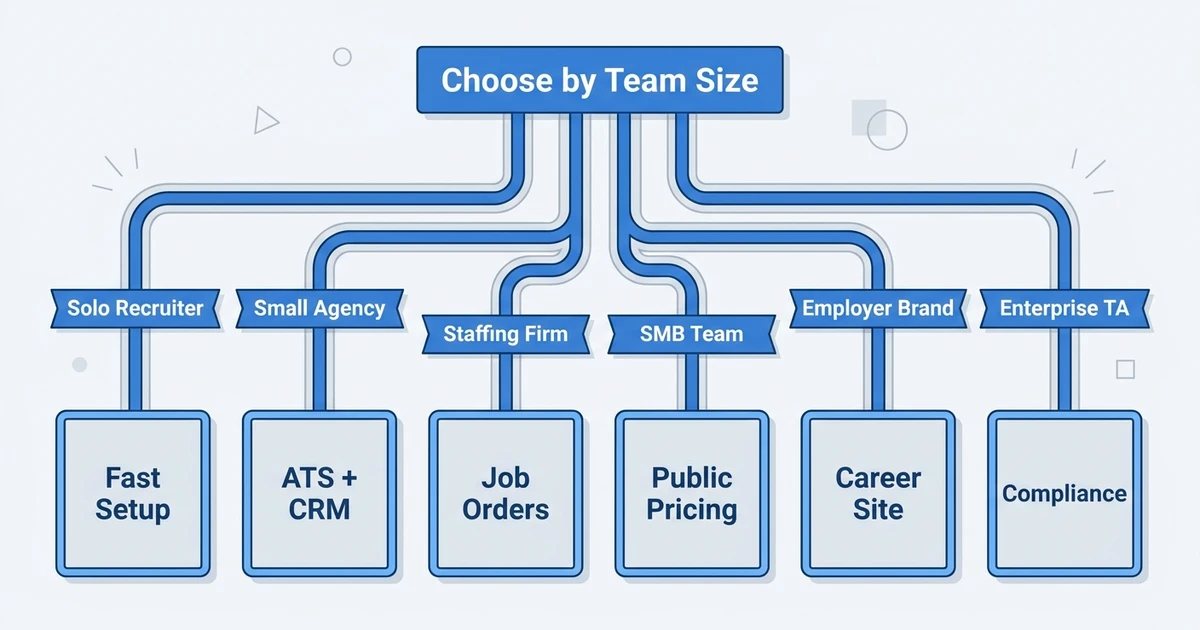
Use this framework:
| Team type | Main need | Best-fit direction |
|---|---|---|
| Solo recruiter | Simple records, outreach, candidate search | ATZ CRM, Manatal |
| Small agency | ATS + CRM, clients, submissions, reporting | ATZ CRM, Recruiterflow, Crelate |
| Growing staffing firm | Job orders, clients, automation, reports | ATZ CRM, Bullhorn, CEIPAL |
| SMB in-house team | Easy ATS, public pricing, hiring collaboration | Workable, JazzHR, Breezy HR |
| Employer brand team | Career site and candidate experience | Teamtailor, Pinpoint, Recruitee |
| Enterprise TA | Compliance, approvals, integration depth | Greenhouse, SmartRecruiters, iCIMS |
If your workflow includes clients, candidates, outreach, submissions, and placements, prioritize a platform that treats those as connected work. A visual board alone will not solve client pipeline or revenue reporting.
The best free ATS tools for recruiters guide can help if budget is the main constraint. The best affordable recruitment software guide is useful if you want low-cost options but still need more workflow depth.
Is ATZ CRM right for your agency?
ATZ CRM is right for your agency if you like simple workflows but need more than a hiring board. It gives recruiters one place to manage candidates, clients, jobs, outreach, notes, submissions, and reports.
That is the key difference from a lightweight ATS. ATZ CRM is not just about moving applicants through stages. It is about helping recruiters manage the full agency workflow.
If you only hire once in a while, a basic ATS may be enough. If your team works open roles every day, follows up with clients, sources candidates, and tracks placements, the added CRM depth matters.
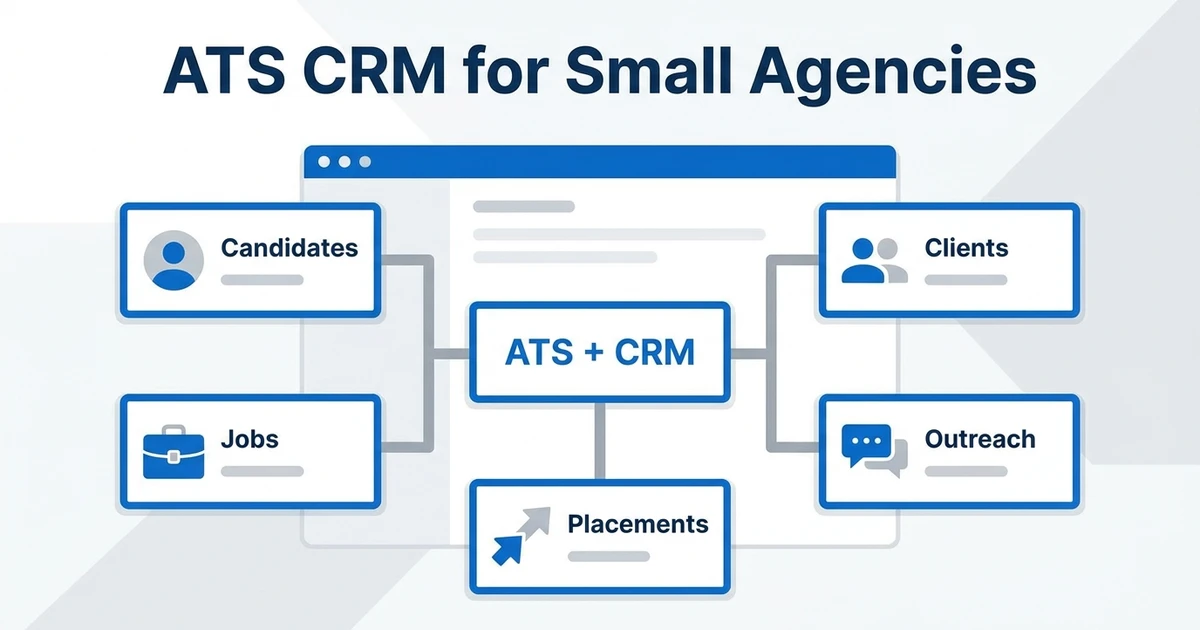
For small teams, the ATS and CRM for small agencies guide explains when a combined platform becomes more useful than separate tools.
What to check before moving beyond a simple ATS
Moving from a simple ATS to a deeper platform is a good time to clean your data. Do not migrate every field just because it exists.
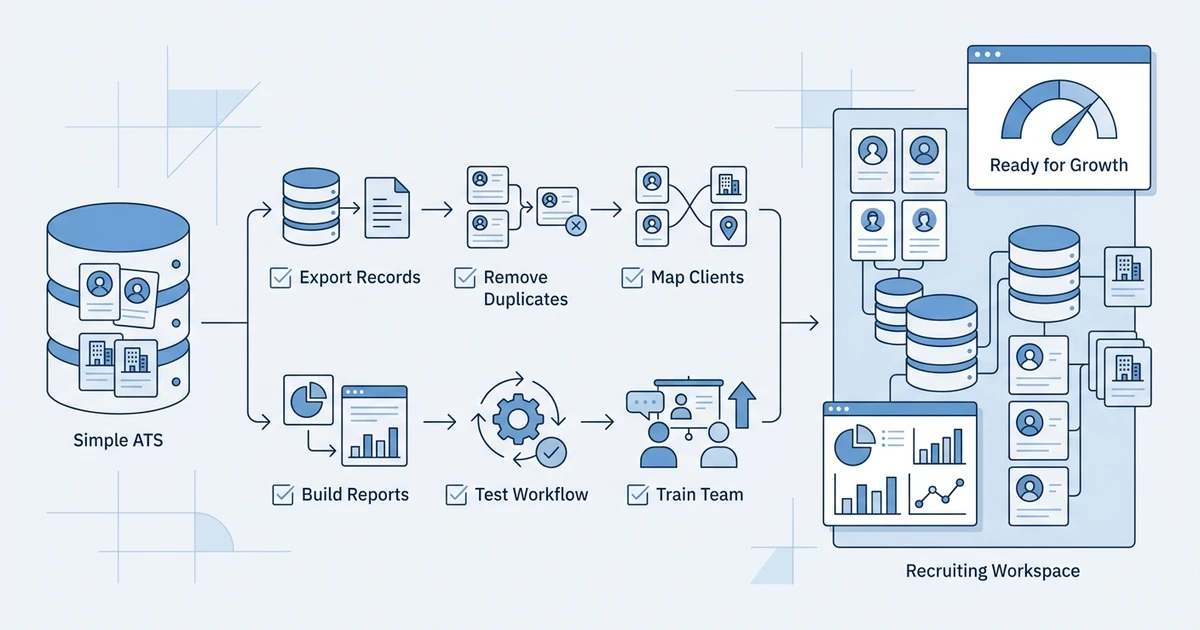
Use this checklist before switching:
- Export candidate records, notes, job history, and stage data.
- Identify duplicate candidates and stale tags.
- Decide which fields recruiters actually use.
- Map client records if you are adding CRM.
- Rebuild core email templates and outreach sequences.
- Define reporting needs before import.
- Test one live role with real candidates.
- Train recruiters on the new daily workflow.
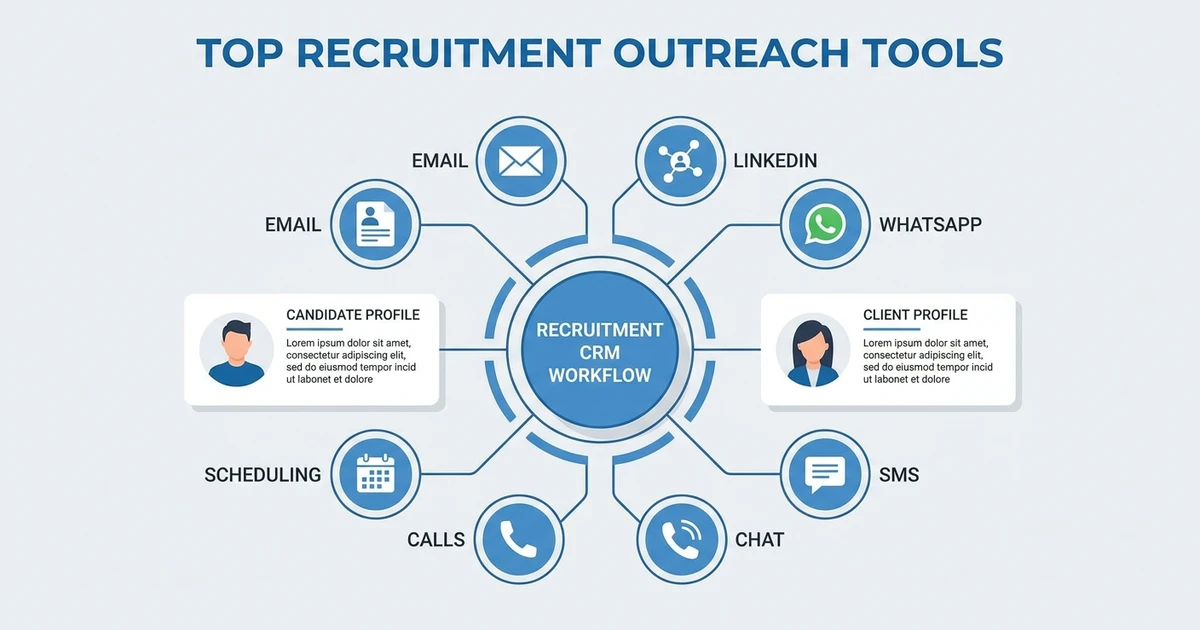
Also review your outreach process. If recruiters are already doing manual follow-up, the recruitment outreach tools comparison can help you decide which automation needs to move into the new system.
A better platform should reduce admin work, not simply give you more places to click.
Frequently Asked Questions
What are the best Breezy HR alternatives for recruitment agencies?
The best Breezy HR alternatives for recruitment agencies are tools that combine ATS, CRM, AI matching, outreach, client workflows, reporting, and migration support. ATZ CRM is a strong first option because it helps agencies manage candidate and client work together.
Are Breezy HR competitors better for small businesses?
Some Breezy HR competitors are better for small businesses when the need is basic applicant tracking, simple setup, or public pricing. Agencies and staffing firms should compare CRM and reporting depth before choosing a small-business ATS.
When should I switch from Breezy HR to an ATS + CRM?
Switch when candidate tracking is no longer the only workflow. If recruiters also manage clients, job orders, submissions, outreach, and revenue reporting, an ATS + CRM becomes more useful than a simple visual pipeline.
Which Breezy HR alternative is best for automation?
The best automation fit depends on whether you need email sequences, candidate matching, status updates, or reporting workflows. ATZ CRM is a strong option when automation needs to connect with candidate records, CRM notes, and recruiter dashboards.
Can ATZ CRM help small agencies migrate from a simple ATS?
Yes. ATZ CRM can help small agencies move candidate, job, client, and activity data into a fuller recruiting workspace. Before switching, clean duplicates and map pipeline stages so recruiters can start with reliable data.
Conclusion
Breezy HR is useful when your hiring process is simple. But recruiting teams do not stay simple forever.
Once you need CRM, sourcing, outreach, AI matching, client visibility, reporting, and cleaner migration, it makes sense to compare broader platforms. The best Breezy HR alternative is the one that fits the next stage of your workflow.
For recruitment agencies and staffing teams, ATZ CRM is the best first shortlist option. It gives you a simple recruiting workspace with the ATS + CRM depth needed to grow.
Compare ATZ CRM pricing before you choose a lightweight ATS that may need extra tools later.