 EN
EN DE
DE ES
ES FR
FR NL
NL PT
PT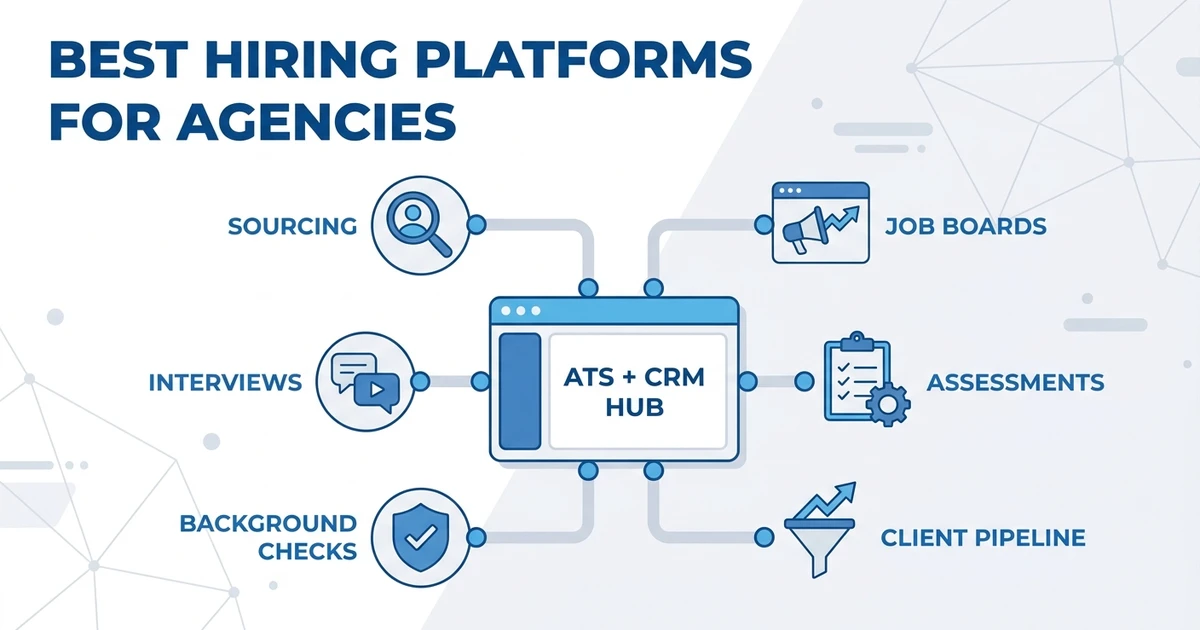



Quick Answer: The best hiring platforms for recruitment agencies are the tools that help you source candidates, manage applicants, automate outreach, assess skills, schedule interviews, and keep client communication organized. For most agencies, the strongest stack starts with an all-in-one ATS + CRM like ATZ CRM, then adds specialist platforms only where they solve a real workflow gap.
A hiring platform is not one single category anymore. For a recruitment agency, it can mean the system that tracks applicants, the job board that brings in active candidates, the sourcing tool that finds passive talent, or the interview tool that helps your team move faster.
The shortlist:
- ATZ CRM
- Indeed
- Glassdoor
- HackerRank
- Spark Hire
- Checkr
- HireRight
- Zoom
The smarter question is, “Which tool removes the most friction from how your agency places candidates?”
What Are the Best Hiring Platforms for Recruitment Agencies?
The best hiring platforms for recruitment agencies help you manage the full path from candidate discovery to placement. That includes sourcing, job posting, applicant tracking, candidate communication, interview coordination, client feedback, reporting, and follow-up.
Agency hiring is different from in-house hiring. You are balancing multiple clients, hiring managers, job orders, candidate pools, and revenue targets at once.
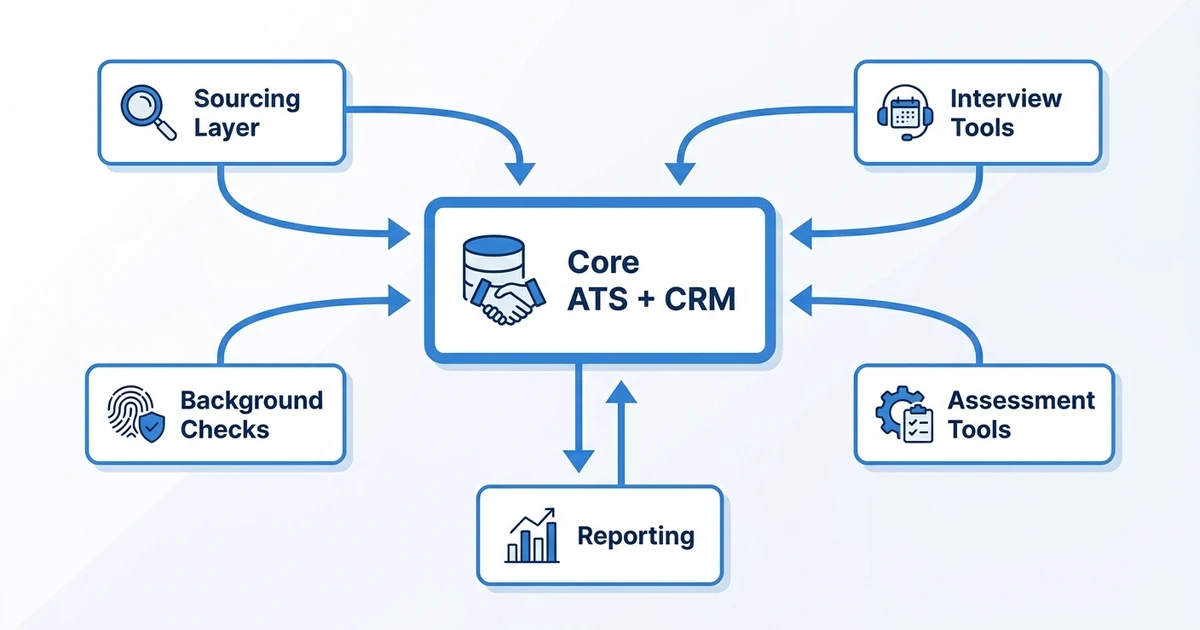
That is why most agencies need a connected stack. Your applicant tracking system for recruitment agencies should act as the operating hub, while job boards, sourcing networks, assessment tools, and interview platforms support specific parts of the workflow.
If the tools do not connect around your daily process, your team ends up copying notes between tabs. That slows down submissions and weakens follow-up.
How Do Hiring Platforms Help Recruitment Agencies Place Faster?
Good hiring platforms reduce the manual work between “we found a candidate” and “the client wants to interview them.” They make records easier to search, next steps easier to track, and client updates easier to manage.
That speed matters because every delay compounds. Candidates go quiet, clients question progress, and recruiters lose sourcing time when they update multiple systems after every call.
The right platform stack helps you:
- Build searchable candidate pools
- Track every candidate stage clearly
- Keep client and hiring manager communication in one place
- Automate follow-ups without losing personalization
- Submit stronger shortlists with cleaner context
- See which jobs, sources, and recruiters need attention
The point is not to collect more software. It is to create a workflow where your team can move from sourcing to submission without losing context.
Which Features Matter Most in a Recruitment Hiring Platform?
Start with the workflow your agency repeats every week. A feature is only useful if it helps recruiters source, screen, submit, follow up, or report with less friction.
For most recruitment agencies, the core checklist looks like this:
- ATS pipeline management for jobs, applicants, interviews, and placements
- Recruitment CRM for managing clients and deals
- Resume parsing and profile enrichment
- Candidate sourcing extension for quick profile capture
- AI candidate matching for faster shortlist creation
- Job posting and application management
- Email, SMS, LinkedIn, and WhatsApp communication support
- Interview scheduling and calendar sync
- Reporting for recruiter activity, sources, jobs, and revenue
- Integrations with the tools your team already uses
- Roles, permissions, and clean data migration
- Support that helps your team go live without weeks of confusion
ATZ CRM fits this category because it combines ATS, CRM, sourcing, automation, reporting, and candidate communication in one recruitment platform.
See how ATZ CRM brings sourcing, AI matching, outreach automation, and client pipelines into one platform built for recruitment agencies. Explore how AI candidate matching can support faster shortlist creation in your hiring workflow.
9 Best Hiring Platforms Every Recruitment Agency Should Consider
Use this table as a practical shortlist. Some tools can run the center of your workflow. Others work best around your core ATS + CRM.
| Platform | Best for | Platform type | Agency use case | Watch-out |
|---|---|---|---|---|
| ATZ CRM | Agency operating hub | ATS + CRM | Manage candidates, clients, jobs, outreach, and reporting | More platform than you need for a basic contact list |
| Passive candidate sourcing | Social sourcing platform | Find talent, research prospects, and start conversations | Needs an ATS/CRM for follow-up discipline | |
| Indeed | Active applicant flow | Job board | Capture inbound applicants for open roles | Volume can create screening work |
| Glassdoor | Employer brand research | Job and review platform | Advise clients and understand candidate perception | Not a full recruiting workflow tool |
| HackerRank | Technical validation | Assessment platform | Screen developers, data talent, and technical profiles | Best for technical roles, not every search |
| Spark Hire | Async video screening | Video interview platform | Standardize early interviews and remote screening | Candidate experience needs thoughtful setup |
| Checkr | Fast background checks | Screening platform | Run checks for roles needing identity or compliance review | Confirm fit for your region and role type |
| HireRight | Global employment screening | Background-check platform | Support enterprise, cross-border, and regulated hiring | Can be heavier than small agencies need |
| Zoom | Live interviews and meetings | Video meeting platform | Run interviews, client intake calls, and candidate prep | Not a recruiting system by itself |
ATZ CRM
ATZ CRM is best for recruitment agencies that want one connected operating hub. It combines ATS and CRM workflows, so your team can manage pipelines, contacts, jobs, outreach, submissions, and reporting in the same workspace.
It is a strong fit if your current setup depends on spreadsheets, a generic CRM, and separate sourcing notes.
Use ATZ CRM when you need AI matching, Chrome sourcing, workflow automation, job posting, reporting, candidate communication, and client pipeline visibility in one system.
LinkedIn is useful for passive candidate discovery. Your recruiters can research career histories, identify likely-fit profiles, and build relationship-driven talent pools.
For agencies, LinkedIn works best as a sourcing layer. It helps you find and approach people, but it should not become your main system of record.
After the first conversation, you still need a place to track follow-ups, associate candidates with jobs, manage submissions, and report on pipeline movement.
Indeed
Indeed is useful when your agency needs active applicant flow, especially for roles with broad market appeal and clear job criteria.
The benefit is reach. The challenge is quality control. A high-response role can create a screening backlog without a clear pipeline and follow-up process.
Use Indeed for demand capture, then move qualified applicants into your core recruiting system quickly. That keeps your team from managing live candidates inside a job board dashboard.
Glassdoor
Glassdoor is useful because candidates research employers before they apply, interview, or accept. Agencies can use that information to advise clients and prepare candidates.
If a client has weak reviews, unclear culture messaging, or repeated interview complaints, your recruiters need to know that before offer stage. It affects candidate confidence.
Glassdoor is not a full agency workflow tool, but it is valuable context for intake calls, job marketing, and client conversations.
HackerRank
HackerRank helps agencies validate technical ability before candidates reach the client. That is useful for software, data, engineering, and technical support roles.
The strongest use case is structured screening. Instead of relying only on keyword matches, your recruiters can use assessments to confirm whether a candidate can handle the work.
Use it when technical validation improves submission quality. Skip it for roles where portfolio review, work history, or direct interview screening gives better signal.
Spark Hire
Spark Hire is useful for one-way and structured video interviews. It can help your agency screen candidates across time zones and reduce back-and-forth scheduling at early stages.
This works well for remote roles, high-volume hiring, or roles where managers want a quick preview before live interviews.
The watch-out is candidate experience. One-way video should feel purposeful, short, and relevant. If it feels like extra friction, strong candidates may disengage.
Checkr
Checkr supports background-check workflows for agencies that need faster screening near offer or compliance review.
For recruitment agencies, the value is process consistency. Your team can reduce ad hoc checks and keep screening steps more structured.
Before adding it, confirm the role types, regions, turnaround expectations, and client requirements.
HireRight
HireRight is a strong fit for agencies that handle global, enterprise, or compliance-heavy hiring. It is often relevant when clients need verification, drug testing, or cross-border screening.
The platform can support complex screening needs where client contracts or industry rules require a formal process.
For small agencies, the main question is whether you need that depth right now. If your searches are mostly local and low-compliance, a lighter background-check workflow may be enough.
Zoom
Zoom remains practical because live conversations still matter. Recruiters use it for intake calls, interviews, prep sessions, shortlist reviews, and final-stage coordination.
Its strength is familiarity. Most clients and candidates already know how to join a meeting without much setup.
The limitation is obvious: Zoom does not manage your recruiting workflow. Use it for live communication, then record outcomes, notes, stages, and follow-ups inside your ATS or CRM.
How Should You Choose the Right Hiring Platform Stack?
Start with your agency model. Permanent placement, executive search, contract staffing, and high-volume recruiting all need different levels of sourcing, automation, compliance, and reporting.
Map tools to the work your team repeats:
- Agency size: solo recruiter, small team, growing agency, or multi-office firm
- Placement model: permanent, contract, temporary, executive search, or mixed
- Candidate volume: targeted outreach or high-volume applicant screening
- Client workflow: simple updates or structured submissions and feedback
- Automation needs: reminders, sequences, status changes, and reporting
- Integration needs: email, calendar, job boards, sourcing, calling, and invoicing
- Support needs: migration, onboarding, training, and day-to-day help
Choose an all-in-one platform if your team needs one source of truth for candidates, clients, jobs, outreach, and reporting.
Add specialist tools when a clear gap remains. Use assessments for technical screening, background checks for client requirements, and video tools when scheduling slows high-volume roles.
For a deeper ATS evaluation process, use this guide on choosing the best ATS alongside your platform shortlist.
What Hiring Platform Mistakes Should Agencies Avoid?
The most common mistake is buying a tool for the symptom, not the workflow. If your agency is missing follow-ups, a bigger job board will not fix the issue. It may only create more applicants to lose track of.
Another mistake is choosing an ATS-only tool when your agency also needs client relationship management. If contacts, deals, jobs, candidates, submissions, and feedback sit in separate places, managers lose visibility.
Avoid these traps:
- Buying more sourcing tools before fixing pipeline follow-up
- Choosing a generic CRM without recruitment workflows
- Ignoring data migration until implementation starts
- Paying for enterprise complexity your team will not use
- Accepting weak reporting because the interface looks simple
- Picking tools that cannot connect with your email, calendar, or job boards
Picture a small agency sourcing from LinkedIn and Indeed. The funnel looks busy, but candidates go quiet because follow-ups live in inboxes and feedback sits in chat messages. The problem is workflow control.
Is ATZ CRM the Right Hiring Platform for Your Agency?
ATZ CRM is a strong fit if your agency wants ATS + CRM, AI matching, sourcing, outreach, client tracking, job posting, reporting, and automation in one system. It is built for recruitment agencies and staffing firms that need both candidate delivery and client pipeline visibility.
It works especially well when your team wants to stop switching between a generic CRM, spreadsheets, job board dashboards, and manual reminders.
It may not be necessary if you only need a basic address book or a one-purpose interview tool. But if your agency is growing, the central platform matters. Your stack should make placement work easier, not harder to audit.
ATZ CRM also gives you a practical path to evaluate fit with real jobs, candidates, and client communication.
Frequently Asked Questions
What is a hiring platform?
A hiring platform helps you attract, source, screen, communicate with, and move candidates through the hiring process. For agencies, it can include ATS, CRM, sourcing, job board, interview, assessment, and screening tools.
What is the difference between a hiring platform and an ATS?
An Applicant Tracking System manages applicants, jobs, resumes, stages, interviews, and hiring activity. A hiring platform is broader and may include ATS, CRM, sourcing, assessment, interview, or job board tools.
What hiring platform is best for recruitment agencies?
The best fit is usually an ATS + CRM platform that manages candidates, clients, jobs, outreach, submissions, and reporting together. ATZ CRM is a strong option before adding specialist tools.
Do recruitment agencies need separate sourcing, interview, and background-check tools?
Some do, but not every agency needs every tool immediately. Start with the core workflow, then add specialist platforms for technical screening, remote interviews, or background checks.
How much should a recruitment agency spend on hiring platforms?
Spend according to workflow value, not feature count. Smaller agencies should prioritize a clean ATS + CRM foundation, while scaling agencies should invest in speed, visibility, follow-up, and reporting.
Final Takeaway: Build a Hiring Platform Stack Around Agency Workflow
The strongest recruitment tech stack starts with the work your agency does every day. You need a central place for candidates, clients, jobs, communication, and reporting before you add specialist tools around it.
Use job boards for active applicants, social platforms for sourcing, assessment tools for validation, video platforms for interviews, and background-check tools where compliance requires them. But keep your operating hub clear.
If you want that hub to combine ATS, CRM, AI matching, sourcing, automation, and reporting, request a demo of ATZ CRM and see how the platform supports your agency workflow before you add another disconnected tool.