 EN
EN DE
DE ES
ES FR
FR NL
NL PT
PT





Quick Answer: The best candidate sourcing tools help recruiters find, enrich, contact, and track people before they apply. For recruitment agencies, the strongest option is usually a tool that connects sourcing activity to candidate records, job pipelines, outreach, and client submissions instead of leaving sourcers in a separate database.
TL;DR:
- ATZ CRM - Best overall for agencies that want sourcing connected to ATS, CRM, outreach, and client submissions
- LinkedIn Recruiter - Best for professional-network sourcing
- hireEZ - Best for broad passive talent search
- SeekOut - Best for technical and niche candidate discovery
- Gem - Best for nurture-heavy talent CRM workflows
- Loxo - Best for sourcing-led recruiting teams
- Juicebox - Best for natural-language people search
- Fetcher - Best for lean teams that want assisted sourcing
- Humanly - Best for high-volume candidate engagement
- ContactOut - Best for contact discovery
- AmazingHiring - Best for engineering talent discovery
- Findem - Best for talent intelligence and market mapping
- SourceWhale - Best for structured sourcing sequences
- Apollo - Best when recruiters also need sales-style prospecting data
- ZoomInfo - Best for company and contact intelligence
- Lusha - Best for lightweight enrichment
- SalesQL - Best for LinkedIn-heavy profile capture
The main decision is not simply which tool finds the most profiles. It is whether your sourcing work turns into cleaner candidate records, faster outreach, better matching, and more client-ready submissions.
Candidate sourcing tools help your agency reach passive talent and build warmer pipelines. The real buying question is whether a tool only finds profiles or helps recruiters turn those profiles into conversations, submissions, and placements.
This guide compares 17 options by workflow fit, strengths, limits, and pricing visibility.
LinkedIn reports that companies whose recruiters use AI-assisted messaging most are 9% more likely to make a quality hire than those using it least in its Future of Recruiting research. That supports a practical point: sourcing tools should improve relevance and timing, not just activity volume.
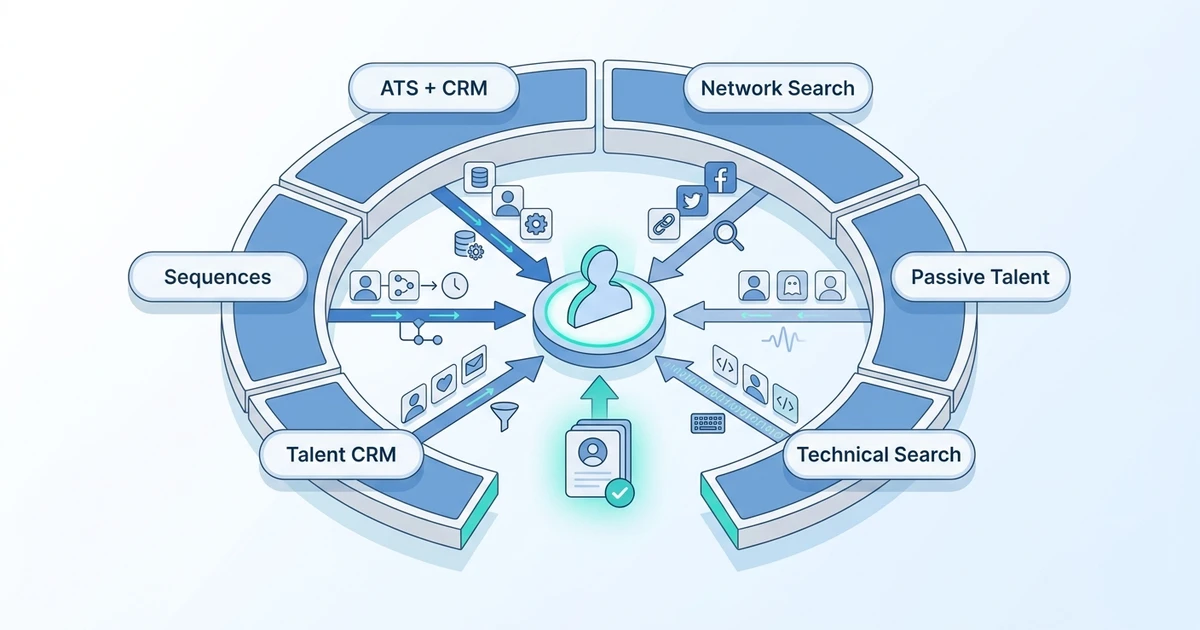
What candidate sourcing tools actually do
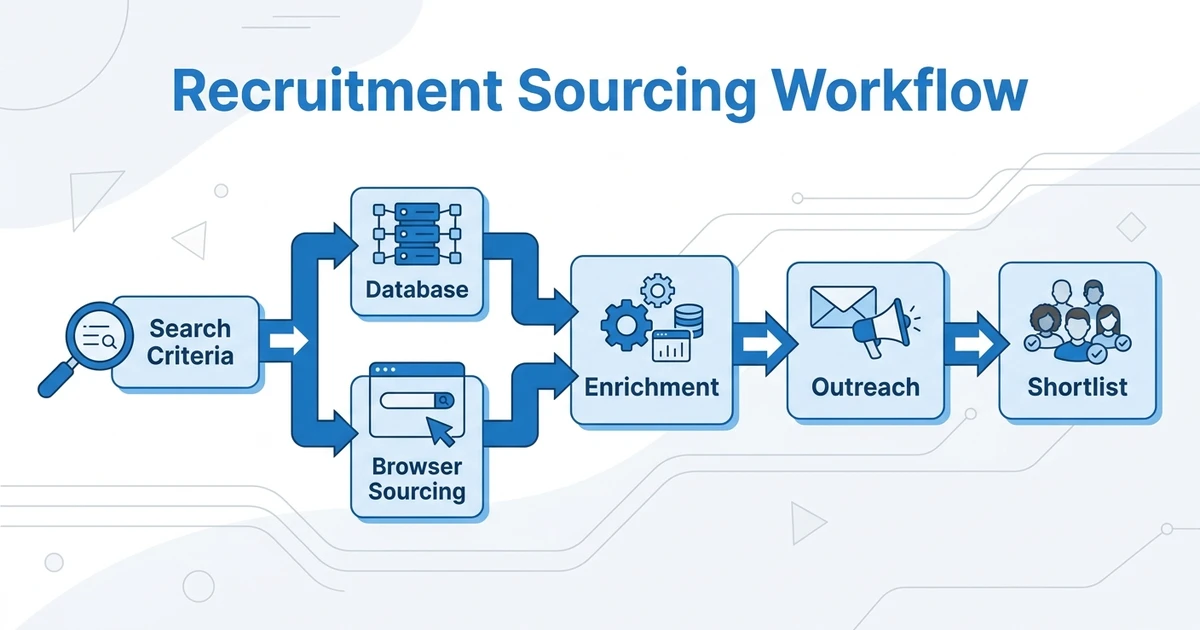
Candidate sourcing software helps recruiters find people who may not have applied to an open job yet. Some tools search professional networks and public profiles. Others enrich contact details, map talent markets, support outreach, or capture profiles into your recruiting database.
For agencies, the most useful tools usually support several jobs:
- Finding passive candidates by role, skill, location, seniority, or company.
- Capturing profiles from LinkedIn or public sources.
- Enriching candidate records with email, phone, company, and social data.
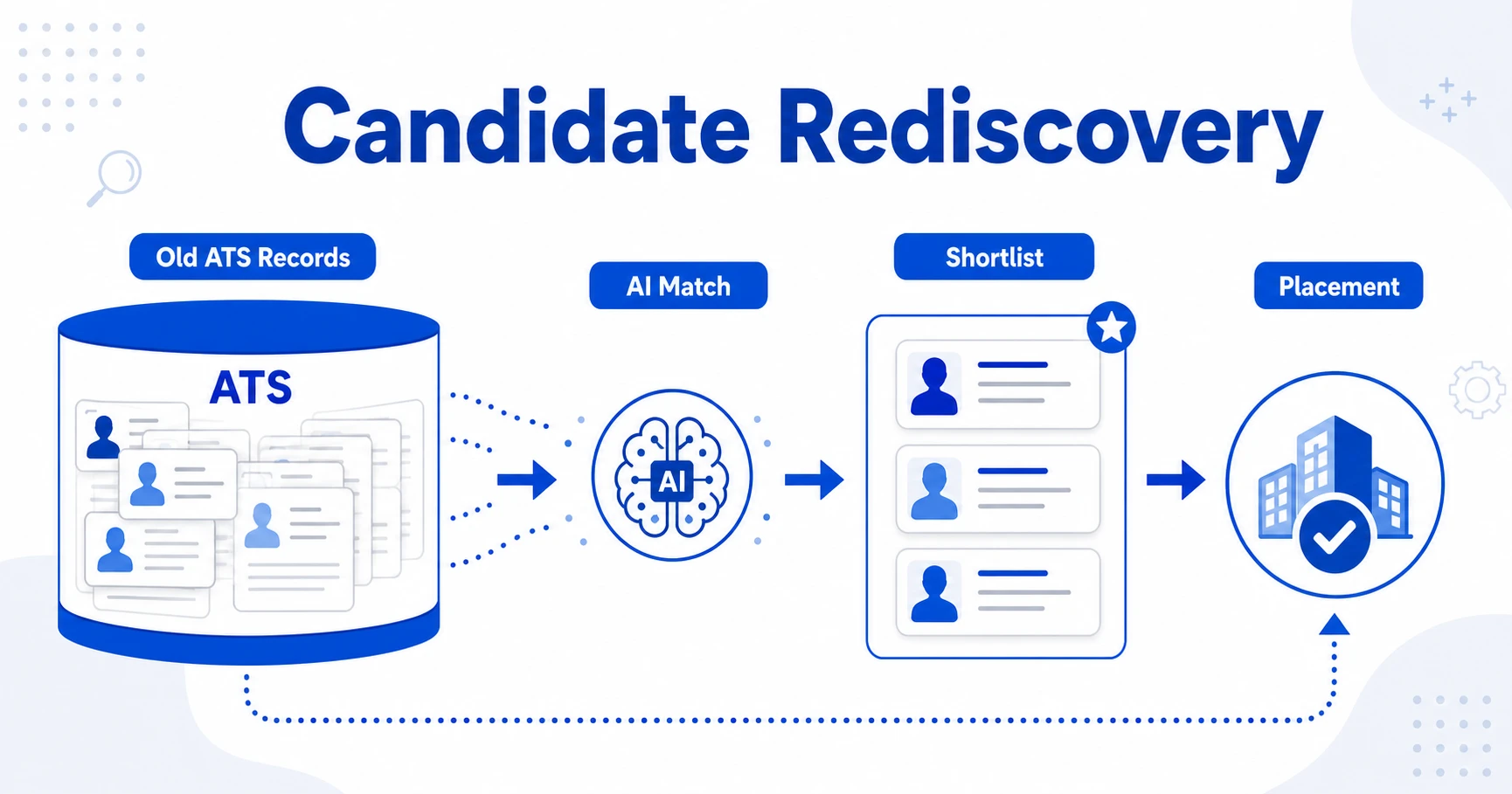
- Matching sourced candidates to live roles.
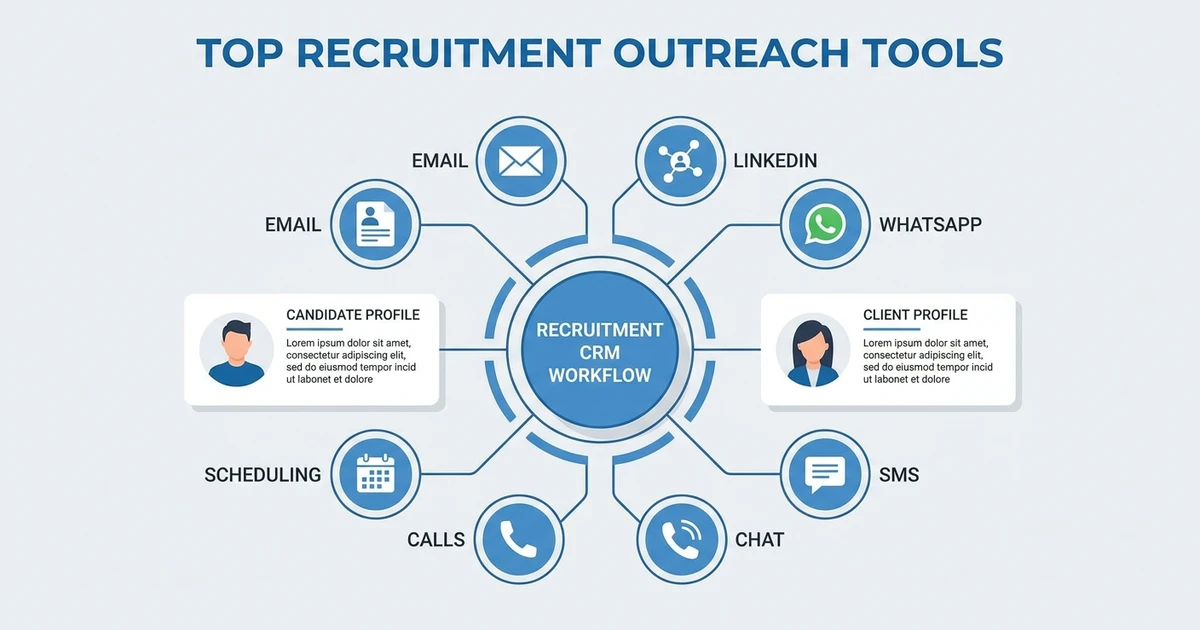
- Sending or supporting follow-up sequences.
- Moving activity back into the ATS, CRM, or recruiting database.
Judge sourcing tools by outcome, not database size alone. A large pool is helpful, but it does not create placements unless recruiters can move from search to outreach to submission.
How agencies should compare candidate sourcing software
Start with workflow, not feature count. Ask where sourcing breaks today: discovery, contact data, outreach, follow-up, CRM visibility, duplication, or reporting.
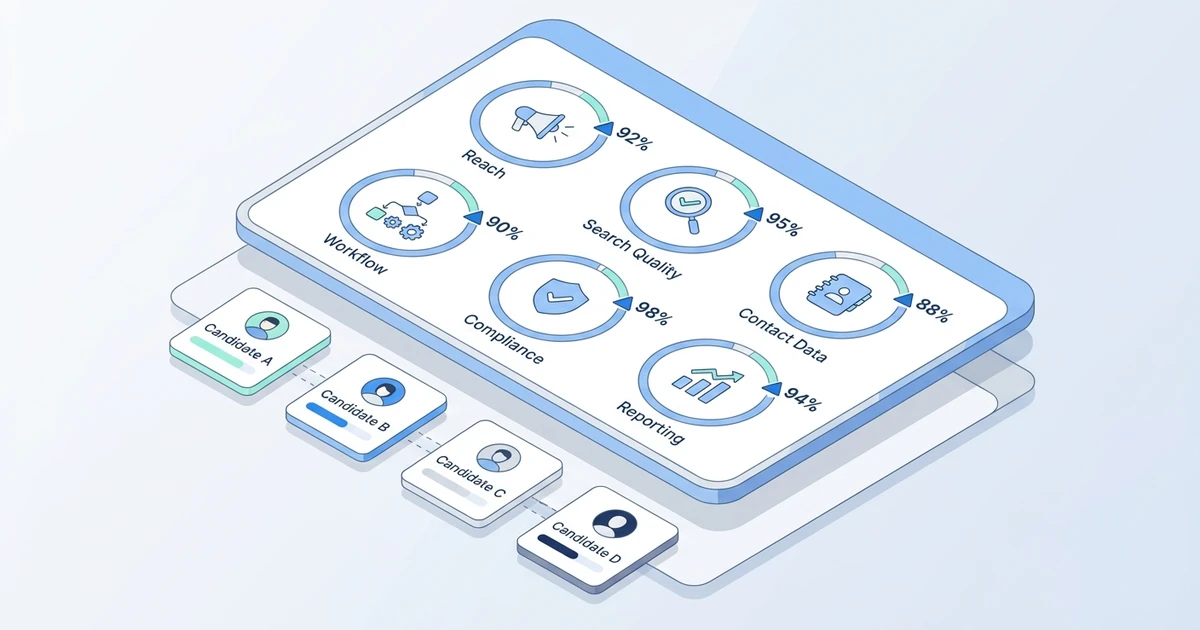
Use these criteria:
- Candidate reach: Does the tool help you find candidates in the markets you actually recruit for?
- Search quality: Can recruiters search by skills, title, company, location, seniority, and Boolean terms?
- Contact enrichment: Does it provide useful email or phone data, and how are credits priced?
- Recruiter workflow: Can profiles move into your ATS or CRM without manual copying?
- Outreach support: Does it support email, LinkedIn workflow, sequences, reminders, or handoff to another tool?
- Data quality: Can it prevent duplicate records and preserve candidate history?
- Compliance controls: Does it help your team manage consent, opt-outs, and data handling?
- Reporting: Can managers see sourcing activity, response rates, pipeline movement, and placement impact?
SHRM found that AI adoption in HR tasks rose to 43% in 2025 from 26% in 2024 in its Talent Trends research. For agencies, AI search, AI-assisted messaging, and automated matching are becoming normal parts of the stack.
Quick comparison of the top candidate sourcing tools
| Rank | Tool | Best fit | Main sourcing strength | Outreach included? | ATS/CRM connection | Pricing visibility |
|---|---|---|---|---|---|---|
| 1 | ATZ CRM | Agencies needing connected sourcing | Profile capture plus ATS/CRM handoff | Yes | Native ATS plus CRM | Public ATZ pricing |
| 2 | LinkedIn Recruiter | Professional network sourcing | LinkedIn search and messaging | Yes | Integrations vary | Contract based |
| 3 | hireEZ | Passive talent discovery | Broad profile search | Yes | Integrations vary | Public plans vary |
| 4 | SeekOut | Technical and niche sourcing | Advanced people search | Yes | Integrations vary | Custom pricing |
| 5 | Gem | Talent CRM nurture | Pipeline engagement | Yes | ATS integrations | Custom pricing |
| 6 | Loxo | Sourcing-led recruiting teams | Database plus recruiting workflow | Yes | Platform based | Not publicly listed |
| 7 | Juicebox | Natural-language people search | AI people search | Limited by workflow | Export or integrations vary | Public and custom options |
| 8 | Fetcher | Lean teams needing help sourcing | Assisted candidate delivery | Yes | Integrations vary | Custom pricing |
| 9 | Humanly | High-volume engagement | Conversational screening | Yes | ATS integrations | Custom pricing |
| 10 | ContactOut | Contact discovery | Email and phone lookup | Limited | Export and integrations vary | Public plans vary |
| 11 | AmazingHiring | Engineering roles | Technical profile aggregation | Limited | Integrations vary | Not publicly listed |
| 12 | Findem | Talent intelligence | Attribute-based search | Yes | Enterprise integrations | Custom pricing |
| 13 | SourceWhale | Sourcing sequences | Recruiting outreach workflow | Yes | ATS integrations | Custom pricing |
| 14 | Apollo | Prospecting teams | Contact data and sequences | Yes | CRM integrations | Public plans vary |
| 15 | ZoomInfo | B2B intelligence | Company and contact data | Yes | CRM integrations | Custom pricing |
| 16 | Lusha | Lightweight enrichment | Contact lookup | Limited | CRM integrations | Public plans vary |
| 17 | SalesQL | LinkedIn-heavy profile capture | Browser-based enrichment | Limited | Export based | Public plans vary |
Want sourcing that flows into the rest of your recruiting desk? See how ATZ CRM connects candidate capture, AI matching, outreach, pipelines, and client submissions in one agency workflow.
17 top candidate sourcing tools for recruitment agencies
1. A connected sourcing workflow for recruitment agencies
Tool reviewed: ATZ CRM.
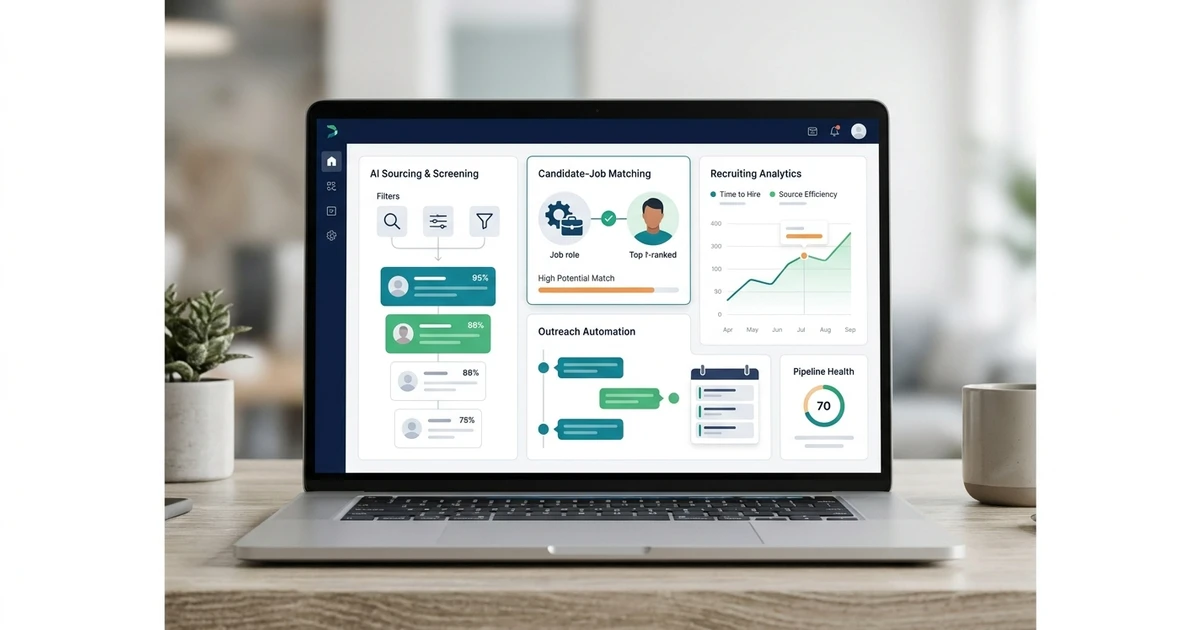
Overview: ATZ CRM is an ATS plus CRM for recruitment agencies that want sourcing connected to the rest of the desk. Recruiters can capture candidates, enrich records, match people to jobs, run outreach, manage client context, and keep the pipeline updated inside one workflow.
Pros:
- Connects sourcing to records, jobs, clients, notes, and submissions.
- Includes Chrome extension sourcing for profile capture.
- Supports AI candidate matching and outreach workflows.
- Useful for candidate and client-facing recruiting activity.
- Public ATZ pricing starts at $12/user/month on annual billing.
Cons:
- Not a standalone global people database.
- Agencies with heavy payroll or VMS needs may need additional operational tools.
- Existing databases may need cleanup before migration.
Pricing: ATZ CRM pricing is public. Plans start at $12/user/month on annual billing, with higher plans adding deeper communication, automation, AI, portal, and support features according to ATZ CRM pricing.
2. The professional network most recruiters already use
Tool reviewed: LinkedIn Recruiter.
Overview: LinkedIn Recruiter is often the first sourcing tool agencies consider because many professional candidates maintain LinkedIn profiles. It helps recruiters search by professional signals and contact candidates through LinkedIn messaging workflows.
Pros:
- Very familiar to most recruiters.
- Strong fit for passive professional sourcing.
- Useful filters for role, company, skills, location, and seniority.
- Messaging workflow is close to where many candidates already respond.
Cons:
- Can become expensive for larger sourcing teams.
- Candidate context may still need to move into your ATS or CRM.
- Response quality depends on relevance and recruiter discipline.
Pricing: Pricing is typically contract based and can vary by region, package, and seat count. Treat it as a sourcing investment that still needs ATS or CRM workflow support.
3. A broad outbound sourcing engine for passive talent
Tool reviewed: hireEZ.
Overview: hireEZ is built for outbound recruiting teams that need to search across many sources, build candidate lists, enrich profiles, and run sourcing campaigns. It is a strong fit when your agency handles hard-to-fill searches and needs more than one network.
Pros:
- Broad passive talent discovery.
- Useful search and filtering workflows.
- Campaign support helps teams move from search to outreach.
- Can support rediscovery when connected well to existing systems.
Cons:
- May overlap with existing outreach or CRM tools.
- Contact data and credits need careful cost review.
- Teams still need a clear handoff process.
Pricing: Public package details can vary, and larger teams usually need sales-assisted pricing. Confirm current seat, contact, and campaign limits before comparing it with an all-in-one option.
4. A search platform for niche and technical profiles
Tool reviewed: SeekOut.
Overview: SeekOut is known for advanced candidate search, talent intelligence, and specialist sourcing use cases. It can fit agencies that recruit technical, cleared, healthcare, engineering, or other skill-specific roles where normal keyword search misses good people.
Pros:
- Strong search depth for specialist roles.
- Useful for talent mapping and hard-to-fill roles.
- Can support diversity sourcing workflows.
- Enterprise features may suit structured sourcing teams.
Cons:
- May be too much for a small agency.
- Pricing is usually not simple self-serve.
- Recruiters still need a placement workflow outside the search layer.
Pricing: Pricing is generally custom or sales-led. Ask about database access, user seats, enrichment, integrations, and implementation before comparing it with agency ATS plus CRM tools.
5. A recruiting CRM for nurture-heavy sourcing teams
Tool reviewed: Gem.
Overview: Gem is a talent CRM and sourcing workflow platform for teams that build and nurture candidate pipelines. It is useful when your sourcing process includes ongoing campaigns, nurture pools, outreach analytics, and coordination with an ATS.
Pros:
- Strong nurture and pipeline engagement workflows.
- Helpful analytics for sourcing and outreach performance.
- Good fit for structured talent acquisition teams.
- Useful when recruiting teams need long-running relationship campaigns.
Cons:
- More aligned with in-house TA than agency client workflows.
- May require another system for client CRM, submissions, and revenue reporting.
- Pricing is usually not visible without a sales conversation.
Pricing: Pricing is commonly custom. Compare total cost with the ATS, CRM, sourcing, and outreach tools your agency would still need.
6. A sourcing-led recruiting platform for agency teams
Tool reviewed: Loxo.
Overview: Loxo combines sourcing, recruiting CRM, outreach, and pipeline workflows. It can fit agencies that want a sourcing-first platform with recruiting operations close behind.
If you are weighing sourcing depth against agency CRM coverage, an agency recruiting platform comparison can help you pressure-test the workflow.
Pros:
- Strong sourcing-led positioning.
- Combines database and workflow features.
- Useful for outbound-heavy recruiting desks.
- Can reduce the need for separate sourcing and outreach tools.
Cons:
- Pricing visibility can be limited.
- Some agencies may prefer a clearer ATS plus CRM model.
- Workflow depth should be checked against your submission and client process.
Pricing: Pricing is not always publicly listed in a simple way. Confirm seat pricing, database access, AI features, outreach limits, and migration support during demo.
7. A natural-language people search option
Tool reviewed: Juicebox.
Overview: Juicebox helps recruiters search for candidates using natural-language prompts and people data. It is a good fit when a sourcer wants to describe the target profile in plain English rather than build long Boolean strings.
Pros:
- Natural-language search reduces Boolean fatigue.
- Useful for fast candidate discovery.
- Strong fit for teams exploring AI sourcing workflows.
- Can help recruiters build target lists quickly.
Cons:
- Output still needs validation by a recruiter.
- Candidate handoff into ATS or CRM must be checked.
- May not replace outreach, CRM, or submissions.
Pricing: Public and custom options may vary by package and usage. Check seat limits, search volume, export rules, and enrichment costs.
8. A managed sourcing assistant for lean teams
Tool reviewed: Fetcher.
Overview: Fetcher combines candidate sourcing support with outreach workflows, making it useful for teams that want help building candidate lists without hiring more sourcers. It can suit smaller recruiting teams or agencies that need extra sourcing capacity.
Pros:
- Helpful for limited sourcing bandwidth.
- Combines candidate delivery with engagement workflows.
- Can reduce manual search time.
- Useful for repeatable role types.
Cons:
- May be less flexible for highly specialized search mandates.
- Requires clear calibration to avoid weak candidate matches.
- Still needs ATS or CRM tracking after outreach.
Pricing: Pricing is commonly sales-led or package based. Ask how candidate volume, campaign volume, and seats affect cost.
9. A conversational option for high-volume engagement
Tool reviewed: Humanly.
Overview: Humanly focuses on conversational AI for candidate engagement and screening. It is not a pure sourcing database, but it can support teams that need to engage and qualify candidates at volume.
Pros:
- Useful for early candidate engagement.
- Reduces repetitive screening conversations.
- Good fit for high-volume workflows.
- Supports a more consistent candidate response process.
Cons:
- Not the first choice if your main need is passive profile discovery.
- Recruiters must keep human oversight in sensitive conversations.
- Agency CRM workflows may require another system.
Pricing: Pricing is typically custom. Confirm whether cost depends on seats, conversations, integrations, or hiring volume.
10. A contact-finding add-on for recruiter workflows
Tool reviewed: ContactOut.
Overview: ContactOut helps recruiters find email and phone details for candidate outreach. It is best treated as an enrichment layer rather than a full recruiting platform.
Pros:
- Useful for contact discovery.
- Browser workflows can support LinkedIn-heavy sourcing.
- Easy to understand for recruiters.
- Can sit alongside an existing ATS or CRM.
Cons:
- Does not replace relationship management.
- Credit usage can affect cost quickly.
- Data accuracy needs monitoring and compliance review.
Pricing: Public plan details can change by credits and package. Review usage limits carefully because enrichment costs can rise with team adoption.
11. A technical talent discovery tool for engineering roles
Tool reviewed: AmazingHiring.
Overview: AmazingHiring helps teams source technical candidates from public professional signals. It fits agencies that recruit engineers, developers, data specialists, and other roles where public technical profiles can reveal stronger fit than resumes alone.
Pros:
- Strong fit for engineering and technical roles.
- Useful for finding candidates beyond normal resume databases.
- Helps sourcers compare public professional signals.
- Can support hard-to-fill technical searches.
Cons:
- Less relevant for non-technical recruiting desks.
- May need another outreach or CRM tool.
- Pricing and package details are not always transparent.
Pricing: Pricing is usually sales-led. Ask about user seats, source coverage, export rules, and integration options.
12. A talent intelligence tool for market mapping
Tool reviewed: Findem.
Overview: Findem focuses on talent intelligence and attribute-based search. It is useful when a team needs to map the market, understand candidate populations, and build targeted pipelines.
Pros:
- Strong for talent mapping and structured search.
- Attribute-based search improves targeting.
- Useful for workforce and pipeline planning.
- Helps teams move beyond simple keyword matching.
Cons:
- May be too enterprise-oriented for small agencies.
- Requires clear sourcing strategy to get full value.
- Does not remove the need for CRM and submissions.
Pricing: Pricing is commonly custom. Confirm implementation needs, data access, user seats, and integration scope.
13. A sourcing-to-sequence workflow for agencies
Tool reviewed: SourceWhale.
Overview: SourceWhale supports sourcing, sequencing, and recruiter productivity workflows. It can fit agencies that already source actively and need better follow-up structure across candidates.
Pros:
- Recruiting-specific outreach.
- Useful for sequence management and follow-up discipline.
- Can support sourcing productivity reporting.
- Good fit for outbound-heavy agency teams.
Cons:
- May overlap with existing email sequence tools.
- Requires clean integration with the system of record.
- Not a full ATS plus CRM replacement.
Pricing: Pricing is commonly custom or package based. Ask about seats, campaign limits, integrations, and analytics.
14. A sales-intelligence database recruiters may use carefully
Tool reviewed: Apollo.
Overview: Apollo is better known as a sales intelligence and outbound platform, but recruiters sometimes use it for contact discovery and outbound workflows. It can be useful for business development and certain candidate-sourcing scenarios.
Pros:
- Strong contact discovery and prospecting.
- Useful for agency business development and client prospecting.
- Email sequencing can support outbound campaigns.
- Public plan options make it easier to benchmark cost.
Cons:
- Not recruitment-native.
- Candidate consent, relevance, and compliance need careful handling.
- Requires another system for recruiting context.
Pricing: Public plans vary by package and usage. Review enrichment credits, email limits, and CRM integration needs before buying it for recruiting.
15. A B2B intelligence layer for client and candidate research
Tool reviewed: ZoomInfo.
Overview: ZoomInfo is a B2B data and intelligence platform. Recruiters may use it for company research, contact discovery, and client-side prospecting, while some teams also use it to support candidate sourcing.
Pros:
- Strong company and contact data.
- Useful for client prospecting.
- Can support targeted outreach workflows.
- Helpful for market mapping.
Cons:
- Not built primarily as recruitment software.
- Pricing can be a major investment.
- Candidate workflow still needs ATS or CRM support.
Pricing: Pricing is typically custom. Confirm data access, credits, user seats, intent data, and CRM integrations before adding it to your recruiting stack.
16. A lightweight enrichment layer for verified contact details
Tool reviewed: Lusha.
Overview: Lusha is a contact enrichment tool that can help recruiters find professional contact details. It works best as an add-on when your existing sourcing process finds good profiles but lacks reliable contact data.
Pros:
- Easy contact lookup.
- Useful for enrichment gaps.
- Can support recruiters and sales teams.
- Public plans make budgeting easier than fully custom tools.
Cons:
- Not a recruiting database.
- Does not manage submissions or jobs.
- Credit-based usage needs monitoring.
Pricing: Public plans vary by credit volume and package. Compare cost against expected monthly lookup volume.
17. A profile capture workflow for LinkedIn-heavy sourcing
Tool reviewed: SalesQL.
Overview: SalesQL is a browser-based profile capture and contact enrichment tool that recruiters may use during LinkedIn-heavy sourcing. It is useful when a recruiter wants to collect profiles and contact details quickly.
Pros:
- Useful browser workflow.
- Helps with contact enrichment.
- Easier to adopt than larger sourcing platforms.
- Can support small sourcing teams with focused needs.
Cons:
- Limited as a full recruiting platform.
- Export-heavy workflows can create messy data if unmanaged.
- Recruiters still need ATS, CRM, and compliance controls.
Pricing: Public plans may vary by credits and users. Check export limits, contact credits, and team controls before rollout.
Standalone sourcing tool or connected ATS plus CRM?
A standalone sourcing tool makes sense when your agency already has a strong system of record and only needs better candidate discovery. For example, a technical search team might use a specialist sourcing platform while still keeping all jobs, notes, client records, and submissions inside the ATS plus CRM.
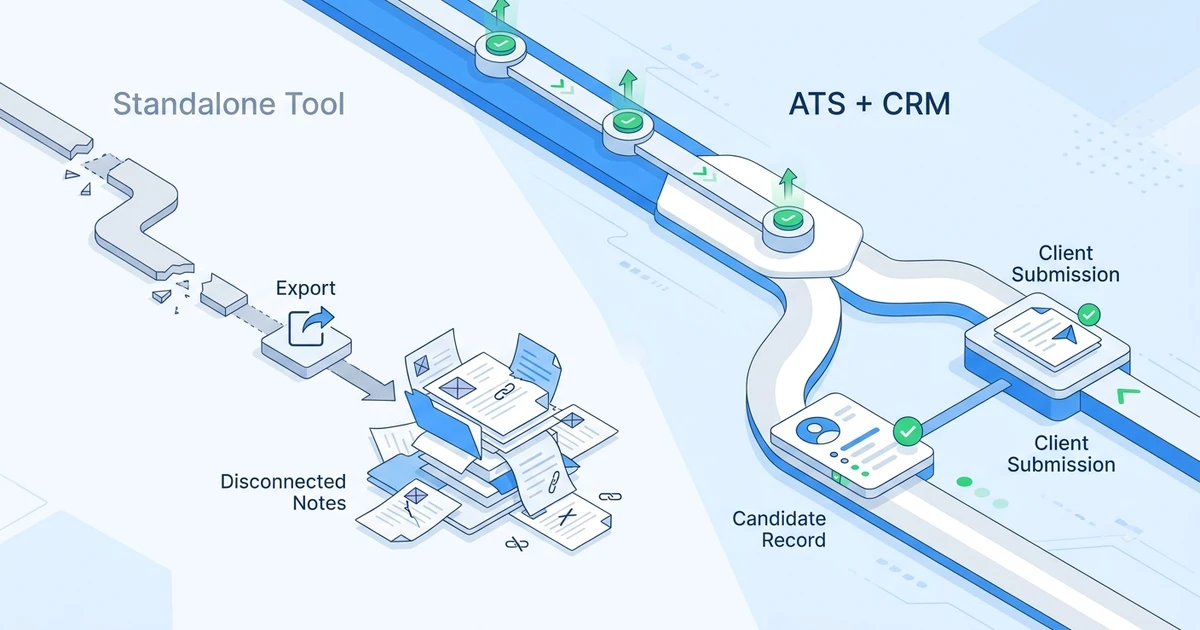
A connected ATS plus CRM makes more sense when sourcing is only one broken part of a larger workflow. If recruiters find candidates but then lose them during outreach, duplicate them during import, or forget to submit them to the right client, the fix is not only a bigger database.
Use standalone sourcing software when:
- Your ATS and CRM are already clean and trusted.
- Recruiters only need wider search coverage.
- Candidate handoff into your system is reliable.
- Your team has dedicated sourcers who can manage a separate workflow.
Use a connected ATS plus CRM when:
- Recruiters source, contact, submit, and place candidates from the same desk.
- Candidate history is scattered across tools.
- Managers need visibility into sourcing activity and placement outcomes.
- You want fewer exports, fewer duplicates, and clearer recruiter ownership.
SHRM’s State of Recruiting analysis reports that 51% of organizations face too few applicants, 50% struggle with losing talent to competitors, and 41% cite candidate ghosting in 2025 recruiting research. Those problems require faster matching, better communication, and cleaner follow-up.
Is ATZ CRM right for candidate sourcing?
ATZ CRM is right for your agency if sourcing needs to connect with the rest of recruiting. That includes candidate capture, multi-channel outreach, AI matching, job pipelines, client communication, submissions, and reporting.
It may not be the only tool you need if your agency wants a massive standalone people database for specialist research. In that case, a sourcing database can sit beside ATZ CRM. The key is making sure candidate context returns to the ATS plus CRM.
Gartner identified AI-first high-volume recruiting as one of the talent acquisition trends shaping 2026 in its talent acquisition trends report. For agencies, the practical version of that trend is simple: let software handle matching and admin, while recruiters focus on relationship quality.
Frequently Asked Questions
What are candidate sourcing tools?
Candidate sourcing tools help recruiters discover potential candidates before they apply. They may include profile search, contact enrichment, AI matching, talent mapping, browser extensions, outreach sequences, and ATS or CRM integrations.
The best tools reduce manual research while preserving recruiter judgment. They should help your team understand why a candidate fits, not just produce a long list of names.
What are the best candidate sourcing tools for recruitment agencies?
The best options depend on whether your agency needs profile discovery, enrichment, outreach, talent intelligence, or ATS plus CRM workflow. ATZ CRM is a strong choice when sourced candidates need to move directly into jobs, outreach, client submissions, and reporting.
Standalone tools can still work for specialist teams if they do not become another disconnected database.
Do sourcing tools replace an ATS?
Most sourcing tools do not replace an ATS. They help you find or contact candidates, while an ATS manages jobs, applications, stages, notes, submissions, and hiring process visibility.
For agencies, an ATS plus CRM is often the better system of record because it connects candidate delivery with client management. Sourcing tools should feed that system, not compete with it.
Should agencies choose standalone sourcing software or an ATS plus CRM?
Choose standalone sourcing software if your only issue is candidate discovery. Choose an ATS plus CRM if sourcing problems are tied to duplicate records, weak follow-up, poor client visibility, or unclear pipeline ownership.
Many growing agencies use both, as long as candidate records, outreach history, and job context stay connected.
How much do candidate sourcing tools cost?
Costs vary by user seats, contact credits, database access, outreach volume, AI features, and contract terms. Some tools offer public plans, while enterprise sourcing platforms often use custom pricing.
When comparing cost, include the full stack. A cheap add-on can become expensive if you still need separate outreach, enrichment, CRM, reporting, and migration tools.
Conclusion
The best candidate sourcing tool is the one that fixes your real bottleneck. If your team cannot find enough relevant people, choose stronger search and enrichment. If your team finds people but loses them in handoff, choose a connected workflow.
For recruitment agencies, sourcing should not end at a profile. It should move into outreach, job matching, client submissions, and placement reporting.
Book a demo with ATZ CRM to compare your current sourcing stack against a connected ATS plus CRM workflow built for agency recruiters.