 EN
EN DE
DE ES
ES FR
FR NL
NL PT
PT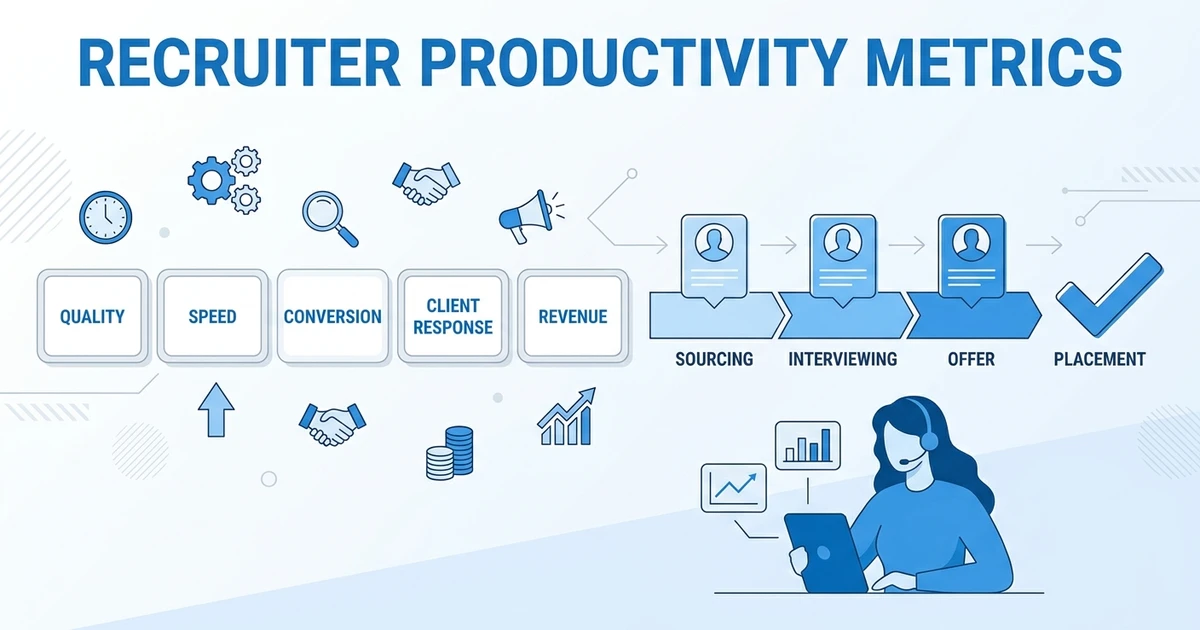





Quick Answer: Recruiter Performance
Recruiter productivity metrics measure whether a recruiter is creating hiring outcomes, not just staying busy. The most useful metrics combine speed, quality, conversion, candidate engagement, client responsiveness, and revenue impact so agency leaders can see which activities actually lead to placements.
Recruiters can look busy and still miss the numbers that matter. Calls, emails, and profile views are useful only when they create qualified progress through the hiring funnel.
That is why productivity measurement needs to go beyond raw activity. Agency leaders need to know whether each recruiter is producing quality submissions, moving candidates faster, improving client trust, and contributing to revenue.
The point is not to micromanage every action. The point is to coach better, balance workloads fairly, and spot performance problems before they show up as missed placements.
What Are Recruiter Productivity Metrics?
These metrics connect recruiter work to hiring outcomes. They show whether sourcing, screening, outreach, follow-up, and client management are turning into pipeline movement.
Good metrics balance effort and output. If you only track effort, recruiters may optimize for volume. If you only track placements, you miss early warning signs until it is too late.
The recruiting workload is also changing. LinkedIn reports that talent acquisition professionals using generative AI save about 20% of their workweek on average LinkedIn, 2025. That means activity counts are becoming less reliable as a measure of human productivity.
SHRM also reports that AI use in HR tasks rose to 43% of organizations in 2025, up from 26% in 2024 SHRM, 2025. When tools automate more admin work, managers need metrics that show judgment, quality, and conversion.
Recruiter Productivity Metrics That Predict Placements
The most useful productivity metrics act like leading indicators. They help you see whether placements are likely before the month ends.
For agency teams, these metrics are usually stronger than raw call or email volume:
- Qualified submissions per open role
- Submittal-to-interview conversion
- Interview-to-offer conversion
- Offer acceptance rate
- Candidate response rate
- Time to first candidate contact
- Time in stage
- Client feedback speed
- Placements per recruiter
- Revenue per recruiter
Ashby’s recruiter productivity report analyzed over 109M applications and 247K jobs from January 2021 through March 2026 Ashby, 2026. That scale shows why recruiter productivity can no longer be judged by gut feel alone.
The real value comes from pairing metrics. A recruiter with high submissions but weak interview conversion may need better qualification. A recruiter with fewer submissions and strong offer movement may be doing deeper intake and stronger candidate control.
Which Recruiter Performance Metrics Are Just Vanity Metrics?
Vanity metrics are not useless. They are incomplete. The problem starts when agencies reward activity that does not improve placement outcomes.
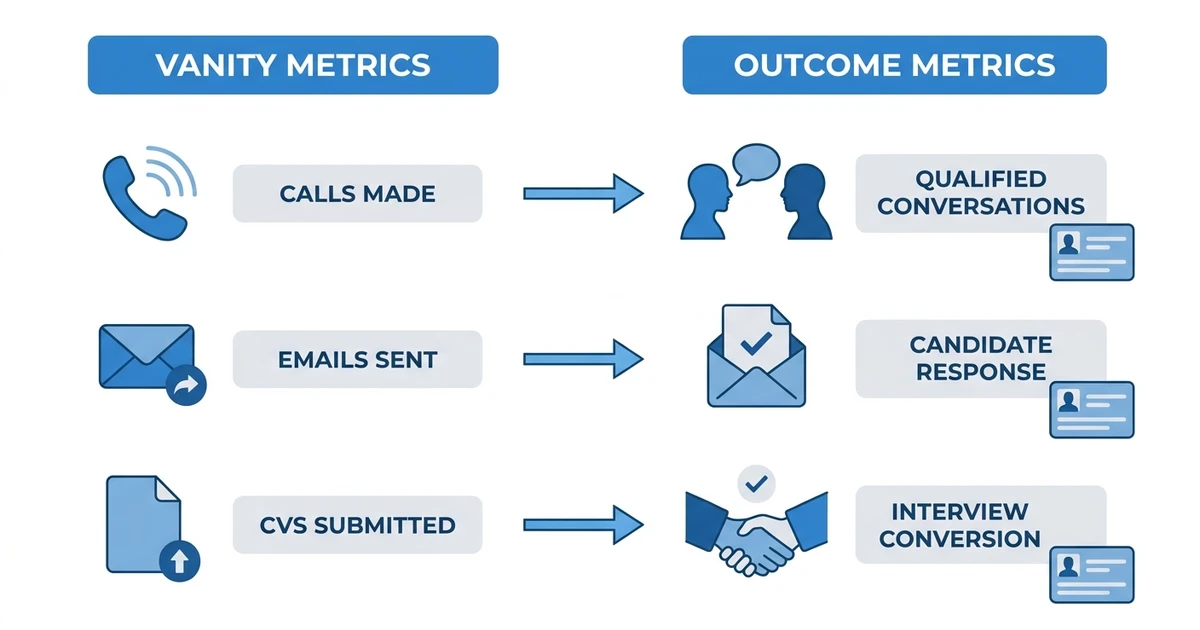
Calls, emails, database searches, and LinkedIn messages can all matter. But if they are measured alone, they encourage surface-level volume.
| Vanity Activity Metric | Stronger Outcome Metric | Why It Matters |
|---|---|---|
| Calls made | Candidate conversations that progress a role | Shows quality of contact, not just dialing |
| Profiles sourced | Qualified submissions accepted by client | Connects sourcing to client value |
| Emails sent | Candidate response rate | Measures message relevance |
| CVs submitted | Submittal-to-interview conversion | Shows qualification strength |
| Jobs worked | Placements or revenue per active job | Connects workload to commercial output |
This table should not be used to shame recruiters. It should help managers ask sharper questions.
For example, a recruiter may have low call volume because they are working a niche technical role with a smaller candidate market. Another recruiter may have high activity because they are cycling through poor-fit profiles. The numbers need context.
How to Measure Recruiting Efficiency Without Punishing Quality
Recruiting efficiency is not about doing everything faster. It is about removing avoidable waste while protecting candidate quality and client confidence.
A good efficiency metric should answer two questions. Did the recruiter move the process forward? Did that movement improve the chance of a placement?
Start by separating speed metrics from quality metrics:
- Speed: time to first contact, time in stage, time to submit, time to client feedback
- Quality: submission acceptance, interview conversion, offer conversion, client satisfaction
- Revenue: placement value, revenue per recruiter, revenue per client account
- Experience: candidate response, drop-off, no-show rate, offer acceptance
The balance matters. If a recruiter submits quickly but clients keep rejecting candidates, speed is hiding waste. If a recruiter is highly selective but roles sit idle, quality is hiding capacity issues.
This is where workflow automation helps. Automating reminders, status updates, interview scheduling, and follow-up tasks gives recruiters more time for judgment-based work.
To see whether that time is improving outcomes, connect workflow data to recruitment reports and dashboards. A better process should show up in stage movement, response speed, and conversion rates.
Recruiter KPI Examples for Agency Managers
Agency managers need KPIs that support coaching, not just inspection. The best recruiter KPI examples show where a manager can help.
Here is a practical framework:
| Manager Question | KPI To Review | Coaching Move |
|---|---|---|
| Is this recruiter finding the right people? | Submission-to-interview conversion | Improve intake, sourcing criteria, or screening depth |
| Is this recruiter moving quickly enough? | Time to submit and time in stage | Remove admin blockers or rebalance workload |
| Is candidate engagement strong? | Response rate and no-show rate | Review outreach quality and follow-up timing |
| Is client management slowing the role? | Client feedback SLA | Escalate account expectations |
| Is output translating to revenue? | Placement value and revenue per recruiter | Align effort to higher-value roles |
Use this framework in weekly one-to-one conversations. A recruiter should leave the meeting knowing what to improve and why it matters.
For example, imagine two recruiters working similar roles. One submits many profiles, but only a small share reach interview. The other submits fewer profiles, but clients consistently interview them. The second recruiter may be more productive because their work creates better conversion.
ATZ CRM’s team goal tracking can help managers connect individual recruiter goals with team outcomes. Recruitment KPI goal tracking then keeps those goals visible instead of buried in a monthly spreadsheet.
How ATZ CRM Helps Track Productivity Across the Full Pipeline
Recruiter productivity is hard to measure when activity, candidate records, client communication, and revenue sit in different tools. You end up comparing exports instead of coaching the team.
ATZ CRM brings ATS and CRM workflows into one platform, which gives managers a cleaner view of recruiter performance across the full pipeline. That includes sourcing, submissions, follow-ups, interviews, offers, placements, and client activity.
This matters because productivity is not one metric. It is a chain. If candidate response improves but client feedback slows, your agency still loses momentum.
For broader measurement context, pair this article with the recruitment analytics playbook, the recruiting funnel playbook, and the cost per hire guide. Together, they help you connect recruiter work to speed, cost, quality, and revenue.
Frequently Asked Questions
What are recruiter performance metrics?
Recruiter performance metrics measure whether recruiter activity creates hiring progress and placement outcomes. They connect activity, quality, conversion, speed, and revenue.
Which productivity KPIs matter most for agencies?
Agencies should track qualified submissions, submittal-to-interview conversion, interview-to-offer conversion, offer acceptance, client feedback speed, placements per recruiter, and revenue per recruiter. These metrics show whether effort is producing commercial progress.
How are recruiter performance metrics different from activity metrics?
Activity metrics show effort, such as calls or emails. Recruiter performance metrics show whether that effort creates pipeline progress, client trust, and placements.
Should recruiters be measured only on placements?
No. Placements matter, but they are lagging indicators. Managers should also review leading indicators such as candidate response, submission quality, and stage conversion.
How can recruitment software help track recruiter performance?
Recruitment software can capture activity, pipeline movement, client feedback, interviews, offers, and placements in one system. That gives managers cleaner data for coaching, forecasting, and workload planning.
Turn Recruiter Activity Into Measurable Placement Growth
The best productivity system does not turn recruiters into data-entry machines. It gives them clarity.
When recruiters know which metrics matter, they can focus on better conversations, sharper qualification, faster follow-up, and stronger client control. Managers can coach with evidence instead of opinion.
ATZ CRM helps agencies track recruiter KPIs, automate follow-ups, monitor pipeline movement, and connect team performance to placement outcomes. Book a demo to see how your agency can turn recruiter activity into measurable growth.