 EN
EN DE
DE ES
ES FR
FR NL
NL PT
PT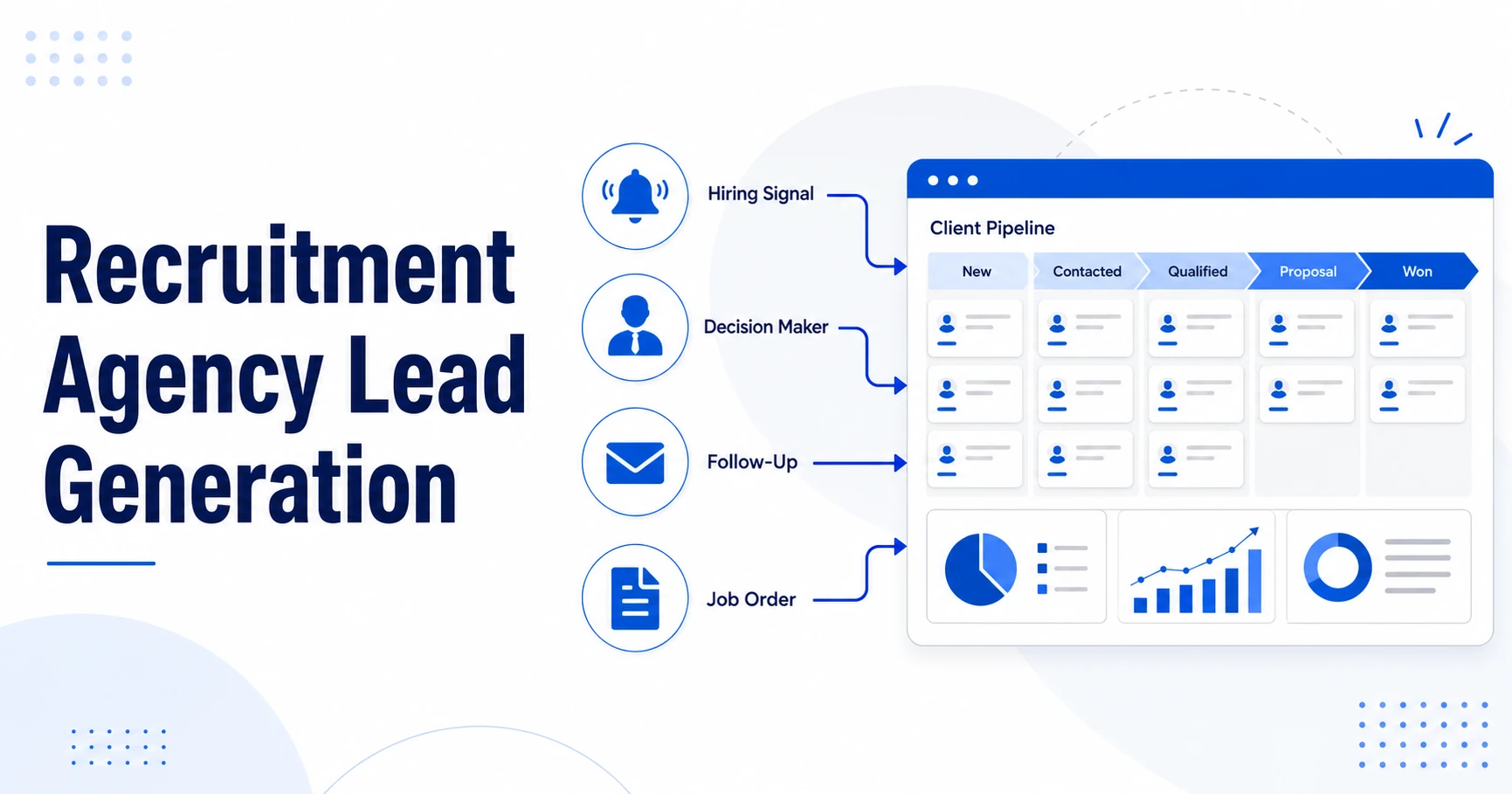





Quick Answer: Lead generation for recruitment agencies means finding companies with a real hiring need, identifying the right hiring decision-maker, and moving that prospect through a repeatable sales pipeline until they become a client. The strongest approach combines hiring-intent signals, niche positioning, multi-touch outreach, CRM follow-up, and revenue tracking so your agency is not dependent on referrals alone.
Why Lead Generation for Recruitment Agencies Breaks Without a System
Most agencies do business development in bursts. A recruiter finishes a placement, realizes the desk is getting thin, sends a batch of cold messages, asks a few old clients for work, and hopes something lands.
That creates the feast-or-famine cycle. You have too much work one month, then not enough qualified job orders the next. The problem is rarely effort. The problem is that lead generation sits outside the operating rhythm of the agency.
Hiring demand still exists, but it is uneven. The U.S. Bureau of Labor Statistics reported that job openings were unchanged at 6.9 million in March 2026 and hires increased to 5.6 million according to the March 2026 JOLTS release. Agencies that wait for demand to announce itself are late.
You need a system that catches demand early. That means your team knows which companies are hiring, which roles are repeated, which accounts match your niche, who owns the decision, and when the next follow-up is due.
What Makes a Good Recruitment Agency Lead
A good lead is not just a company with an open role. Plenty of open roles are low-value, stale, poorly funded, or already assigned to another supplier. Your sales pipeline should filter for accounts where your agency can actually win.
Start with five qualification signals:
- Hiring intent: The company has open roles, repeated postings, growth news, or a known skill gap.
- Client fit: The role sits inside your niche, geography, salary band, or hiring model.
- Urgency: The hiring need affects revenue, delivery, compliance, or team capacity.
- Decision-maker access: You can reach the hiring manager, founder, department head, or talent leader.
- Repeat-placement potential: The account could need more than one hire over time.
This is where many recruiters waste effort. They chase any vacancy instead of the vacancies they can credibly fill. A healthcare recruiter should not spend the same energy on a generic office role that a specialist competitor can handle faster.
The best leads give you a reason to speak with authority. If you know the market, understand the salary pressure, and have candidate insight, your outreach sounds like a recruiter who can solve the problem rather than another supplier asking for terms.
Where to Find Recruitment Agency Leads Before Competitors Do
Recruitment agency lead generation starts with signals. A signal is a visible clue that a company may need help hiring now or soon.
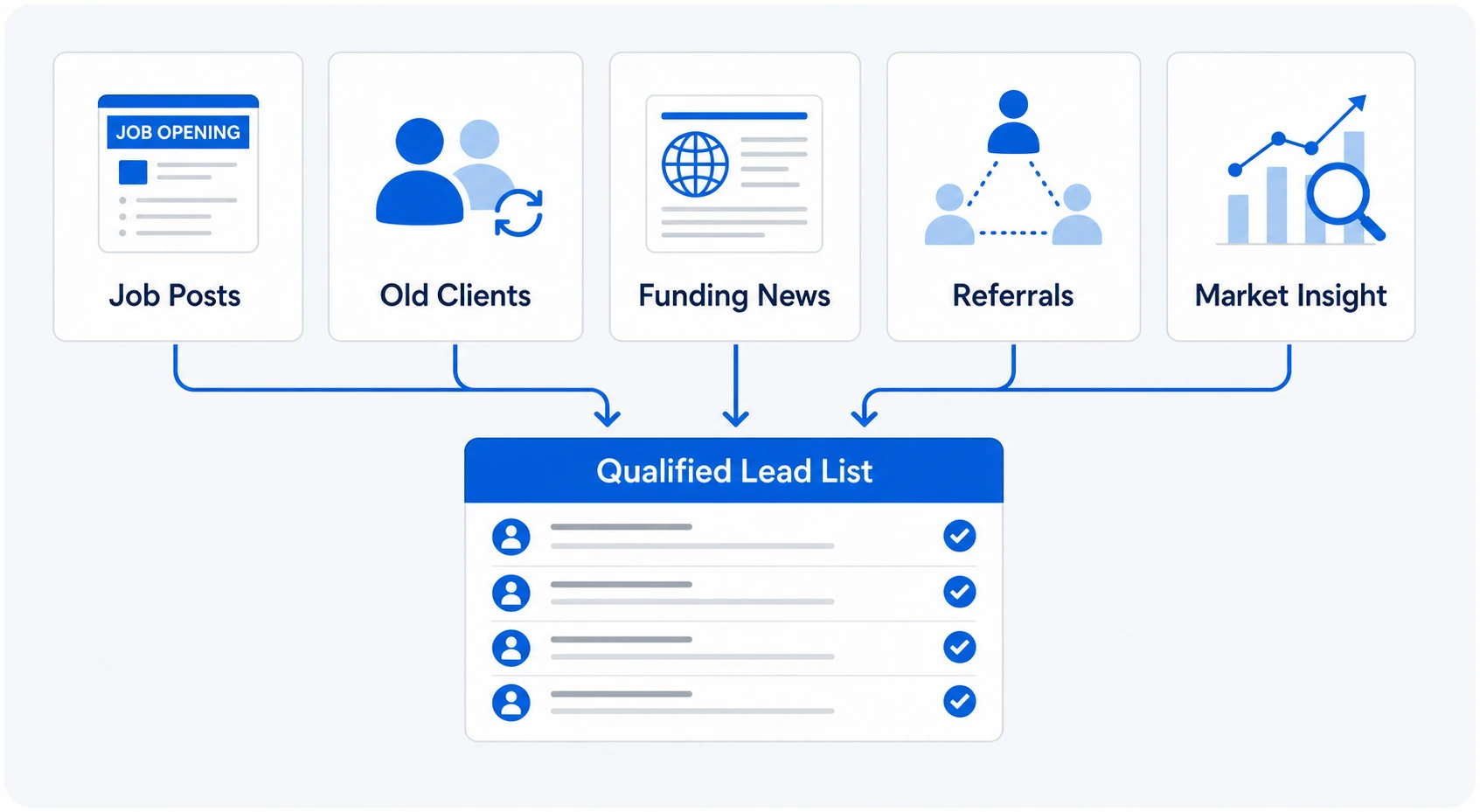
Indeed Hiring Lab describes the 2026 labor market as cautious, selective, and uneven, with its hiring trends report drawing on millions of real-time job postings and labor-market data in its 2026 outlook. That is exactly why broad prospecting is weak. You need to follow the data that points to active demand.
| Lead source | Best signal | Speed | Data needed | Best ATZ CRM workflow |
|---|---|---|---|---|
| Job postings | New or repeated open roles | Fast | Company, role, hiring manager | Prospecting pipeline plus follow-up sequence |
| Previous clients | New hiring activity or role expansion | Fast | Past contacts, old job orders | Client reactivation workflow |
| Funding or expansion news | Budget and headcount growth | Medium | Trigger event, department, decision-maker | Target-account list |
| Candidate-market insight | Hard-to-fill role pattern | Medium | Candidate availability, salary data | Consultative outreach |
| Referrals | Warm trust path | Variable | Source, contact, need | Referral tracking plus nurture |
Job postings are the obvious starting point, but do not stop there. Repeated postings are often stronger than new postings because they show a role is hard to fill. A company reposting the same engineering, nursing, sales, or finance role every few weeks is telling you something.
Old clients are another underused source. If you placed for a company last year, check whether their team is expanding again, whether the hiring manager moved to a new employer, or whether the role you filled has become a recurring need.
How to Build a Recruitment Agency Sales Pipeline
A recruitment agency sales pipeline turns lead generation into a managed process. Without stages, every prospect lives in someone’s inbox, spreadsheet, or memory. That makes follow-up inconsistent and reporting nearly impossible.
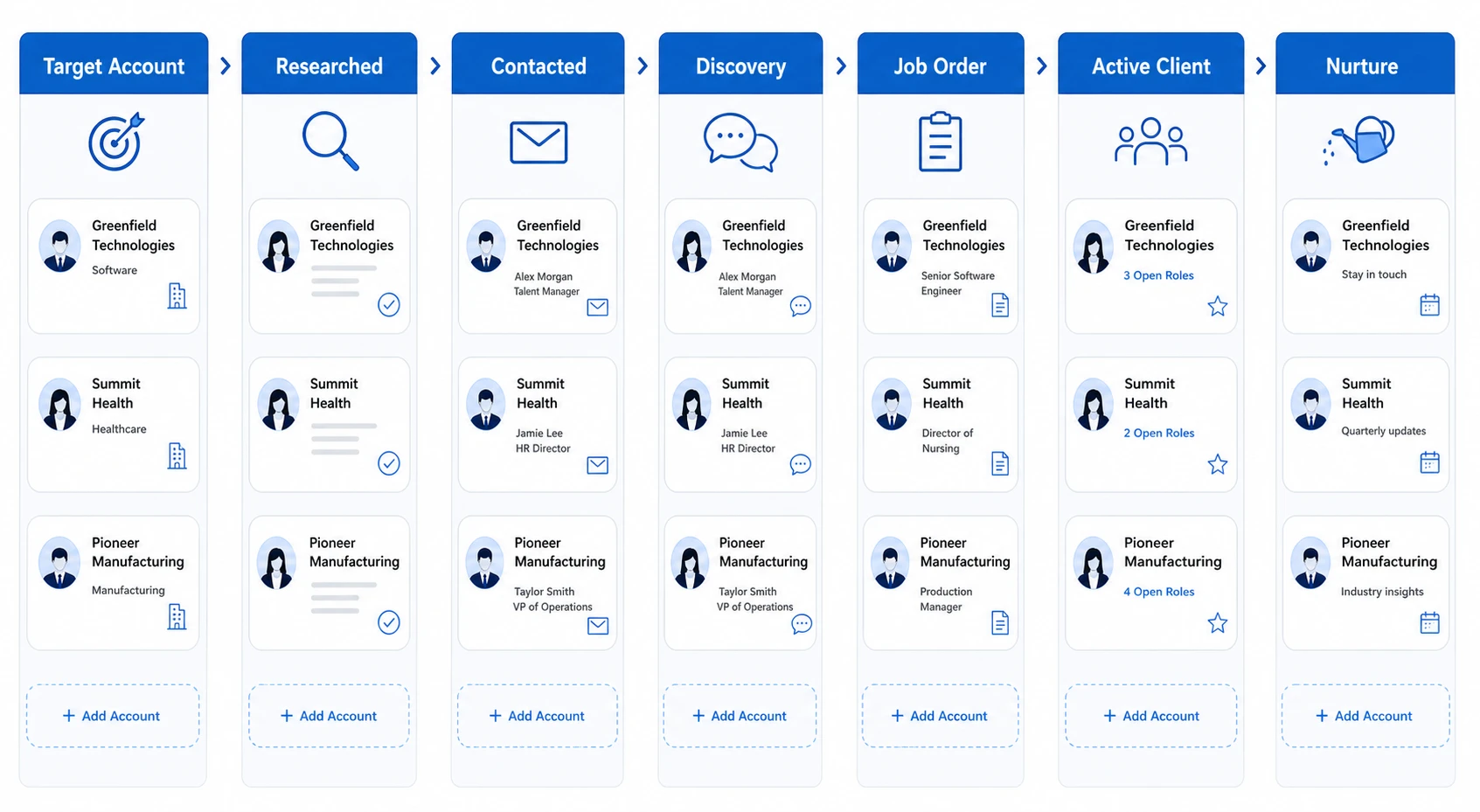
Keep the pipeline simple enough for recruiters to use every day:
| Stage | What it means | Exit criteria |
|---|---|---|
| Target account | Company matches your niche | Account owner assigned |
| Researched | Hiring signal and decision-maker identified | Outreach angle written |
| Contacted | First touch sent | Follow-up scheduled |
| Replied | Prospect responded | Need qualified |
| Discovery booked | Meeting scheduled | Role or hiring plan discussed |
| Job order won | Search agreed | Intake complete |
| Active client | Live search or repeat account | Delivery underway |
| Nurture | Not ready now | Next value-led touch scheduled |
The stage names can change, but the behavior should not. Every account needs an owner, a next action, and a reason it belongs in the pipeline.
Use recruitment CRM features to keep this visible. Your team should be able to open the CRM and see which prospects need a call today, which accounts are waiting on a proposal, and which old clients should be reactivated.
ATZ CRM helps agencies manage client pipelines, scheduled follow-ups, and outreach sequences in one recruitment CRM. See how recruitment CRM features turn scattered prospecting into a repeatable business development workflow.
Outreach Sequences That Turn Hiring Signals Into Client Conversations
One cold message rarely wins a client. The goal is not to annoy a hiring manager. The goal is to show up with relevant context more than once, at the moment they may need help.
A practical sequence looks like this:
- Day one: Send a short message tied to a visible hiring signal.
- Day three: Follow up with a candidate-market observation or salary insight.
- Day seven: Call or send a LinkedIn message with a specific reason for reaching out.
- Day twelve: Share one useful angle, such as why the role may be hard to fill.
- Day twenty: Send a polite close-out message and move the account to nurture.
The best outreach is specific. “Saw you’re hiring” is weak. “You have had the same senior data engineer role open for several weeks, and the strongest candidates in that market are asking for remote flexibility” is much stronger.
Use outreach sequences for recruiters when the follow-up pattern is repeatable. Your team should spend time improving the message and qualification angle, not remembering who needs touch four.
How to Track Lead Generation Metrics That Actually Predict Revenue
Activity alone can mislead you. A recruiter can send hundreds of messages and still create no qualified job orders. Measure the path from prospecting to revenue instead.
Track these metrics every week:
- Prospect-to-reply rate
- Reply-to-meeting rate
- Meeting-to-job-order rate
- Job-order-to-placement rate
- Revenue by lead source
- Speed to first touch after a hiring signal appears
- Follow-up completion rate
These metrics tell you where the pipeline is leaking. If replies are low, your targeting or message is wrong. If meetings happen but job orders do not, your discovery call may not be qualifying urgency or budget. If job orders arrive but placements do not, delivery and candidate supply need attention.
Recruitment KPI tracking dashboards matter because they connect business development to outcomes. Calls and emails are useful only when they create meetings, job orders, submissions, placements, and revenue.
How ATZ CRM Supports Recruitment Agency Lead Generation
ATZ CRM gives your agency one place to manage both sides of the business: candidate delivery and client development. That matters because recruitment sales depends on proof. If you can show real candidate-market insight, your client conversation becomes more consultative.
Inside ATZ CRM, you can manage account lists with prospecting tools for recruiters, move leads through a client pipeline, trigger follow-up sequences, and track business development activity against revenue. That gives owners and team leads a clear view of what is actually working.
The unified ATS+CRM model also helps recruiters avoid a common mistake: selling work the delivery team cannot support. If your team can see candidate supply, active pipelines, past placements, and client conversations together, they can qualify leads with more discipline.
For staffing firms, that connection is especially important. Staffing agency software should not treat sales and recruiting as separate worlds. The best client pipeline is informed by the candidate market you already understand.
Frequently Asked Questions
What does agency lead generation mean?
Agency lead generation is the process of identifying companies with a real hiring need, finding the right decision-maker, and moving that prospect into a structured client pipeline. It works best when your team tracks hiring signals, outreach, follow-ups, meetings, job orders, and placement revenue in one system.
How do recruitment agencies get clients?
Recruitment agencies get clients through referrals, job-posting signals, former client reactivation, niche market insight, outbound outreach, partnerships, and content that proves hiring expertise. The most reliable agencies do not depend on one channel. They run a weekly prospecting rhythm and track every lead source.
What is the best lead source for a staffing agency?
The best lead source is usually a company showing a current hiring signal, such as repeated job postings, team expansion, funding, leadership change, or a hard-to-fill role in your niche. Referrals are warmer, but hiring-intent signals are easier to scale because your team can research and act on them every week.
How many follow-ups should recruiters send to a prospective client?
Most recruitment agency outreach needs several touches because hiring managers are busy and timing changes quickly. A practical sequence includes an initial message, a value-led follow-up, a phone or LinkedIn touch, a candidate-market insight, and a final break-up message. Stop when the prospect opts out or clearly says the timing is wrong.
What CRM stages should a recruitment agency use for business development?
A simple recruitment agency sales pipeline can use stages like target account, researched, contacted, replied, discovery booked, job order won, active client, and nurture. The exact names matter less than consistency. Your team should always know which prospects need action and which accounts are turning into revenue.
Which metrics show whether recruitment agency lead generation is working?
Track prospect-to-reply rate, reply-to-meeting rate, meeting-to-job-order rate, job-order-to-placement rate, revenue by lead source, and speed to first touch. Activity metrics matter, but revenue movement matters more. If a lead source creates conversations but no job orders, fix the targeting or drop it.
Conclusion
Recruitment agency growth gets easier when lead generation becomes a weekly operating system. You do not need random outreach bursts. You need hiring signals, clear qualification rules, structured follow-up, and pipeline metrics that show whether business development is turning into revenue.
The agencies that win are usually not the ones sending the most messages. They are the ones reaching the right companies with the right context before the role becomes another stale vacancy.
ATZ CRM helps you run that rhythm with prospecting tools, client pipelines, automated outreach, and KPI tracking in one ATS+CRM platform. Book a demo to see how your agency can turn lead generation into a repeatable client acquisition workflow: request an ATZ CRM demo.