EN
 DE
 ES
 FR
 NL
 PT
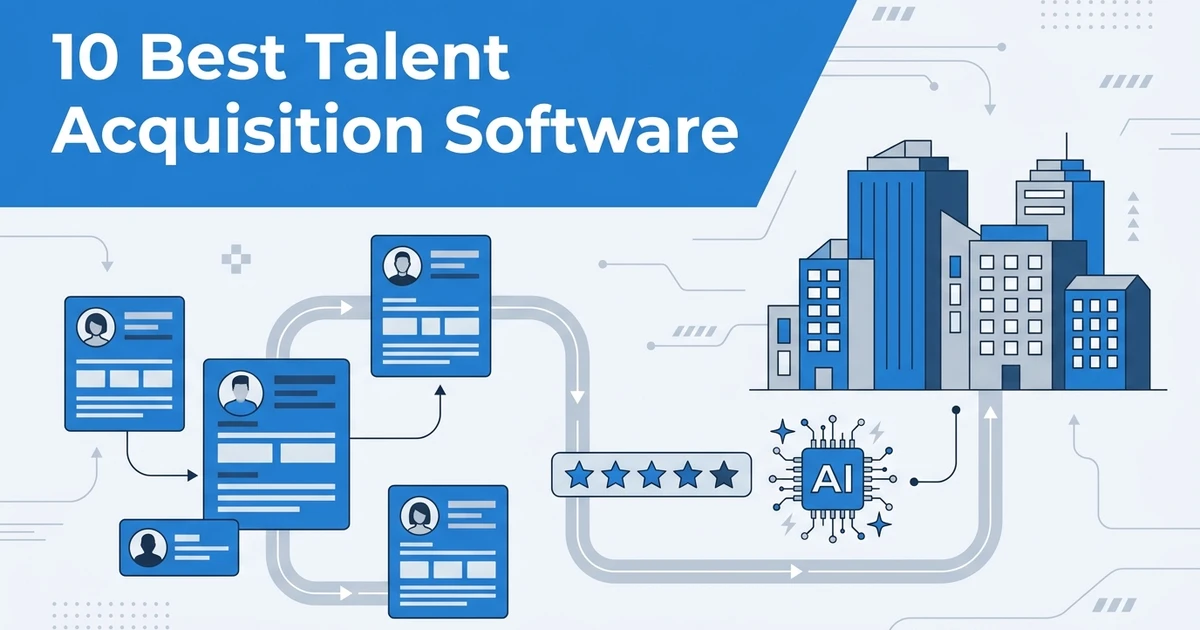


Quick Answer: The best talent acquisition software for a recruitment agency looks different from what a large in-house HR team needs. Agencies need fast candidate-to-client matching, relationship tracking across multiple clients, and placement reporting in one system, not a standalone hiring suite built for a single company’s own open roles. Compare platforms on sourcing depth, AI matching, per-recruiter pricing, and whether client-side relationship management is built in or missing entirely.
TL;DR:
- ATZ CRM - Best overall for agencies that want AI matching and client CRM together
- Loxo - Best built-in sourcing database and talent intelligence platform
- Crelate - Best flexible ATS + CRM for relationship-driven teams
- Vincere - Best modular suite for international agencies
- Bullhorn - Best enterprise staffing ecosystem
- Manatal - Best budget-friendly AI-assisted ATS
- Recruiterflow - Best automation-heavy ATS + CRM
- Zoho Recruit - Best low-cost option inside the Zoho ecosystem
- CEIPAL - Best workforce-led talent acquisition workflow
- Avionte - Best high-volume staffing operations platform
Most “talent acquisition software” guides are written for a company hiring its own employees, not an agency placing candidates with dozens of clients at once. That difference matters more than any feature checklist, because the software an in-house TA team needs and the software an agency needs often aren’t the same product category at all.
Talent acquisition is already the single biggest area where HR organizations apply AI. SHRM’s research on AI adoption in HR found that among organizations using AI at all, 64 percent apply it to talent acquisition first, ahead of learning and development or performance management.
Agencies evaluating software today are choosing among tools that increasingly compete on that exact capability.
This guide compares 10 platforms that fit the agency model, where candidate sourcing, client relationships, and placement tracking all have to work together. Each entry below notes the pricing model, where the platform fits best, and the specific tradeoff an agency should check before signing a contract.
What Makes Talent Acquisition Software Different for Agencies vs. In-House Teams
An in-house talent acquisition team hires for one company’s open roles. Their software needs to manage job requisitions, interview scorecards, and internal approval chains, all pointed at a single employer brand.
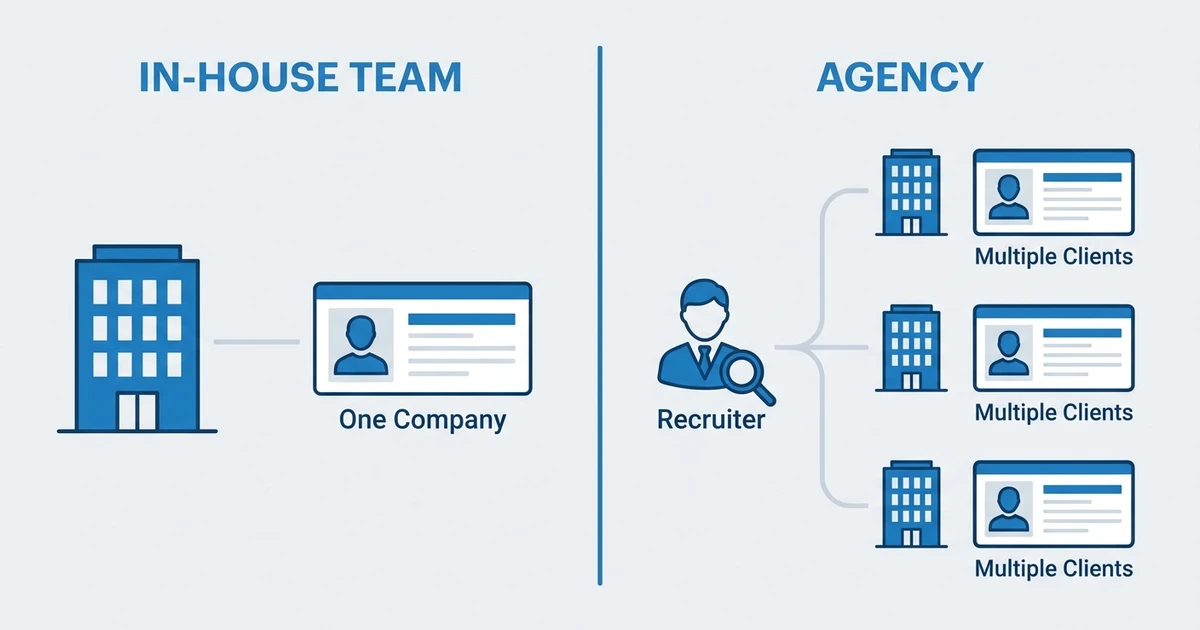
A recruitment agency works in reverse. You’re managing candidates and clients at the same time, often across dozens of open roles for different companies, and your software needs a CRM layer that in-house TA suites simply don’t build.
There’s a second difference that’s easy to miss: candidate ownership over time. An in-house ATS treats a candidate who didn’t get the one job they applied for as closed. Your agency can’t afford that. The same candidate might be the right fit for a different client’s role three months from now, and you’ve already paid the cost of sourcing and vetting them once.
Research cited by SHRM found that only about 1 in 100 candidates who apply for a role end up hired across typical hiring funnels. For an agency juggling multiple job orders, that math only works if your software helps you match the right candidates to the right roles faster than a manual search ever could.
That’s the real test for a talent acquisition platform at an agency: does it help you work a candidate across multiple client opportunities, or does it assume every candidate belongs to exactly one job requisition the way in-house hiring software does.
How We Evaluated These 10 Platforms
Each platform below was evaluated against criteria that matter specifically for agency recruiting, not generic HR buying criteria:
- AI-assisted matching: Does it help surface and rank candidates against multiple open roles, not just one?
- Client relationship management: Is there a built-in CRM for tracking client accounts, or do you need a separate tool?
- Sourcing depth: Does it include a candidate database and sourcing tools, or only an applicant pipeline for people who already applied?
- Pricing transparency: Is per-user pricing published, or does it require a sales call to find out what your team will actually pay?
- Fit by agency size: Is it realistic for a 5 to 20 person agency, or built for staffing operations with hundreds of recruiters?
Published pricing below reflects figures reported at the time of writing. Vendors change pricing and packaging often, so confirm current rates directly before budgeting.
We weighted these five factors because they map to how a real agency desk actually loses money: a candidate who never gets matched to the right role, a client relationship that goes cold because nobody logged the last call, or a sourcing gap that forces a recruiter back onto manual LinkedIn searches. A platform that scores well on a feature checklist but fails on any of these five points will still cost you placements.
AI-assisted matching carries more weight than it did a year ago. Generative AI use in hiring climbed to 37% of organizations actively integrating or experimenting with it, up from 27% the year before, according to LinkedIn Talent Insights’ Future of Recruiting 2025 report. A platform with no matching intelligence at all is starting to look dated against that trend.
Quick Comparison Table
| Platform | Best for | Starting price | AI matching | Built-in client CRM |
|---|---|---|---|---|
| ATZ CRM | AI matching + client CRM together | $12/user/mo | Yes | Yes |
| Loxo | Sourcing database depth | Free tier, then ~$169/user/mo | Yes | Yes |
| Crelate | Relationship-driven mid-market teams | $85/user/mo | Yes (add-on tiers) | Yes |
| Vincere | International modular suite | ~£69/user/mo plus add-on | Yes (add-on tiers) | Yes |
| Bullhorn | Enterprise staffing ecosystem | Custom quote only | Yes | Yes |
| Manatal | Budget-friendly AI ATS | $15/user/mo | Yes | Limited |
| Recruiterflow | Automation-heavy workflow | $119/user/mo | Yes (add-on tier) | Yes |
| Zoho Recruit | Low-cost Zoho ecosystem fit | $25/recruiter/mo | Limited | Limited |
| CEIPAL | Workforce-led operations | ~$24/user/mo plus modules | Yes | Moderate |
| Avionte | High-volume staffing | Custom quote only | Yes | Yes |
The 10 Best Talent Acquisition Platforms in 2026
Read the “Starting price” column with one caveat in mind: most vendors beyond ATZ CRM, Manatal, and Zoho Recruit either gate their real AI and sourcing features behind a higher tier or require a custom quote once your team grows past a handful of seats. Confirm the all-in price for the features you actually need, not just the entry-level sticker.
1. ATZ CRM
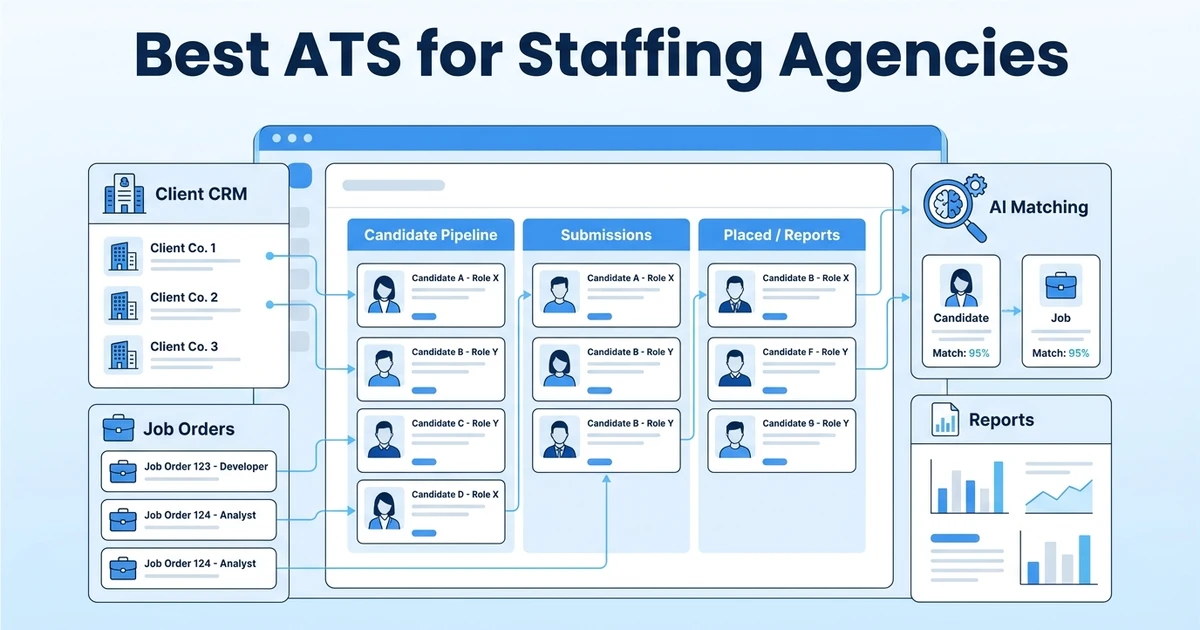
ATZ CRM is the best first choice for agencies that want AI candidate matching and client relationship management in one platform instead of stitching together separate tools. Its AI candidate matching scans your existing database and ranks candidates against open roles automatically, and the built-in CRM tracks client accounts, deals, and communication alongside the candidate pipeline.
Pricing starts at $12 per user per month on the Pro plan, scaling to $24 on Business and $60 on Enterprise, with an unlimited free trial and no credit card required. The main watch-out is scale: very large staffing operations with hundreds of recruiters and dedicated workforce or payroll needs should evaluate whether they need additional specialized modules alongside it.
2. Loxo
Loxo bundles an ATS, recruiting CRM, sourcing database, and outreach automation into what it calls a talent intelligence platform. Its sourcing graph is marketed as covering roughly 1.2 billion profiles with contact reveal credits, though data accuracy varies by role and geography.
A free plan covers one user with full ATS and CRM access, while paid plans start around $169 per user per month, with the sourcing graph, AI agents, and API access reserved for the Professional and Enterprise tiers. It’s a strong fit for agencies that want deep sourcing built in, but budget for the jump from the free tier to a paid plan with real AI sourcing features.
3. Crelate
Crelate combines an ATS and recruiting CRM with AI agents, client portals, and analytics aimed at relationship-driven hiring teams. Its candidate sourcing tools and contact data enrichment make it a reasonable fit for agencies that want one system for both candidates and client business development.
The Essentials plan starts at $85 per user per month, with Business at $119 adding AI assistance and reporting, and Business Plus or Platform tiers requiring a custom quote for deeper automation and enterprise controls. Smaller agencies should confirm which AI features are actually included at their plan level before assuming parity with Business-tier reviews.
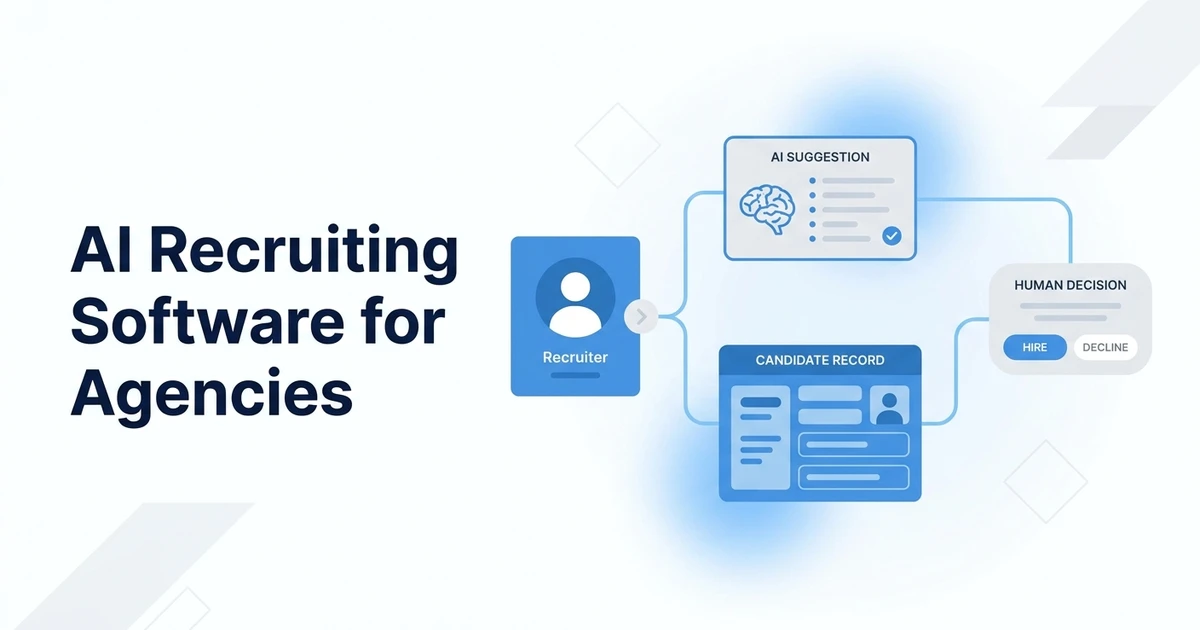
See how ATZ CRM’s AI recruiting software built for agencies keeps candidate matching and client relationships in the same pipeline. Start a free trial and compare it against your current sourcing and CRM setup.
4. Vincere
Vincere pairs a unified CRM and ATS database with modular AI add-ons, called Smart Packs, that range from basic job creation and CV scoring tools to full AI suites with candidate presentation and Pay & Bill features. Its LiveList feature for sharing shortlists with clients is a notable agency-specific touch.
The core license runs about £69 per user per month, but the required Smart Pack add-on ranges from £25 to £349 per agency per month depending on tier, meaning the real cost for a 10-seat agency can run closer to £830 per month before setup and migration fees. Model the full add-on cost before comparing it against flat per-user pricing elsewhere.
5. Bullhorn
Bullhorn is a mature, enterprise-scale staffing platform with a broad integration ecosystem and strong brand recognition in the industry. It can fit larger agencies that need scale, established vendor relationships, and deep third-party integrations.
Bullhorn does not publish pricing and requires a custom quote, and the tradeoff for its scale is complexity. Smaller or mid-size agencies should weigh implementation time and administrative overhead against what a lighter platform could deliver for the same recruiting workflow.
6. Manatal
Manatal is an AI-powered ATS targeting small and mid-size agencies that want AI candidate scoring without an enterprise price tag. The Professional plan starts at $15 per user per month on annual billing, though it caps open jobs and candidate volume, and API access is reserved for the $55 per user per month Enterprise Plus tier.
It’s a reasonable entry point for a small agency testing AI-assisted screening for the first time, but confirm your expected candidate volume against the plan’s limits before committing, since the lowest tier fills up faster than it looks.
7. Recruiterflow
Recruiterflow is an ATS and CRM built around automation, with multichannel outreach sequences, a sourcing Chrome extension, and reporting as standard features on its Platform plan. A separate AIRA add-on brings AI features like an AI notetaker, candidate matching, and automated submissions, priced on request.
The Platform plan runs $119 per user per month on annual billing or $149 monthly, which puts it at a similar price point to Crelate. Agencies specifically wanting the AI feature set should budget for AIRA as a separate line item rather than assuming it’s bundled.
8. Zoho Recruit
Zoho Recruit’s Staffing Agency edition is a budget option inside the broader Zoho ecosystem, with a free tier and paid plans from $25 per recruiter per month on annual billing up to $75 for Enterprise. It can suit smaller teams moving off spreadsheets or already using other Zoho products.
The tradeoff is depth. Several buyer-guide sources note that add-ons and agentic AI features can push real costs 30 to 50 percent above the sticker price, and AI matching capability is lighter than purpose-built recruiting AI tools. Treat the advertised entry price as a starting point, not the full picture.
9. CEIPAL
CEIPAL is built around workforce and vendor management workflows alongside recruiting, which can suit agencies with high-volume contract or contingent placement needs. Its ATS pricing starts around $24 per user per month according to third-party buyer guides, though CEIPAL itself does not publish full pricing, and Workforce or VMS modules are quoted separately.
If your agency’s main need is simply faster candidate-to-client matching rather than broader workforce management, CEIPAL’s breadth may be more platform than you need day to day.
10. Avionte
Avionte is an operations-heavy platform often evaluated by staffing firms with high-volume temp and contract placement needs. It does not publish pricing, using a custom quote based on agency size, modules, and transaction volume, and third-party estimates suggest implementation costs can run from $5,000 to $20,000 or more depending on scope.
It’s worth evaluating if your agency’s bottleneck is operational scale rather than candidate matching speed, but confirm the full implementation timeline and cost before assuming it solves a sourcing problem specifically.
Talent Acquisition Platforms vs. an All-in-One ATS+CRM: Which Does Your Agency Need?
If your agency’s biggest problem is finding and ranking the right candidates faster, pure sourcing-heavy platforms like Loxo make sense as a starting point. If your biggest problem is that candidates and client relationships live in two disconnected systems, an all-in-one ATS+CRM solves a different, often more expensive, problem.
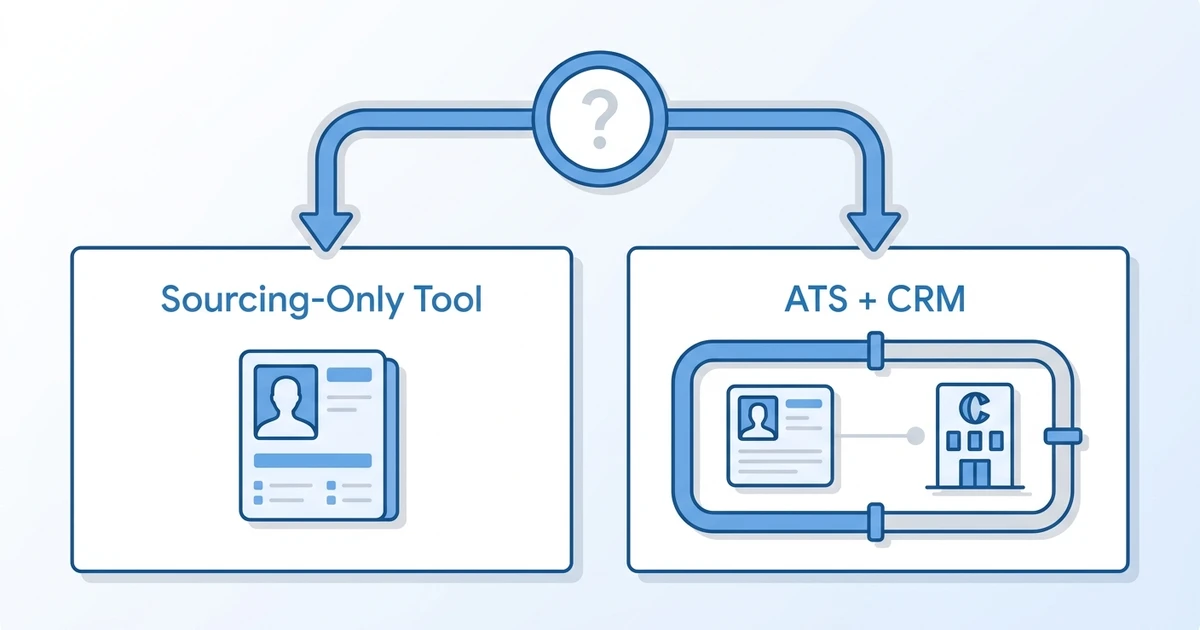
Most small and mid-size agencies find that the client relationship gap costs them more placements than a sourcing gap does. A great candidate match that gets lost because nobody followed up with the client is a bigger loss than a slightly less sophisticated sourcing algorithm.
Think about the last placement that fell through after a strong first interview. In many cases, the candidate was fine. What broke down was the follow-up: a client email that sat unanswered for three days, or a status update that only lived in one recruiter’s head instead of a shared record. Sourcing tools don’t fix that. A connected CRM does.
Is ATZ CRM Right for Your Agency?
ATZ CRM is right for recruitment agencies that want AI candidate matching, sourcing, and client relationship management working together instead of as separate subscriptions. It fits solo recruiters, small teams, and mid-size agencies that need to move fast without an enterprise implementation timeline, with recruiter productivity tools built around that single-pipeline workflow.
It is not the right fit if your agency specifically needs deep workforce management, Pay/Bill, or payroll processing built into the same platform as your ATS. In that case, compare it against operations-heavy platforms like Avionte or CEIPAL instead, and consider whether ATZ CRM could still own the front-office recruiting layer while a separate system handles back-office payroll.
A fair objection is cost at scale. A 40-recruiter agency paying per user on ATZ CRM will spend more in total than a flat-fee tool, even at a competitive per-seat rate. Weigh that against what it costs today to keep a separate sourcing tool and client CRM in sync by hand, since that reconciliation work is rarely tracked as a real expense even though it eats real recruiter time.
If you’re not sure which category fits, start with a free trial and run one real search against your own candidate database. For more on how AI-assisted matching fits into a broader sourcing strategy, see our comparison of AI recruiting software for agencies and our guide to building a talent pipeline.
Frequently Asked Questions
What is the best talent acquisition software for recruitment agencies?
There is no single best talent acquisition software for every agency. ATZ CRM fits agencies that want AI candidate matching and client relationship tracking in one system, Loxo and Crelate fit agencies that want a built-in sourcing database, and Bullhorn or Vincere fit larger operations that need an established enterprise ecosystem.
How much does talent acquisition software cost?
Pricing ranges from around 15 dollars per user per month for budget options like Manatal to 150 dollars or more per user per month for platforms like Loxo and Recruiterflow, with Bullhorn and Avionte using custom enterprise quotes instead of published pricing. Add-ons for AI sourcing, data enrichment, or workforce modules often add 20 to 50 percent on top of the base price.
Is enterprise talent acquisition software like Greenhouse or SmartRecruiters right for a recruitment agency?
Usually not as a first choice. Those platforms are built for a single company hiring for its own roles, not for an agency juggling multiple clients, candidate relationships, and placement fees at once. Agencies typically need software that combines applicant tracking with a client-facing CRM instead.
What features should agencies look for in a talent acquisition platform?
Look for AI-assisted candidate matching, a searchable candidate database, client relationship and pipeline tracking, reporting on time-to-fill and placement rates, and transparent per-recruiter pricing. Confirm whether sourcing, data enrichment, or AI features are included or sold as paid add-ons.
Is ATZ CRM a good fit for talent acquisition at a recruitment agency?
Yes, for agencies that want AI candidate matching, sourcing, and client relationship management in one platform rather than stitching together a separate ATS and CRM. It is less of a fit for large staffing operations that specifically need deep workforce, payroll, or Pay/Bill modules built into the same system.
Conclusion
The right talent acquisition platform for your agency depends on which gap actually costs you placements: sourcing speed, client follow-up, or operational scale at high volume. Match the platform to that specific gap instead of the longest feature list.
If the gap is a disconnect between candidate matching and client relationships, book an ATZ CRM demo and walk through your current pipeline to see where AI matching and a built-in CRM would close it.