EN
 DE
 ES
 FR
 NL
 PT
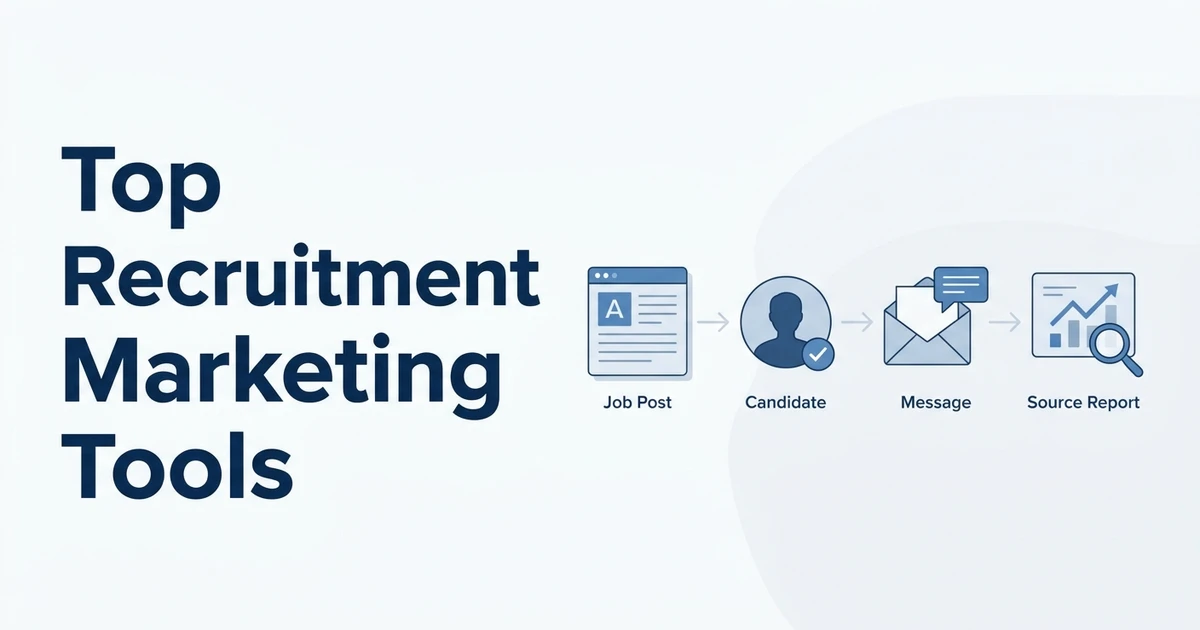


Quick Answer: The best recruitment marketing tools depend on where your candidate funnel is losing people: job visibility, employer-brand discovery, candidate nurture, or source-to-hire measurement. Most agencies need a small connected stack that makes each channel measurable and keeps candidate conversations attached to the recruiting system.
Where does your candidate funnel lose people?
A job post gets attention, but few qualified people respond. Another role attracts plenty of applicants, yet the team spends hours sorting out who fits. A former candidate tells you they never heard back after an earlier process. Those are different problems, so they need different tools.
Recruitment marketing is the work of attracting and engaging people who could fit current or future roles. It borrows useful ideas from marketing, such as audience selection, clear messages, useful content, channel planning, and measurement. The candidate is not a lead to push through a funnel. They are a person deciding whether your opportunity deserves their time. For more channel and campaign ideas, see this guide to recruitment marketing ideas.
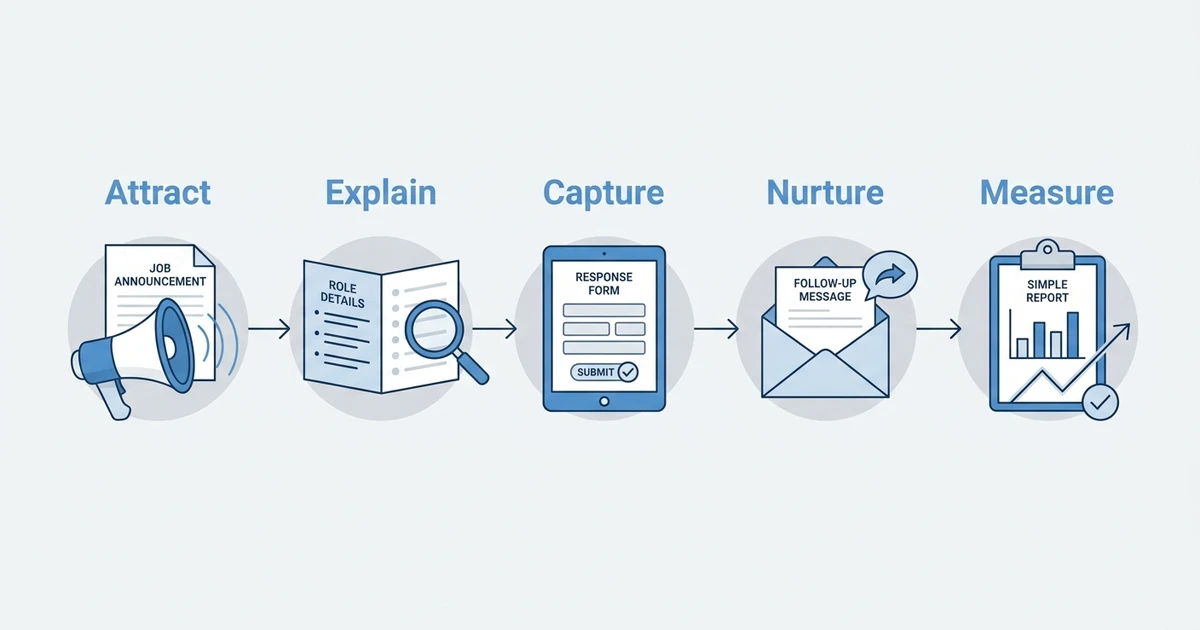
Map the journey before shopping for software:
- Attract: Put relevant work in front of the people you want to reach.
- Explain: Give candidates a truthful picture of the role, team, employer, and process.
- Capture: Make it easy to express interest or apply.
- Nurture: Keep a useful, permission-aware relationship when timing is not right.
- Learn: Measure which sources lead to qualified conversations and hires.
A low response rate may point to the role message, channel, pay range, location, or application friction. A strong response followed by poor progression could mean the audience is too broad or the qualification criteria are unclear. Buying an automation product before diagnosing the leak can make the wrong process run faster.
What counts as a recruitment marketing tool?
The phrase covers several categories. Some tools distribute job ads. Others help a company explain its employer value proposition, build a career site, nurture a talent community, or understand which channels bring candidates into the pipeline. A platform can cover more than one category, but the labels alone do not tell you what is included in a plan.
An applicant tracking system (ATS) records applicants and manages hiring stages. A candidate relationship management system (CRM) helps recruiters keep track of people and conversations over time. Recruitment marketing may use either system, alongside job advertising, content, email, social publishing, and analytics tools.
That distinction matters for agencies. Your client owns the employer brand and the job conditions. Your agency may own sourcing, candidate communication, and the relationship with the client. Before buying, decide who will create the content, approve it, pay for promotion, respond to candidates, and retain the data.
A connected stack gives each activity a clear owner and preserves context as candidates move from attraction to recruiter follow-up. When job responses, source information, and outreach history are visible in the recruiting workflow, the team can review channel quality alongside candidate progress. Agencies running larger paid campaigns can connect campaign tools to that same candidate record so media activity and recruiter outcomes stay in view.
Which recruitment marketing tools fit each job?
Start with the task and its handoff. The tool should make the next step easier, and the resulting candidate information should reach the people responsible for follow-up.
| Tool category | What it helps with | Good fit when | Check before buying |
|---|---|---|---|
| Job advertising and distribution | Places roles on selected job boards or channels | You need reach for active candidates | Channel coverage, spend controls, source reporting, and duplicate handling |
| Programmatic job advertising | Allocates and optimizes job advertising across channels | You manage substantial or complex media activity | How optimization works, what data is returned, and who controls budget changes |
| Employer brand and career pages | Explains culture, roles, and employee experience | Candidates need more context before applying | Content ownership, accessibility, mobile experience, and update process |
| Talent CRM and nurture | Stores candidate interests and supports follow-up over time | You have repeat roles or a large passive pipeline | Consent, segmentation, frequency controls, and ATS/CRM sync |
| Email marketing | Sends segmented campaigns and tracks engagement | You need newsletters or longer-term talent updates | Permission, unsubscribe handling, deliverability, and integration |
| Social publishing | Plans and coordinates organic posts | Several people publish jobs or employer content | Approval workflow, account access, analytics, and content reuse |
| Review and reputation tools | Helps monitor employer reviews and employer profile engagement | Candidates research employers before responding | Review response process, profile options, market coverage, and reporting |
| Source analytics | Connects campaign or referral origins to later funnel stages | You want to compare channel quality | Attribution model, data completeness, and how offline sources are logged |
A tool can have a wide feature set and still be a poor fit. If your agency handles a handful of carefully targeted executive searches, a high-volume media buying platform may be unnecessary. If you recruit across many locations and job families, manual posting and spreadsheet tracking can become difficult to maintain.
The best first purchase often addresses a repeated constraint. It may be a stronger career page, a channel with access to a hard-to-reach audience, or a reliable way to send updates to candidates who have opted in. Make the choice based on your workflow rather than the largest feature list.
How do the leading tools compare for agency use?
Use product categories as your shortlist, then validate the current plan and feature details with each provider. Product names below illustrate distinct jobs. Availability, pricing, and functionality can change, so confirm details for your country and account before committing.
ATZ CRM
ATZ CRM brings agency recruiting workflows together across candidate and client records, job board integrations, email follow-up, and AI matching. This gives agencies a way to connect candidate attraction with the day-to-day work of tracking a candidate, coordinating next steps, and maintaining client context.
Recruitment teams can use ATZ CRM to connect job distribution, candidate records, and recruiter follow-up in one agency workflow. Keeping those steps together makes it easier to see which opportunities candidates responded to and what the team should do next.
Joveo
Joveo describes its platform around programmatic job advertising and recruitment marketing. That category can fit teams that manage paid job campaigns across multiple channels and need centralized media activity. It is designed for teams that need dedicated campaign and media management alongside their agency recruiting workflow.
Ask how budgets are set, whether the system changes bids or allocations automatically, what controls recruiters retain, and how source data moves into your candidate records. A media dashboard is only useful if your team can connect campaign activity to candidate quality and later outcomes.
Indeed
Indeed offers employer tools that include job posting and sponsored visibility, with additional options for screening and sourcing depending on the package and market. It can be a direct channel for reaching active job seekers, but paid visibility should be evaluated against the roles and locations you actually recruit for.
Before spending, review how the budget is set, when the post stops, what candidate information is available, and whether applications can be organized in your ATS. Check current product terms because feature access can vary by subscription and geography.
LinkedIn Recruiter
LinkedIn Recruiter is a sourcing and engagement option for finding professionals through LinkedIn. It may suit searches where professional profiles, saved searches, and direct outreach are central to the work. It is not a substitute for a structured candidate database or a full agency operating workflow.
Check the seat model, search and message limits, available integrations, and how your team captures notes after outreach. Your agency should also follow the platform’s current terms and applicable privacy requirements when gathering and using profile information.
Glassdoor
Glassdoor’s employer products focus on how job seekers discover and assess employers, including employer profiles, reviews, and brand insights. That can support employer reputation work, especially when a client needs to understand what candidates may see while researching the company.
A profile cannot compensate for a mismatch between the message and the employee experience. Agree with the client on who monitors feedback and how concerns will be addressed. Measure visits and engagement as signals, not as proof that a profile caused an application or hire.
Mailchimp
An email marketing platform can help send segmented newsletters and nurture messages to a permissioned audience. It is useful when your agency maintains a talent community or sends role updates to people who asked to receive them. It should not become a second candidate database with its own conflicting contact history.
Check how unsubscribes and preferences sync with your recruitment system, who can export the audience, and whether campaign reporting can be connected to qualified responses. Keep messages specific and useful. A generic monthly blast can train candidates to ignore you.
Hootsuite
A social media management tool can help coordinate organic publishing across social accounts. It may be useful when your team publishes recurring employer or job content and needs a shared calendar or review process. It does not replace audience research or a clear reason for a candidate to engage.
Confirm which channels and account types are supported, how permissions are managed, and what analytics are available. Keep a person responsible for replies and moderation. Scheduling a post is not the same as building a conversation.
Textio
Textio focuses on language used in recruiting content, such as job descriptions and candidate communications. A writing aid can help teams review wording and produce more consistent drafts, but recruiters still need to verify the role requirements, pay details, and tone before publishing.
Use a tool as an editing aid rather than a guarantee of inclusive or effective language. Ask what the product evaluates, how recommendations are explained, and whether your team can apply its own review standards. Test outputs against a real job brief and have the hiring team confirm the meaning.
What should you measure before increasing recruitment marketing spend?
Measure the path from exposure to an outcome your agency values. Clicks and impressions can help diagnose reach, but they do not show whether an audience is likely to become a candidate who can meet a client’s requirements. Choose a small set of definitions and use them consistently.
Useful measures include:
- Qualified response rate: How many people who responded met the agreed must-have criteria?
- Source-to-interview progression: Which sources produced candidates who advanced to a meaningful conversation?
- Time to first useful response: How quickly did the team respond to a candidate who showed interest?
- Candidate conversion by stage: Where did people disengage, and did the process give them enough information?
- Cost per qualified conversation: Include advertising spend and recruiter time where you can track it consistently.
- Re-engagement: How many previously known candidates responded to a relevant update?
These metrics need context. Compare roles with similar seniority, location, pay, and urgency. A niche engineering role and a high-volume support role do not share the same candidate market. A channel can generate fewer applicants but still be useful if the people it reaches are a stronger fit.
SHRM’s 2025 Talent Trends research found that social media was the most commonly used recruiting strategy, reported by 55% of surveyed organizations. SHRM’s 2025 Talent Trends report describes the survey population and methodology. Treat that result as a signal that social media is widely used, not a reason to put every role on every social platform.
The Chartered Institute of Personnel and Development reported that 81% of respondents to its 2024 resourcing and talent planning research had taken action to improve employer brand in the previous year. CIPD’s employer brand factsheet summarizes that finding. It also notes that only 14% had taken steps to measure employer brand impact, according to the same CIPD employer brand factsheet. That measurement gap is a useful reminder to decide what evidence would change your plan before adding another channel.
How can a small agency build a connected candidate-attraction stack?
You do not need a large marketing department to create a repeatable process. Start with one role family or client, define the candidate you need, and build a simple feedback loop between outreach and recruiter follow-up.
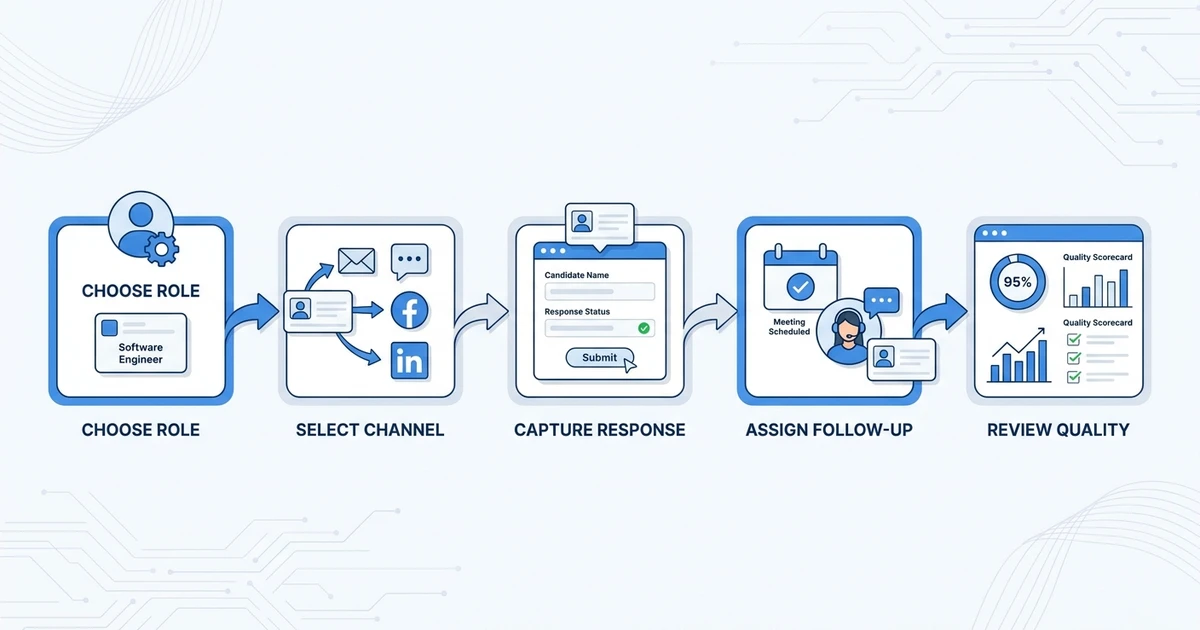
- Choose the problem. Decide whether you need more qualified applicants, better response from passive candidates, stronger employer context, or clearer source data.
- Write a role message. Include the work, location, schedule, compensation range where available, key requirements, and the reason the opportunity may suit the audience. Ask the client to confirm accuracy.
- Select one or two channels. Pick channels based on where relevant candidates are likely to see the role. Avoid spreading a small budget across too many places to learn anything.
- Create one capture path. Make it clear where an interested candidate should respond. Send responses to the recruiting workflow where someone owns the next step.
- Set follow-up responsibility. Name who will reply, how quickly, and what happens when the candidate is not a fit for this role but may suit another one.
- Review quality and friction. Look at qualified responses, candidate questions, drop-off points, and the time the team spends processing each channel.
- Keep or change one thing at a time. If you change the message, channel, and application form together, you may not know what improved the result.
A connected record matters. When a candidate replies to an ad or email, recruiters should know what the person saw, which role they asked about, and what conversation has already happened. That context prevents duplicate outreach and helps your team respond like people, not campaign software.
If you want job posting, candidate records, and follow-up activity connected to agency workflows, compare ATZ CRM’s job board integrations and automated recruitment email sequences against the steps your team repeats today.
How do you choose recruitment marketing tools without creating tool sprawl?
Make a short buying brief before demos. Describe the task, who owns it, what information enters the tool, where the result needs to go, and how you will judge whether it helps. Ask the vendor to demonstrate your workflow, not a generic tour.
Use this checklist:
- Audience fit: Does the tool reach the candidate group you need, in the geography where you recruit?
- Workflow fit: Does it support agency work across multiple clients, roles, and recruiters?
- Integration: Can it pass candidate, source, campaign, and response data to the system your team uses?
- Data ownership: Can you export records and history in a usable format if you leave?
- Permission and preference management: Can you respect opt-outs and contact preferences across connected tools?
- Measurement: Can you see downstream progress, not just activity inside the channel?
- Cost: Check seats, usage, media spend, implementation, support, and contract terms together.
- Adoption: Can the people who need it use it during a busy recruiting day?
One tool should own each important action. If your email platform sends the message, your recruiting system should still show that it happened. If a media platform reports an applicant source, recruiters should be able to preserve that source in the candidate record. Clear ownership reduces duplicate work and makes reports more useful.
Do not select software only because it uses AI. Ask what data it uses, which recommendations the recruiter can inspect, what the system does automatically, and how errors can be corrected. Any automation that contacts candidates should have clear rules, stop conditions, and a way for a person to take over.
Before signing, make the handoff test part of the evaluation. Pick one candidate response from a sample campaign and follow it from its source through the recruiter’s next action. Check whether the record keeps the role, channel, message, response, owner, and follow-up date together. Ask what happens if a person opts out, changes their contact preference, or is already in the database. A clean handoff is a practical sign that marketing activity can fit the agency’s recruiting process without creating a separate candidate history.
For each tool, name an internal owner and a review date. Someone should decide whether the campaign continues, what the numbers mean, and which changes are worth trying. This does not require a large analytics project: a short monthly review of a few comparable roles can reveal whether a channel attracts the right audience or only adds volume. Keep a note of changes to role criteria, message, or budget so the team does not confuse a new result with a proven channel effect.
Frequently Asked Questions
What are the top recruitment marketing tools for agencies?
The best choices depend on the work you need to improve. Agencies may compare job advertising, employer brand platforms, candidate nurture, email, social publishing, and source analytics, then keep only the tools that connect to their recruiting workflow.
Is an ATS a recruitment marketing tool?
An ATS is primarily designed to manage applicants and hiring stages. Some ATS products include job distribution, career pages, or candidate nurture, so check the specific capabilities rather than assuming that every ATS covers the full marketing process.
What is the difference between recruitment marketing software and an ATS?
Recruitment marketing software helps attract and engage potential candidates. An ATS organizes applications and hiring activity after someone enters the process. Some products combine these functions, but buyers should test how each part works.
Which recruitment marketing tools help with passive candidates?
Candidate relationship management and email nurture tools can help you keep an appropriate relationship with people who may not be looking today. Use relevant messages, maintain accurate preferences, and give candidates a clear way to stop receiving updates.
How should an agency compare recruitment marketing results?
Compare similar roles and channels using qualified responses, progression, candidate experience signals, and the effort required to follow up. Do not treat clicks or applications as proof that a channel produced a placement.
Conclusion
The right recruitment marketing stack is the one that solves a real funnel problem and preserves context for the recruiter who speaks with the candidate next. Choose channels by audience, then connect each response to a clear owner and a useful measure.
If your agency wants job posting, candidate records, and follow-up in one shared workflow, explore ATZ CRM and see how its recruiting tools can keep candidate attraction connected to day-to-day agency work.