EN
EN DE
DE ES
ES FR
FR NL
NL PT
PT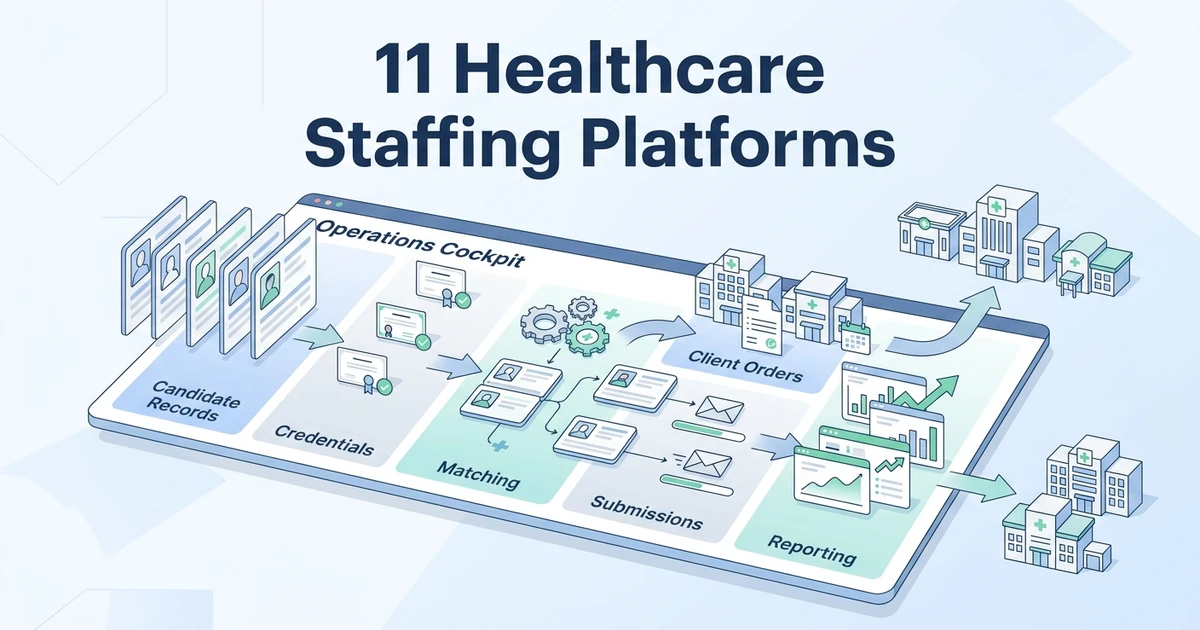



Quick Answer: The best healthcare staffing software helps agencies manage candidate records, credentials, job orders, client communication, matching, submissions, onboarding, and reporting without slowing recruiters down. For agencies that need a connected ATS plus CRM, the right choice should support healthcare recruiting workflows while keeping candidate and client context in one place.
TL;DR:
- ATZ CRM - Best overall for healthcare recruitment agencies that need ATS, CRM, matching, submissions, communication, and reporting
- Bullhorn - Best for enterprise staffing firms with complex workflows
- Avionte - Best for staffing teams that need front and back-office coverage
- CEIPAL - Best for firms that want ATS, CRM, and workforce management coverage
- JobDiva - Best for larger staffing teams with heavy database search needs
- LaborEdge - Best for healthcare staffing teams needing dedicated operational workflows
- ActivateStaff - Best for shift-heavy teams focused on mobile workforce engagement
- AkkenCloud - Best for staffing teams that want recruiting, CRM, and onboarding together
- TempWorks - Best for staffing firms that need operational and back-office depth
- Employdrive - Best for agencies prioritizing onboarding and credential support
- TrackerRMS - Best for staffing CRM teams that need recruiting and client workflows
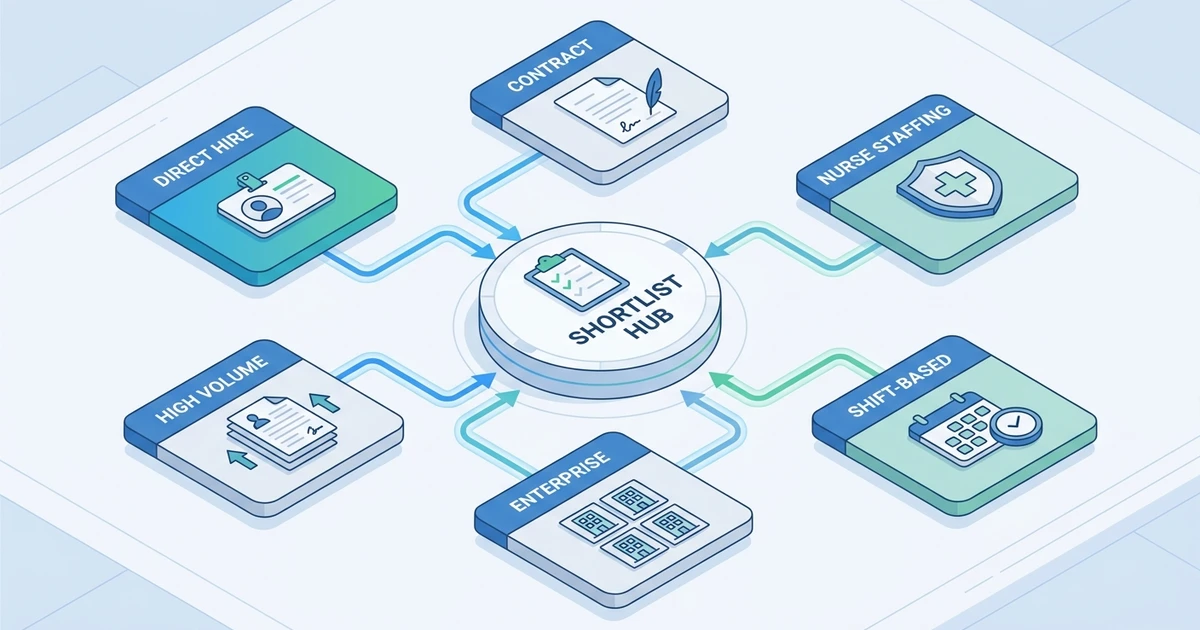
The best healthcare staffing platform depends on your placement model. Direct-hire medical recruiters usually need ATS plus CRM speed, while contract, per diem, and shift-heavy teams may need deeper credentialing, onboarding, scheduling, payroll, or VMS support.
Healthcare staffing agencies do not buy platforms for tidy dashboards. They buy them because open roles are urgent, credentials matter, clients expect speed, and candidates often move fast between opportunities.
This guide compares 11 options by healthcare workflow fit, ATS and CRM coverage, operational depth, pricing visibility, and when each type of agency should shortlist it.
Different healthcare staffing agencies need different software. A direct-hire medical recruiter does not work the same way as a per diem nurse staffing firm, and a regional agency does not need the same stack as an enterprise operation.
Healthcare demand keeps pressure on staffing operations. The U.S. Bureau of Labor Statistics projects healthcare occupations to grow much faster than average from 2024 to 2034, with about 1.9 million openings each year in its Occupational Outlook Handbook.
That pressure changes the buying decision. Your software has to help recruiters move quickly, but it also has to protect records, communication history, client requirements, and candidate trust.
What healthcare recruitment software needs to handle
Healthcare staffing software must handle more than jobs and resumes. It needs to support healthcare-specific data, time-sensitive communication, compliance-sensitive workflows, and recurring placement patterns.
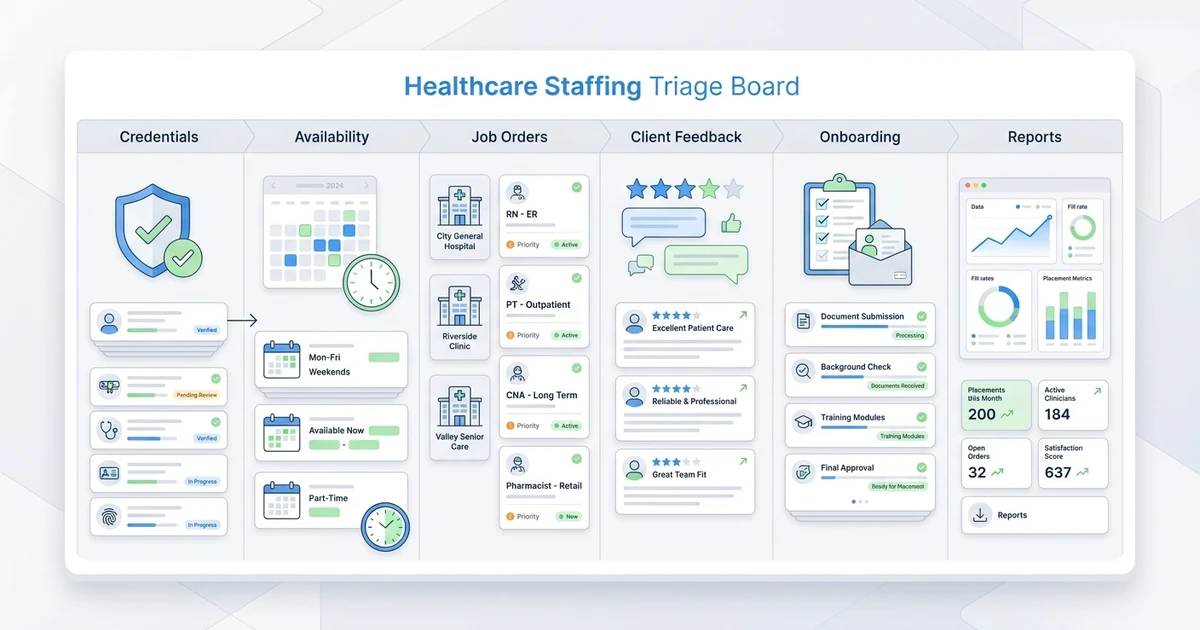
At minimum, compare tools against these needs:
- Candidate database and resume search.
- Healthcare skills, specialties, licenses, and credentials.
- Job orders, client facilities, and contact records.
- Availability, assignment, contract, or shift context.
- Candidate matching and shortlist creation.
- Email, SMS, LinkedIn, WhatsApp, or phone communication.
- Client submissions and feedback.
- Onboarding and document collection.
- Reporting for recruiter activity, pipeline, placements, and revenue.
Registered nurse employment is projected to grow 5% from 2024 to 2034, with about 189,100 openings each year according to the Bureau of Labor Statistics. Nurse recruitment software has to help teams manage repeat demand, candidate availability, and fast follow-up.
The best platform for your agency depends on where the work breaks. Some agencies need a better recruitment CRM. Others need credentialing, scheduling, payroll, VMS, or pay-and-bill depth. Many need a mix.
How to compare healthcare staffing agency software
Start by mapping your desk. Write down how a role enters the agency, how recruiters find candidates, how credentials are checked, how clients receive submissions, how candidates are onboarded, and how placements are reported.
Then score each tool against your actual workflow:
- Recruiting fit: Does it support candidate search, matching, outreach, submissions, and recruiter activity?
- Healthcare fit: Can it store specialties, credentials, license status, facility needs, and compliance-sensitive notes?
- Client workflow: Can your team manage healthcare clients, contacts, job orders, feedback, and relationship history?
- Operational fit: Do you need scheduling, payroll, time capture, onboarding, credentialing, or VMS support?
- Speed: Can recruiters move from search to outreach to submission without copying data?
- Reporting: Can managers see open roles, recruiter work, submissions, placements, and revenue trends?
- Implementation: How much cleanup, migration, training, and admin will the platform need?
- Pricing clarity: Can you estimate the real cost before signing a contract?
HRSA projects nationwide nursing shortages, including 108,960 registered nurses and 245,950 licensed practical nurses in its health workforce projections. Agencies competing in that market need systems that reduce recruiter drag.
Quick comparison of healthcare recruitment platforms
| Rank | Tool | Best fit | ATS/CRM | Healthcare workflow depth | Back-office/scheduling fit | Pricing visibility |
|---|---|---|---|---|---|---|
| 1 | ATZ CRM | Healthcare recruitment agencies | Yes | Strong recruiting workflow | Pair with specialist tools if needed | Public ATZ pricing |
| 2 | Bullhorn | Enterprise staffing | Yes | Strong staffing workflow | Strong ecosystem | Custom pricing |
| 3 | Avionte | Staffing operations | Yes | Staffing-focused | Strong back-office fit | Custom pricing |
| 4 | CEIPAL | Workforce staffing | Yes | Staffing and workforce workflows | Package dependent | Package dependent |
| 5 | JobDiva | High-volume staffing | Yes | Database-heavy staffing | Varies by setup | Custom pricing |
| 6 | TempWorks | Temp and contract staffing | Yes | Staffing operations | Strong back-office fit | Custom pricing |
| 7 | AkkenCloud | Staffing and onboarding | Yes | Staffing workflow | Back-office modules | Custom pricing |
| 8 | LaborEdge | Healthcare staffing operations | Yes | Healthcare-focused | Strong operational fit | Custom pricing |
| 9 | ActivateStaff | Shift-heavy staffing | Partial | Workforce engagement | Strong mobile and shift fit | Custom pricing |
| 10 | Vars Health | Healthcare staffing workflows | Yes | Healthcare-focused | Strong operational positioning | Custom pricing |
| 11 | TrackerRMS | Staffing CRM teams | Yes | Broad agency workflow | Varies by modules | Not publicly listed |
If your healthcare recruiters need candidate matching, client communication, submissions, and CRM visibility in one place, see how ATZ CRM supports healthcare recruitment workflows without enterprise bloat.
11 best medical staffing platforms for agencies
1. A connected ATS plus CRM for healthcare recruitment agencies
Tool reviewed: ATZ CRM.
Overview: ATZ CRM is an ATS plus CRM for recruitment agencies that need candidate records, job pipelines, client relationships, communication, submissions, reporting, and AI matching in one place. For healthcare recruiting teams, it is strongest when the core problem is recruiter speed and client visibility.
It can support medical staffing workflows where recruiters need to source candidates, match them to open roles, manage client communication, and keep candidate records clean.
Pros:
- Connects healthcare recruitment workflows with ATS and CRM activity.
- Supports ATS for healthcare staffing use cases.
- Helps agencies manage CRM for medical staffing agencies workflows.
- Includes AI candidate matching for faster shortlist creation.
- Public ATZ pricing starts at $12/user/month on annual billing.
Cons:
- Agencies that need deep payroll, VMS, or shift scheduling may need specialist operational tools.
- Credentialing workflows should be mapped during demo.
- Existing data quality affects migration success.
Pricing: ATZ CRM pricing is public. Plans start at $12/user/month on annual billing, with higher tiers adding deeper communication, automation, AI, portals, reporting, and support according to ATZ CRM pricing.
2. An enterprise staffing platform for complex operations
Tool reviewed: Bullhorn.
Overview: Bullhorn is a major staffing platform used by larger agencies and enterprise staffing firms. It fits healthcare staffing teams that need broad staffing workflows, implementation support, and ecosystem depth.
It is best suited to teams with complex operations, multiple desks, and resources to manage implementation and administration.
Pros:
- Strong enterprise staffing fit.
- Broad ecosystem and integration options.
- Useful for large teams with complex candidate and client workflows.
- Familiar to many staffing leaders.
Cons:
- Can be too heavy for small healthcare recruiting agencies.
- Implementation may require more time and admin ownership.
- Pricing usually requires a sales process.
Pricing: Pricing is generally custom. Ask about users, modules, implementation, support, marketplace tools, and operational add-ons.
3. A platform for staffing firms with front and back-office needs
Tool reviewed: Avionte.
Overview: Avionte is a staffing platform for agencies that need recruiting, onboarding, and back-office workflow support. It can fit healthcare staffing operations that need more than a lightweight ATS.
The strongest use case is operational staffing, where candidate management, onboarding, assignments, and office workflows need to connect.
Pros:
- Good fit for staffing operations.
- Supports front and back-office needs.
- Useful for agencies managing assignments and onboarding.
- Can fit temp and contract staffing models.
Cons:
- May be more operational than a direct-hire healthcare recruiter needs.
- Pricing is usually custom.
- Implementation and training should be planned carefully.
Pricing: Pricing is typically custom or sales-led. Confirm recruiting, onboarding, payroll, reporting, and integration costs during evaluation.
4. A workforce and staffing platform with healthcare use cases
Tool reviewed: CEIPAL.
Overview: CEIPAL supports ATS, CRM, workforce, and staffing workflows. It can fit healthcare staffing teams that want a broader platform for recruiting and workforce operations.
It is most relevant when your agency needs recruiting workflows plus operational visibility across candidates, clients, and assignments.
Pros:
- Covers recruiting and staffing workflows.
- Can support workforce-oriented operations.
- Useful for teams comparing ATS and CRM in one platform.
- May fit agencies with high-volume recruiting needs.
Cons:
- Feature breadth can create setup complexity.
- Pricing and packages need careful review.
- Recruiter adoption should be tested during demo.
Pricing: Pricing may depend on package, modules, and contract terms. Confirm current plans, implementation, and support details.
5. A high-volume staffing database for healthcare recruiters
Tool reviewed: JobDiva.
Overview: JobDiva is a staffing platform often considered by high-volume teams that need database search, automation, and staffing workflow support. It can fit healthcare recruiters managing large candidate pools and recurring demand.
Its value is strongest when your agency needs database reach and staffing process automation.
Pros:
- Strong candidate database orientation.
- Useful for high-volume staffing teams.
- Supports recruiting workflow automation.
- Can fit larger agencies with recurring role demand.
Cons:
- May be too much for smaller teams.
- Pricing is usually custom.
- User experience and workflow fit should be tested carefully.
Pricing: Pricing is usually quote based. Ask about users, database capacity, automation, integrations, implementation, and support.
6. A staffing operations platform for temp and contract teams
Tool reviewed: TempWorks.
Overview: TempWorks is built for staffing agencies that need operational workflow support around temp, contract, onboarding, payroll, and back-office processes. Healthcare staffing teams with shift or assignment-heavy models may consider it.
It is less about simple recruitment CRM and more about staffing operations.
Pros:
- Strong temp and contract staffing fit.
- Supports back-office staffing workflows.
- Useful when operational control matters as much as recruiting.
- Relevant for agencies managing assignments and time-sensitive staffing.
Cons:
- Direct-hire healthcare recruiters may not need the full operational stack.
- Pricing and setup are usually sales-led.
- Recruiting CRM experience should be evaluated against daily recruiter needs.
Pricing: Pricing is typically custom. Confirm modules, implementation, support, payroll, time capture, and integration requirements.
7. A recruiting and onboarding option for staffing agencies
Tool reviewed: AkkenCloud.
Overview: AkkenCloud supports staffing agency workflows across recruiting, CRM, onboarding, and operational modules. It can fit healthcare staffing teams that need candidate and client records with onboarding support.
It is a practical shortlist option when your agency wants one staffing platform rather than separate recruiting and onboarding tools.
Pros:
- Combines recruiting, CRM, and onboarding workflows.
- Useful for staffing agencies with operational needs.
- Can support candidate and client management.
- Relevant for contract or temp staffing teams.
Cons:
- May require process setup to avoid complexity.
- Pricing is generally custom.
- Interface and adoption should be tested with recruiters.
Pricing: Pricing is usually sales-led. Ask about recruiting, onboarding, back-office modules, users, and support.
8. A healthcare staffing platform for workforce operations
Tool reviewed: LaborEdge.
Overview: LaborEdge is built around healthcare workforce and staffing operations. It can fit agencies that need healthcare-specific workflows rather than a generic recruitment platform.
It is most relevant for teams that need credentialing, compliance, assignment, and healthcare staffing operations close to recruiting.
Pros:
- Healthcare staffing focus.
- Useful for compliance-sensitive workflows.
- Supports healthcare agency operations.
- Relevant for teams managing assignment complexity.
Cons:
- May be more operational than sales and recruiting teams need.
- Pricing visibility is limited.
- Agencies should compare recruiter CRM depth during demos.
Pricing: Pricing is generally custom. Confirm credentialing, onboarding, scheduling, integrations, and support scope.
9. A mobile-first workforce option for shift-heavy staffing
Tool reviewed: ActivateStaff.
Overview: ActivateStaff focuses on workforce engagement, job matching, mobile workflows, and shift-oriented staffing. It can fit healthcare agencies where candidate availability, communication, and mobile self-service matter.
It is most useful when the agency’s workflow centers on filling shifts and keeping workers engaged.
Pros:
- Strong mobile workforce engagement angle.
- Useful for shift-heavy staffing models.
- Helps candidates interact with jobs and availability.
- Relevant for high-speed staffing operations.
Cons:
- May not replace a full agency ATS plus CRM.
- Direct-hire healthcare recruiters may need less workforce tooling.
- Pricing is usually custom.
Pricing: Pricing is typically sales-led. Ask how worker volume, mobile workflows, matching, and integrations affect cost.
10. A healthcare staffing workflow platform for modern agencies
Tool reviewed: Vars Health.
Overview: Vars Health positions itself around healthcare staffing workflows, including recruitment, onboarding, scheduling, placements, payroll, and invoicing. It can fit agencies that want a healthcare-focused operating layer.
It is worth reviewing if your team wants healthcare-specific workflow depth across the candidate and operational lifecycle.
Pros:
- Healthcare staffing workflow focus.
- Covers a broad set of operational needs.
- Useful for agencies comparing end-to-end healthcare staffing platforms.
- Can support candidate, facility, placement, and back-office workflows.
Cons:
- Broad workflow coverage may require careful implementation.
- Pricing is usually custom.
- Agencies should check CRM and recruiter usability in detail.
Pricing: Pricing is generally custom. Confirm modules, implementation, support, data migration, scheduling, payroll, and invoicing scope.
11. A staffing CRM with healthcare agency workflow coverage
Tool reviewed: TrackerRMS.
Overview: TrackerRMS combines CRM, ATS, staffing workflows, and reporting. Healthcare staffing agencies may consider it when they want recruitment and sales activity connected.
It can fit teams that want a broad agency platform with CRM depth rather than a healthcare-only operational system.
Pros:
- ATS plus CRM workflow coverage.
- Useful for staffing and recruitment agencies.
- Supports candidate and client relationship management.
- Reporting can help managers track recruiting and sales activity.
Cons:
- Healthcare-specific depth depends on configuration.
- Pricing visibility may be limited.
- Agencies should test workflows for credentialing, onboarding, and shift needs.
Pricing: Pricing is commonly not publicly listed in a simple plan table. Confirm users, modules, implementation, integrations, and reporting needs.
How to choose software by healthcare staffing model
Your staffing model should decide the shortlist. A general “best software” list is only useful after you know what job the platform must do.
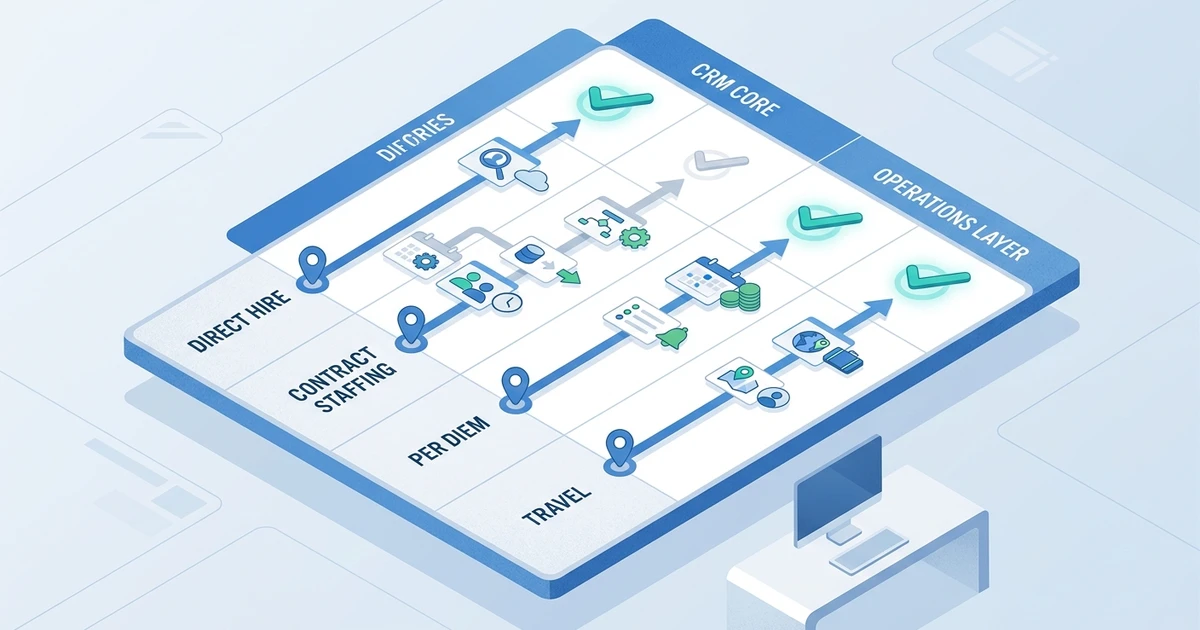
For direct-hire healthcare recruitment, prioritize:
- Candidate database search.
- AI matching.
- CRM and client communication.
- Submissions and feedback.
- Reporting by recruiter, source, client, and placement.
For contract staffing, prioritize:
- Availability and assignment context.
- Onboarding and document tracking.
- Client requirements.
- Communication speed.
- Reporting across active roles and placements.
For per diem, travel, or shift-heavy models, prioritize:
- Mobile worker engagement.
- Scheduling and availability.
- Credential visibility.
- Fast matching.
- Time, payroll, or operational integrations.
The AHA 2026 Health Care Workforce Scan highlights changing staffing models, AI foundations, engagement, and redefining workforce needs as core workforce strategy themes. Agencies should pick tools that match those operating realities, not just tools with the longest feature list.
Is ATZ CRM right for healthcare staffing agencies?
ATZ CRM is right for healthcare staffing agencies that need recruitment workflow, CRM visibility, candidate matching, communication, submissions, and reporting in one platform. It is especially useful when recruiters need to manage both candidates and healthcare clients from the same record system.
It fits agencies that want to move faster without buying a heavy enterprise suite. Recruiters can work across candidate search, job pipelines, client contacts, outreach, and submissions without losing context.
ATZ CRM may not cover every deep healthcare staffing operation on its own. If your team needs advanced payroll, VMS, credentialing, or shift scheduling, you may pair ATZ CRM with specialist tools or choose a back-office-first staffing platform.
For many agencies, the best setup is a connected recruitment core plus specialist operations where needed. That keeps recruiters focused on candidate and client momentum while the operational layer handles highly specific staffing requirements.
Frequently Asked Questions
What is healthcare recruitment software?
Healthcare recruitment software helps agencies manage healthcare candidates, client requirements, job orders, credentials, submissions, onboarding, scheduling, and reporting. The exact feature mix depends on whether the agency handles direct hire, contract, per diem, travel, or temp staffing.
Some tools focus on recruiting and CRM. Others focus on scheduling, payroll, credentialing, and operational workflows.
What is the best healthcare staffing software for agencies?
The best option depends on your agency model. ATZ CRM is a strong fit when you need ATS plus CRM, candidate matching, communication, submissions, client visibility, and reporting.
Enterprise or shift-heavy staffing firms may need platforms with deeper back-office, payroll, VMS, or scheduling support. The right choice should match your daily workflow, not just the category name.
What features should medical staffing software include?
It should include candidate search, healthcare specialties, credential visibility, job order management, client communication, outreach, submissions, onboarding, reporting, and migration support. Shift-heavy teams may also need availability, scheduling, time capture, and payroll workflows.
Ask vendors to demo a real healthcare role from intake to placement. That reveals more than a feature checklist.
Is healthcare recruitment software different from a normal ATS?
Yes. A normal ATS can track applicants and stages, but healthcare staffing often requires credential fields, compliance-sensitive notes, facility requirements, recurring placements, availability, and faster communication.
Healthcare agencies also need CRM depth because client relationships and repeat orders drive revenue. That is why ATS plus CRM coverage matters.
How much does medical staffing software cost?
Pricing varies by users, modules, implementation, integrations, support, worker volume, onboarding, scheduling, payroll, and contract terms. Many healthcare staffing platforms use custom pricing.
Compare software based on total cost, not only subscription price. A platform that needs fewer add-ons may be more affordable than one with a lower entry point but many required modules.
Conclusion
Healthcare staffing software should match the way your agency actually works. Direct-hire teams need a strong ATS plus CRM. Contract and temp teams may need deeper operational support. Shift-heavy agencies may need mobile workforce and scheduling workflows.
The best shortlist is the one that reflects your candidates, clients, compliance needs, and placement model.
Book a demo with ATZ CRM to see how your healthcare staffing team can manage ATS, CRM, AI matching, communication, reporting, and migration support in one recruitment workflow.