EN
 DE
 ES
 FR
 NL
 PT
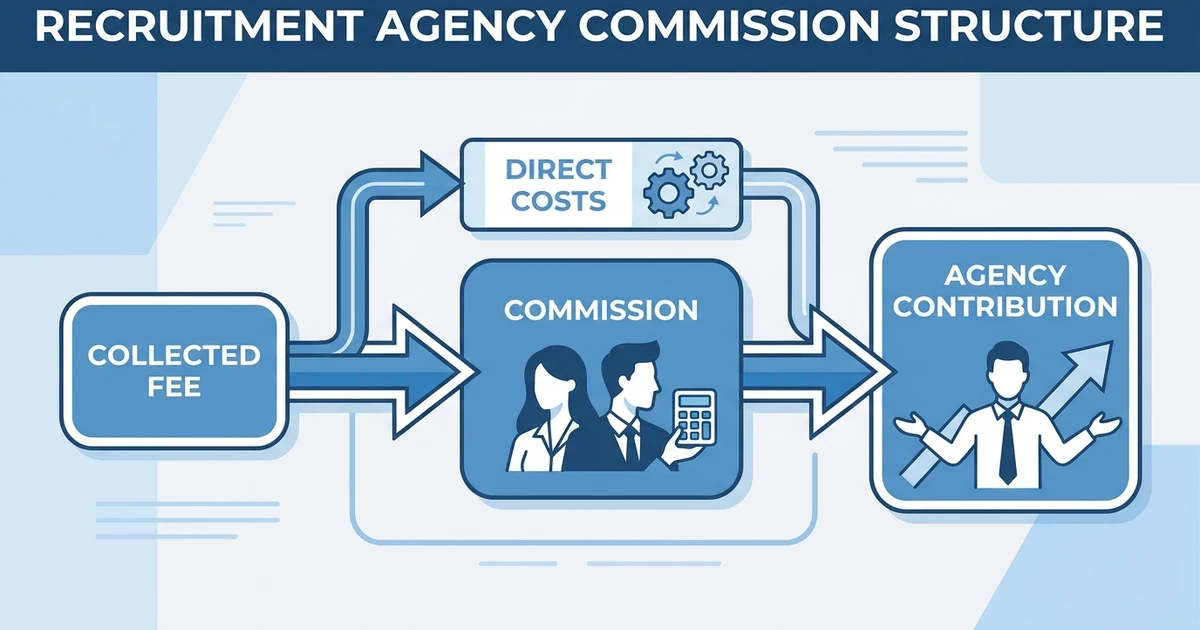


Quick Answer: A recruitment agency commission structure defines when commission is earned, which revenue or margin it uses, how contributors share credit, and when payment is made. The right plan depends on your desk model, costs, client terms, employment arrangements, and local rules, so compare the mechanics instead of copying a headline percentage.
A commission plan affects more than what an individual recruiter earns. It also determines when the agency pays, how shared work is recognized, and whether a placement remains financially workable after delivery costs.
This guide is for agency owners and team leaders reviewing compensation. It compares common plan mechanics and gives you a transparent way to model the numbers without assuming that one percentage fits every desk.
A placement fee is not the same as commissionable profit
A client fee, an invoice, cash collected, commissionable revenue, and contribution after direct costs are different measures. A plan should name the one it uses and explain how adjustments work. Otherwise, two people can look at the same placement and reasonably calculate different payouts.
The label “commission” can also hide important details. Does the recruiter earn it when the client signs, when a candidate starts, when the invoice is issued, or when the fee is collected? Does the amount change if the client receives a credit or the candidate leaves during a guarantee period? Put those rules in writing before a search begins.
A performance-related pay scheme also needs more than a formula. The Chartered Institute of Personnel and Development (CIPD) reports that 60% of surveyed UK organisations linked bonuses or basic pay to some assessment of performance. The survey covers employers broadly, not recruitment agencies specifically. Read CIPD’s 2024 findings on pay and performance. It also found that 39% did not link pay to performance for any employee, which shows that employers use different approaches. See the survey results and their scope.
What should a recruitment agency commission plan define?
Before choosing a rate, write the operating rules. A clear plan should answer:
- Eligibility: Which placements, services, or collected fees count?
- Commission base: Is the calculation based on invoiced fees, collected fees, gross margin, or another defined amount?
- Earning event: What must happen before commission is earned?
- Credit ownership: Who receives credit when several people contribute?
- Payout timing: When is commission calculated and paid?
- Adjustments: How do refunds, replacement guarantees, split invoices, or client disputes affect it?
- Plan changes: How are changes communicated and how are existing searches handled?
- Review process: Who answers questions and resolves calculation disputes?
Avoid relying on informal explanations or spreadsheet conventions that only one manager understands. If the plan uses tiers or thresholds, include worked examples showing how a payout changes immediately below and above each boundary.
Have the agreement reviewed for local employment and payroll rules. For U.S. employers, the Internal Revenue Service classifies commissions as supplemental wages and explains that federal withholding can depend on how a commission is identified and paid with regular wages. That guidance is specific to U.S. federal payroll; use the relevant authority for other locations. Check the IRS Employer’s Tax Guide for commission withholding rules.
Which recruitment agency commission structure fits each desk?
The model should match how work is sold and delivered. Compare the following structures by the behavior they reward and the rules you would need to document. These are design options, not a claim about what agencies typically pay.
| Model | How it can be defined | Useful question to test | Tradeoff to examine |
|---|---|---|---|
| Salary plus commission | A fixed salary with an additional payout tied to a defined result | Does the team understand what earns the variable amount? | Set clear earning and payment rules alongside fixed payroll commitments |
| Threshold or draw | Commission applies after an agreed threshold, or an advance is reconciled under written terms | Can a recruiter explain when the threshold is reached and how any draw is handled? | Terms can be confusing if recovery, timing, or shortfalls are not explicit |
| Tiered commission | Different payout levels apply to defined ranges of credited performance | Do the boundaries encourage sustainable work and remain easy to calculate? | A small boundary change can produce a large difference in payout expectations |
| Team pool | A defined pool is allocated across a team or desk | Which contributions count, and who approves the allocation? | Shared outcomes can make individual ownership less obvious |
| Split desk | Separate credit is assigned to specified parts of client and candidate delivery | Is the split agreed before people begin the search? | Unclear ownership can create disputes when contributions change |
A small agency may begin with a straightforward formula, while a multi-desk team may need written ownership rules and a review process. Do not choose complexity because it looks sophisticated. Choose the simplest plan that reflects the work you want to reward and that your team can verify.
At this point, an operations system may help you keep job, placement, owner, and invoice records together. ATZ CRM provides a placement management software for recruiters; its recruitment KPI dashboards and goal tracking can help review activity and outcomes. It does not replace a written compensation plan or payroll advice. Check the workflows against your own process before deciding whether they fit.
How should perm, retained, and contract placements be handled?
For permanent contingency work, decide whether the commission base is the agreed fee invoiced or cash received, and what happens if the client pays in installments or requests a replacement. The client agreement should use compatible language so the agency can explain the fee event and the staff payout event without contradiction.
For retained searches, define whether payment milestones change the timing of commission or only the final amount. For contract staffing, decide whether the plan uses a placement fee, a period’s collected gross margin, or another measure. Make clear how extensions, early endings, unpaid invoices, and shared account work affect credit.
Do not treat “perm,” “retained,” and “contract” as complete plan rules. Each label still leaves open when the fee is earned, how it is measured, and who qualifies for credit. Put those specifics into examples that match the agreements your agency signs.
How do you calculate commission without losing sight of margin?
The following numbers are illustrative only. They show how a plan’s base changes the payout; they are not market rates or a recommendation.
Assume a placement produces $20,000 in collected fees and has $2,000 in direct delivery costs. Leave base payroll, employer costs, overhead, refunds, and taxes out of this simplified example so the arithmetic is easy to inspect.
| Illustrative calculation | Fee-based plan | Margin-based plan |
|---|---|---|
| Collected fee | $20,000 | $20,000 |
| Direct delivery costs | $2,000 | $2,000 |
| Commission base | $20,000 collected fee | $18,000 after direct costs |
| Illustrative plan rate | 20% of fee | 25% of margin |
| Commission amount | $4,000 | $4,500 |
| Contribution after direct costs and commission | $14,000 | $13,500 |
The fee-based calculation is $20,000 × 20% = $4,000. The margin-based calculation is ($20,000 − $2,000) × 25% = $4,500. In both columns, contribution is what remains after the stated direct costs and commission, before other payroll costs, operating overhead, taxes, or adjustments.
The example does not tell you which rate or base to use. Substitute your own costs and plan terms, then test a lower-fee placement, a shared search, and a client payment delay. If a formula only works when every placement has the same economics, revisit the assumptions.
How should split-desk credit work when several people contribute?
Imagine one consultant opens the client relationship, another sources and screens the candidate, and a delivery coordinator manages interview logistics. The plan should say which contributions earn credit and how the agency records that decision. A percentage split can work only if the team understands the rule and knows who approves exceptions.
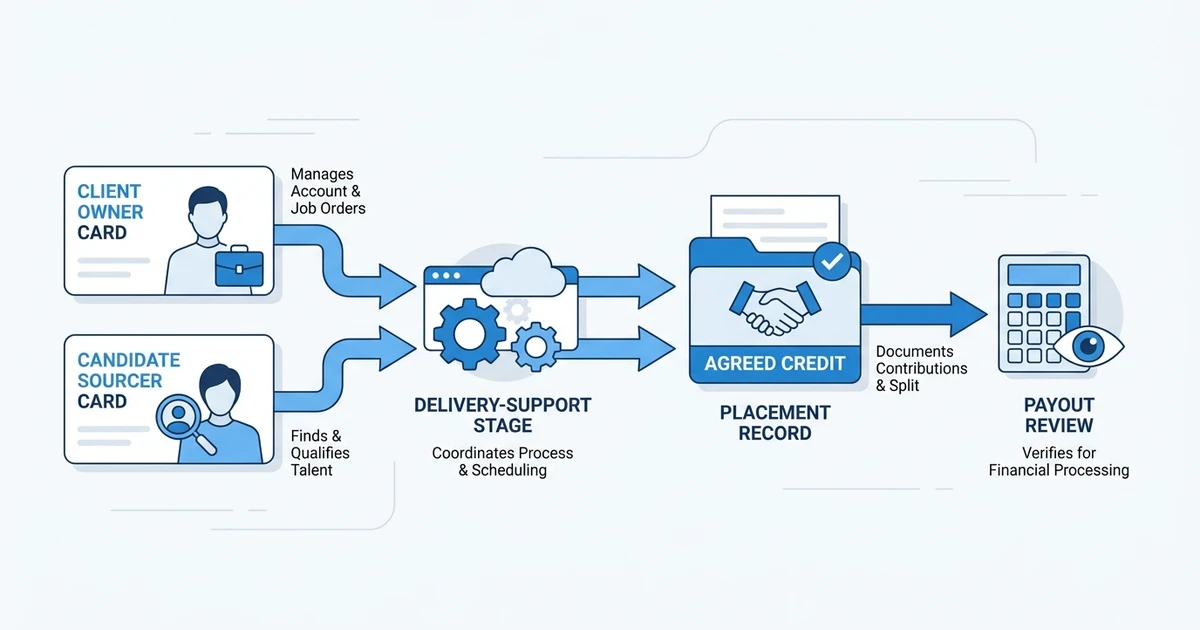
Decide when credit is set. Some teams may agree ownership before the search starts; others may document it when a candidate is submitted. Whichever point you choose, record changes when responsibilities shift and explain whether a handoff changes the split.
Test the rule against less tidy cases: a client returns with a second role, two recruiters submit candidates, a candidate comes from a shared database, or the original account owner leaves. If the plan cannot resolve the case without a private negotiation, tighten the written rule before the next placement.
How do you test a commission plan before rolling it out?
Back-test the formula using anonymized placements with different fee sizes, delivery costs, payment timing, and team contributions. Compare the proposed payouts with the agency’s actual client agreements and payroll process. Keep a record of the assumptions, especially where a contract or guarantee changes the calculation.
Then ask a few team members to calculate sample payouts without coaching. If they arrive at different answers, the plan needs clearer language or examples. Check how it behaves in a low-revenue period, how a late client payment affects the payout date, and how the agency will handle a disputed placement credit.
The CIPD’s reward guidance says variable-pay outcomes depend on factors such as goal design, the work being encouraged, perceived fairness, and how rewards are allocated. Treat communication and employee feedback as part of plan design, not an afterthought. Review CIPD guidance on reward and variable pay.
Frequently Asked Questions
What should a recruitment agency commission plan define?
It is a written policy defining when commission is earned, the calculation base, placement-credit rules, and payment timing. It should also explain adjustments and how the agency resolves questions about a payout.
Should recruitment commission be based on invoiced or collected fees?
Either can be used if the plan defines it clearly and the agency can administer it consistently. Consider the effect on cash timing, client terms, and employee expectations, then confirm the arrangement under applicable local rules.
How should a split-desk commission plan allocate credit?
Define which contributions count and when the split is decided. Test the rule against shared sourcing, repeat client roles, and handoffs so the team can understand how credit changes.
What commission rate should a recruitment agency pay?
There is no single rate that fits every agency. Model a proposed rate against your fee base, delivery costs, salaries, overhead, role mix, and client terms before putting it in writing.
Can a recruitment agency pay commission-only compensation?
This depends on local wage, employment, and contract rules. Ask a qualified adviser in the relevant jurisdiction before offering a commission-only arrangement.
How should a guarantee-period replacement affect commission?
Write down how a replacement, refund, or credit affects the client fee and the employee payout. Align the compensation policy with the client contract and have the terms reviewed for your location.
Conclusion: make the rules clear before the next placement
A commission plan works best when your team can see how the calculation follows from the client agreement, recorded contributions, and payment terms. Choose a model your agency can afford and administer, test it against real past scenarios, and write down how exceptions will be handled.
If your team needs a clearer view of job ownership and placement outcomes, explore whether ATZ CRM’s placement management software for recruiters and recruitment KPI and goal tracking features fit the way you work. Keep the compensation rules in your written plan and confirm payroll treatment with a qualified local adviser.