 EN
EN DE
DE ES
ES FR
FR NL
NL PT
PT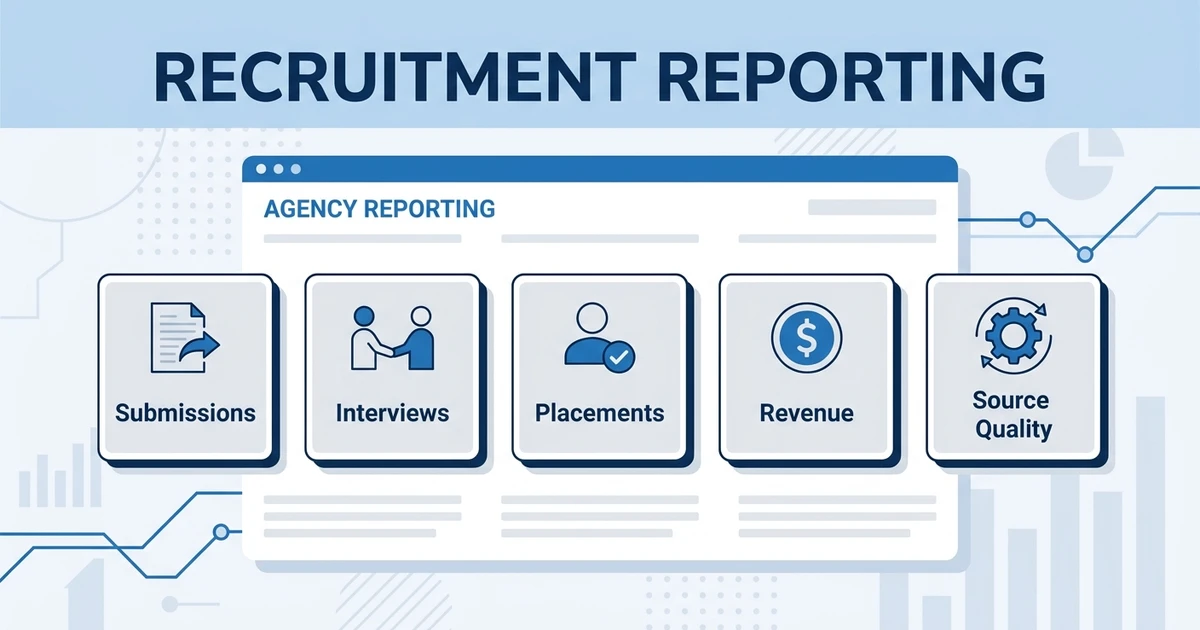





Quick Answer: Recruitment reporting helps agencies turn scattered work into a clearer operating rhythm. It gives recruiters, account managers, and leaders a shared way to see what happened, what should happen next, and where revenue or delivery risk is starting to build.
Recruitment reporting is easy to ignore when the desk is busy. Recruiters can still send emails, add candidates, chase clients, and move jobs forward without stopping to redesign the process. The problem is that growth exposes every weak handoff. A note that made sense to one recruiter becomes unclear to the next person. A client promise gets buried in an inbox. A candidate who should have been easy to rediscover disappears behind weak tags or duplicate records.
This guide explains how to build the workflow, what to track, which software capabilities matter, and how to keep the process useful for real agency work rather than turning it into another admin exercise. Agencies often have plenty of activity data but little clarity on which actions produce interviews, starts, placements, and revenue.
Why recruitment reporting should connect activity to revenue
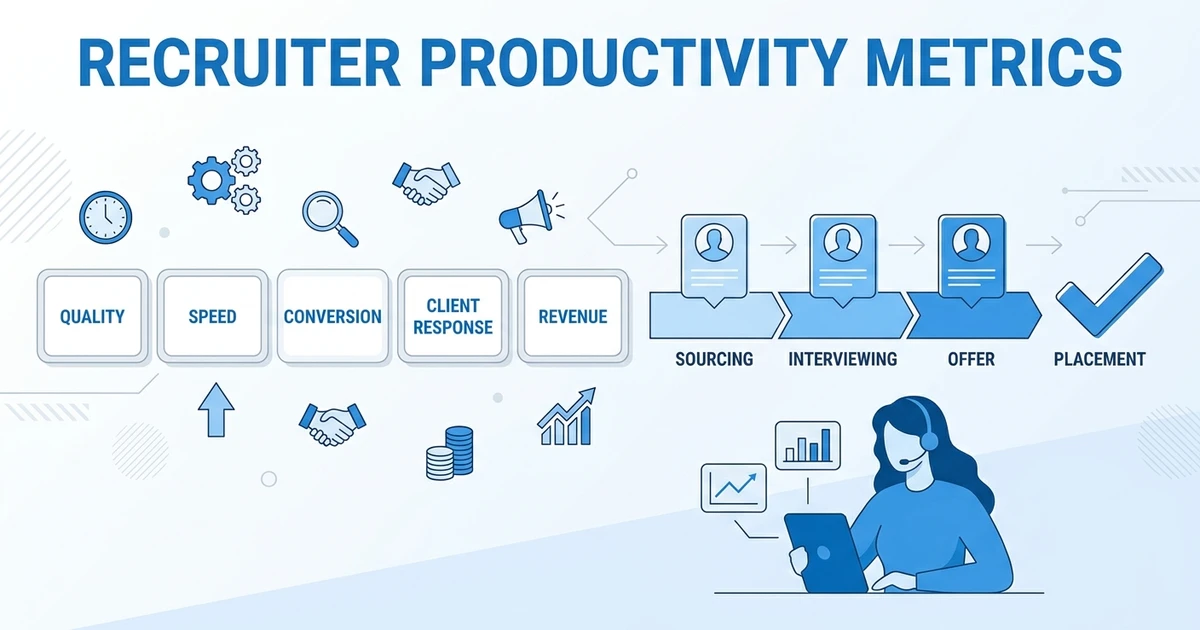
Reporting should not stop at calls made or resumes sent. Agency leaders need to see whether activity creates qualified candidates, client conversations, interviews, offers, placements, and revenue.
For agencies, the risk is rarely one dramatic failure. It is the slow accumulation of small gaps: a client conversation not logged, a candidate profile not updated, a job stage that means different things to different people, or a deal that stays open long after the buyer has gone quiet.
SHRM notes that recruiting teams are investing in AI and automation to improve candidate flow and reduce friction in the hiring process American Staffing Association staffing KPI guidance. That is useful context, but software only helps when the underlying workflow is clear enough for the team to follow.
A better process gives your agency three advantages:
- Recruiters spend less time rebuilding context before taking action
- Account managers can see client movement without chasing internal updates
- Leaders can coach from evidence instead of anecdotes
- Candidates and clients get a more consistent experience across the team
The aim is not to make every recruiter behave like an operations analyst. The aim is to make the right action easy at the right moment.
What agency reporting should include
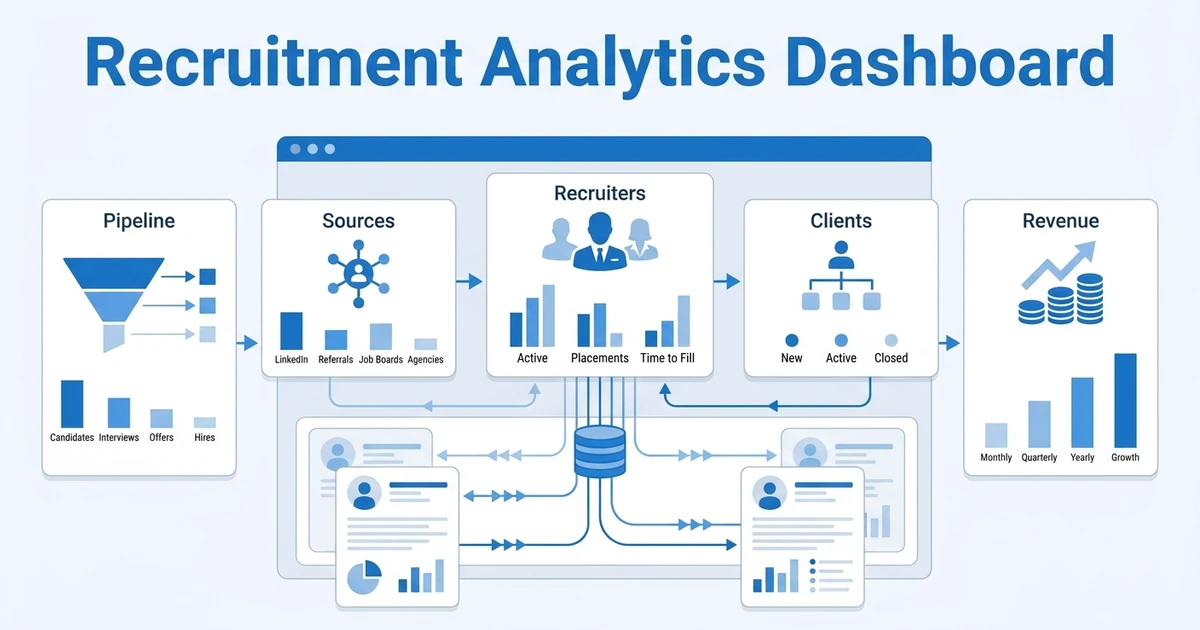
A useful reporting view connects sourcing, outreach, candidates added, submissions, interviews, offers, placements, client activity, deal movement, and recruiter goals.
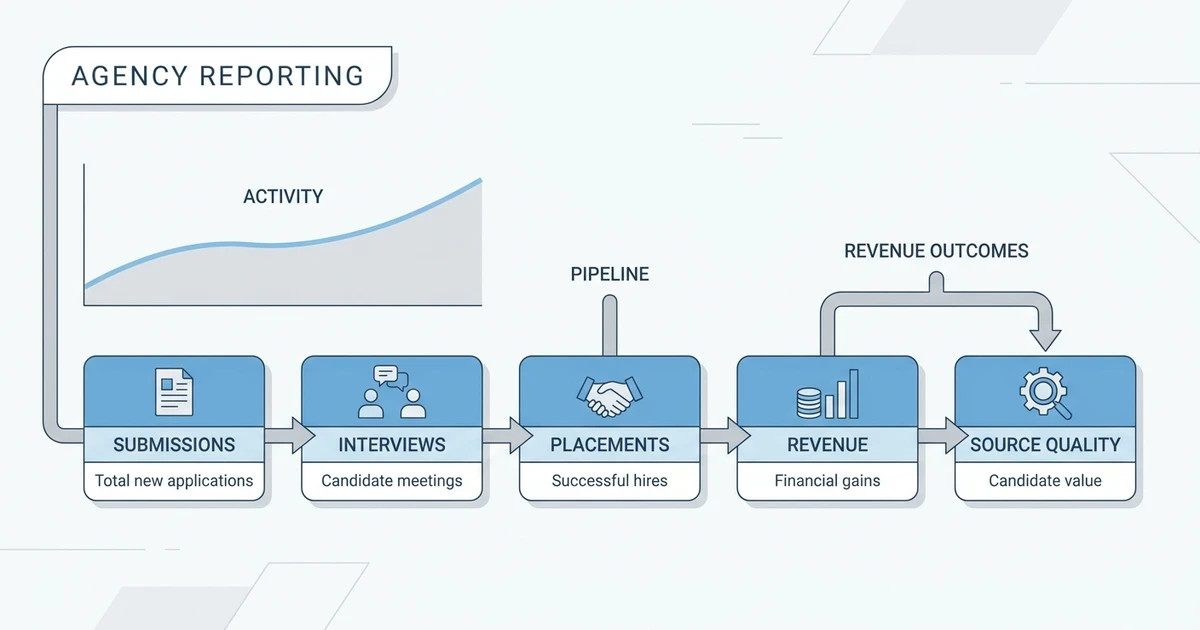
A useful setup starts with the records that drive agency revenue. Candidate records, client contacts, job orders, submissions, interviews, deals, and placements should not behave like separate filing cabinets. They should tell one story.
| Workflow area | Weak agency setup | Strong agency setup |
|---|---|---|
| Ownership | One person remembers the context | Records show owner, activity, and next action |
| Visibility | Updates live in inboxes or spreadsheets | Updates connect to candidates, clients, jobs, and revenue |
| Follow-up | Recruiters rely on memory | The system shows reminders, activity, and stalled work |
| Reporting | Leaders count activity after the fact | Leaders review movement, bottlenecks, and outcomes |
| Adoption | The process feels like extra admin | The workflow fits how recruiters already work |
This is where reports and dashboards becomes important. The page or feature you use should support the workflow directly, not force recruiters to jump into a separate tool every time the work moves forward.
Your team should be able to answer basic operational questions without a meeting:
- Who owns the next action?
- Which client, candidate, job, or deal does this activity belong to?
- What happened last?
- What is blocked?
- Which action would move the opportunity or search forward?
If those answers are hard to find, the agency does not have a reporting problem yet. It has a workflow visibility problem.
Where agency reporting becomes misleading
Reports become misleading when data is incomplete, stages are inconsistent, recruiters track work outside the system, or leaders focus on volume without reviewing quality.
Most teams do not choose messy workflows. Mess grows because recruiters are moving quickly and the system is slower than the desk. When the tool does not match the work, people create side channels.
The usual side channels are familiar: spreadsheets for priority lists, email folders for client history, private notes for candidate context, chat messages for urgent feedback, and duplicate records when search feels unreliable.
LinkedIn’s Future of Recruiting guidance argues that AI can elevate recruiters by helping them identify, assess, and hire in a skills-driven market SHRM guidance on recruiters as strategic talent advisors. That kind of improvement depends on data and process quality. If the records are disconnected, smarter tools have less useful context to work with.
The simplest diagnostic is to follow one real placement backward. Find the candidate, the source, the first outreach, the client job, the submitted profile, the feedback, the interview notes, the offer movement, and the final revenue outcome. If the story breaks in several places, the workflow needs attention.
How to build a reporting rhythm that teams trust
Use a small set of weekly reports, define each metric, review exceptions, and connect coaching to pipeline movement rather than public scorekeeping.
A practical rollout starts small. Pick the highest-friction workflow, define the minimum information needed, and make that information easier to capture inside the system than outside it.
Use this sequence:
- Define the moment that starts the workflow
Decide what action creates the record. It might be a new job order, a sourced candidate, a client reply, a submitted profile, or a sales opportunity.
- Set required fields only where they protect quality
Too many required fields slow recruiters down. Require the fields that protect ownership, follow-up, reporting, or compliance, then let optional detail live in notes.
- Attach the workflow to existing recruiter behavior
If recruiters already work from candidate, client, and job records, add the next step there. Do not send them to a separate tracker unless there is no other option.
- Create a visible next action
Every active record should show what happens next, who owns it, and when it should happen. Without that, the workflow is only a history log.
- Review exceptions weekly
Look for records with no next action, stale stages, missing owners, duplicate entries, and activity happening outside the tool. Exceptions show where the process is too heavy or unclear.
Agencies that want a more connected operating model should also review recruitment KPI and goal tracking and team goal tracking because the strongest workflows usually connect candidate delivery with client relationship management.
What to look for in reporting software
Look for dashboards that combine ATS and CRM data, recruiter goals, source quality, client movement, submissions, interviews, placements, and revenue forecasting.
Do not evaluate software only by feature lists. Evaluate whether the system makes the desired behavior natural. A tool can have every checkbox and still fail if recruiters need six clicks to complete the action they perform all day.
Strong agency software should give you:
- Connected ATS and CRM records
- Searchable activity history
- Clear owners and next actions
- Role-based permissions
- Templates that reduce repetitive typing
- Automation that supports follow-up without hiding context
- Reporting that connects activity to outcomes
- Easy export and migration support
The American Staffing Association describes a practical path where candidate conversations lead to client submissions, submissions lead to interviews, interviews lead to starts, and starts create gross profit LinkedIn Future of Recruiting guidance. The point for agencies is simple: the system should show movement across that path, not only store contact details.
For adjacent education, this related ATZ guide is useful: recruitment analytics dashboard guide.
How a connected platform supports agency reporting
The platform connects recruiter activity, candidate movement, client relationships, submissions, placements, and revenue dashboards so leaders can coach with better context.
The benefit of ATZ CRM is that agency teams can keep candidates, clients, jobs, activities, submissions, and reporting in one connected workspace. That matters when your team needs speed but cannot afford to lose the context behind the speed.
A recruiter should not have to ask three teammates what happened before contacting a client. A manager should not have to export several spreadsheets to understand pipeline health. A founder should not have to guess which part of the desk is creating revenue and which part is just creating noise.
ATZ CRM helps agencies bring those signals closer together through recruitment KPI calculator and connected recruitment workflows. The practical result is cleaner handoffs, better visibility, and fewer decisions made from incomplete information.
Frequently Asked Questions
What is recruitment reporting?
Recruitment reporting is the process of tracking hiring and agency performance metrics across candidates, clients, jobs, recruiter activity, submissions, interviews, offers, and placements.
Why does reporting matter for agencies?
It helps leaders understand where pipeline movement is strong, where work is stuck, and which activities are connected to revenue.
Which recruitment reports should agencies review weekly?
Agencies should review candidate pipeline, client activity, submissions, interviews, offers, placements, source quality, and recruiter goal progress.
How can reporting improve recruiter coaching?
Reporting helps managers coach around specific bottlenecks instead of vague performance concerns. A recruiter may need better sourcing, stronger qualification, or faster follow-up depending on the data.
What makes reporting unreliable?
Unreliable reporting usually comes from inconsistent stages, missing activity data, duplicate records, unclear definitions, and work tracked outside the ATS or CRM.
Conclusion
This workflow is not about adding process for the sake of process. It is about helping recruiters, account managers, and leaders see the same reality before the work drifts into inboxes, spreadsheets, and memory.
When the workflow is clear, your team can move faster with less cleanup. Recruiters know what to do next, clients get better follow-up, candidates receive more consistent communication, and leaders can see which actions are creating outcomes.
If your agency is ready to tighten this workflow, book a demo of ATZ CRM and see how connected ATS + CRM workflows help teams manage candidates, clients, jobs, and revenue from one place.
A final implementation note: treat the first version as a working operating rhythm, not a permanent rulebook. The team should review what recruiters actually use, where they still create side trackers, and which required fields create friction. Good systems become stronger when leaders listen to the people using them every day, especially when the desk is busy and shortcuts are most tempting.
That review should be practical. Ask which information helped someone make a better decision, which fields were ignored, which reminders prevented a missed follow-up, and which reports changed coaching conversations. Keep the parts that support action and remove the parts that only look tidy in theory. This is how the workflow earns trust instead of becoming another checklist, and it gives leaders a calmer way to improve the desk without interrupting live client work.
If adoption still feels uneven, review the workflow with one live candidate, one live client, and one active job order on screen. That keeps the conversation grounded. Recruiters can point to the exact moment where the process helps or slows them down, and leaders can adjust the system based on evidence rather than preference. The best agency workflows are simple enough for daily use and structured enough to survive growth. That balance is where software starts to feel useful.
For larger teams, assign one owner to maintain the workflow and one reviewer from the recruiting desk to challenge it. Operations can protect consistency, but recruiters protect reality. When both voices are involved, the process is less likely to become a management artifact and more likely to reflect the pressure of live searches, client changes, candidate movement, and revenue targets. That is the standard every agency workflow should meet.