 EN
EN DE
DE ES
ES FR
FR NL
NL PT
PT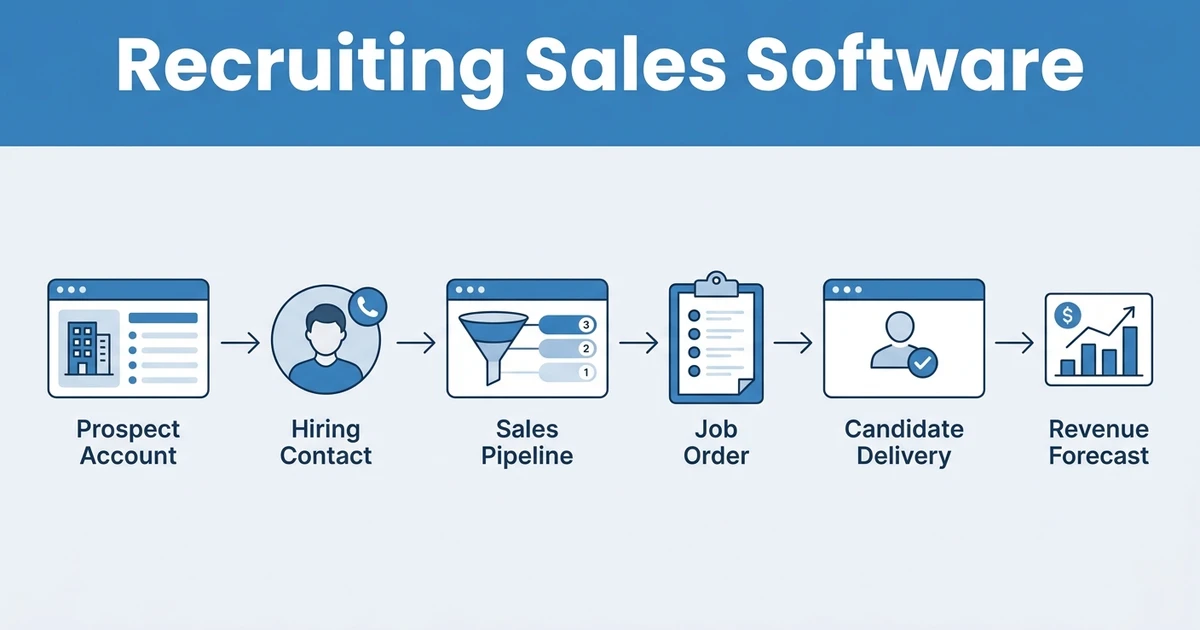



Quick Answer: Staffing and recruiting sales software helps agencies manage client acquisition, hiring contacts, sales pipelines, job orders, follow-ups, and revenue forecasting in one system. The best option connects sales activity with recruiting delivery, so a won job order can move directly into candidate sourcing, submissions, placements, and reporting.
If your recruitment agency is growing, your sales process cannot live in scattered inboxes, spreadsheet tabs, and personal reminders. You need a system that shows which accounts are warm, which hiring contacts need follow-up, which job orders are close to landing, and which deals are likely to become placement revenue.
That is where agency sales software becomes different from a normal CRM. A normal CRM helps you manage sales conversations. Agency sales software helps you manage the full path from prospect account to job order, candidate delivery, placement, and repeat client revenue.
What Is Staffing and Recruiting Sales Software?
Staffing and recruiting sales software is a commercial workflow system for recruitment agencies. It helps your team manage target accounts, hiring contacts, outreach, discovery calls, job orders, sales pipelines, client follow-ups, and forecasted revenue.
The important part is the agency context. Your team is not selling a one-time SaaS subscription or a generic service package. You are winning hiring work, qualifying job orders, moving candidates through delivery, and turning successful placements into repeat business.
A good system should answer practical questions every day:
- Which target accounts are showing hiring intent?
- Which contacts need follow-up this week?
- Which opportunities are likely to become job orders?
- Which job orders have enough candidate coverage?
- Which clients are creating the most placement revenue?
- Which sources and sales activities are producing real business?
The market is large enough that this discipline matters. The American Staffing Association says staffing provided job and career opportunities for about 11 million employees in 2024, and nearly 2.2 million temporary and contract employees worked for America’s staffing companies during an average week in 2024 according to its staffing industry statistics.
That volume creates pressure. When your team handles many clients, roles, candidates, submissions, and follow-ups, loose sales tracking quickly becomes a revenue problem.
Why Generic Sales CRMs Break for Recruitment Agencies
Generic sales CRMs are useful at the beginning. They can store companies, contacts, deals, tasks, notes, and calls. If you are a solo recruiter with a small prospect list, that may be enough for a while.
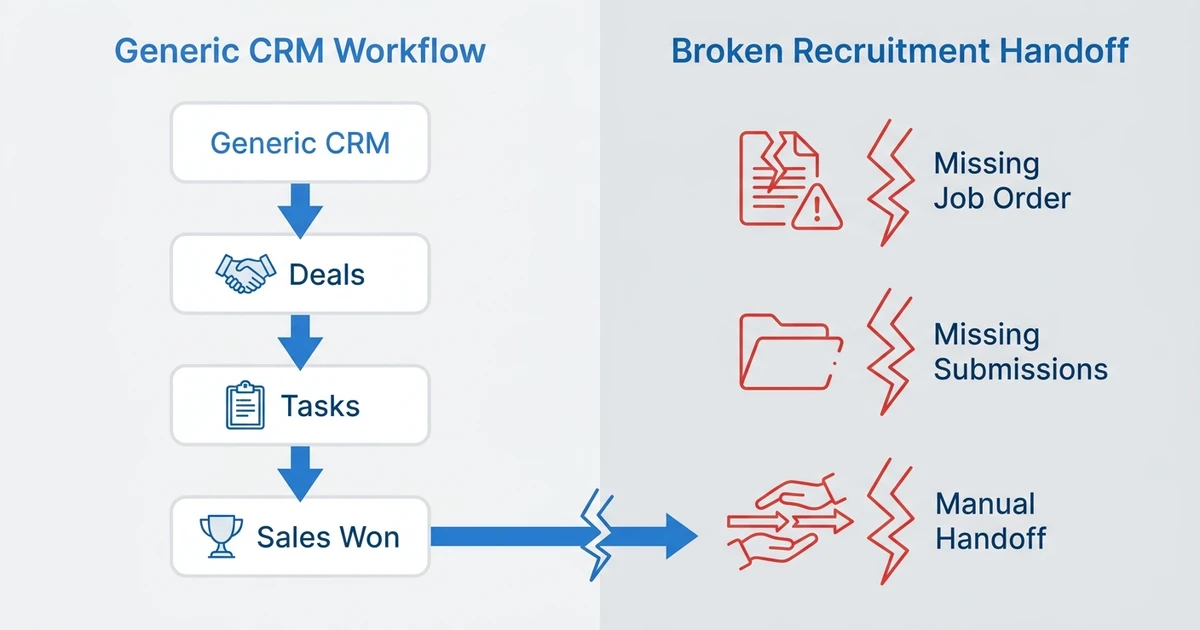
The problem starts when the sale turns into delivery. A generic CRM may show that a deal is won, but it usually does not know what happens after the client gives you a job order.
For a recruitment agency, the real workflow looks like this:
| Workflow area | Generic sales CRM | Recruiting sales software |
|---|---|---|
| Client contacts | Stores contacts and notes | Connects contacts to roles, submissions, feedback, and revenue |
| Sales pipeline | Tracks deals and stages | Tracks opportunities, job orders, and client hiring demand |
| Follow-ups | Manages tasks and reminders | Connects follow-ups to account history, open roles, and candidate activity |
| Delivery handoff | Often manual | Moves job context into recruiting workflows |
| Reporting | Sales activity and deal value | Sales activity, job order movement, submissions, placements, and forecasted revenue |
This is why many agencies outgrow generic CRM setups. The sales team can see the opportunity, but recruiters cannot see the full context. Recruiters can see candidates, but sales leaders cannot see whether delivery is supporting the forecast.
The handoff becomes messy. A BD rep wins a role, sends notes in Slack or email, and the recruiter rebuilds the brief manually. If anything is missed, the client experience suffers before the search even starts.
Staffing Sales Software vs Recruitment CRM vs ATS
The terms can blur, so it helps to separate them by workflow. Sales software, CRM, ATS, and unified ATS plus CRM platforms can overlap, but they are not the same thing.
| Software type | What it manages | Best for | Where it falls short |
|---|---|---|---|
| Generic sales CRM | Companies, contacts, deals, tasks, sales reporting | Early-stage business development | Weak on job orders, candidate delivery, submissions, and placements |
| ATS-only platform | Jobs, candidates, applications, interviews | Recruiting delivery | Weak on client acquisition, sales pipeline, and revenue forecasting |
| Recruitment CRM | Clients, contacts, candidates, relationships, outreach | Relationship-led recruiting teams | May still require a separate ATS if delivery is not deep enough |
| Unified ATS + CRM | Client sales, job orders, candidates, submissions, placements, reporting | Staffing and recruiting agencies that need sales and delivery together | Requires team adoption across both BD and recruiting |
The right choice depends on what you are trying to fix. If your only problem is remembering follow-ups, a simple CRM may work. If your bigger problem is connecting won business to live delivery, you need an agency-specific system.
This is why recruitment CRM features matter more for agencies than generic deal tracking. Your sales pipeline should not end at “closed won.” It should create the job order, inform delivery, and keep revenue visible.
Key Features to Look For in Recruiting Sales Software
The best recruitment agency sales software should help your team sell, deliver, and forecast from one shared view. It should reduce admin without hiding the details that make agency work different.
Start with these core features:
- Client and contact records with full relationship history
- Custom sales pipeline stages for agency business development
- Job order tracking connected to client opportunities
- Outreach sequences, reminders, and follow-up tasks
- Email, calendar, calling, SMS, and meeting activity logging
- Candidate submission visibility for account managers
- Client feedback and collaboration workflows
- Candidate and client source tracking
- Revenue forecasting by client, role, recruiter, and source
- Reporting dashboards for BD and delivery leaders
- AI support for meeting notes, call summaries, matching, and follow-up
- Clean import and migration from spreadsheets or old systems
Do not evaluate features as a checklist only. Evaluate the path between them. A sales pipeline is more useful when it can turn into a job order. A job order is more useful when it can trigger candidate sourcing. Reporting is more useful when it connects sales activity to placement outcomes.
AI is also becoming part of the buying decision. SHRM reports that 43% of organizations now use AI in HR tasks, up from 26% in 2024; it also reports that 51% use AI to support recruiting, and 89% of HR professionals whose organizations use AI for recruiting say it saves time or increases efficiency according to its 2025 Talent Trends research.
For agencies, that does not mean replacing recruiters. It means your sales and delivery data needs to be clean enough for AI to help with notes, outreach, matching, and pipeline prioritization.
The Best Sales Workflow for Staffing and Recruiting Agencies
A strong sales workflow is simple enough for your team to follow every day and detailed enough for leaders to forecast revenue. It should show where every client opportunity stands and what needs to happen next.
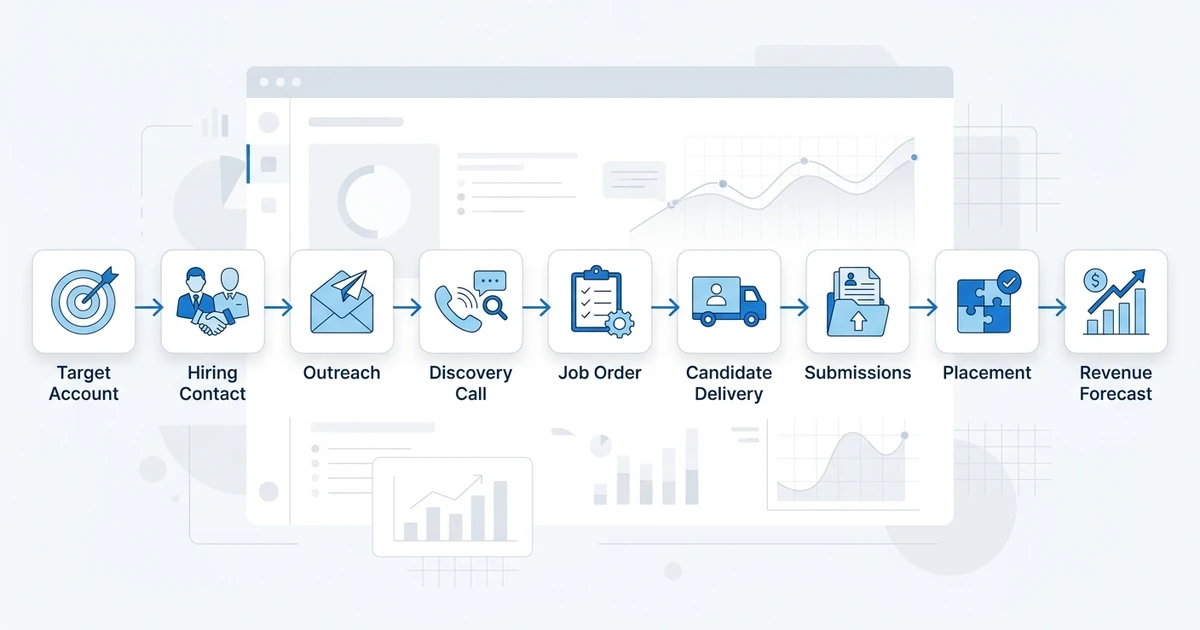
Use this as a practical model:
- Target account identified
- Hiring contact added or enriched
- Outreach sequence started
- Reply or discovery call logged
- Opportunity qualified
- Job order created
- Candidate delivery begins
- Submissions and feedback tracked
- Placement or revenue forecast updated
- Account moved to nurture, reactivation, or expansion
The workflow should not depend on one person’s memory. If a sales rep is out for a day, another team member should still know the account history, current need, last contact, open job order, delivery status, and next action.
This is also where sales and recruiting need shared language. A “qualified opportunity” should mean the same thing to BD and delivery. A “job order” should have enough detail for recruiters to act. A “hot account” should have a next step, not just a feeling.
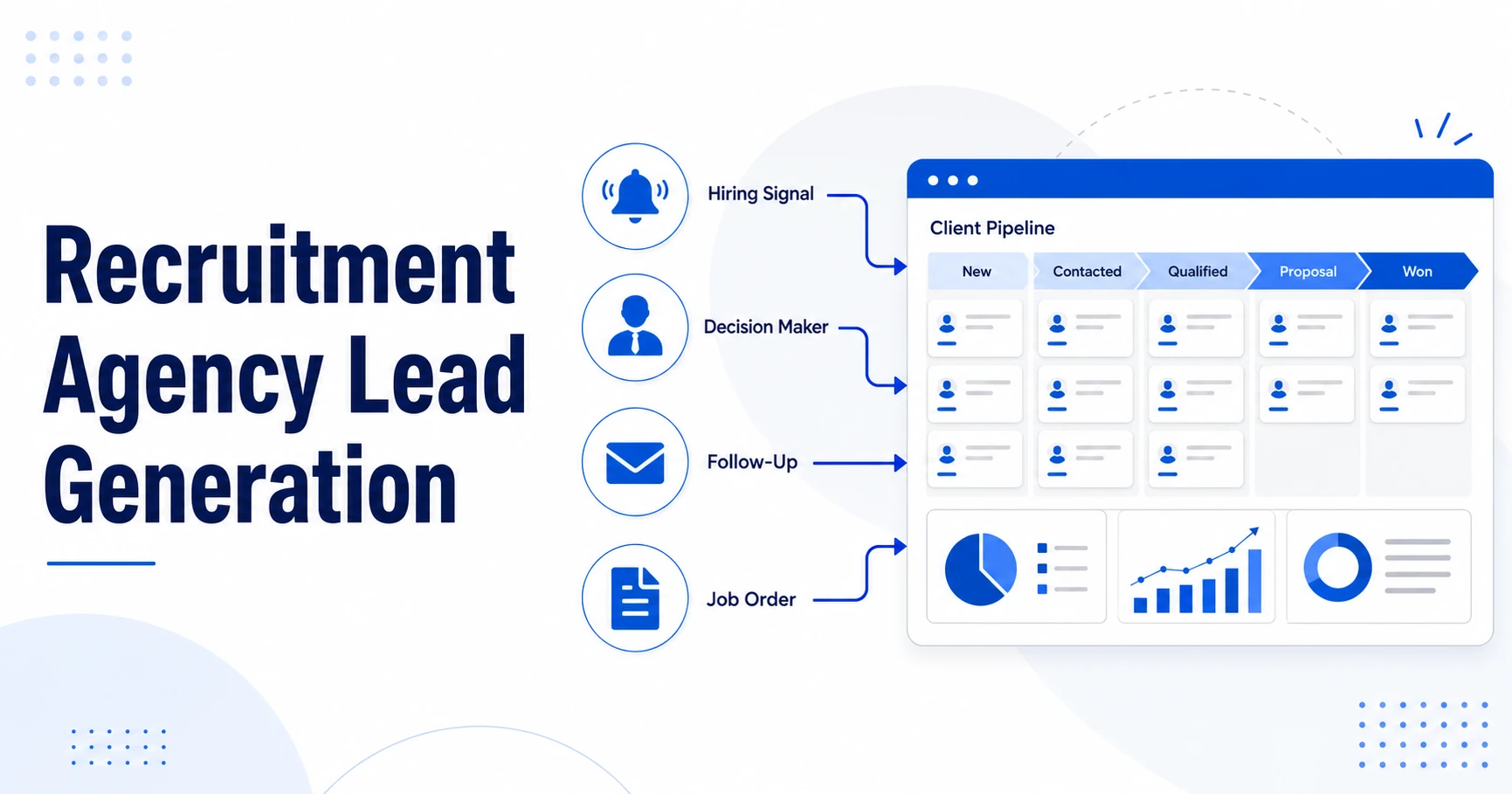
If your team already has lead sources and prospecting tactics, connect them to recruitment agency lead generation workflows. The goal is not more activity for its own sake. The goal is more qualified conversations that become job orders your team can actually fill.
How ATZ CRM Supports Staffing and Recruiting Sales Teams
ATZ CRM supports staffing and recruiting sales teams by connecting client development with recruiting delivery. Your team can manage prospects, contacts, deals, job orders, candidates, submissions, communication, and reporting without forcing sales and recruiting into separate systems.
That matters because recruitment sales is only valuable when delivery can follow through. A client conversation should not disappear into a notes field. It should connect to the company record, hiring contact, opportunity, job order, candidate pipeline, submissions, feedback, and placement outcome.
ATZ CRM gives agencies the core sales workflow pieces in one workspace:
- Recruitment-specific client CRM
- Custom sales pipelines and deal tracking
- Job order management
- Outreach sequences and follow-up reminders
- AI meeting notes and call intelligence
- Candidate sourcing and AI matching
- Client portal workflows
- Reporting and dashboards
- Revenue and placement visibility
- Migration support for existing data
The stronger point is the connection between those pieces. Your BD team can qualify demand, your recruiters can see delivery context, and your managers can review pipeline health without rebuilding reports manually.
If your sales pipeline and candidate delivery live in separate systems, use ATZ CRM to test a connected workflow from prospect account to placement revenue. Review ATZ CRM pricing or request an ATZ CRM demo to compare it against your current CRM plus ATS stack.
When a Generic CRM Is Enough, and When It Is Not
A generic CRM can be enough if your sales process is still light. If you are a solo recruiter with a short list of prospects, a few warm contacts, and no delivery team, simple contact and deal tracking can work.
It may also work if your agency uses a separate ATS and only wants a basic client address book. In that case, the cost of changing systems may not be worth it yet.
But a generic CRM becomes risky when your agency needs to manage:
- Multiple BD reps or recruiters
- Many hiring contacts across client accounts
- Repeated job orders from the same company
- Sales-to-delivery handoffs
- Candidate submissions tied to client opportunities
- Placement revenue by source, recruiter, and client
- Forecasting across active and likely job orders
The warning sign is workaround growth. If your team needs a CRM for contacts, an ATS for candidates, a spreadsheet for job orders, a doc for client notes, and another sheet for forecasting, the system is not really cheaper. It is just hiding cost in admin time.
This is where staffing agency software becomes more practical than generic sales software. Staffing agencies need sales context and recruiting context in the same operating rhythm.
How to Evaluate Recruiting Sales Software Before You Buy
Do not evaluate software only from a demo script. Test it with your real agency workflow. Pick one active prospect, one existing client, one job order, and one placed candidate, then see whether the system can connect the story.
Ask these questions during evaluation:
- Can we import companies, contacts, candidates, jobs, and notes cleanly?
- Can our sales stages match how we actually win business?
- Can a won opportunity become a job order without duplicate entry?
- Can recruiters see client context before sourcing?
- Can account managers see submissions and client feedback?
- Can managers report on sales activity, job orders, placements, and revenue?
- Can we forecast likely revenue without rebuilding spreadsheets?
- Can the team use it daily without heavy admin?
Also check whether the software supports your market. US and UK agencies often need clean email and calendar sync, strong data privacy practices, fast support, client communication history, and reporting that separates activity from revenue movement.
LinkedIn’s Future of Recruiting 2025 research surveyed 1,271 recruiting professionals in management roles or higher, including 252 search and staffing professionals, across 23 countries in September 2024 according to its survey methodology. That global lens matters because agency workflows vary, but the need for clear recruiter productivity and relationship data is consistent.
Is ATZ CRM Right for Your Agency?
ATZ CRM is a strong fit if your agency wants one system for sales and delivery. It is especially relevant when you are replacing spreadsheets, outgrowing a generic CRM, or trying to connect client development with candidate pipelines.
It is also a good fit if you want an affordable, recruitment-specific system without enterprise complexity. ATZ CRM includes ATS, CRM, AI matching, outreach, job posting, client workflows, reporting, and migration support in one platform.
You should consider ATZ CRM if:
- You want client CRM and ATS in one workspace
- You need sales pipeline and job order visibility
- You want recruiters and BD reps working from shared records
- You need reporting across client activity and placement outcomes
- You want AI and automation built around agency workflows
- You want a free-start path before committing fully
It may not be the first choice if you only need a basic address book, if you do not manage candidates, or if your team wants a generic sales CRM with no recruiting workflow attached.
For agencies that care about revenue discipline, the bigger question is simple: can your current setup show the path from first client touch to placed candidate and forecasted revenue? If not, the software gap is already affecting growth.
Frequently Asked Questions
What is staffing and recruiting sales software?
This software helps agencies manage client acquisition, hiring contacts, sales pipelines, job orders, follow-ups, and revenue forecasting. Unlike a generic CRM, it should connect sales activity with recruiting delivery so your team can move from client demand to candidate submissions and placements.
What is the difference between recruiting sales software and a CRM?
A CRM usually manages companies, contacts, deals, tasks, and communication history. Recruiting sales software includes those basics, but adds agency-specific workflows such as job orders, candidate submissions, client feedback, placements, and revenue reporting.
Can staffing agencies use a generic CRM?
Yes, a staffing agency can use a generic CRM when the team is small and only needs contact tracking or simple deal management. It becomes limiting when you need job order tracking, candidate delivery visibility, placement reporting, and sales-to-recruiting handoff in the same system.
What features should recruitment agency sales software include?
Recruitment agency sales software should include client records, hiring contacts, sales pipelines, job orders, follow-up reminders, outreach sequences, activity logging, reporting, and revenue forecasting. It should also connect to candidate workflows so sales and delivery teams do not work from separate versions of the truth.
How does sales software help staffing agencies win more clients?
Sales software helps staffing agencies win more clients by making prospecting, follow-up, account ownership, and job order movement visible. Managers can see which activities create qualified conversations, which conversations become job orders, and which job orders turn into placement revenue.
Does ATZ CRM include sales pipeline and job order tracking?
Yes. ATZ CRM includes custom sales pipelines, deal tracking, client CRM, job order management, outreach, candidate workflows, reporting, and revenue visibility. That makes it useful for agencies that want sales and recruiting delivery in one platform.
When should an agency upgrade from spreadsheets to recruiting sales software?
Upgrade when your team starts missing follow-ups, duplicating client notes, losing job order context, or rebuilding reports manually. If you cannot quickly see active opportunities, next actions, job order status, and likely revenue, spreadsheets are slowing the agency down.
Choose Sales Software That Connects Revenue to Delivery
Recruitment sales cannot stop at deal tracking. A staffing or recruiting agency needs software that connects client acquisition to job orders, candidate delivery, submissions, placements, and revenue forecasting.
Generic CRMs can help early, but they usually leave a gap between sales and recruiting delivery. That gap becomes expensive as soon as your team has more clients, more recruiters, and more live job orders than one person can track from memory.
ATZ CRM is built for agencies that want client CRM, sales pipeline, ATS, job orders, outreach, AI matching, and reporting in one connected system. If you want to see how that workflow fits your agency, start your free ATZ CRM trial with no credit card required and test it against your real sales pipeline.